

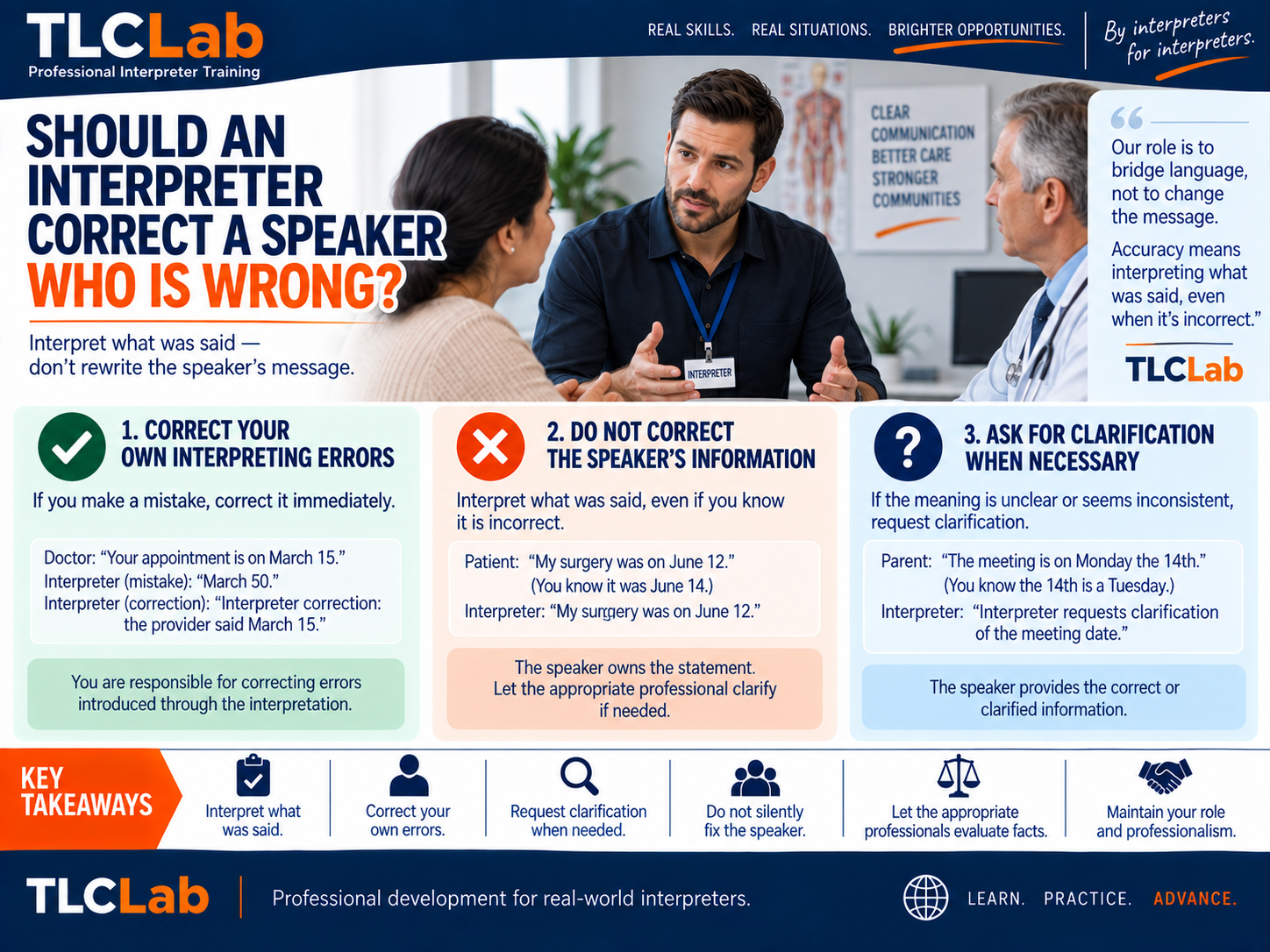
Professional interpreters are responsible for accuracy—but that does not mean correcting everything that sounds wrong.
This distinction can be difficult for new interpreters.
A patient may give the wrong date. A witness may contradict something they said earlier. A parent may provide information the interpreter believes is incorrect. A speaker may use the wrong name, number, or fact.
The interpreter may know the correct information and feel tempted to fix the mistake.
Usually, that is not the interpreter’s role.
At TLCLab, interpreter training emphasizes an important principle: the interpreter is responsible for accurately interpreting what was said, not for correcting the speaker’s facts.
However, this is very different from correcting an interpreting error made by the interpreter.
Understanding that difference is essential.
If the Interpreter Makes the Mistake, Correct It
Suppose a doctor says:
"Your appointment is on March 15."
The interpreter accidentally says March 50—or March 16.
If the interpreter realizes the mistake, it should be corrected immediately.
A professional correction might be:
“Interpreter correction: the provider said March 15.”
The interpreter is responsible for correcting errors introduced through the interpretation.
The same applies if the interpreter:
mishears a number, leaves out important information, uses the wrong term, changes a negative into a positive, or realizes that part of the message was interpreted incorrectly.
In those situations, correction protects accuracy.
But What If the Speaker Is Wrong?
Now consider a different situation.
A patient says:
"My surgery was on June 12."
The interpreter remembers from an earlier conversation that the surgery was actually June 14.
Should the interpreter silently change June 12 to June 14?
No.
The interpreter should interpret:
"My surgery was on June 12."
The patient owns the statement.
If the doctor notices a discrepancy, the doctor can ask for clarification.
The interpreter should not independently decide which information is correct.
At TLCLab, students learn that interpreting accurately sometimes means interpreting information that may itself be inaccurate.
Contradictions Should Usually Remain Contradictions
This becomes especially important in legal interpreting.
Imagine a witness previously said:
"I arrived at 9:00."
Later, the same witness says:
"I arrived around 10:00."
The interpreter may immediately recognize the contradiction.
But the interpreter should not change the second statement to 9:00 just to make the testimony consistent.
The contradiction may be important.
Attorneys, judges, investigators, or other participants are responsible for evaluating what the witness says.
The interpreter’s responsibility is to faithfully communicate both statements.
Correcting the speaker could unintentionally alter evidence or change the meaning of the testimony.
Do Not Use Outside Knowledge to Fix the Message
Sometimes interpreters know more about the situation than the current conversation reveals.
For example, a school interpreter may know from previous meetings that a student is in seventh grade.
During a new meeting, the parent says:
"He is in eighth grade."
Even if the interpreter believes the parent is mistaken, the interpreter should generally interpret exactly what the parent said.
The interpreter should not automatically substitute:
"He is in seventh grade."
That would turn the interpreter from a communication professional into an editor of the speaker’s information.
The appropriate participant can clarify the fact.
What About an Obvious Slip of the Tongue?
Some situations are less clear.
A speaker may say:
"Take the medication three times a week—sorry, three times a day."
In that case, the speaker corrected themselves.
The interpreter should reflect the correction accurately.
But if the speaker does not correct themselves, the interpreter should be cautious about deciding that a statement was simply a mistake.
What seems obvious to the interpreter may not actually be obvious.
When meaning is unclear, clarification is safer than assumption.
Clarification Is Different From Correction
The interpreter may sometimes need to clarify because the message cannot be interpreted accurately as stated.
Suppose someone says:
"My appointment is Monday the 14th."
But the interpreter realizes that the 14th falls on Tuesday.
The interpreter should not silently choose Monday or Tuesday.
If the inconsistency makes the message unclear, the interpreter may appropriately request clarification:
“Interpreter requests clarification of the appointment date.”
The speaker can then correct or confirm the information.
The key difference is that the speaker owns the correction.
The interpreter does not make it for them.
Why Silent Corrections Are Risky
Silently fixing a speaker may seem helpful, but it can create serious problems.
The interpreter might be wrong.
The information may be intentionally inconsistent.
The contradiction may matter to another participant.
The interpreter may unintentionally change testimony, medical history, educational information, or instructions.
Professional interpreters should resist the temptation to improve the conversation.
Accuracy does not mean making the conversation factually perfect.
It means accurately communicating what the participants actually say.
How TLCLab Helps Interpreters Understand the Difference
At TLCLab, interpreter training helps students develop the professional judgment needed for situations like these.
Interpreters must know when to correct themselves, when to request clarification, and when to simply interpret the speaker’s words exactly as they were spoken.
Remember the distinction:
If the interpreter makes the error, correct it.
If the speaker provides incorrect information, interpret it accurately.
If the meaning is genuinely unclear, request clarification.
The interpreter protects the message but does not take ownership of the speaker’s facts.
That responsibility remains with the people having the conversation.
Interpret what was said. Correct your own errors. Clarify when necessary. Never silently rewrite the speaker’s message.