

Conference interpreting solved this decades ago. Sign language interpreting solved it too. Spoken-language community interpreting mostly did not, and interpreters absorb the difference.
The Thirty-Minute Problem
Moser-Mercer, Künzli and Korac published a pilot study in Interpreting in 1998 that remains the anchor citation. Experienced simultaneous interpreters working continuously showed a significant increase in meaning errors past roughly thirty minutes — the standard turn length under normal working conditions.
The finding that matters most is not the thirty minutes. It is this: the interpreters appeared unaware of the decline. Three of the five subjects analyzed carried on for another thirty minutes. Physiological markers of stress rose over the same period.
You do not feel accuracy leaving. You feel fine, and the errors increase anyway.
Later work on remote interpreting found the onset earlier still — error rates climbing somewhere around fifteen to eighteen minutes into a thirty-minute turn, rather than past the thirty-minute mark as in live conditions.
Which is to say: the modality most community interpreters now work in is the one where solo endurance fails fastest.
What the Standards Say
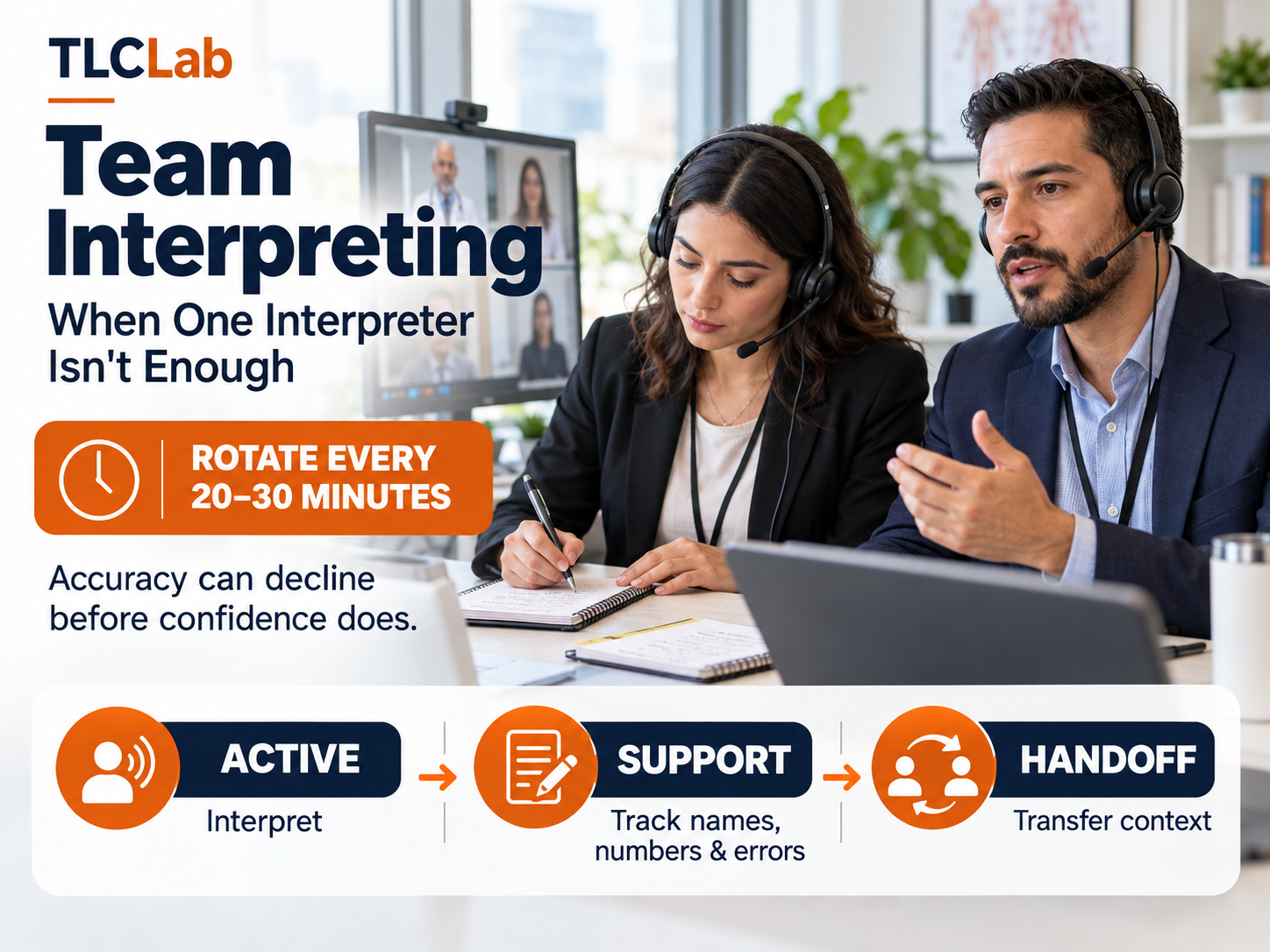
AIIC's professional standards are direct: an interpreter shall not, as a general rule, work alone in a simultaneous booth without a colleague available to relieve them. A team is generally two interpreters per language per booth, rotating every twenty to thirty minutes.
AIIC also requires that for distance interpreting, the working day or team strength be adapted to compensate for reduced sensory input and increased cognitive load.
The analogy AIIC's Swiss chapter uses is worth borrowing when you talk to clients: for the same reason there are always two pilots.
The Support Interpreter Is Not Resting
This is the part people misunderstand. The off-turn interpreter is working.
AIIC describes the role plainly: during their time off, the interpreter helps the colleague by finding documents and jotting down numbers and names.
NAJIT's position paper on team interpreting in court-related proceedings goes further, framing the Support Interpreter as a safety net doing everything possible to ensure accuracy. If the Support Interpreter catches an error, they inform the Active Interpreter immediately so a proper correction can be made on the record in a timely fashion.
NAJIT also makes a point that pushes against a common fear — that corrections make interpreters look incompetent. Their framing is the opposite: interpreters who correct are living up to the oath they took.
So the support role is: capturing numbers, names, dates and figures; tracking terminology; flagging errors immediately; monitoring the time; and being ready to take over if the active interpreter has to stop.
When a Second Interpreter Is Warranted
In community settings, the realistic triggers:
- Encounters likely to exceed about an hour of active work
- Simultaneous mode for any sustained period
- Multi-party events — care conferences, IEP meetings, depositions with several speakers
- Dense technical or numerical content where a second set of ears on figures materially reduces risk
- Legal proceedings where the rendition is the record
- Emotionally heavy content, where cognitive and emotional load compound
- Remote work of any length, given the earlier fatigue onset
Most of these are routine assignments currently staffed with one interpreter.
Handoffs and Not Taking Over
Agree the rotation before you start — turn length, how the signal is given, how you will pass a terminology note. Change at a natural seam rather than mid-sentence. The outgoing interpreter stays until the incoming one is settled.
Supporting without taking over is its own discipline. You pass a note; you do not speak over your colleague. You flag a consequential error immediately and let the Active Interpreter make the correction. You do not correct word choices that are merely different from yours. And in legal settings, note NAJIT's point that the Active Interpreter's rendition is what enters the record — your job is to protect it, not to replace it.
If you are the active interpreter and you are tiring, say so. NAJIT notes that when an interpreter states on the record that they need relief because of fatigue, the court is given the opportunity to respond. Announcing it is professional conduct, not weakness.
Making the Case to a Client
The argument that works is not about interpreter comfort. It is about error rates.
Two interpreters cost more than one. An error in a consent discussion, a deposition, or a discharge instruction costs more than both. There is published evidence that accuracy declines predictably past a known threshold, and that interpreters cannot detect the decline themselves — which means a solo interpreter's assurance that they are fine is not evidence that they are.
Lead with that, name the duration or complexity trigger, and offer the comparison to the other interpreting fields that already treat this as standard. Clients who book conference interpreters are already paying for teams without argument.
How TLCLab Covers It
At TLCLab, team interpreting is taught as a skill rather than a luxury: the rotation protocol, the support role, the error-flagging convention, and the language for requesting a team.
The underlying fact is the one worth keeping. Past the threshold, your accuracy drops and your confidence does not.
That is exactly why the standard exists in every setting that takes accuracy seriously.