

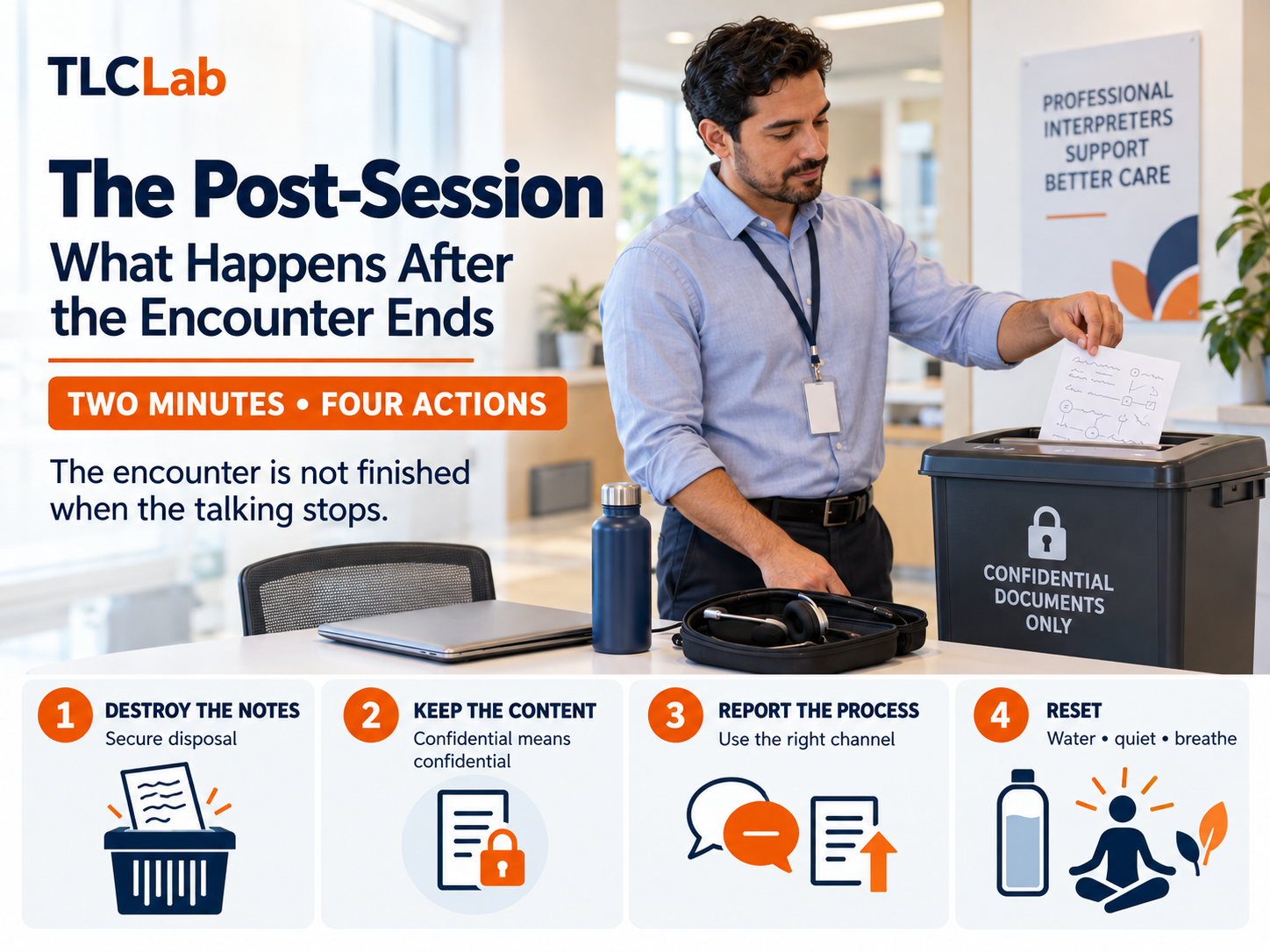
The pre-session at least has a name. The post-session usually does not even get that.
The appointment ends, you pack up, and you are already thinking about the next assignment. But four things should happen in the two minutes after an encounter, and interpreters who skip them create problems that surface later.
Your Notes Are Not Yours to Keep
Interpreter notes are a working tool for one encounter and nothing else. They exist to support accuracy in the moment, and once the encounter is over, they are a loose collection of medical or legal details about an identifiable person, sitting in your bag.
Standard practice across medical and legal interpreting is the same: destroy them at the end of the assignment. The NCIHC Standards of Practice require interpreters to protect written patient information in their possession, and the simplest way to protect it is not to have it.
Practically: shred, or dispose of them securely at the facility if there is a bin for it. Not in a public trash can. Not in a notebook you carry to the next ten assignments. And nothing identifying in a notes app on your phone.
Two exceptions worth knowing. Some facilities have their own procedure for note disposal — follow theirs. And in legal settings, if the court, counsel, or your agency instructs you to preserve something, preserve it and ask rather than destroying on your own initiative.
What You May Report and What You May Not
This is the heart of it, and the distinction is cleaner than people expect.
Content is confidential. What the patient said, what the diagnosis was, what the family disclosed, what the witness testified. None of that travels with you — not to the agency, not to the next provider, not to a colleague as an interesting case.
Process is reportable. How the communication went is a different category: audio quality was unusable; the patient appeared to speak a different language than booked; the modality was not working for the setting; the interpreter was asked to perform tasks outside the role; the encounter ran well past the scheduled time.
The test is whether you could say it without revealing anything about the person. “The provider repeatedly asked me to explain the consent form” is a process concern. “The patient was refusing a biopsy” is content.
One specific trap, worth repeating from the legal context: when a new provider asks what the patient has told you so far, that is a content question, and the answer is that the patient can be asked directly. You interpreted a history; you did not take one.
Flag Problems Through the Right Channel
If something went wrong, the channel matters as much as the content.
A communication barrier the facility should know about — no translated materials available, a patient who needs a different language, a provider practice that is causing repeated misunderstanding — goes to the facility or the agency through whatever reporting process exists, not to the next person you talk to.
A safety concern goes to the provider in the room, during the encounter, not afterward in an email. By the time you are in the parking lot, the people who could act on it are gone.
And a concern about your own performance — a correction you are unsure you made clearly, a term you want to verify — is worth noting and raising with the agency if it could have affected the encounter.
The Operational Debrief
Some settings expect a short review afterward, and it is useful where it exists.
Guidance for clinicians working with interpreters recommends discussing after the session any concerns, difficulties, or mishaps that occurred and how to avoid them next time with the same family. That is a process conversation, and it is appropriate.
What it is not is a case discussion. If the debrief drifts toward the patient’s situation rather than the mechanics of communication, redirect it or end it.
In high-intensity settings, a debrief may also serve a different purpose — giving the interpreter somewhere to put the weight of what they just interpreted. That is a legitimate need, covered properly in its own right, and it is the kind of structure agencies should be building rather than leaving to chance.
Your Own Reset
Thirty seconds between a child abuse disclosure and a routine appointment is not enough, and most interpreters take it anyway because the schedule is the schedule.
Where your workflow allows it: stand up, drink water, let your voice rest, and let the content of the last encounter close before the next one opens. Where it does not allow it, that is a scheduling problem worth naming to whoever builds your schedule.
How TLCLab Covers It
At TLCLab, the post-session is taught alongside the pre-session, because the encounter is not finished when the talking stops.
Destroy the notes. Keep the content. Report the process. Reset.
Two minutes, every time.