

A physician explains a new treatment plan. An attorney addresses a judge while a defendant listens through an interpreter. A school administrator hands a parent a written notice that must be understood immediately. Each situation involves interpreting, but the interpreter may not perform the work in the same way.
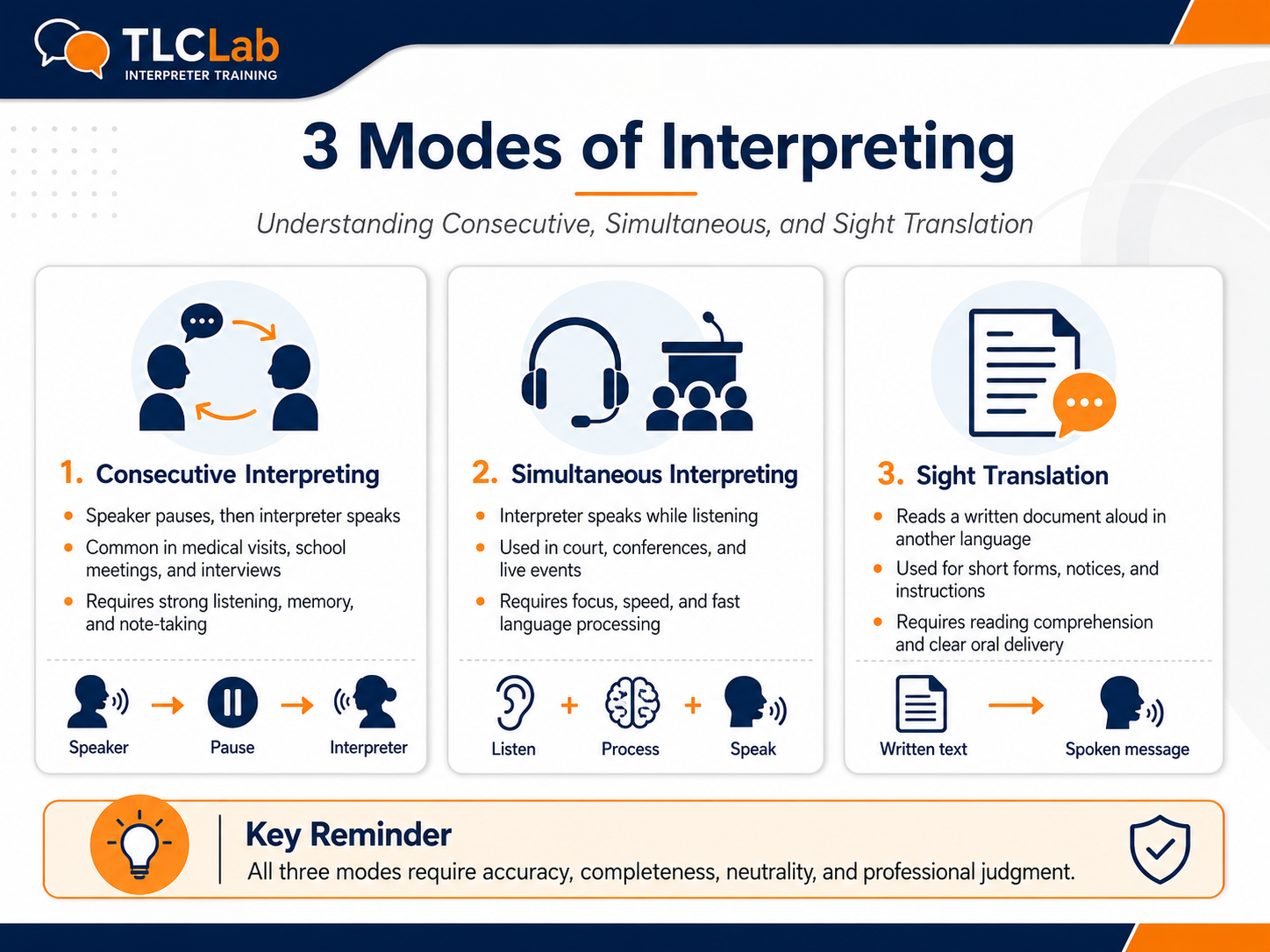
Professional interpreters generally work using three primary modes of interpreting: consecutive interpreting, simultaneous interpreting, and sight translation. Each mode requires different skills, serves a different purpose, and creates its own challenges.
Speaking two languages is only the beginning. A professional interpreter must know which mode is appropriate, how to perform it accurately, and when to request a change in the communication process if accuracy begins to suffer.
Understanding these three modes gives new interpreters an important foundation for medical, legal, educational, government, community, and business assignments.
Mode 1: Consecutive Interpreting
Consecutive interpreting occurs when the speaker talks for a period of time, pauses, and allows the interpreter to deliver the message in the other language.
The communication follows a pattern:
Speaker → Pause → Interpreter → Speaker → Pause → Interpreter
This is one of the most common interpreting modes because it allows the interpreter time to listen, process the meaning, organize information, and then reproduce the message accurately.
Imagine a physician saying:
"I would like you to take this medication twice a day with food. If you experience dizziness or difficulty breathing, stop taking it and contact us immediately."
The interpreter listens to the complete idea, possibly takes brief notes, and then interprets the message.
The interpreter should not interrupt after every few words unless necessary. At the same time, the interpreter should not allow the speaker to continue for several minutes if the amount of information becomes too difficult to retain accurately.
Where Consecutive Interpreting Is Used
Consecutive interpreting is common in:
- Medical appointments
- Parent-teacher conferences
- IEP meetings
- Social service interviews
- Attorney-client meetings
- Depositions
- Business meetings
- Community programs
- Government interviews
The length of each speaking segment depends on the complexity of the information and the interpreter's ability to retain it.
The Skills Behind Strong Consecutive Interpreting
Successful consecutive interpreting depends heavily on active listening and memory.
The interpreter is not simply waiting for the speaker to stop. While listening, the interpreter is identifying:
- The main idea
- Supporting details
- Names and dates
- Numbers
- Sequences
- Negations
- Conditions
- Changes in thought
- Questions
- Tone and register
Note taking can support memory, but notes should not become a transcript. Symbols, abbreviations, arrows, numbers, and keywords can help the interpreter reconstruct the speaker's meaning without attempting to write every sentence.
A Common Consecutive Mistake
One of the greatest risks is summarizing.
A speaker might say:
"My daughter started complaining about stomach pain last Thursday. It became worse Saturday night, and yesterday she also developed a fever."
An interpreter should not reduce that to:
"Her daughter has had stomach pain and a fever for several days."
The summary sounds reasonable, but important information has disappeared. The timeline and progression of symptoms may matter.
The goal of consecutive interpreting is not to communicate the general idea. It is to reproduce the complete meaning as accurately as possible.
Mode 2: Simultaneous Interpreting
In simultaneous interpreting, the interpreter listens to the speaker and delivers the interpretation almost at the same time.
Rather than waiting for a complete section of speech, the interpreter begins interpreting while the original speaker continues talking.
There is usually a short delay between the speaker's words and the interpreter's delivery. This delay is sometimes called lag time or décalage.
Simultaneous interpreting requires the brain to perform several tasks at once:
Listen → Understand → Process → Interpret → Continue Listening
That combination makes simultaneous interpreting one of the most cognitively demanding modes.
Where Simultaneous Interpreting Is Used
Simultaneous interpreting may be used in:
- Courtrooms
- Conferences
- Large meetings
- Training sessions
- Public presentations
- International events
- Some educational settings
- Certain remote interpreting environments
In a courtroom, for example, an interpreter may simultaneously interpret proceedings for a defendant who needs to understand everything being said but is not currently speaking.
At a conference, interpreters may work from booths using headsets and microphones while participants listen through receivers.
Why Simultaneous Interpreting Is Difficult
The interpreter cannot simply wait to hear an entire sentence before beginning. Languages may organize information differently.
A verb that appears at the beginning of a sentence in one language may appear much later in another. The interpreter must sometimes wait just long enough to understand the structure while still keeping pace with the speaker.
Listening and speaking simultaneously also creates intense mental workload.
If concentration slips for even a few seconds, the interpreter may lose part of the message.
Strong simultaneous interpreters develop:
- Excellent listening concentration
- Fast language processing
- Strong short-term memory
- Broad vocabulary
- Anticipation skills
- Controlled delivery
- Familiarity with the subject matter
Speed Does Not Replace Accuracy
Beginning interpreters sometimes assume simultaneous interpreting means speaking as quickly as possible.
It does not.
The goal is to stay sufficiently close to the speaker while producing an accurate and understandable interpretation.
If the speaker becomes excessively fast, reads complicated material rapidly, or uses unfamiliar terminology, the interpreter may need to intervene according to the setting's protocol.
Trying to "catch up" by dropping information is not an acceptable solution.
Professional interpreting requires accuracy before speed.
Mode 3: Sight Translation
The third mode is sight translation.
Sight translation occurs when an interpreter reads a written document in one language and orally renders its meaning into another language.
The source is written, but the output is spoken.
For example, a patient may receive a short consent notice written in English and need it read aloud in another language. An interpreter may be asked to sight translate the document.
Sight translation may initially look easier than consecutive or simultaneous interpreting because the words remain visible on the page. In reality, it requires a combination of reading comprehension, translation ability, interpreting skills, and oral delivery.
Where Sight Translation Is Used
Sight translation may occur with:
- Medical instructions
- Consent documents
- Court documents
- School notices
- Short letters
- Government forms
- Appointment instructions
- Policies or procedural information
Before beginning, the interpreter should quickly examine the document whenever possible.
Look for:
- Headings
- Dates
- Names
- Numbers
- Technical terminology
- Abbreviations
- Complicated sentences
- Signatures or legal language
- Sections that may require clarification
This brief review helps the interpreter understand the structure before beginning the oral rendering.
Sight Translation Is Not Document Translation
Sight translation should not be confused with written translation.
A professional written translator can research terminology, revise wording, check references, edit the translation, and proofread the final document.
Sight translation happens much more quickly and is delivered orally.
Because there is usually little opportunity for extensive research or revision, interpreters should recognize when a document is too long, too technical, or too legally significant to be handled appropriately through sight translation.
A twenty-page contract, for example, should not automatically be treated like a one-paragraph appointment notice simply because someone asks the interpreter to "read it."
Professional judgment matters.
Choosing the Right Mode
The three interpreting modes are not competing techniques. Each exists because communication situations create different needs.
Consecutive interpreting works especially well for interactive conversations in which people take turns speaking.
Simultaneous interpreting is useful when listeners need immediate access to continuous speech without repeatedly stopping the speaker.
Sight translation provides oral access to written material when the situation and document are appropriate for that method.
During a single assignment, an interpreter may even use more than one mode.
Consider a court assignment. The interpreter may simultaneously interpret courtroom proceedings, switch to consecutive interpreting when the defendant speaks, and later sight translate a short written instruction.
The professional skill is not simply knowing how to perform each mode. It is recognizing when and why to use it.
Accuracy Connects All Three Modes
Although the techniques are different, the interpreter's responsibility remains consistent.
Whether working consecutively, simultaneously, or from a written document, the interpreter must preserve:
- Meaning
- Intent
- Tone
- Register
- Important details
- Questions
- Uncertainty
- Negations
- Numbers and dates
The interpreter should not add explanations simply because they seem helpful. The interpreter should not remove information because it appears repetitive. The interpreter should not improve a speaker's grammar, soften an uncomfortable statement, or replace unfamiliar information with a guess.
When something cannot be heard, understood, remembered, or accurately rendered, the professional response is to request clarification or repetition rather than invent meaning.
Building Competence in All Three Modes
New interpreters should practice the modes separately before expecting to perform them comfortably under pressure.
For consecutive practice, listen to short recordings, take structured notes, and reproduce the complete message without looking at a transcript.
For simultaneous practice, begin with slower material and gradually increase complexity and speed. Record yourself and compare the interpretation with the original message.
For sight translation, practice scanning short documents before delivering them aloud. Pay attention to terminology, sentence structure, numbers, and natural oral delivery.
Most importantly, review your performance.
Ask yourself:
Did I preserve the entire message? Did I change the speaker's tone? Did I omit information? Did I add explanations? Did I guess when I should have asked for clarification?
Professional interpreting is developed through repeated practice, feedback, and self-correction.
Three Modes, One Professional Responsibility
Consecutive interpreting, simultaneous interpreting, and sight translation require different techniques, but all three serve the same fundamental purpose: allowing people who use different languages to communicate accurately and meaningfully with one another.
A skilled interpreter does more than switch between languages. The interpreter listens carefully, processes meaning, selects the appropriate mode, manages information under pressure, and protects the integrity of every speaker's message.
Mastering the three modes gives interpreters the flexibility to move confidently between a medical appointment, courtroom, school meeting, conference, business discussion, or community setting.
The environment may change. The technique may change. The pace may change.
The professional standard does not.
Listen accurately. Understand completely. Interpret faithfully.