
A bilingual professional completes an interpreter training program and begins preparing for assignments. Another interpreter completes formal training, gains experience, and later passes a recognized certification examination. Both may be capable professionals, but they are not necessarily considered certified interpreters.
The terms trained interpreter and certified interpreter are sometimes used interchangeably, but they have different meanings.
Understanding the difference is especially important for new interpreters who are planning their careers. Professional training is often the foundation that teaches you how interpreting actually works. Certification is an additional professional step that may allow you to demonstrate your knowledge and skills through a recognized credentialing process.
Speaking two languages is only the beginning. Professional interpreting requires accuracy, ethics, terminology knowledge, listening skills, memory, judgment, professional boundaries, and the ability to manage communication under pressure.
What Is a Trained Interpreter?
A trained interpreter is someone who has completed formal education or professional training specifically focused on interpreting.
Interpreter training can be provided through colleges, universities, professional organizations, healthcare systems, court programs, language service companies, and specialized interpreter training programs.
The purpose of training is to teach an interpreter how to perform the job professionally rather than simply relying on bilingual ability.
A strong interpreter training program may cover:
- Interpreter ethics and standards of practice
- Confidentiality
- Professional boundaries
- Consecutive interpreting
- Simultaneous interpreting
- Sight translation
- Memory development
- Note-taking techniques
- Cultural awareness
- Medical terminology
- Legal terminology
- Educational terminology
- Remote interpreting
- Over-the-phone interpreting
- Video remote interpreting
- Managing difficult encounters
- Professional conduct
These skills are important because interpreting involves much more than replacing words in one language with words in another.
An interpreter must listen to the complete message, understand its meaning, retain important details, and reproduce that message accurately in another language without adding, omitting, softening, or changing what the speaker intended to communicate.
Training helps develop those professional habits.
A Certificate of Training Is Not the Same as Certification
One of the most important distinctions for new interpreters is the difference between receiving a training certificate and becoming a certified interpreter.
When you successfully complete an interpreter training program, you may receive a certificate documenting that you completed the required coursework or training hours.
That certificate is valuable because it demonstrates that you have invested in professional interpreter education.
However, receiving a certificate of completion does not automatically mean that you are professionally certified.
For example, an interpreter might complete a comprehensive interpreter training course and receive documentation showing that the required training was successfully completed.
That individual can accurately describe themselves as a trained interpreter or as having completed professional interpreter training.
They should not automatically describe themselves as a certified interpreter unless they have earned a certification that authorizes them to use that professional designation.
What Is a Certified Interpreter?
A certified interpreter has completed the requirements established by a recognized certification body, government agency, court system, or other credentialing organization.
The specific requirements depend on the type of certification.
A certification process may require:
- Proof of language proficiency
- Completion of interpreter education
- A written examination
- An oral examination
- Testing in consecutive interpreting
- Testing in simultaneous interpreting
- Sight translation
- Ethics knowledge
- Specialized terminology knowledge
- Continuing education
- Periodic renewal of the credential
Different interpreting specialties may also have different certification processes.
For example, medical interpreting, court interpreting, and other specialized areas may evaluate different competencies.
Because requirements vary, interpreters should carefully research the certification that applies to the type of work they want to perform.
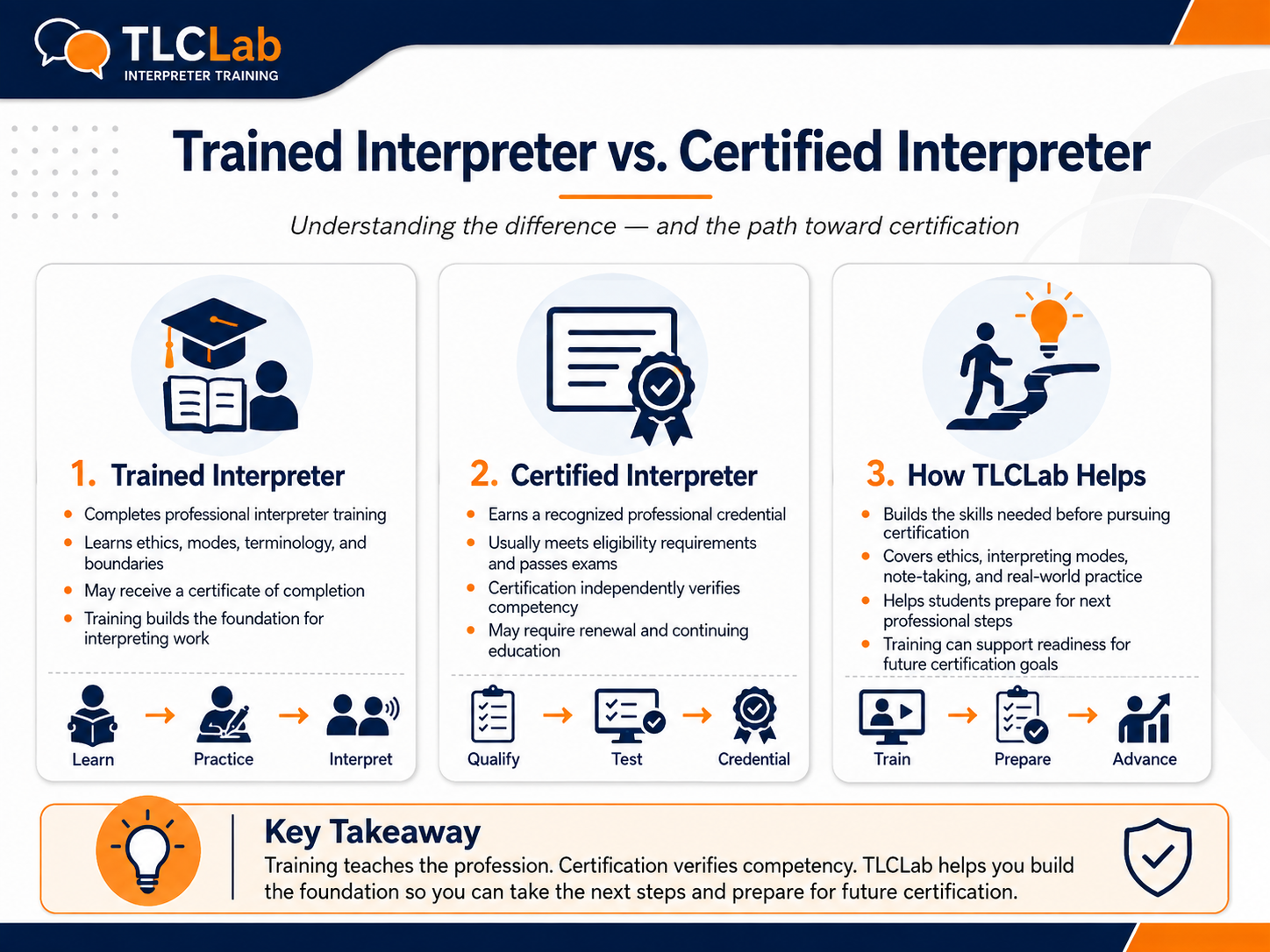
Training Teaches. Certification Evaluates.
A simple way to understand the difference is:
Training prepares you for the profession. Certification evaluates whether you have met the requirements of a particular credentialing program.
During training, you learn the concepts and techniques needed to become an interpreter.
You practice listening, memory, terminology, consecutive interpreting, simultaneous interpreting, sight translation, ethics, and professional decision-making.
Certification usually comes later and involves demonstrating your knowledge or abilities through an independent assessment.
That is why professional training can be an important step toward certification.
You generally would not want your first exposure to interpreter ethics, sight translation, consecutive interpreting, or professional boundaries to occur while taking a certification examination.
Preparation matters.
Can Someone Be a Professional Interpreter Without Certification?
Yes.
A trained interpreter may be qualified to work professionally without holding a formal certification, depending on the language, setting, employer, jurisdiction, and assignment requirements.
Certification may not be available for every language or every interpreting specialty.
Some interpreters may also work in environments where professional training and demonstrated language proficiency are required but a specific certification is not.
A trained interpreter may have substantial qualifications, including:
- Professional interpreter education
- Strong bilingual proficiency
- Years of interpreting experience
- Specialized terminology knowledge
- Continuing education
- Excellent professional references
- Proven interpreting ability
Certification is an important professional achievement, but the absence of certification does not automatically mean that someone is unqualified.
The requirements of the assignment must always be considered.
Does Certification Mean an Interpreter Knows Everything?
No.
Certification represents an important level of professional achievement, but interpreters must continue learning throughout their careers.
Language changes.
Terminology changes.
Technology changes.
Professional expectations change.
An interpreter may also move into unfamiliar specialties.
Someone who has substantial experience interpreting in healthcare may need additional preparation before working in a complex legal environment. Likewise, an interpreter who has primarily worked onsite may need additional practice before handling demanding remote interpreting assignments.
Professional development does not stop when someone receives a credential.
Certification should be viewed as an important milestone rather than the end of professional education.
Why Professional Titles Matter
Interpreters should always represent their qualifications accurately.
If you have completed formal interpreter training but have not earned a recognized certification, appropriate descriptions may include:
Trained Interpreter
Professionally Trained Interpreter
Interpreter Training Program Graduate
If you later earn a recognized certification, you can use the professional designation permitted by the organization that issued that credential.
Accurate terminology protects your professional reputation.
Clients, employers, healthcare organizations, courts, schools, and language companies may make staffing decisions based on an interpreter's stated qualifications.
Professionalism begins with accurately representing what you have accomplished.
Think of Interpreter Development as a Career Path
Becoming an interpreter is rarely one single step.
Instead, think of professional development as a progression:
Bilingual Ability → Interpreter Training → Practice → Professional Experience → Certification → Continuing Education
Not every interpreter will follow exactly the same path.
Some may begin working after completing training and pursue certification later. Others may complete specialized education before entering a particular field.
The important point is that professional interpreters continue developing their knowledge and skills.
Training gives you a foundation.
Practice builds confidence.
Experience develops judgment.
Certification may provide recognized verification of your abilities.
Continuing education helps you continue growing after you begin working.
Preparing for the Next Step with TLCLab
This is where TLCLab Interpreter Training can become an important part of your professional journey.
TLCLab is designed to help bilingual individuals move beyond simply knowing two languages and begin developing the knowledge, techniques, and professional habits required of working interpreters.
Through TLCLab training, you learn about interpreting ethics, confidentiality, professional boundaries, consecutive and simultaneous interpreting, sight translation, terminology, note-taking, remote interpreting, cultural awareness, and many of the real-world situations interpreters may encounter.
The goal is not to suggest that completing a training program automatically makes someone certified. Instead,
TLCLab helps provide the professional foundation you can build on as you move toward your career goals.
After completing your training, you may decide to gain professional experience, continue studying, specialize in medical or legal interpreting, or prepare for a recognized certification examination.
TLCLab helps you take that important first professional step by giving you structured training and a clearer understanding of what professional interpreting requires.
From there, you can continue practicing, expanding your terminology, strengthening your interpreting techniques, researching certification requirements, and preparing yourself for the additional steps necessary to pursue certification.
Training is the foundation. Certification can be the next milestone. TLCLab helps prepare you to begin that journey with the knowledge, skills, and professional mindset needed to move forward.