

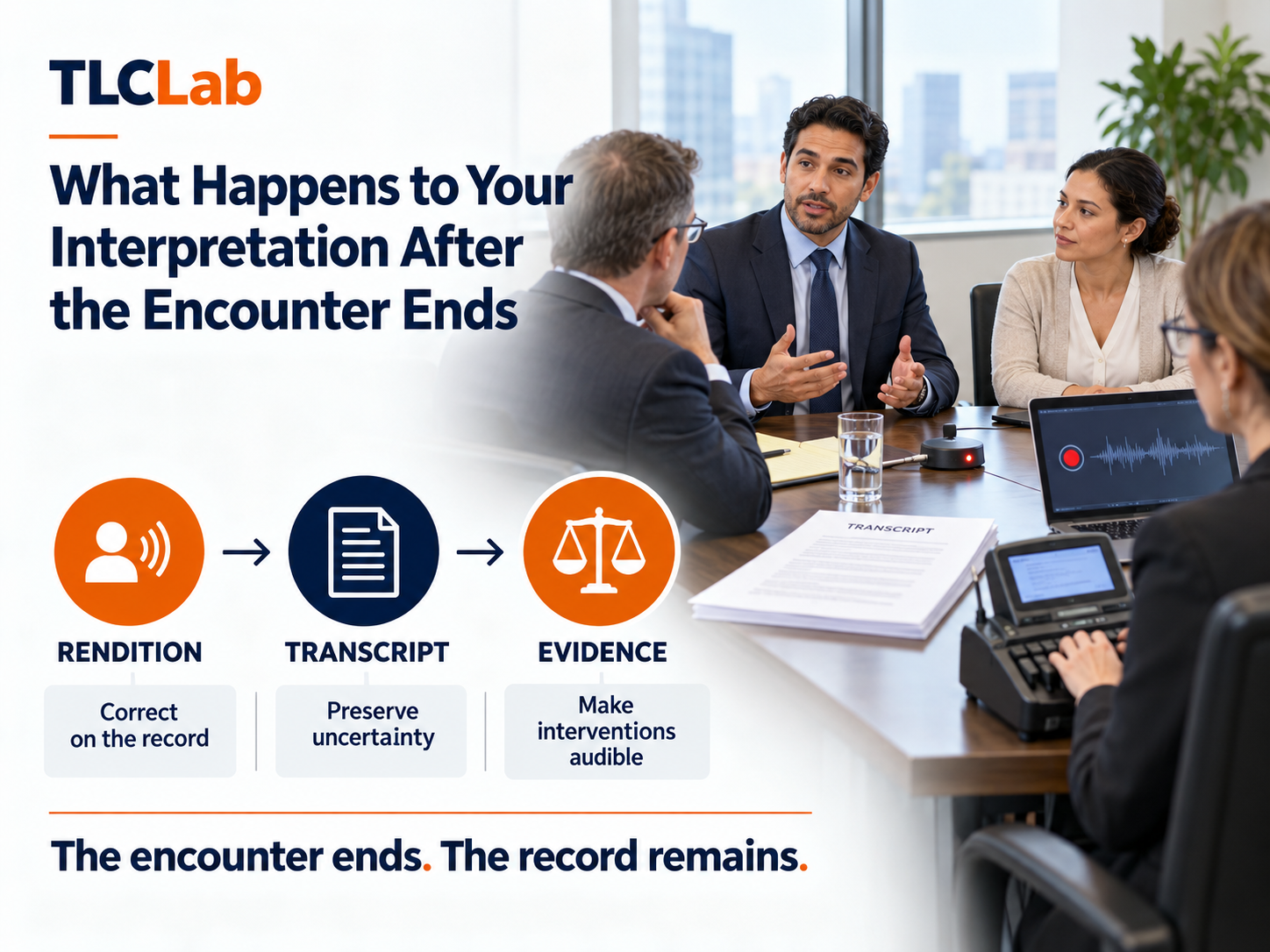
In a typical interpreted deposition, the certified transcript contains only the interpreter's English.
The witness's original answer — in Mandarin, Spanish, Arabic, Haitian Creole — does not appear anywhere in it. The court reporter records the English the interpreter produced. That English becomes the testimony.
If the case goes to trial, passages may be read aloud in open court. The witness may be impeached with them. A jury may decide something based on them.
Those are your words.
Most interpreter training treats an assignment as a closed event: you interpret, it ends, you go home. In legal and medical settings that is not what happens. The rendition is preserved, and it can be examined months or years later by people whose job is to find a problem with it.
A note: this article is professional education, not legal advice. Procedures vary by jurisdiction, by court, and by case-specific protocol. Follow the rules that apply where you work.
The Oath Changes Your Position
In court proceedings and most depositions, the interpreter is sworn before beginning — an oath to render a true and accurate interpretation. In the courtroom, taking that oath makes the interpreter an officer of the court.
NAJIT's position paper on team interpreting makes a point worth sitting with: it is the interpreter who takes the oath, no one else, and the interpreter who is ultimately responsible for the interpretation.
Not the agency. Not the attorney who hired you. You.
Why Depositions Are Consecutive
Deposition protocols generally require consecutive interpretation, and the reason is the record.
The court reporter has to capture discrete utterances. Simultaneous whispering produces overlapping speech that cannot be cleanly transcribed. Consecutive takes longer and produces a cleaner transcript, which is the entire point.
NAJIT also rejects summary interpreting in legal settings outright. Canon 1 of its Code of Ethics and Professional Responsibilities bars omitting or altering, and summarizing requires the interpreter to decide what matters — a determination the interpreter is not qualified to make and which turns them into a participant rather than a conduit.
A condensed rendition is not a faster interpretation. It is a different record.
Correcting Yourself on the Record
Every interpreter makes errors. What separates professionals is what happens next.
NAJIT published an account of an interpreter in consecutive mode, on the record, who heard "2" when the witness said "12" and rendered it that way. A moment later she caught it and said, in both languages, "Interpreter's correction: not 2, but 12."
The detail the author added: the interpreter was not fired.
That is the whole lesson. A correction made in the moment is a routine professional act. The same error left standing becomes part of sworn testimony about a quantity, a date, or an age.
Three things make a correction work:
Speed. Correct as soon as you catch it. The further the record moves on, the harder it is to identify what is being corrected.
Form. State it in the third person, identify it as an interpreter's correction, and give both the erroneous and correct renditions. "Interpreter's correction: the interpreter said 2; the witness said 12."
Both languages where appropriate, so no one in the room is operating on a version that has been superseded.
An interpreter who hides errors to appear competent is producing an unreliable record while looking confident. Those are not the same thing, and attorneys who work with interpreters regularly can tell the difference.
When Counsel Challenges Your Rendition
This will happen, and it is not an attack.
Guidance written for interpreters new to depositions gives two phrases worth memorizing.
If you are confident your rendition was correct: "The interpreter stands by his/her interpretation."
If counsel is right, or has offered a better choice: "The interpreter stands corrected."
In either case, state the term at issue, spell it for the record, and give your explanation briefly. Spelling matters — the court reporter needs it, and a later reviewer needs to know exactly which word was disputed.
What not to do: argue, become defensive, or treat the challenge as a judgment about your competence. The attorney is protecting the record, which is their job. Under Federal Rule of Civil Procedure 30(c)(2), objections at a deposition are noted on the record and the examination proceeds, with testimony taken subject to the objection. The disagreement is preserved for someone else to resolve later.
That is the system working.
Check Interpreters
In higher-stakes depositions you may find a second interpreter present, retained by the opposing party to monitor your work.
This is normal practice, and the ABA recommends it to attorneys handling foreign-language depositions.
Protocols vary, but the shape is consistent. The check interpreter monitors rather than interprets. If they disagree, they raise it with their counsel, and a proposed correction is stated simply for the record. The interpreter of record need not respond, but may state briefly whether they agree or disagree. The check interpreter does not interpret for the witness, does not correct the witness, and should not be drawn into a back-and-forth with you.
Some protocols go further. In proceedings before the USPTO's Patent Trial and Appeal Board, the procedure specifies that if the two interpreters cannot reach a mutually agreeable rendition, an objection goes on the record, each interpreter states what they believe the correct interpretation to be, and the Board decides what weight to give each.
Two professional notes. First, introduce yourself to the check interpreter — this is a colleague performing a legitimate function, and interpreters who treat check interpreters as adversaries have misunderstood the role. Second, the presence of a check interpreter means your work is being reviewed in real time by someone qualified to review it, which is a reason to be precise rather than a reason to be nervous.
The Record Keeps Moving After You Leave
This is the part almost no training covers.
Errata sheets. Federal Rule of Civil Procedure 30(e) allows a deponent to review the transcript and make changes in form or substance, with reasons, within 30 days. Courts have held that changes correcting inaccurate interpretations are permissible — particularly where counsel objected to the interpretation during the deposition. Your rendition can be formally amended after the fact.
Competing translations. If an attorney believes an interpretation was wrong, they may commission a second interpreter to review a recording and produce a competing version. Attorneys are advised to make independent audio or video recordings for precisely this purpose. Your work can be compared, line by line, against someone else's rendering of the same audio, by someone with time, a transcript, and a reason to find fault.
Impeachment at trial. Deposition testimony is used to impeach witnesses. Passages are read aloud. A witness may be asked to explain a contradiction between two statements — one or both of which passed through an interpreter.
The official version controls. There is an account of a juror who understood the witness's language and heard something different from the official rendition. The judge instructed the jury that they must rely on the interpretation provided by the certified interpreter.
Read that again. In the proceeding, your rendition was the testimony — even where a listener who spoke the language disagreed with it.
The Medical Version of the Same Problem
Healthcare interpreters sometimes assume none of this applies to them. It does, in a different form.
The chart is a record. Medical risk guidance advises providers to use a qualified interpreter for informed consent discussions and to document the modality — phone, video, in person — along with the interpreter's name or agency. Remote services often supply an interpreter ID number in place of a signature. Your presence and identity are recorded.
Consent forms carry your signature. As covered in an earlier post, many consent forms include an interpreter line, and some ask you to attest to more than you can accurately attest to. That document persists.
Encounters are increasingly recorded. Video remote sessions, ambient documentation tools, and telehealth platforms produce artifacts that did not exist a decade ago.
Medical records become evidence. Malpractice litigation routinely examines what a patient was told and whether they understood it. Where an interpreter was present, how that information was conveyed becomes a live question.
The deposition version is more visible. The medical version is slower and just as real.
What This Changes About How You Work
Correct in the moment, every time. The record's permanence is the argument. Nothing you let pass gets quietly fixed later.
Avoid the clean-up instinct. Interpreters sometimes smooth a witness's hesitant, repetitive, or contradictory speech into something more coherent. In a legal record that is not politeness — the hesitation may be the point, and the contradiction may be the evidence.
Make interventions audible. Every clarification, correction, and note belongs on the record. A problem resolved quietly did not happen, as far as the transcript is concerned.
Flag what you cannot do. Deposition protocols commonly provide that an interpreter unable to interpret a word, expression, or special term must advise the parties of the issue on the record. That is the expected professional response, not an admission of failure.
Be careful with documents handed to you cold. NAJIT's position on on-the-spot interpretation of sound files is that it is not recommended and that only a written transcription and translation is appropriate evidence for the record. The same caution belongs around documents you are asked to sight translate without preparation. Many protocols require exhibits be given to the interpreter in advance, often three days out.
How TLCLab Covers This
At TLCLab, legal-setting training includes what happens to a rendition after the assignment ends, because interpreters who understand that their words are being preserved work differently from interpreters who believe the encounter is over when they leave.
The correction scripts, the stands-by and stands-corrected language, the check interpreter relationship, and the protocols that govern exhibits and unfamiliar terms are all learnable before you need them — which is better than learning them during the deposition where it matters.
Most of what interpreters do disappears the moment it is said.
In these settings, it does not.