

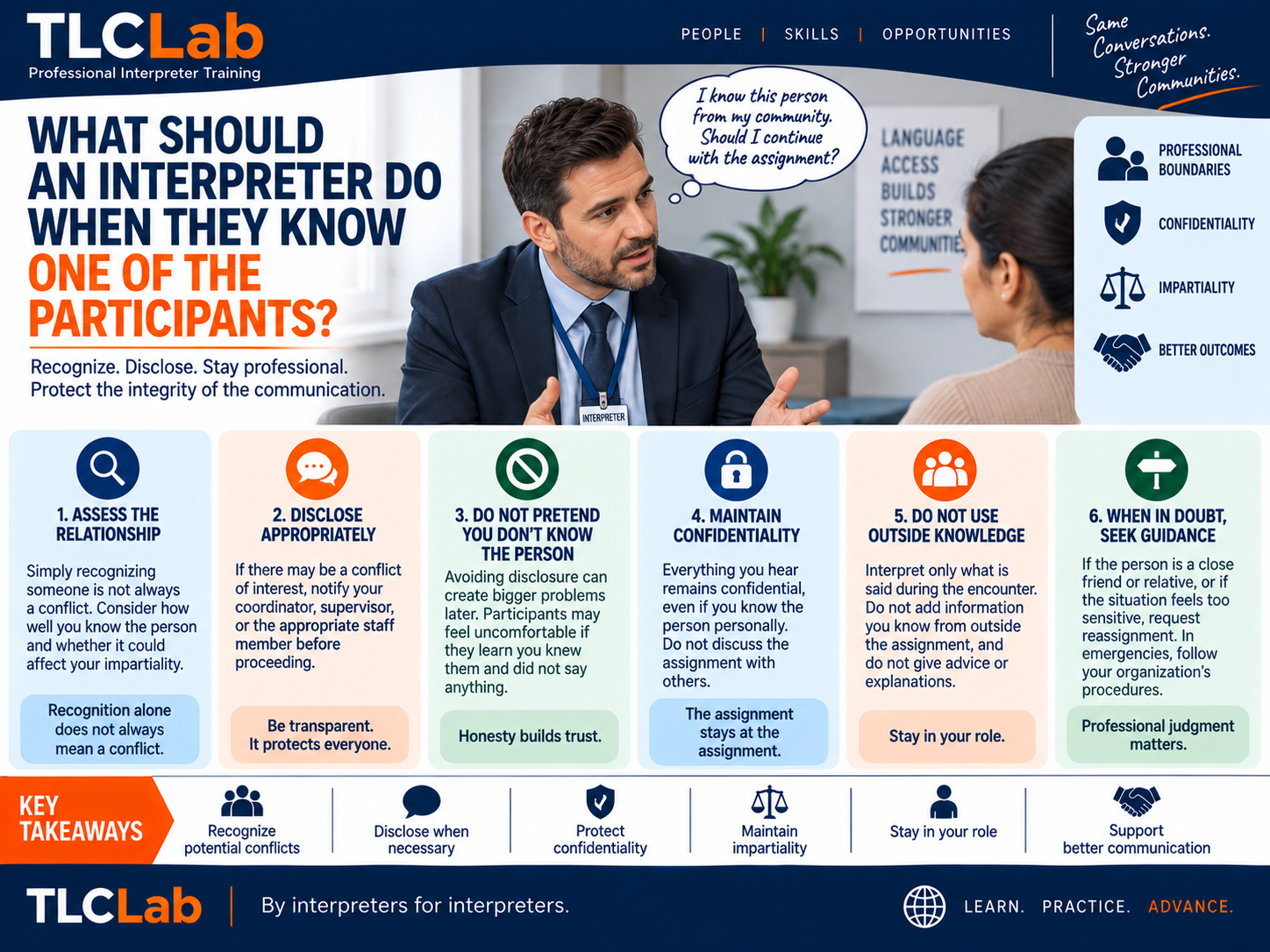
Professional interpreters sometimes work in small communities where it is possible to recognize a patient, parent, teacher, attorney, client, or other participant.
You may discover that the person is a neighbor, former coworker, family acquaintance, someone from your community, or even someone you have interpreted for before.
Knowing one of the participants does not automatically mean that you cannot complete the assignment. However, it can create concerns involving confidentiality, impartiality, professional boundaries, and conflicts of interest.
At TLCLab, interpreter training emphasizes that the interpreter should evaluate the situation carefully and take appropriate steps before proceeding.
First, Ask Whether There Is a Real Conflict of Interest
Simply recognizing someone is not always a conflict.
For example, you may recognize a person from a local store, school, community organization, or previous interpreting assignment without having any meaningful personal relationship with them.
The more important questions are:
Do I have a personal relationship with this person?
Could that relationship affect my impartiality?
Could the participant reasonably feel uncomfortable with me interpreting?
Do I know information about the person outside this assignment that could influence me?
If the answer raises concerns, the interpreter should address the situation before continuing.
Disclose the Conflict Appropriately
If you know the participant well enough that a conflict may exist, follow the procedures of the language service company or organization.
You may need to notify the coordinator, supervisor, or appropriate staff member.
Keep the disclosure professional and limited.
You do not need to explain the entire history of your relationship.
A simple statement such as:
“I know one of the participants personally and would like to disclose a possible conflict of interest.”
may be enough for the organization to determine whether reassignment is appropriate.
At TLCLab, interpreters are taught that transparency protects both the interpreter and the participants.
Do Not Pretend You Do Not Know the Person
Sometimes interpreters hesitate to disclose a relationship because they are worried about losing the assignment.
That can create bigger problems later.
Imagine interpreting a sensitive medical appointment for someone who knows you socially. The person may spend the entire appointment worrying about whether you will discuss their information outside the room.
Even if you would never do so, the situation may affect their willingness to communicate honestly.
Professional interpreting depends on trust.
If the relationship is significant enough to create concern, it should be addressed rather than ignored.
Confidentiality Still Applies
If you continue with the assignment, everything you learn remains confidential according to professional standards and organizational policies.
Knowing the person personally does not change that responsibility.
You should not later say:
"I saw someone you know at the hospital today."
You should not discuss details with mutual friends or family members.
You should also avoid mentioning the assignment socially afterward unless professional procedures specifically require communication with an authorized person.
Confidentiality does not disappear when the assignment involves someone familiar.
In many ways, confidentiality becomes even more important.
Do Not Use Outside Knowledge
Another risk occurs when the interpreter already knows information about the participant.
Suppose you know that the person recently changed jobs, has a family problem, or has previously discussed a medical issue with you socially.
That information does not automatically belong in the interpreting encounter.
Interpret what is actually said.
Do not add:
"I think she means..."
or:
"I know that he has had this problem before."
Your outside knowledge should not become part of the conversation unless the participant chooses to provide that information themselves.
The interpreter is responsible for the message being communicated in the current encounter—not for supplying additional background.
Avoid Becoming More Helpful Because You Know the Person
Personal familiarity can make professional boundaries harder to maintain.
A friend or acquaintance may say:
"Can you explain this to me afterward?"
or:
"You know me—what do you think I should do?"
It may feel uncomfortable to refuse, but the interpreter's professional role remains the same.
Do not provide medical advice, legal opinions, educational recommendations, or other guidance simply because you know the person.
Interpret the question to the appropriate professional.
A personal relationship should not turn the interpreter into an advisor.
What If the Participant Is a Close Friend or Relative?
The closer the relationship, the greater the possibility that reassignment will be appropriate.
Interpreting for a close friend or relative may make it difficult to remain impartial, especially during sensitive conversations.
The participant may also hold back information because they do not want someone they know hearing it.
In healthcare, legal, mental health, or highly personal situations, this can significantly affect communication.
Whenever possible, disclose the relationship and allow the organization to decide whether another qualified interpreter should be assigned.
What If No Replacement Is Immediately Available?
Real-world situations are not always simple.
There may be an emergency or a rare language in which another interpreter is not immediately available.
In those situations, follow the organization's procedures and professional guidance.
The priority may be ensuring that communication can take place while also documenting or managing the potential conflict appropriately.
The interpreter should not independently decide that normal standards no longer matter simply because the situation is difficult.
Maintain Professional Behavior After the Assignment
If you see the person later in the community, do not automatically discuss the interpreting encounter.
Let the participant decide whether they want to acknowledge that you were there.
This is an important professional habit, especially in smaller communities where interpreters may repeatedly encounter clients socially.
A simple rule is useful:
The assignment belongs at the assignment.
Do not carry confidential information into your personal relationship.
How TLCLab Helps Interpreters Recognize Conflicts
At TLCLab, interpreter training helps students understand that professional interpreting involves judgment as well as language skills.
Interpreters need to recognize situations involving conflicts of interest, confidentiality, impartiality, professional boundaries, and personal relationships.
Knowing one of the participants does not automatically mean that you must decline every assignment.
But it does mean that you should stop and evaluate the situation professionally.
Ask yourself:
Can I remain impartial?
Can confidentiality be protected?
Could the relationship affect communication?
Would the participant reasonably be uncomfortable?
Should I disclose the relationship before continuing?
Professionalism means protecting the integrity of the interpreting process—even when the person across from you is someone you already know.
Recognize the relationship. Disclose when necessary. Protect confidentiality. Maintain your role.