

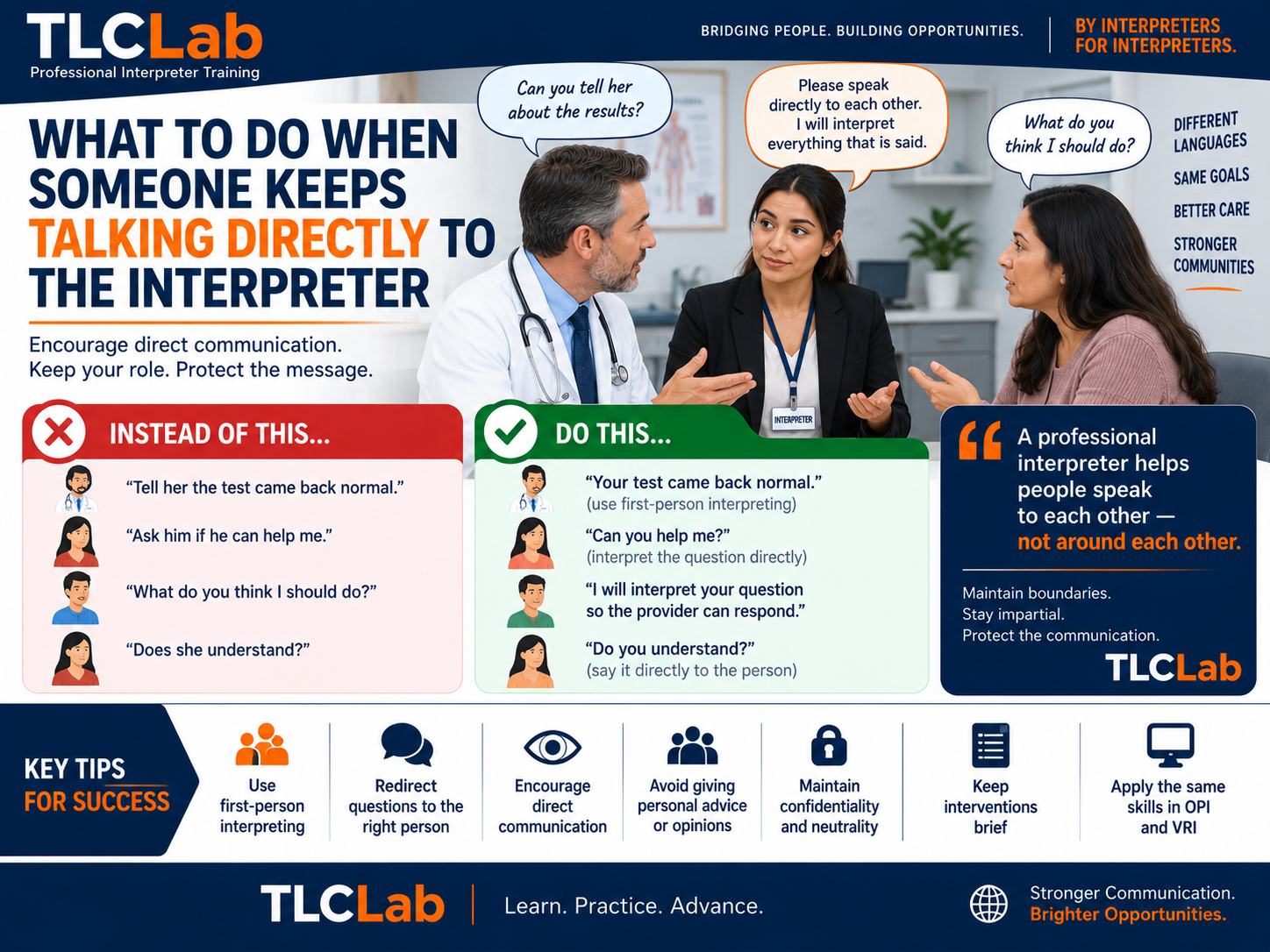
Professional interpreting works best when the people involved communicate **with each other**, while the interpreter provides accurate language access between them.
In real assignments, however, this does not always happen.
A doctor may look at the interpreter and say:
"Ask her how long she has had the pain."
A teacher may say:
"Tell the parent that the student needs to improve attendance."
A client may look directly at the interpreter and ask:
"What do you think I should do?"
When this happens repeatedly, the interpreter can easily become the center of the conversation instead of the bridge between the actual participants.
At TLCLab, interpreter training emphasizes that professional interpreters should encourage **direct communication** whenever possible. The interpreter facilitates the conversation but should not become an additional participant, spokesperson, advisor, or decision-maker.
Learning how to redirect communication professionally is an important skill for medical, legal, educational, community, OPI, and VRI interpreters.
Why Do People Talk Directly to the Interpreter?
Most of the time, participants are not intentionally doing anything wrong.
They may simply be unfamiliar with professional interpreting.
A provider may naturally look at the interpreter because the interpreter is the person immediately understanding their language.
A client may feel more comfortable speaking to the interpreter because they share a language.
A teacher or caseworker may believe that saying:
"Tell her..."
is simply how interpreted communication works.
The interpreter's job is not to criticize the participants.
Instead, the interpreter can use professional techniques that gradually encourage everyone to communicate directly.
Use First-Person Interpreting
One of the most effective ways to keep the conversation direct is to interpret in the first person.
Suppose a doctor says:
"Ask him whether he has taken the medication today."
Instead of interpreting:
"The doctor is asking whether you took your medication today,"
the interpreter should generally render the message as:
"Have you taken your medication today?"
If the patient responds:
"No, I forgot this morning,"
the interpreter says:
"No, I forgot this morning."
First-person interpreting keeps ownership of each statement with the original speaker.
It also helps the participants begin to interact with each other rather than constantly addressing the interpreter.
At TLCLab, first-person interpreting is an important professional habit because it supports accuracy, transparency, and direct communication.
Do Not Automatically Answer Questions Directed at You
Sometimes a participant asks the interpreter a question that actually belongs to someone else.
For example, a patient may ask:
"Do you think this medicine will make me sleepy?"
The interpreter may understand the medication, but the question belongs to the healthcare provider.
Do not answer it personally.
Interpret the question:
"Do you think this medicine will make me sleepy?"
The provider can then answer, and the interpreter interprets the response.
The same principle applies in other settings.
If a parent asks:
"Do you think I should sign this IEP?"
interpret the question to the appropriate school professional.
If a client asks:
"Do you think the judge will agree?"
do not provide legal opinions.
Interpret the question or redirect it appropriately.
The interpreter does not need to have the answer.
The interpreter needs to make sure the right person receives the question.
Encourage Participants to Speak Directly to Each Other
Sometimes first-person interpreting is enough to improve communication.
In other situations, a brief reminder may be useful.
You might say:
"Please speak directly to each other. I will interpret everything that is said."
This can be particularly helpful at the beginning of an assignment.
It establishes expectations without creating a lengthy interruption.
Once participants understand the process, the conversation often becomes much more natural.
The interpreter should then step back into the interpreting role and allow the participants to communicate.
Maintain Natural Eye Contact
Body positioning can influence communication.
In an onsite assignment, interpreters should avoid positioning themselves as though they are the main person being interviewed.
For example, in a medical appointment, the provider and patient should ideally be able to see each other comfortably.
The interpreter can sit or stand in a position that allows communication without becoming the visual center of the interaction.
If the provider continually looks at the interpreter, the interpreter can maintain professional positioning and avoid encouraging an extended personal exchange.
The goal is subtle.
You are helping create an environment where the participants naturally begin speaking to one another.
Do Not Become the Messenger
Statements such as:
"Tell her..."
or:
"Ask him..."
are extremely common.
The interpreter does not need to correct every instance verbally.
Instead, simply interpret the actual message directly.
Provider:
"Tell him his blood test came back normal."
Interpreter:
"Your blood test came back normal."
Attorney:
"Ask her whether she signed the document."
Interpreter:
"Did you sign the document?"
This keeps the communication direct without unnecessarily interrupting the conversation.
Over time, many speakers naturally begin addressing the other participant more directly.
Be Careful With "What Does He Mean?"
A participant may turn to the interpreter and ask:
"What does he mean?"
That question can create pressure for the interpreter to explain someone else's statement.
Be careful.
If the original message is unclear, the person who made the statement should clarify it.
You can interpret:
"What do you mean?"
The original speaker can then explain.
The interpreter interprets that explanation.
This protects the interpreter from independently changing, simplifying, or expanding someone's message.
At TLCLab, students learn that clarification should come from the appropriate participant whenever possible.
Avoid Private Conversations With One Participant
Direct communication with the interpreter can sometimes develop into side conversations.
A patient may quietly say:
"Between you and me, I don't trust this doctor."
A parent may say:
"Don't tell the teacher this, but..."
An attorney may ask:
"Do you think he's telling the truth?"
These situations can compromise impartiality and transparency.
The interpreter should not become a private communication partner for one side of the encounter.
Information relevant to the interpreted conversation should be handled openly and according to professional standards.
If necessary, remind participants that you are there to interpret the communication between everyone involved.
Stay Neutral When Someone Looks for Agreement
Sometimes people talk directly to the interpreter because they want validation.
They may say:
"You understand why I'm upset, right?"
or:
"You agree with me, don't you?"
The interpreter should not take sides.
You can interpret the statement or question to the other participant when appropriate.
Avoid nodding in agreement, offering personal opinions, or responding in a way that creates the appearance of an alliance.
Professional neutrality helps both sides trust the interpreting process.
Direct Communication in OPI and VRI
This challenge is not limited to onsite interpreting.
In over-the-phone interpreting, a provider may say:
"Interpreter, tell the patient that..."
The interpreter can still use first-person interpreting and deliver the statement directly.
In video remote interpreting, participants may look at the screen instead of at each other.
This is understandable because the interpreter is physically visible on the device.
Even so, the interpreter can encourage direct communication through first-person delivery and brief professional reminders when necessary.
At TLCLab, OPI and VRI training helps students understand how the same professional principles apply even when technology changes the interaction.
Know When to Intervene
Not every statement directed toward the interpreter requires an interruption.
Professional judgment matters.
If someone says:
"Ask him where he lives,"
you can simply interpret:
"Where do you live?"
No additional explanation is necessary.
However, intervention may be appropriate if:
* Participants repeatedly exclude one another
* Someone asks the interpreter for personal advice
* A private side conversation begins
* Someone asks the interpreter not to interpret something
* The interpreter is being asked to explain or make decisions
* Communication is becoming confusing
The purpose of intervention is not to enforce rules mechanically.
The purpose is to protect accurate and transparent communication.
Keep the Interpreter's Presence Minimal
When an intervention is necessary, keep it short.
For example:
"Interpreter requests that participants speak directly to each other."
or:
"Interpreter will interpret that question to the provider."
Then return to interpreting.
Long explanations can draw even more attention toward the interpreter.
Professional communication management should solve the problem without turning the interpreter into the focus of the meeting.
Direct Communication Builds Trust
When participants communicate directly, several positive things happen.
The conversation feels more natural.
The client has a stronger voice.
The professional can better observe the client's reactions.
Questions and answers remain connected to the people who actually asked them.
The interpreter becomes less visible as a participant while remaining essential as a communication professional.
That is often a sign that the interpreting process is working well.
How TLCLab Helps Interpreters Manage Direct Communication
At TLCLab, interpreter training prepares students for situations that happen during real assignments—not just vocabulary exercises.
Interpreters need to know how to use first-person interpreting, maintain professional boundaries, manage side conversations, request clarification, remain impartial, and encourage participants to communicate directly with one another.
These skills become especially important when people begin treating the interpreter as the person they should talk to rather than as the professional facilitating communication.
The solution is usually not confrontation.
It is professional redirection.
Use first person.
Interpret questions to the appropriate participant.
Avoid personal advice.
Maintain neutrality.
Keep interventions brief.
Help people communicate with each other, not through you as a separate participant.
A professional interpreter is present throughout the conversation, but the conversation does not belong to the interpreter.
The speakers own the message. The interpreter protects access to it.