

A mother describes how her son got the bruise. The explanation does not match the injury.
You are the only person in the room who heard it in the original language.
Interpreters encounter this and reach for one of two wrong answers: either “I’m bound by confidentiality, so it isn’t mine to act on,” or “I have to report this myself.” Both can be mistaken, and which one is wrong depends on where you are standing.
This article is professional education, not legal advice. Mandatory reporting law is state-specific and changes. Verify your own obligations with your state’s statute, your agency, or an attorney.
The Duty You Definitely Have
Before any of the legal complexity: your first obligation is one you have everywhere, in every state, in every setting.
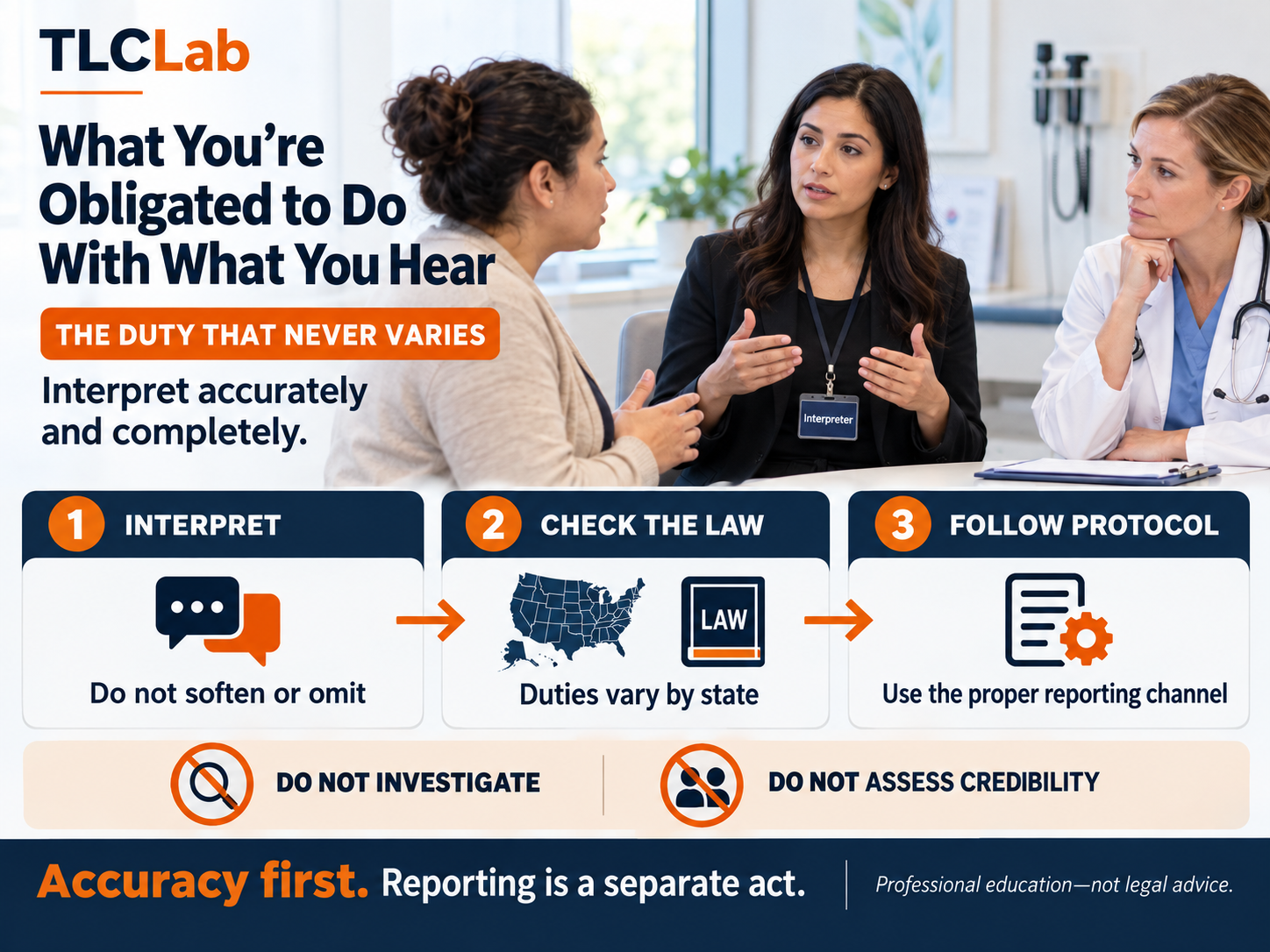
Interpret it accurately and completely.
The most common real failure is not a missed report. It is an interpreter who hears a disclosure, finds it disturbing or unclear, and softens it, omits it, or decides it was probably nothing — and then the provider, who very likely is a mandated reporter, never receives it.
If the disclosure reaches the provider intact, the person with the clearest legal duty and the most information now has what they need. If it does not, you have removed the decision from everyone.
Nothing else in this article matters as much as that.
Whether You Are a Mandated Reporter Depends on Your State
Here is the structural picture.
Every state identifies in statute who must report suspected child abuse and neglect. Roughly 46 states designate specific professions — physicians, nurses and other health care workers, teachers, social workers, law enforcement, child care providers, mental health professionals.
Interpreters are rarely named. You will usually not find “interpreter” on the list.
But there is a second route. In roughly 17 to 18 states plus Puerto Rico, any person who suspects child abuse or neglect is required to report, regardless of profession. A few states — Indiana, New Jersey, North Carolina and Wyoming among them — require all persons to report without designating professions at all.
In an “any person” state, you are a mandated reporter. Not as an interpreter — as a person.
The National Health Law Program examined this question specifically for health care interpreters and arrived at a practical test: look for an “any person” or “every person” provision in your state’s statute. If it is there, health care interpreters have a reporting duty. Their review found interpreters obligated in most states, with only one state clearly not requiring health care interpreters to report.
Their analysis also raises a wrinkle worth knowing: in some states, an interpreter who functions as part of the hospital’s own process — employed staff rather than an outside contractor — may fall inside a professional category even where freelance interpreters would not. Employment status can change the answer.
The counts above come from national summaries that are revised periodically, and legislatures amend these statutes regularly. Treat them as the shape of the landscape, not as current law in your state.
Child Abuse Is Not the Only Regime
Separate statutory schemes cover suspected abuse, neglect, or exploitation of elders and vulnerable or dependent adults. The designated reporter lists differ from the child abuse lists, and so do the thresholds and the agencies that receive reports.
If you work in geriatrics, home health, or long-term care, that is a second set of rules to check, not an extension of the first.
What Reporting Does and Does Not Override
Confidentiality and mandatory reporting are not actually in conflict, though it feels that way.
The NCIHC Standards of Practice require the interpreter to maintain confidentiality and not disclose information outside the treating team — with an explicit exception for the patient’s consent or where disclosure is required by law.
A reporting statute that applies to you is a legal requirement. It fits inside the exception. You are not violating confidentiality by meeting an obligation the law imposes.
What reporting does not do is convert you into an investigator.
What You Should Not Do
Do not question the patient yourself. Follow-up questions belong to the provider or the investigating agency. An interpreter who starts probing has stepped out of the role and may also have contaminated how the account is later evaluated.
Do not assess credibility. Whether an explanation holds up is not your determination to make. Interpret what was said and let the people with the clinical and investigative training weigh it.
Do not decide it is covered. Assuming the provider will report it, and therefore saying nothing, is a bad default. In most settings the provider heard the same disclosure through you and will act. But “someone else probably handled it” is not a position you want to be in if they did not.
Do not report in place of interpreting. Accuracy comes first and is not optional. A report is a separate act.
The Harder Cases
What you hear outside the encounter. A comment in the waiting room, a remark between family members in the hallway, something said in the other language that nobody else in the building understood. Here you may genuinely be the only person who knows. If you are in a jurisdiction where you have a duty, it is not limited to things said during the appointment.
What is said in the other language and not addressed to anyone. This is where the role and the duty most clearly diverge. The transparency principle already says everything said in the encounter gets interpreted. That principle is what keeps this situation from arising in the first place.
What to Actually Do This Week
Three steps, none of which require a lawyer.
Find out whether your state has an “any person” provision. Your state’s child protective services agency publishes its reporter requirements, and the federal Child Welfare Information Gateway maintains state-by-state summaries.
Ask your agency what their protocol is. Many have one. Many interpreters have never asked. If the agency has no answer, that is itself useful information.
Ask the facility. Hospitals and school districts have internal reporting procedures, and knowing the route in advance is better than working it out in a hallway.
How TLCLab Covers It
At TLCLab, this is taught as what it is: a duty that varies by jurisdiction, sitting on top of one duty that never varies.
Interpret it completely, exactly as it was said. Then know whether your state asks more of you.
Most interpreters have never checked.