

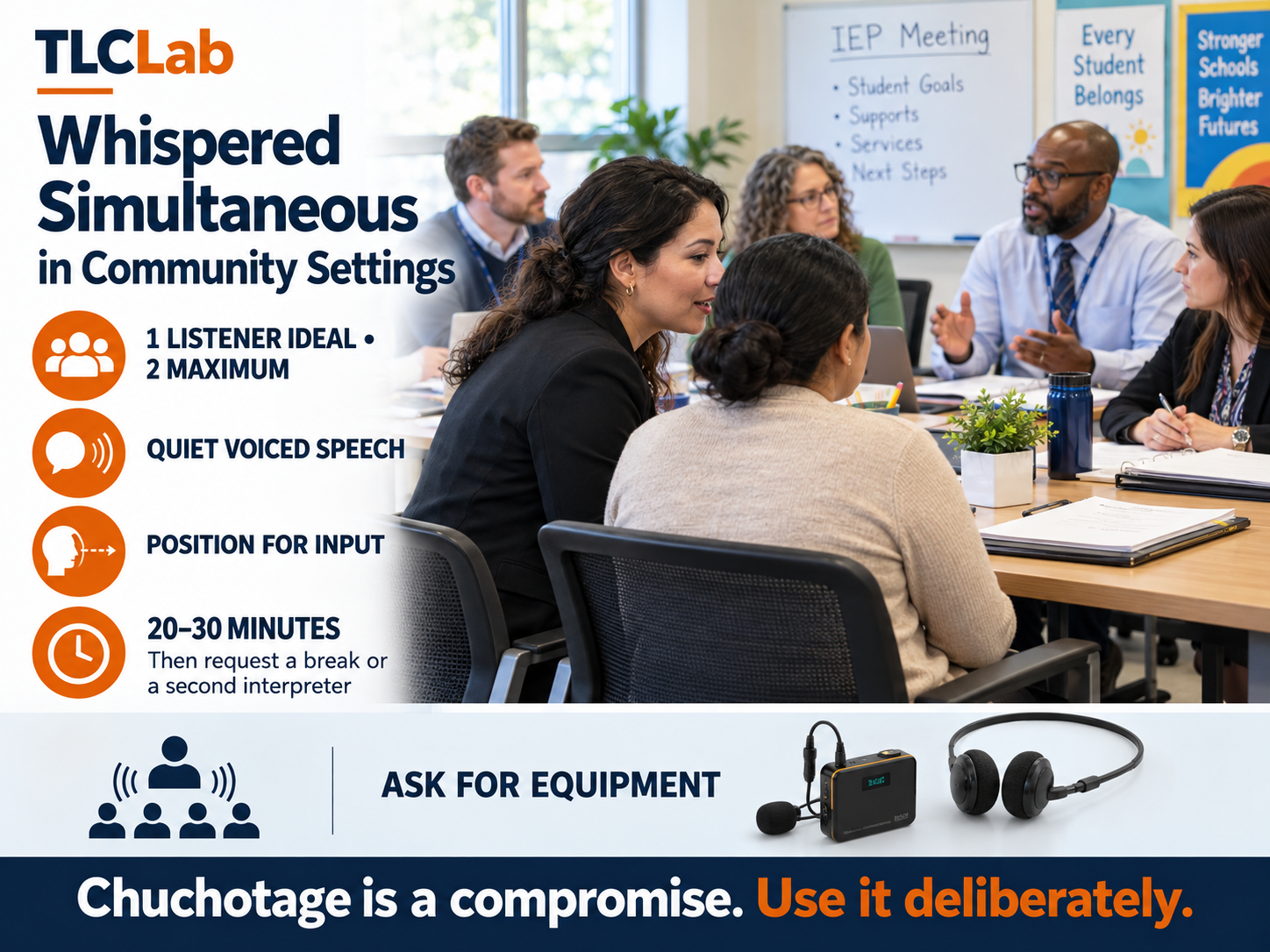
An IEP meeting with nine people at the table. One parent needs interpretation. Nobody booked equipment, nobody is going to pause after each sentence, and the team is already twenty minutes behind.
So you lean in and start whispering.
Chuchotage (whispering) shows up constantly in community work — IEP and care conferences, hearings, group therapy, town halls, trainings — and almost no spoken-language training program teaches it.
What the Standards Actually Say
Whispered interpreting is simultaneous interpreting without a booth. AIIC describes it as serving one or two people, with the interpreter seated close and speaking in a low voice.
AIIC’s own position is blunter than most interpreters realize: this modality should be avoided, because ambient sound and the interpreter’s voice interfere both with the interpretation and with everyone else’s experience of the meeting. AIIC allows that it is useful in specific circumstances — a group moving between venues, for example — and recommends portable equipment to offset its problems.
The listener limit is firm. One is ideal. Two is the practical maximum. Beyond that, the interpretation is either inaudible to the people who need it or audible to the people who don’t.
So the honest framing: chuchotage is a compromise. Knowing that is what lets you use it well and push back when it is the wrong call.
When It’s the Right Call Anyway
In community settings it earns its place when one or two people need access in a meeting that will not stop for consecutive; when consecutive would double the length of a long proceeding; when the listener needs continuous access to discussion that is not directed at them; and when there is no time to arrange anything else.
That last one is most of the time, which is why the skill matters.
Don’t Actually Whisper
The most useful technical correction in this article.
A true whisper is unvoiced — air passing the vocal folds without vibration. It is harder to produce for long stretches, harder to understand, and carries farther in a quiet room than people expect, because the hiss cuts through.
What you want is quiet voiced speech. Your vocal folds engaged, volume low, articulation crisp. Think of the register you would use talking to someone beside you in a theatre, not a stage whisper.
Intelligibility at low volume comes from consonants, not loudness. Over-articulate the endings of words. Slow slightly. A clearly articulated quiet voice is understood at a fraction of the volume a mumbled one requires.
Position for Input Before Output
There is an old rule in interpreting: no input, no output. In chuchotage it governs where you sit.
Your first priority is hearing the speakers — all of them, including the one across the table who talks quietly. Your second is being heard by your listener. Interpreters routinely reverse these, settle in close to the listener, and then spend the meeting unable to hear the people they are interpreting.
Practically: sit slightly behind and to the side of your listener, angled so your mouth is near their ear while your own ears face the room. Favor the listener’s better ear if they have one. Avoid sitting with your back to any active speaker. If the room has a hard surface behind you, expect your voice to carry.
And ask for the seat before the meeting starts. Once everyone is settled, you are stuck with what is left.
It Is More Tiring Than It Looks
Whispered work is simultaneous interpreting with three extra burdens: you have no sound insulation, so you hear yourself competing with the speaker; you are producing speech in an unnatural vocal mode; and you are usually holding an awkward physical posture.
Industry guidance commonly puts sustainable high-quality chuchotage at twenty to thirty minutes before vocal fatigue and declining accuracy set in, and treats two alternating interpreters as standard for anything longer.
Community interpreters are regularly asked to do three hours of it alone. That is not a demanding assignment — it is an unachievable one, and the quality loss is invisible to everyone in the room except you.
Ask for the Equipment
Portable systems — a transmitter microphone and receiver headsets, often called a bidule or tour-guide system — solve most of this. You speak at normal conversational volume into a microphone. Your listener hears you clearly through headphones. More than two people can be served. You no longer need to sit inches from anyone’s ear.
AIIC recommends exactly this for situations where whispering cannot be avoided. The sets are inexpensive relative to a single meeting’s staff time, and a school district or hospital that runs these meetings monthly should own one.
Making the case to a client works better framed around the meeting than around you: without equipment, one parent gets a degraded version of a legally significant discussion while eight professionals are distracted by whispering.
When It’s Imposed on You Anyway
Say what the modality can and cannot deliver, briefly and without complaint, in the pre-session. Ask for your seat. Ask for a break every thirty minutes, or for the second interpreter. And if the room is too loud or too large for it to work, say so rather than producing something that sounds like interpretation and is not.
How TLCLab Covers It
At TLCLab, whispered simultaneous is treated as a distinct skill — vocal production at low volume, positioning, stamina limits, and the language for requesting equipment or a team.
It is the modality community interpreters are asked for most often and trained in least.