
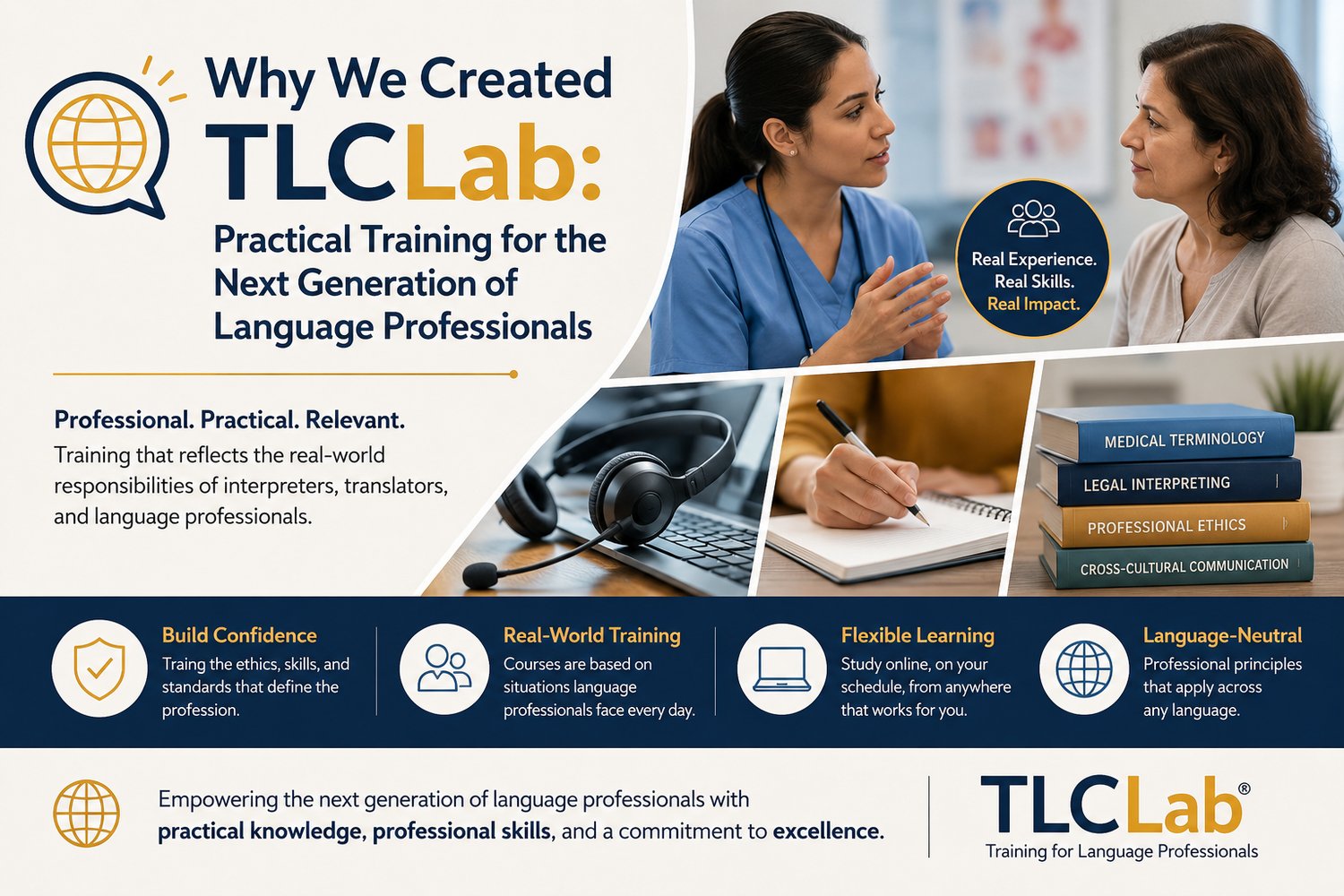
Why We Created TLCLab: Practical Training for the Next Generation of Language Professionals
Since 2000, our team has worked within the language-services industry, helping individuals, organizations, and communities communicate across languages and cultures.
Throughout this experience, we have worked with professional interpreters, translators, clients, project managers, healthcare providers, educators, legal professionals, businesses, government agencies, and community organizations.
These experiences helped us recognize an important need within the industry: people interested in language careers need training that is practical, accessible, professional, and connected to the realities of the work.
That realization became the foundation for TLCLab.
More Than an Online Training Portal
TLCLab was created as a professional learning platform for people who want to develop the knowledge and skills needed to work in interpreting, written translation, and other areas of the language-services industry.
The idea was not simply to create another collection of online courses. Our goal was to build a training environment that helps students understand what language professionals actually experience on the job.
Knowing two languages is an important starting point, but bilingual ability alone does not automatically prepare someone to work as a professional interpreter or translator.
Language professionals must also understand:
- Professional ethics
- Confidentiality
- Interpreter boundaries
- Industry terminology
- Cultural differences
- Communication techniques
- Interpreting technology
- Professional conduct
- Client expectations
- Accuracy and impartiality
An interpreter may be asked to assist during a medical appointment, legal proceeding, parent-teacher conference, social-service interview, business meeting, or emergency call.
A translator may be responsible for a document containing medical, legal, educational, financial, technical, or highly sensitive personal information.
In each of these situations, accuracy matters.
TLCLab was designed to help students recognize that responsibility and prepare for it.
Training Based on Real Industry Experience
One of the central ideas behind TLCLab is that training should be connected to real professional experience.
Since 2000, our team has observed how the language-services industry has grown, changed, and adapted to new technology and increasing demands for language access.
Our courses are informed by situations language professionals regularly encounter, including:
- Medical appointments and healthcare terminology
- Legal proceedings and interpreter standards
- School meetings and educational environments
- Social-service and community assignments
- Over-the-phone interpreting
- Video remote interpreting
- On-site interpreting
- Written translation and document preparation
- Confidentiality and professional ethics
- Cultural communication challenges
- Difficult or high-stakes interpreting scenarios
Rather than focusing only on definitions and theory, TLCLab explains how professional standards apply during actual assignments.
Students learn why an interpreter must interpret everything that is said, why an interpreter cannot provide personal advice, how to manage unfamiliar terminology, how to request clarification professionally, and how to remain impartial when a conversation becomes emotional or difficult.
The objective is not simply to help students complete a course. It is to help them enter the profession with a clearer understanding of what clients, agencies, patients, attorneys, educators, businesses, and other professionals will expect from them.
Making Professional Training More Accessible
Another major reason we created TLCLab was accessibility.
Traditional training is not always convenient for working adults, parents, students, or people attempting to begin a new career. In-person programs may require travel, fixed schedules, and significant time away from work or family responsibilities.
TLCLab allows students to complete training online and move through the material in a more flexible way. Lessons can be reviewed again when additional practice is needed, and students can study from a location that works for them.
This flexibility is especially important in the language-services profession.
Many prospective interpreters and translators already work in other fields or have family and community responsibilities. They may have valuable language abilities but need a realistic pathway for turning those abilities into professional skills.
We wanted TLCLab to help create that pathway.
A Language-Neutral Approach
The language-services industry includes hundreds of languages, dialects, and cultural communities. For this reason, TLCLab’s primary training approach is language-neutral.
The professional principles taught in our courses apply regardless of whether someone works in Spanish, Polish, Arabic, Mandarin, French, Portuguese, Russian, Ukrainian, Vietnamese, or another language.
Certain lessons may use Spanish-English examples to demonstrate concepts such as false cognates, register, terminology, or linguistic differences. However, students are encouraged to apply the same analysis to their own language pairs.
This approach allows TLCLab to serve a broader community while reinforcing an essential professional habit: interpreters and translators must continuously research and strengthen the terminology, cultural knowledge, and linguistic challenges associated with their individual working languages.
Preparing Students for Different Career Paths
Not every student entering TLCLab will follow the same professional path.
Some may want to become medical interpreters. Others may be interested in legal, educational, community, over-the-phone, video, or on-site interpreting.
Some students may discover that they prefer written translation, localization, proofreading, editing, quality control, desktop publishing, or language project management.
TLCLab introduces students to these different possibilities so they can make informed decisions about their professional development.
The platform also emphasizes that training is only one part of building a successful career. Language professionals must continue improving their skills, expanding their terminology, following ethical standards, learning new technology, and pursuing additional credentials when appropriate.
Our goal is to give students a strong foundation while encouraging continued professional development.
Supporting Quality Across the Language-Services Industry
TLCLab was also created to support the clients and communities that depend on language access.
A well-prepared interpreter helps protect communication between:
- Patients and healthcare providers
- Parents and educators
- Attorneys and clients
- Government agencies and community members
- Businesses and customers
- Social-service professionals and families
A trained translator helps ensure that important written information is accurate, understandable, complete, and appropriate for its intended audience.
When language professionals receive stronger training, everyone benefits.
Organizations receive more reliable service. Interpreters and translators feel more confident in their responsibilities. Most importantly, individuals with limited English proficiency are better able to understand information, express themselves, and participate meaningfully in decisions that affect their lives.
Responding to a Changing Industry
The language-services industry has changed significantly since 2000.
Today’s language professionals may work through video platforms, telephone systems, mobile applications, translation-management systems, cloud-based portals, and artificial-intelligence-assisted tools.
Technology can make language services faster and more accessible, but it does not eliminate the need for trained professionals.
Interpreters and translators must understand how to use technology appropriately while continuing to protect accuracy, confidentiality, impartiality, data security, and professional judgment.
TLCLab was created with this changing environment in mind. Our goal is to combine established professional principles with the tools and expectations of the modern language-services industry.
The Future of TLCLab
We see TLCLab as a growing educational resource for both new and experienced language professionals.
As the industry evolves, training must evolve with it. Remote interpreting platforms, artificial intelligence, translation technology, changing certification requirements, data security, and new communication methods are reshaping the profession.
TLCLab will continue to develop courses and resources that address these changes while maintaining the principles that remain at the center of professional language service:
- Accuracy
- Confidentiality
- Impartiality
- Competence
- Respect
- Professional boundaries
- Accountability
Built From Experience and Created With Purpose
The idea behind TLCLab came from professional experience in the language-services industry dating back to 2000.
During that time, we have seen the opportunities available to bilingual individuals, as well as the challenges they may face when attempting to enter the profession without structured and practical training.
We wanted to create a place where bilingual individuals could begin developing professional skills, where working interpreters could strengthen their knowledge, and where students could explore the many career opportunities available within language services.
TLCLab was created to help prepare knowledgeable, ethical, confident, and responsible language professionals.
It is more than a training portal. It is an investment in better-prepared professionals, stronger communication, improved language access, and a more connected future.