

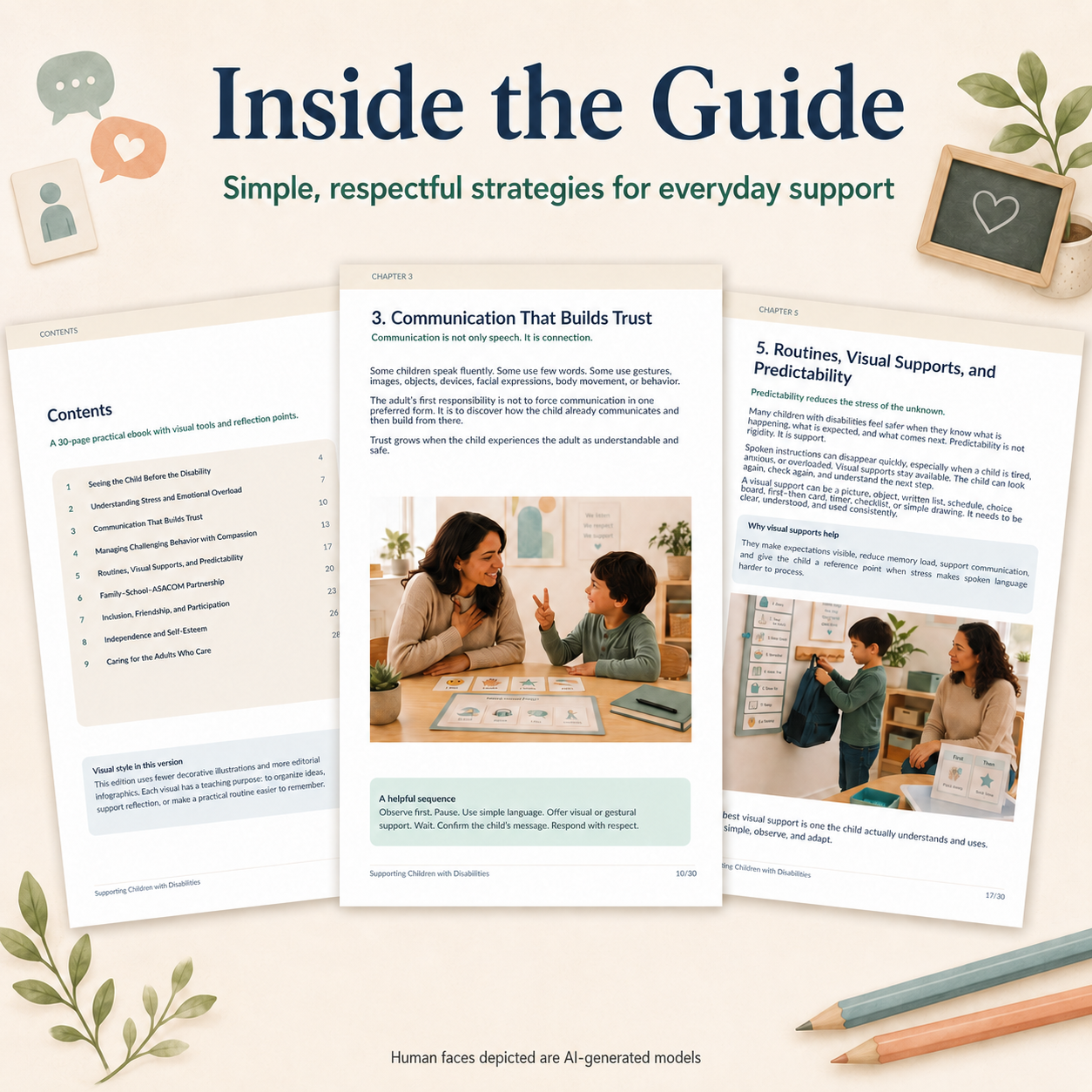
Supporting children with disabilities does not always require complicated systems. Many meaningful changes begin with small daily choices: how adults communicate, how routines are presented, how stress is noticed, and how the child is included with dignity.
Whether you are a parent, teacher, classroom assistant, or support worker, these simple strategies can help create calmer, clearer, and more respectful support at home and in the classroom.
If you would like a complete practical resource, you can download the Supporting Children with Disabilities Practical Guide here
1. See the Child Before the Disability
A disability may explain some support needs, but it never describes the whole child. Every child has preferences, strengths, emotions, fears, interests, and a need to belong.
Instead of starting with the label, start with curiosity.
Ask yourself:
What does this child enjoy?
When do they feel calmer?
What helps them participate?
What makes this moment harder for them?
This simple shift helps adults move from judgment to support. The goal is not to “fix” the child, but to understand their needs, reduce barriers, and support participation with dignity.
2. Notice Early Signs of Overload
Many difficult moments begin before they become visible to adults. A child may already be tired, confused, overstimulated, anxious, or unable to communicate a need.
Early signs of overload can include covering ears, freezing, crying, hiding, refusing, running away, silence, restlessness, or difficulty starting a task.
When adults notice early signs, they can respond sooner with less pressure.
Helpful responses may include:
Pausing
Using fewer words
Offering a break
Reducing noise
Showing a visual cue
Giving one predictable next step
Responding early can often prevent stress from becoming a bigger crisis.
3. Use Clear and Low-Pressure Communication
When a child is stressed, long explanations can feel overwhelming. Simple, calm language is often more helpful.
Instead of saying:
“Hurry up.”
Try:
“One step now. I will wait.”
Instead of saying:
“Use your words.”
Try:
“Show me: help, break, or finished.”
Communication support is not only about speech. It can include gestures, pictures, objects, visual cards, written words, communication devices, facial expressions, or body movement.
The most important thing is to respect the child’s message and give them a safe way to communicate.
4. Make Routines Visible
Predictability can reduce stress because the child knows what is happening now and what comes next.
Visual supports can include:
Visual schedules
First-then cards
Choice boards
Timers
Checklists
Routine cards
Simple drawings or written steps
A visual routine works best when adults actually use it. Point to it, teach it calmly, repeat the same words, and keep the steps simple.
The goal is not to decorate the wall. The goal is to help the child understand, participate, and feel more secure during daily routines.
5. Support Independence Without Taking Over
Helping a child does not always mean doing the task for them. Sometimes the best support is the smallest useful support.
Adults can ask:
“What is the smallest support I can give so the child can still participate?”
That might mean waiting, pointing, offering a visual cue, helping with one step, or simply staying nearby.
Independence does not mean leaving the child alone to struggle. It means giving respectful support while protecting the child’s chance to try.
Small moments matter:
A child choosing between two options.
A child asking for help.
A child completing one step of a routine.
A child joining a group activity in their own way.
These are meaningful forms of progress.
Final Thoughts
Supporting children with disabilities is not about having perfect answers. It is about paying attention, adapting support, communicating with respect, and protecting the child’s dignity.
Small changes in adult language, routines, visual support, and teamwork can make daily life clearer and more manageable for everyone involved.
If you want a deeper practical resource, the Supporting Children with Disabilities Practical Guide is a 30-page PDF ebook created for parents, teachers, classroom assistants, and support workers.
Inside, you will find simple strategies for communication, stress, visual routines, behavior support, inclusion, independence, and family-school collaboration.
Comments ()