

If you've ever looked at a resistor and thought, "How is anyone supposed to remember all of these colors?" you're not alone.
For many beginners, resistor color codes feel like something you must memorize before you can troubleshoot electronics. Fortunately, that's not true.
Once you understand the pattern behind the colored bands, identifying resistor values becomes much easier—and with a digital multimeter nearby, you can quickly confirm your results.
Whether you're repairing electronics, assembling kits, or learning circuit troubleshooting, knowing how to interpret resistor color codes is an essential skill.
Why Resistors Use Color Bands
Unlike larger electronic components, resistors are often too small to print a complete value directly on the body.
Instead, manufacturers use colored bands that represent:
- Significant digits
- A multiplier
- Tolerance
- (Sometimes) temperature coefficient
This standardized system allows resistors to be identified regardless of manufacturer.
Start by Finding the Tolerance Band
Before reading any colors, orient the resistor correctly.
The tolerance band is usually:
- Gold
- Silver
- Brown (on precision resistors)
- Red (on precision resistors)
This band is normally spaced slightly farther away from the other bands.
Read the resistor from the opposite end toward the tolerance band.
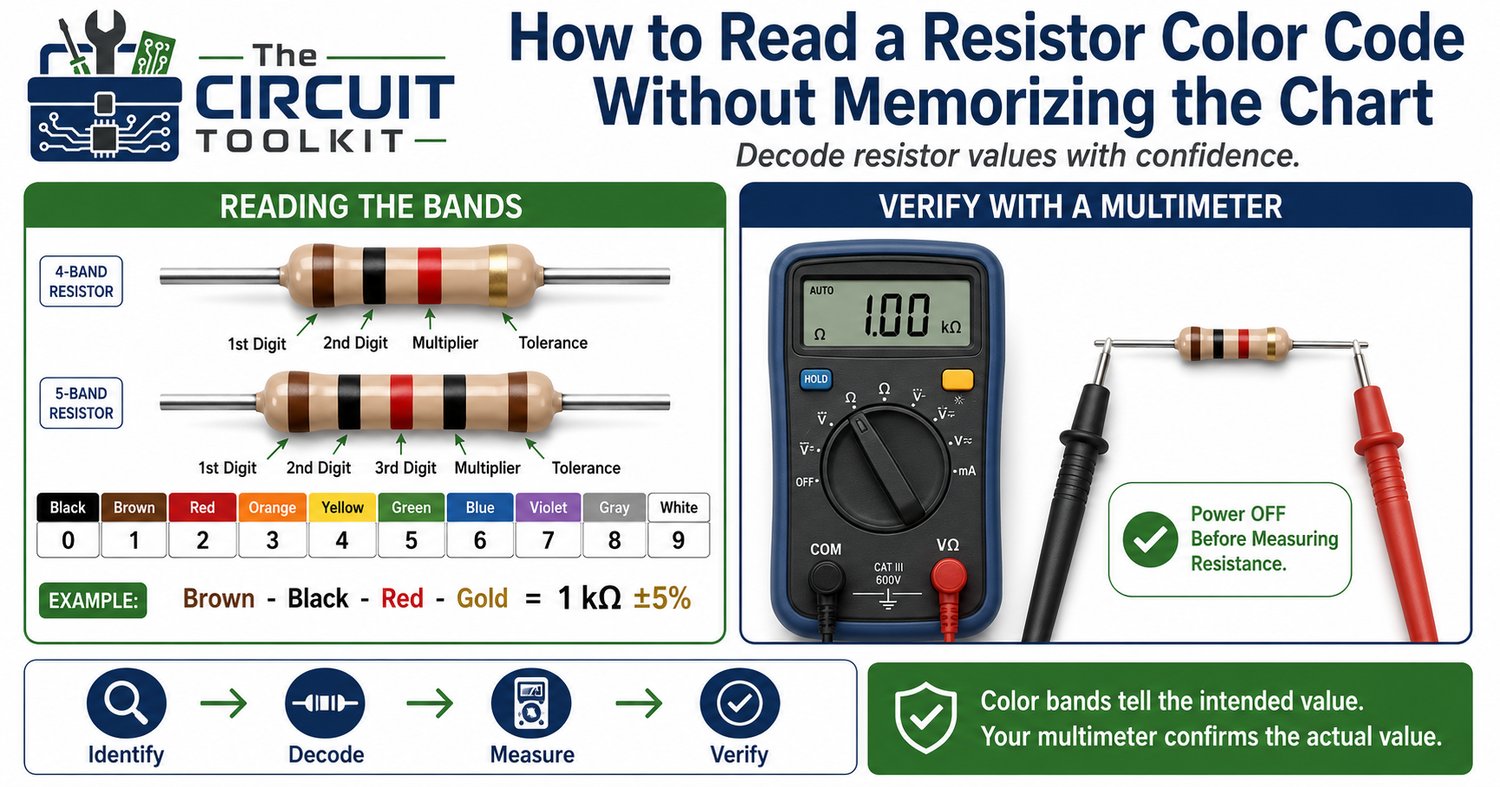
Understanding a Four-Band Resistor
A typical four-band resistor uses:
- Band 1: First digit
- Band 2: Second digit
- Band 3: Multiplier
- Band 4: Tolerance
Example:
Brown – Black – Red – Gold
Break it down:
- Brown = 1
- Black = 0
- Red multiplier = ×100
So:
10 × 100 = 1,000 Ω (1 kΩ)
Gold means the resistor has a tolerance of ±5%.
Five-Band Resistors
Higher-precision resistors often use five bands.
Instead of two significant digits, they use three.
Example:
Brown – Black – Black – Brown – Brown
This becomes:
100 × 10 = 1,000 Ω
with ±1% tolerance.
Don't panic when you see five bands—they provide greater precision.
A Simple Way to Remember the Digits
Instead of memorizing every value immediately, remember the sequence:
Black = 0
Brown = 1
Red = 2
Orange = 3
Yellow = 4
Green = 5
Blue = 6
Violet = 7
Gray = 8
White = 9
With practice, you'll recognize the common colors naturally.
Always Verify With a Multimeter
Color bands tell you the intended value.
A multimeter tells you the actual value.
Before measuring:
- Remove power from the circuit.
- Discharge any stored energy.
- If necessary, isolate one end of the resistor from the circuit to avoid parallel paths affecting the reading.
A resistor marked 1 kΩ may measure:
- 998 Ω
- 1.01 kΩ
- 995 Ω
All of these are perfectly acceptable for a ±5% resistor.
Don't Assume a Different Reading Means Failure
Many beginners replace perfectly good resistors because the meter doesn't exactly match the color code.
Remember:
Manufacturing tolerances are normal.
Temperature also affects resistance slightly.
More importantly, resistors measured while still connected to a circuit can appear lower because other components create parallel current paths.
When a measurement doesn't make sense, ask:
"Am I measuring only the resistor—or the entire circuit?"
Burned Resistors
If a resistor has overheated:
- The color bands may become discolored.
- The body may crack.
- The value may drift far outside tolerance.
- The resistor may become completely open.
When the bands can no longer be read, use:
- The circuit schematic
- An identical resistor elsewhere on the board
- The manufacturer's documentation
Avoid guessing whenever possible.
A Practical Troubleshooting Tip
Suppose a resistor measures open.
Before replacing it, ask why it failed.
Resistors often burn because another component has shorted, causing excessive current.
Replacing only the resistor may result in another burned resistor when power is restored.
Professional troubleshooting always searches for the root cause before replacing components.
Conclusion
Reading resistor color codes isn't about memorization—it's about understanding a simple pattern.
Once you know how the bands represent digits, multipliers, and tolerances, identifying resistor values becomes second nature.
Combine that knowledge with proper multimeter measurements, and you'll avoid many of the common mistakes that slow down new troubleshooters.
The goal isn't just to identify components.
It's to understand what they're telling you about the health of the entire circuit.
If you're building your electronics troubleshooting skills, the Ohm's Law & Resistor Quick Reference Guide and the Beginner Circuit Troubleshooting Guide from The Circuit Toolkit provide easy-to-follow reference charts, resistor examples, and practical measurement techniques that help you diagnose circuits with confidence instead of guesswork.