

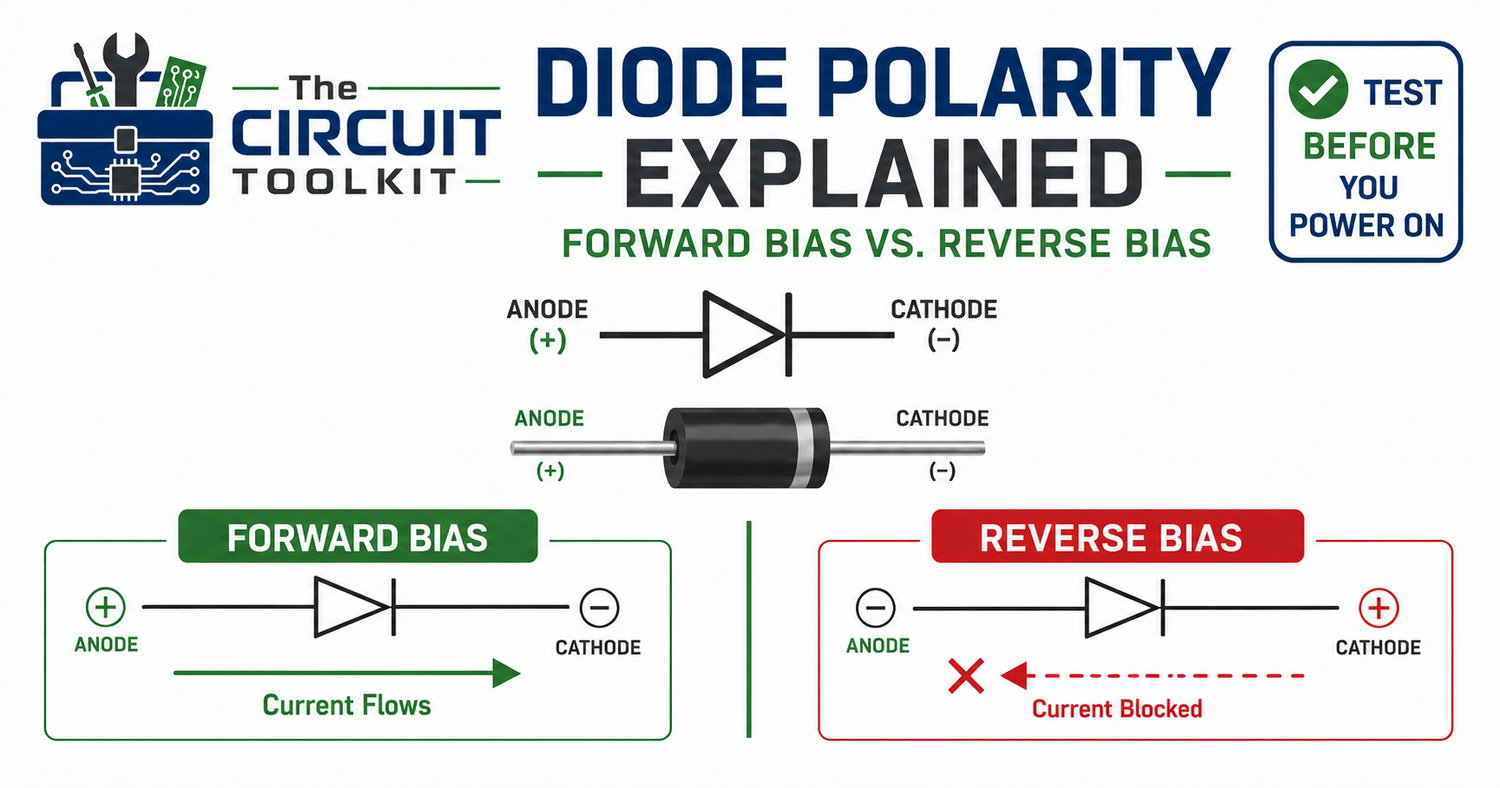
One of the fastest ways to damage an electronic circuit—or spend hours chasing a fault—is misunderstanding diode polarity. Diodes are among the simplest semiconductor components, yet they perform some of the most important jobs in electronics. They protect power supplies, convert AC to DC, prevent reverse polarity damage, clamp voltage spikes, and steer current exactly where it needs to go.
The good news is that checking a diode takes only a few seconds. Spending those few seconds before applying power can prevent blown fuses, damaged components, and unnecessary troubleshooting.
What Does a Diode Do?
A diode is designed to allow current to flow primarily in one direction while blocking it in the opposite direction. This one-way behavior is why diodes are often compared to electrical check valves.
The two terminals are:
- Anode
- Cathode (identified by the stripe on most through-hole diodes)
When the anode is at a higher potential than the cathode by approximately the diode's forward voltage, the diode conducts. When the polarity is reversed, the diode blocks current under normal operating conditions.
Forward Bias vs. Reverse Bias
Understanding these two operating modes is essential.
Forward Bias
In forward bias:
- Current flows through the diode.
- Silicon diodes typically drop about 0.6–0.7 volts.
- Schottky diodes generally have a lower forward voltage.
- LEDs have forward voltages that depend on color and material.
Forward-biased diodes appear in:
- Rectifier circuits
- LED indicators
- Protection circuits
- Voltage references
Reverse Bias
In reverse bias:
- Current flow is extremely small.
- The diode behaves like an open switch.
- Protection circuits depend on this blocking action.
If a standard rectifier diode conducts significantly in reverse under normal conditions, it may be damaged.
How to Check a Diode with a Multimeter
Most digital multimeters include a diode-test mode, which applies a small current and displays the forward voltage.
A healthy silicon diode will normally show a forward voltage near 0.6–0.7 V when measured in the forward direction. When the test leads are reversed, the meter typically indicates an open circuit or overload.
Keep in mind that in-circuit measurements can be affected by parallel components. If the reading seems unusual, compare it with the schematic or isolate one lead following the equipment manufacturer's service procedure.
Common Diode Mistakes
Even experienced technicians occasionally encounter these issues:
- Installing the diode backward
- Confusing the cathode stripe
- Assuming every diode has the same forward voltage
- Ignoring reverse-polarity protection circuits
- Replacing a failed diode without investigating the root cause
When a diode fails, it is often a symptom of another problem, such as excessive current, overvoltage, or incorrect polarity elsewhere in the circuit.
Practical Troubleshooting Tip
When a circuit refuses to power up:
- Verify the supply voltage.
- Inspect reverse-polarity protection diodes.
- Check bridge rectifiers.
- Test suspicious diodes with the meter's diode mode.
- Compare measurements with the schematic when available.
Working through these steps methodically is usually faster than replacing components at random.
Safety Reminder
Always de-energize equipment and allow stored energy in capacitors to discharge before performing resistance or diode measurements. High-voltage equipment and mains-powered systems require appropriate training, procedures, and protective equipment.
Build Better Troubleshooting Habits
Understanding diode polarity is one of the foundational skills every technician should master. Whether you're repairing industrial equipment, building hobby projects, or learning electronics for the first time, recognizing forward bias, reverse bias, and correct component orientation will save time and reduce mistakes.
If you'd like a printable quick-reference sheet that summarizes diode symbols, polarity identification, forward vs. reverse bias, common applications, and multimeter testing, check out the Diode Guide available in The Circuit Toolkit Payhip store. It makes an excellent bench reference for students, technicians, and engineers.