
Your feet are quiet overachievers. They carry you through your day, absorb impact, keep you balanced, and rarely get the appreciation they deserve. Think about it: without them, getting around would be nearly impossible.
How much do you actually know about them? These surprising facts might make you see your feet in a whole new light.
1. The largest recorded feet
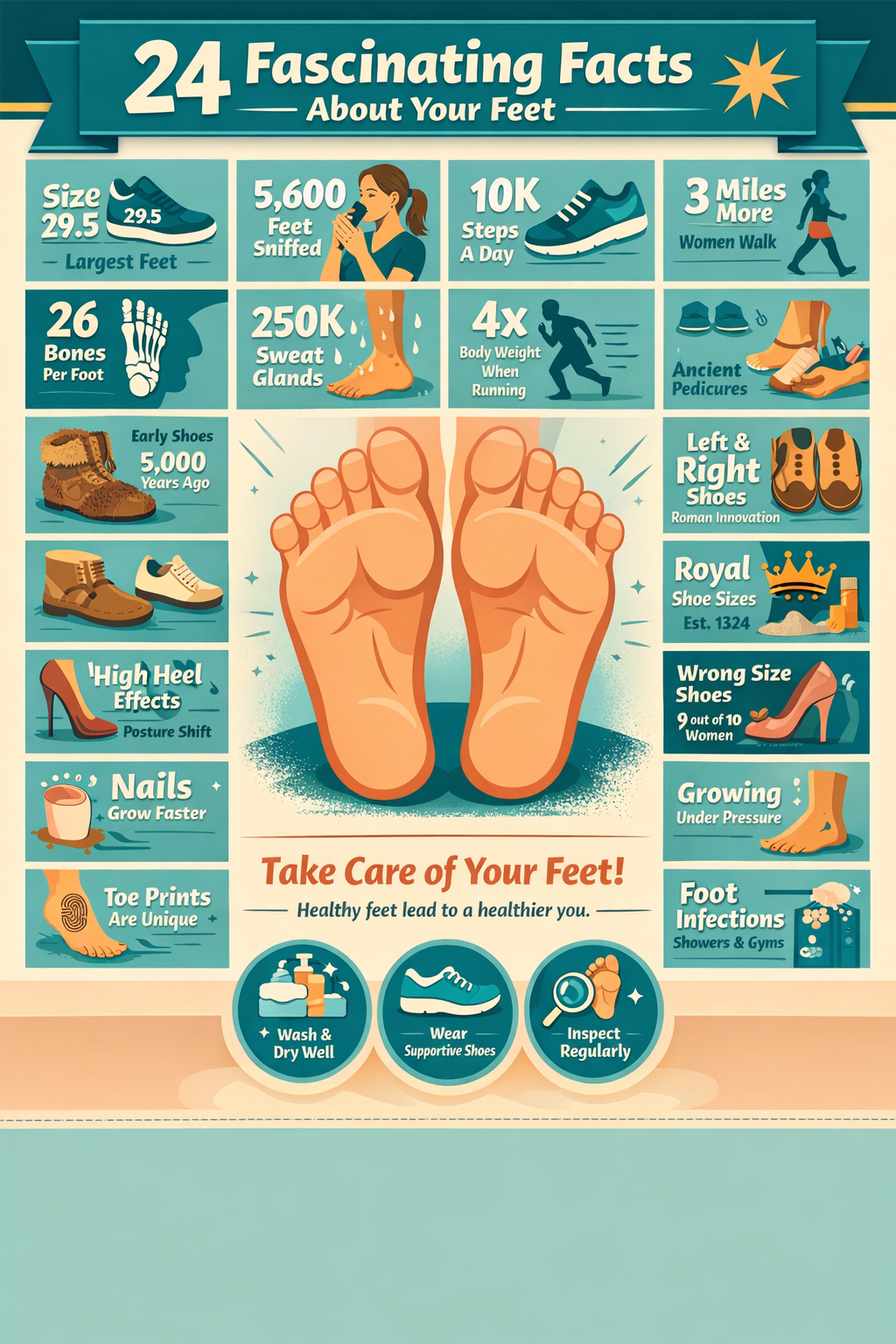
The record for the world’s largest feet belonged to Matthew McGrory, who wore a U.S. size 29.5 shoe. Matthew, a 7-foot-6-inch actor, held Guinness World Records for the largest feet and the longest toes (excluding cases of elephantiasis). Born in 1973, he appeared in the 1994 edition of the Guinness Book of Records for his, at the time, size 23 feet.
2. A very unusual world record
Madeline Albrecht holds a Guinness World Record for having smelled over 5,600 pairs of feet in the name of science. This feat (lol) was conducted in the mid-1990s while working at the Hill Top Research Lab, where she tested the effectiveness of foot powders and antiperspirants over a 15-year period.
3. You walk farther than you think
The average person takes around 10,000 steps per day. Over a lifetime, that can add up to roughly 185,075 kilometers/115,000 miles, enough to circle the Earth about four times.
4. Women tend to log more daily miles
On average, women walk about 5 kilometers/ 3 miles more per day than men.
5. You’re born with more foot bones than you keep
Babies are born with soft cartilage that eventually fuses into the 26 bones in each adult foot.
6. A quarter of all your bones are in your feet
Each foot contains 26 bones. Together, both feet account for about 25 percent of all the bones in the human body.
7. There are more than 100 muscles, tendons, and ligaments in each foot
The foot is made up of several intricate layers of tissues and bones. It’s a mechanical masterpiece. Tiny, but powerful.
8. Your feet are sweat factories
A pair of feet contains approximately 250,000 sweat glands. Each foot contains more sweat glands per square inch than any other part of the body.
9. They can produce a lot of moisture
Those sweat glands can generate up to half a pint of perspiration per day.
10. Running multiplies pressure
When you run, your feet can absorb forces up to four times your total body weight with each step.
11. Ancient Egyptians had pedicures
Archaeological findings show that ancient Egyptians practiced detailed foot grooming thousands of years ago. There’s even evidence to suggest they practiced a type of Reflexology too.
12. Footwear has ancient origins
The earliest known shoes date back thousands of years and were made from animal hides to protect against hard surfaces and harsh climates.
13. The Romans changed shoe design
The ancient Romans were the first to create distinct left and right shoes. Before that, footwear was interchangeable.
14. Shoe sizing has royal roots
In 1324, Edward II of England standardized shoe sizes by declaring that one barleycorn, about 0.9cm/ .33 (one-third) of an inch, would equal one shoe size. That system still influences sizing today.
15. It's Bette to shop for shoes later in the day
Your feet naturally swell as the day goes on, making the afternoon the best time to try on new shoes.
16. Most women wear the wrong size shoe
Studies suggest that 9 out of 10 women wear shoes that are too small.
17. Foot problems affect women more often
Women are about four times more likely than men to experience foot issues, often due to footwear choices.
18. High heels shift your entire skeleton
Wearing a shoe with heels changes your center of gravity, shifts your pelvis, alters your spine alignment, and increases pressure on the forefoot. If something as simple as a heel can do all this, imagine the amazing effects Reflexology can have on the entire body.
19. Nails respond to life stages
Fingernails and toenails tend to grow faster in hot weather, with increased activity, during pregnancy, and throughout the teenage years.
20. Your feet change size under pressure
When you stand, your feet can lengthen by up to two sizes due to the spreading of bones and soft tissue.
21. Communal spaces can spread infections
Public showers and locker rooms can expose your feet to conditions such as plantar warts, athlete’s foot, and ringworm. Proper hygiene and protective footwear can go a long way in preventing these common issues
22. There’s a “foot orgasm” phenomenon
In rare cases, stimulation of certain foot nerves has triggered spontaneous orgasms due to how sensory pathways overlap in the brain. The body is wild.
23. Toe prints are unique
Just like fingerprints, your toe prints are unique to you.
24. Your feet have thousands of nerve endings
Each foot contains around 8,000 nerve endings, making them incredibly sensitive. No wonder reflexology reaches so deeply.
You only get one pair of feet, and they carry the full weight of your life, literally. From thousands of steps a day to absorbing impact, balancing posture, and housing thousands of nerve endings, they deserve more than just being squeezed into shoes and forgotten.
Reflexology offers a focused, intentional way to support this hardworking foundation and support the body’s natural ability to restore balance. It is not just about your feet. It is about your entire body.
If your feet have been quietly doing their job without much appreciation, consider this your sign. Book a Reflexology session and give them the attention they have earned. Your whole body will thank you.
💜

Comments ()