
Two quick questions:
1.) How often are you assessing and targeting discourse skills with patients?
2.) How comfortable/confident do you feel targeting discourse skills in speech therapy?
Research indicates that discourse analysis is one of the best ways that SLPs can see “mild” cognitive communication disorders manifest after a neurological change. Discourse goes beyond just word finding skills or stringing words together in a sentence. It forces us to combine both our cognitive and linguistic skills together efficiently and effectively.
Therefore, discourse analysis allows SLPs as SLPs the opportunity to see how attention, memory, word finding and so much more contributes to our patients having meaningful exchanges with those around them. However, most of the standardized testing we have available in our field for attention, memory, word finding, etc. don’t help us in analyzing discourse. These tests measure discrete skills and patients might even score Within Normal Limits on these tests, but still have discourse deficits.
Evidence suggests a patient’s spoken discourse skills can predict how well they do vocationally, how socially participative they are, etc. But, if spoken discourse is so important, why aren’t more Speech Language Pathologists assessing and treating it? Why is it left out of so many evaluations and treatment plans?
One theory is that many SLPs don’t know HOW to manage spoken discourse.
What are the different types of discourse?
Do you target all of them with patients who want to get better at expressive language?
How do you write a goal for discourse?
How do you take data on discourse?
What are the active treatment ingredients for discourse?
What therapy activities can be used to target spoken discourse in a session?
How do you even document that you targeted spoken discourse in a therapy visit?
Several research articles (see (6) references below) are listed below that contain answers to these questions. However, let’s at least cover the basics first……
Different Types of Discourse
· Descriptive- used when describing people, objects, places/scenes, occurrences
· Narrative- used when telling or retelling stories or events
· Expository- used when we are explaining concepts or tasks
· Persuasive Discourse- used when we are trying to influence others
Why is it important to understand the different discourse types? A 2025 research article indicates "Given the differences between types of discourse, when SLPs include discourse in a client’s treatment program, the types of discourse activities the client wants to address should align very closely with the types of dis-course assessed and treated in the clinic room" (Leaman & Archer, 2023)
An example of me introducing the concept of Spoken Discourse is as follows:
“Mr./Mrs. _________, as you know, we are working to improve your expressive communication. So far, we have been working on word finding, but it’s time to go beyond that because we don’t just speak in random words or sentences--- we speak in conversations. Let’s create a list of all the different types of conversations you have throughout your day. These can be conversations you have at work, at home, out in the community, etc.”
After we have identified what type of discourse is the most FREQUENT, IMPORTANT, and MOST CHALLENING for a patient, we can proceed with creating Discourse Rubric(s) and planning therapy activities in which they can be used.
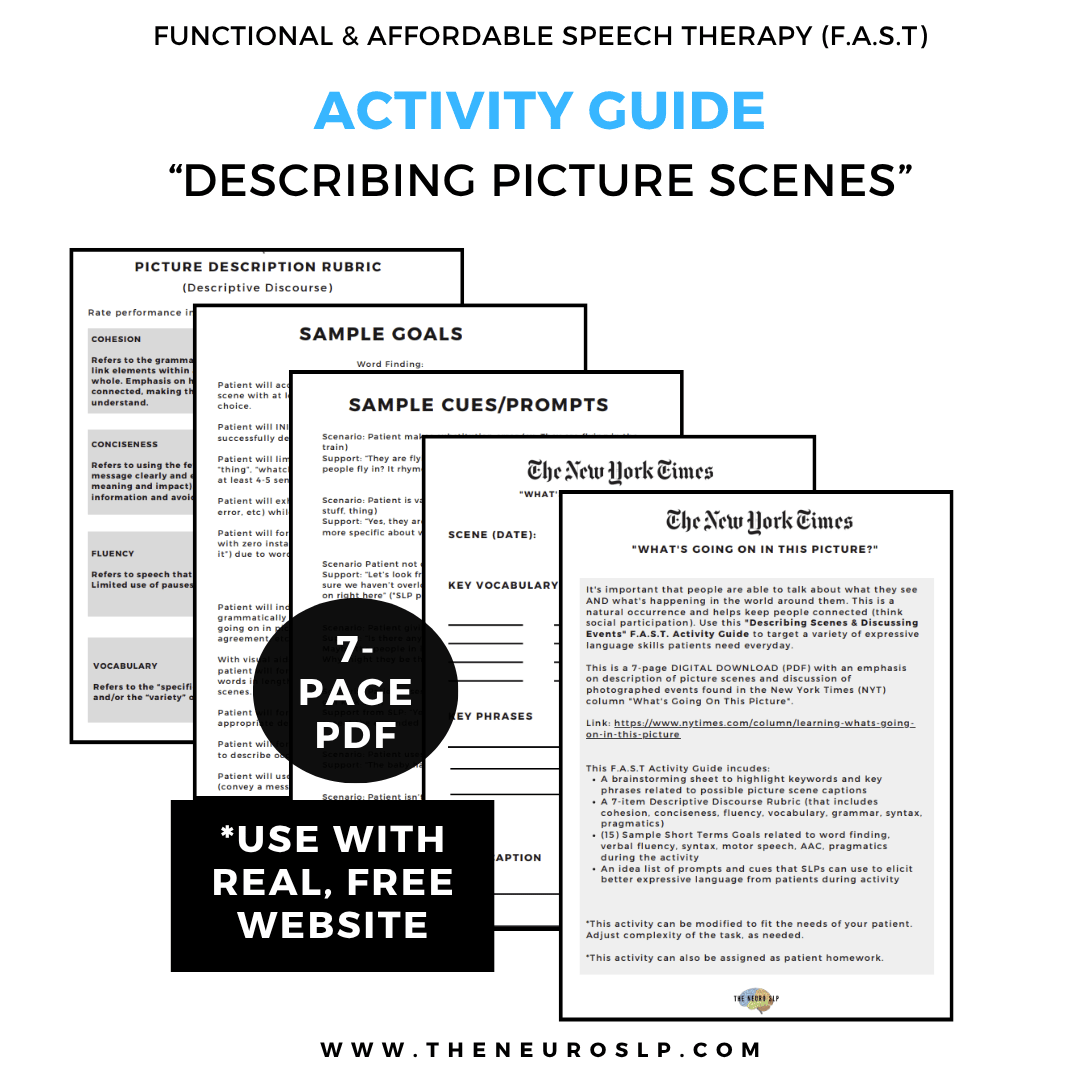
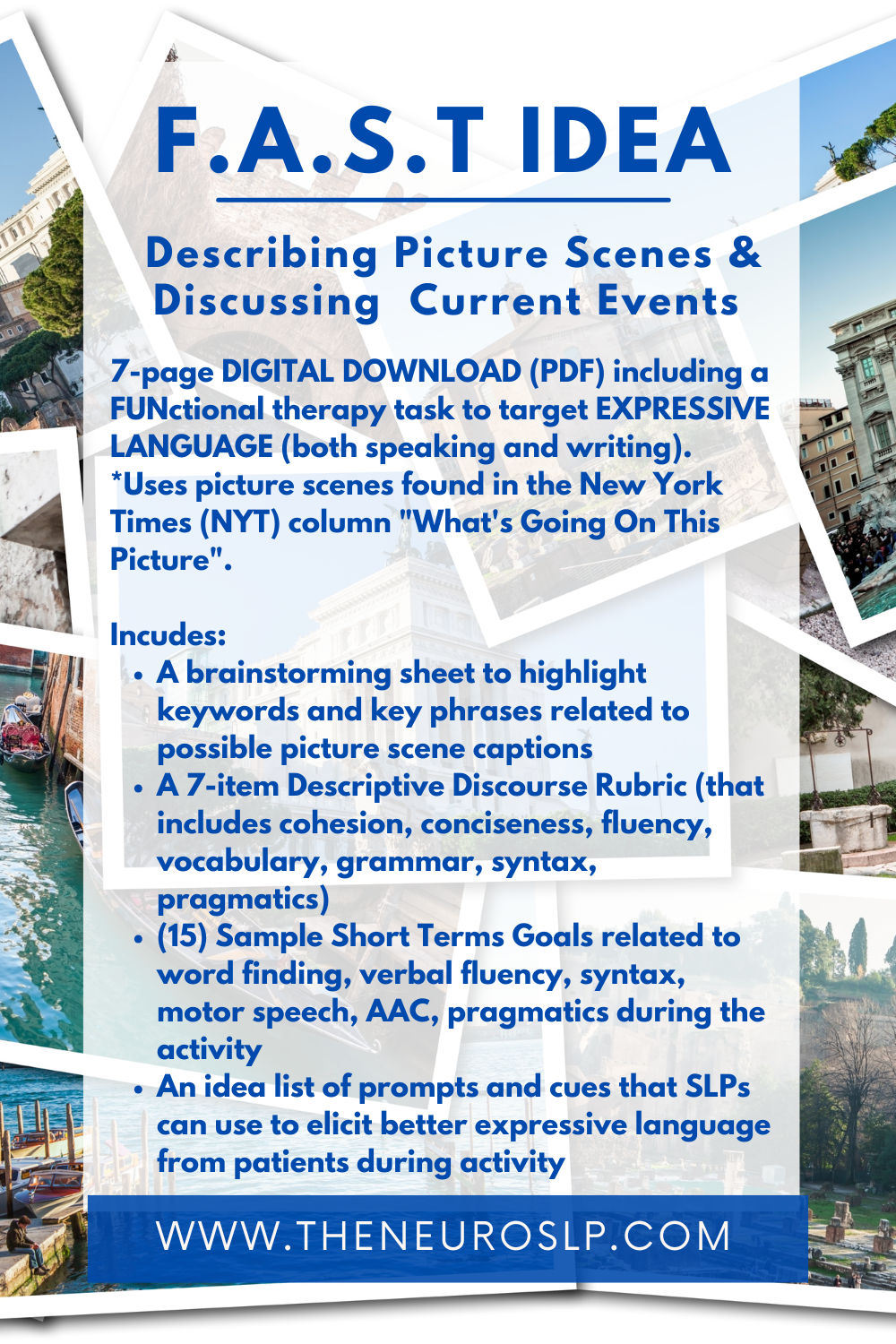
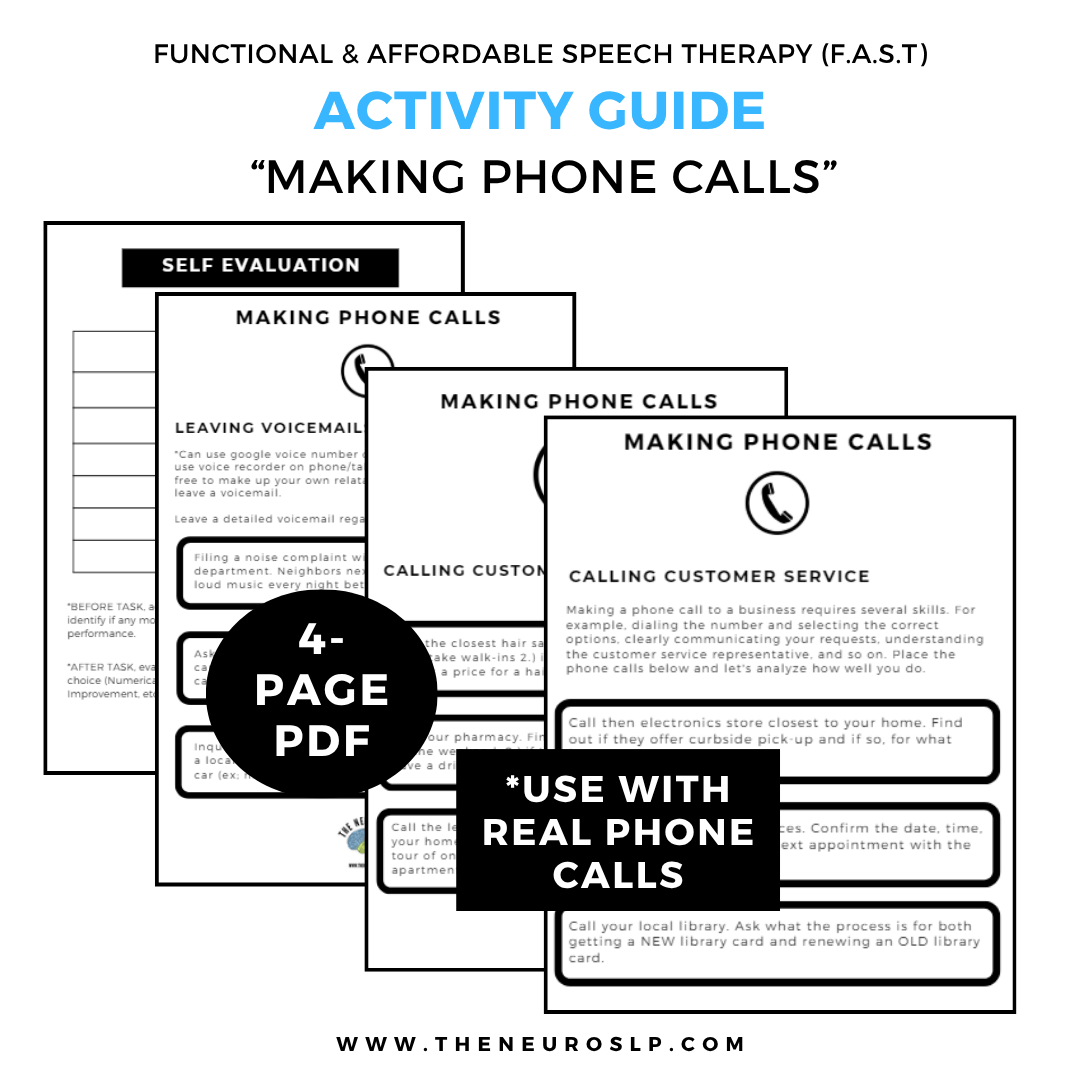
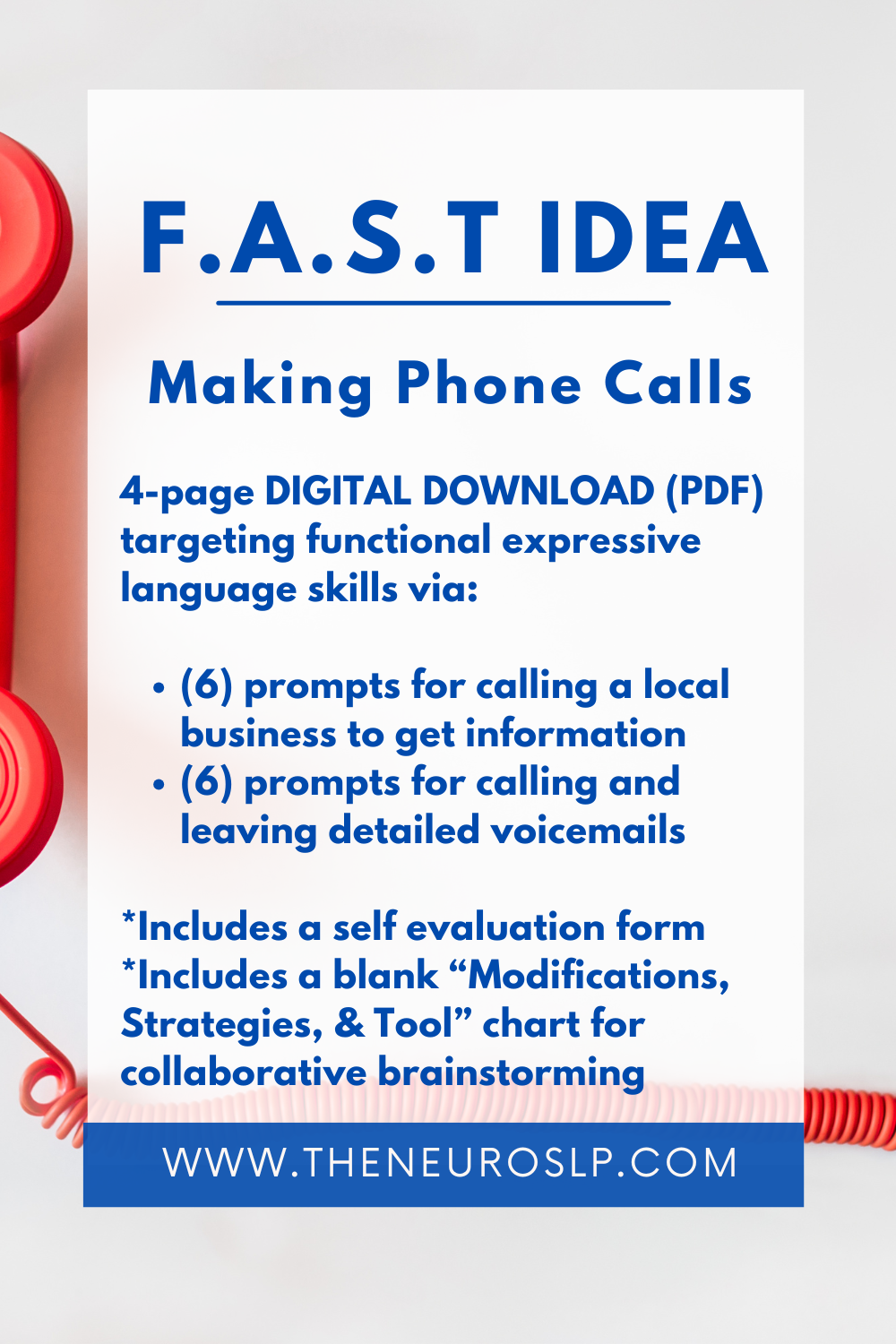
Examples of F.A.S.T Activity Guides related to descriptive discourse can be found HERE.
Stay Tuned for Part 2 where I dive deeper into how to use Discourse Rubrics in clinical practice—particularly with the TBI population.
As always, have some FUNctional therapy sessions!
-Dana (The Neuro SLP)
References:
Leaman, M & Archer, B (2023). Choosing Discourse Types That Align With Person-Centered Goals in Aphasia Rehabilitation: A Clinical Tutorial. Perspectives of the ASHA Special Interest Groups, 8(2), 254-273.
Lê, K., Coelho, C., & Fiszdon, J. (2022). Systematic Review of Discourse and Social Communication Interventions in Traumatic Brain Injury. American journal of speech-language pathology, 31(2), 991–1022.
Myers, J. R., Solomon, N. P., Lange, R. T., French, L. M., Lippa, S. M., Brickell, T. A., Staines, S., Nelson, J., Brungart, D. S., & Coelho, C. A. (2022). Analysis of Discourse Production to Assess Cognitive Communication Deficits Following Mild Traumatic Brain Injury With and Without Posttraumatic Stress. American journal of speech-language pathology, 31(1), 84–98.
Norman, R. S., Mueller, K. D., Huerta, P., Shah, M. N., Turkstra, L. S., & Power, E. (2022). Discourse Performance in Adults With Mild Traumatic Brain Injury, Orthopedic Injuries, and Moderate to Severe Traumatic Brain Injury, and Healthy Controls. American journal of speech-language pathology, 31(1), 67–83.
Stark B. C. (2019). A Comparison of Three Discourse Elicitation Methods in Aphasia and Age-Matched Adults: Implications for Language Assessment and Outcome. American journal of speech-language pathology, 28(3), 1067–1083.
Steel, Joanne & Bogart, Elise & Togher, Leanne. (2021). Narrative Discourse Intervention After Traumatic Brain Injury: A Systematic Review of the Literature. Topics in Language Disorders. 41. 47-72.
Steel, J., Coluccio, I., Elbourn, E., & Spencer, E. (2024). How do speech-language pathologists assess and treat spoken discourse after TBI? A survey of clinical practice. International journal of language & communication disorders, 59(2), 591–607.




Comments ()