
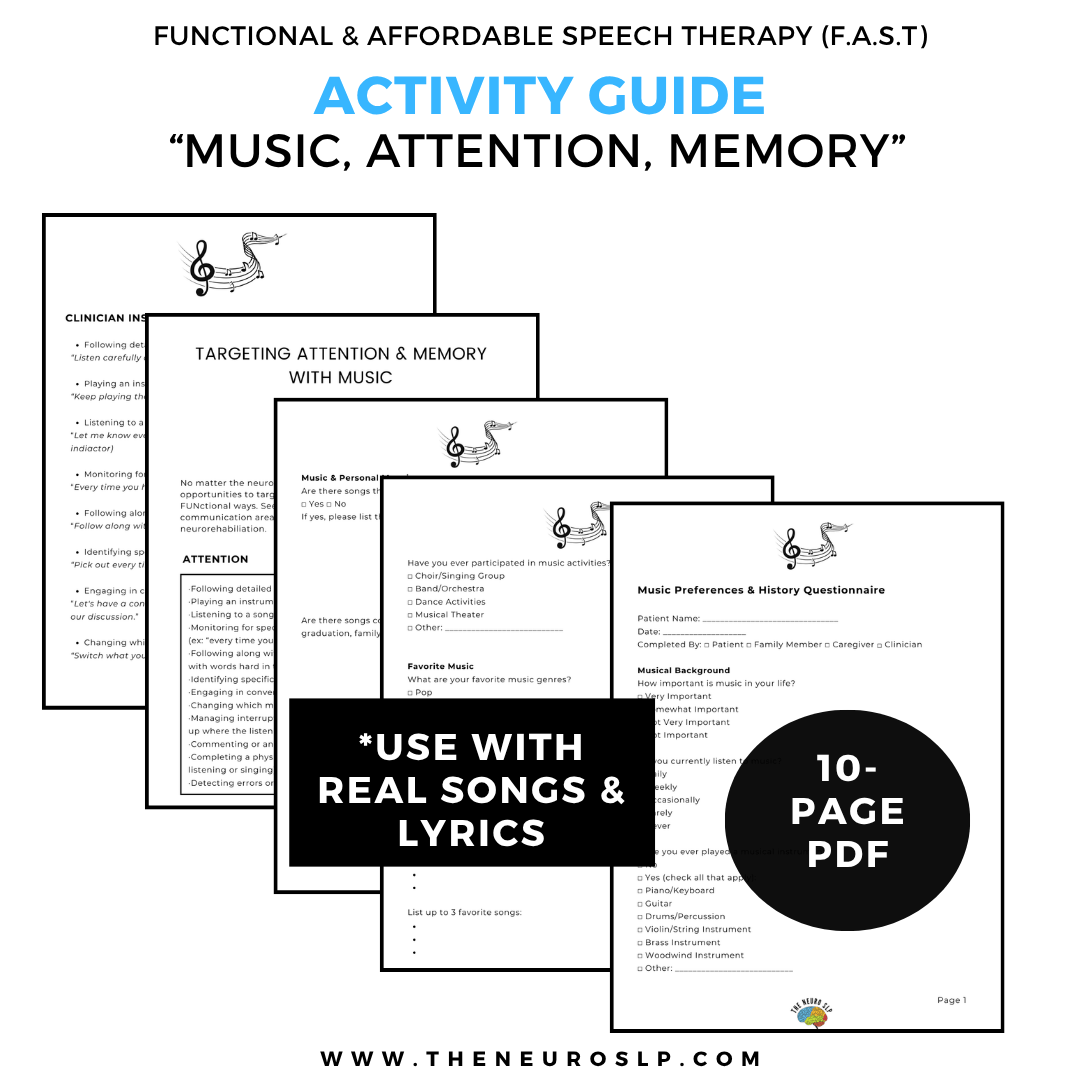
>>> CLICK HERE to download 10-page "Music & Cognition: Functional & Affordable Speech Therapy Guide" to get started including music in your neurorehabilitation today.
As Speech-Language Pathologists, many of us are constantly searching for therapy activities that are functional, person-centered, engaging, and affordable. We want materials that don't require endless prep time or complicated instructions. At the same time, we want interventions that are evidence-informed and support meaningful outcomes for our patients.
This is where MUSIC comes in.
One of the most powerful, and often underutilized, tools available to SLPs is MUSIC.
Whether you're working with patients who have had a stroke or brain injury... or working with a patient with dementia or Parkinson's disease, music offers countless opportunities to target therapy goals (in ways that feel motivating and FUNctional).
Music checks off all the boxes when choosing speech therapy activities:
- -RELEVANT (because who doesn't like music?; it's universal)
- -FUNCTIONAL (because music is everywhere, and connects people from all over)
- FREE/AFFORDABLE (we can access any song, anywhere, anytime because of the internet)
- LITTLE/NO PREP (because there's so many different ways music can be used)
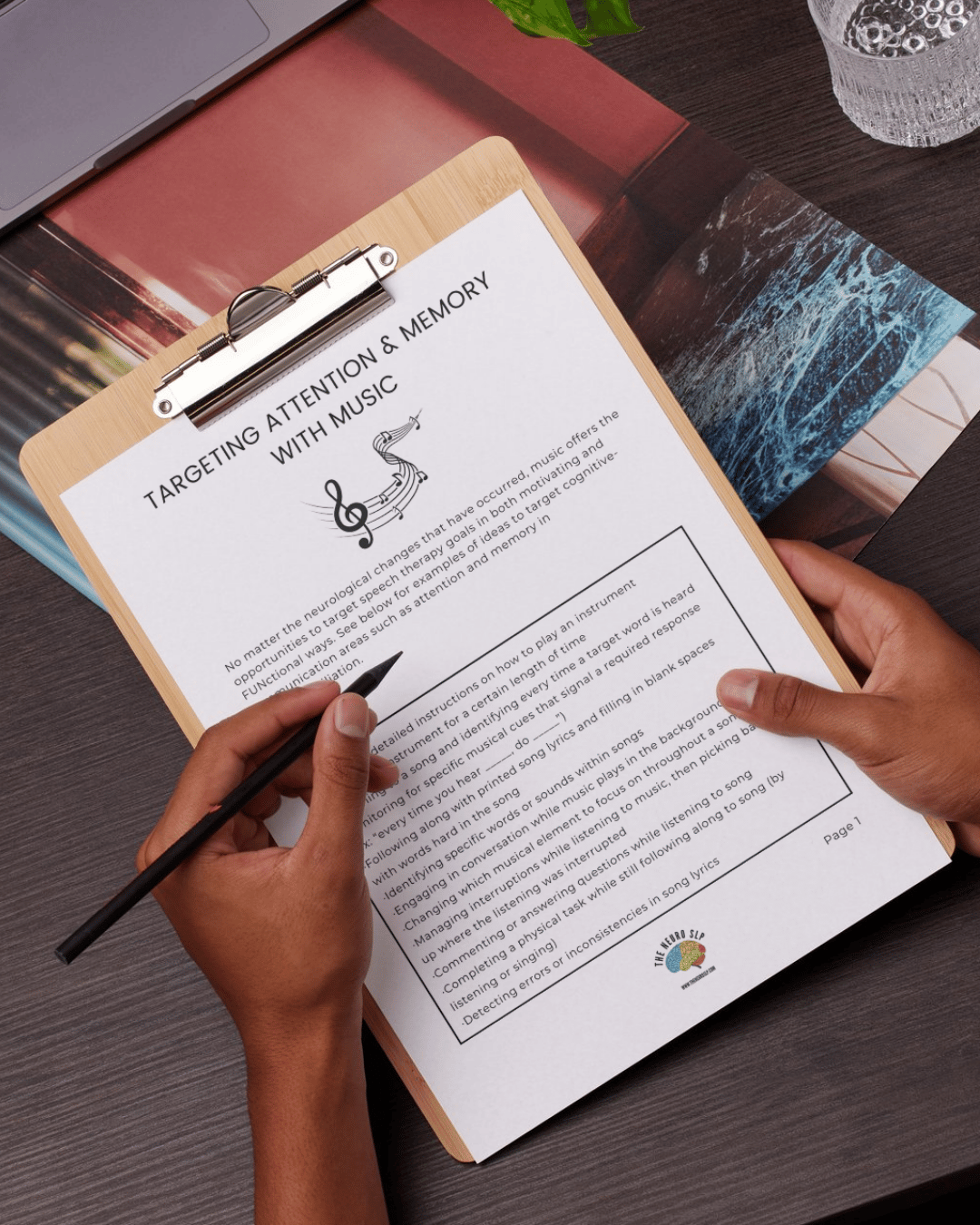
Let's explore (10) different ways music can be incorporated across cognitive-communication areas such as ATTENTION and MEMORY.
ATTENTION
- Following detailed instructions on how to play an instrument
- Listening to a song and identifying every time a target word is heard
- Following along with printed song lyrics and filling in blank spaces with words hard in the song
· Identifying specific words or sounds within songs
- Engaging in conversation while music plays in the background
- Changing which musical element to focus on throughout a song
MEMORY
- Learning new song lyrics
- Learning a new musical rhythm pattern
- Learning multiple steps in playing a new musical instrument
- Repeating back a song lyric line by line as it is heard and song is paused
- Delayed recall of instructions once a song ends (ex: “when this song ends, play this song next” OR “when the song ends, look up___”)
>>> CLICK HERE to download 10-page "Music & Cognition: Functional & Affordable Speech Therapy Guide" to get started including music in your neurorehabilitation today.
Again, music is a great therapeutic tool that can be adapted to address a variety of communication and cognitive-communication. And because music isn’t boring, it allows for intense, repeated practice that is required to leverage neuroplasticity in neurorehabilitation. (*remember 10 principles of neuroplasticity)
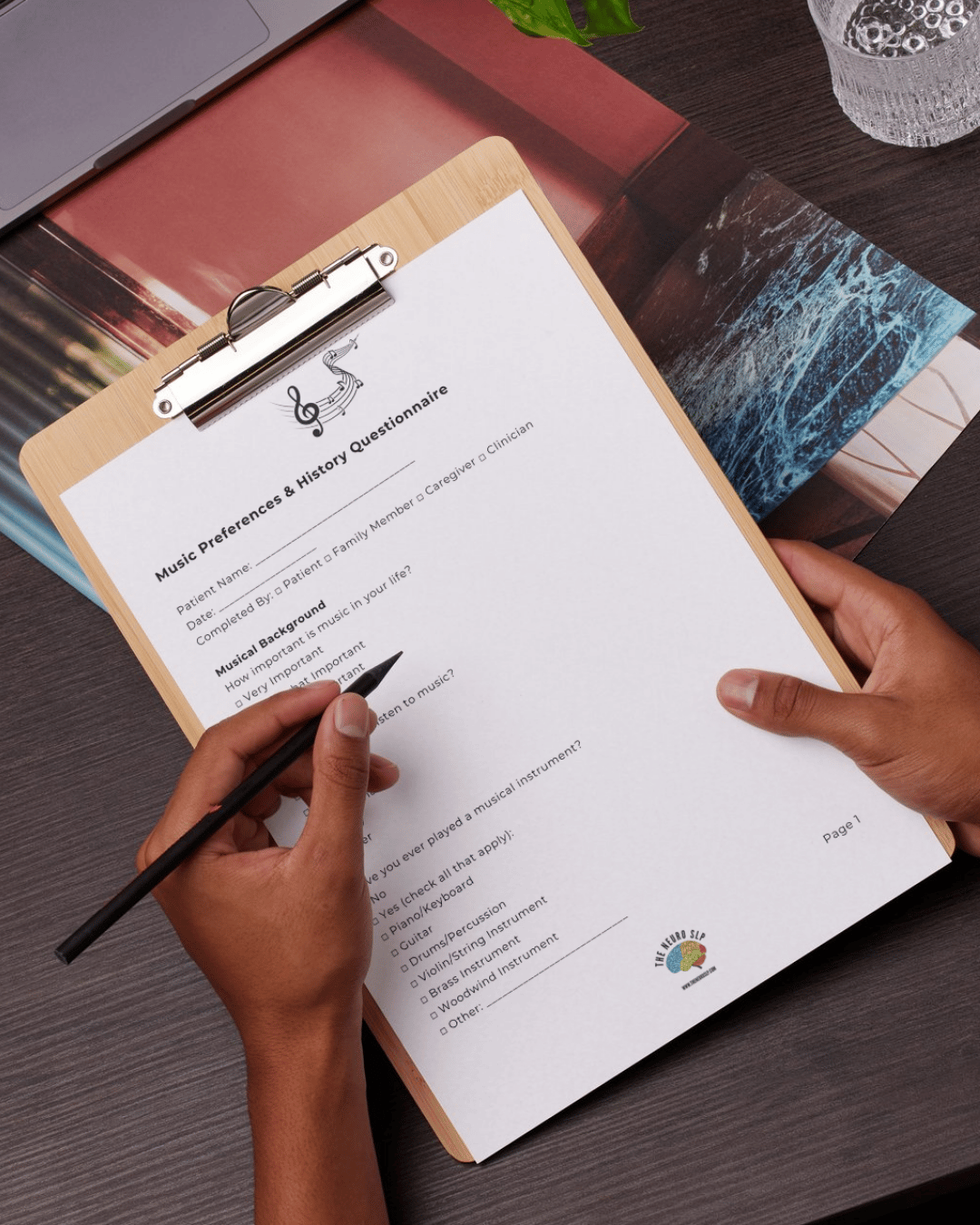
The key is selecting the musical activities and materials (ex: songs, lyrics, and instrumentals) that YOUR patients like and find relevant to their life. After that, you’re good to go with a FUNCtional and evidence-informed speech therapy activity.
Hope this helped! As always, have some amazing therapy sessions.
-Dana (The Neuro SLP
Relevant Research:
Ong A, Namasivayam-MacDonald A, Kim S, Werden Abrams S. The use of music and music-related elements in speech-language therapy interventions for adults with neurogenic communication impairments: A scoping review. Int J Lang Commun Disord. 2024 Nov-Dec;59(6):2632-2654
Sihvonen AJ, Leo V, Ripollés P, Lehtovaara T, Ylönen A, Rajanaro P, Laitinen S, Forsblom A, Saunavaara J, Autti T, Laine M, Rodríguez-Fornells A, Tervaniemi M, Soinila S, Särkämö T. Vocal music enhances memory and language recovery after stroke: pooled results from two RCTs. Ann Clin Transl Neurol. 2020 Nov;7(11):2272-2287
Vetro-Kalseth D, Vaudreuil R, Morrison H, Howland K, Bronson H. Auditory cognition lab: a music therapy and speech-language pathology co-treatment for military-connected populations with auditory and cognitive impairment. Front Neurol. 2025 Sep 1;16:1642056


Comments ()