
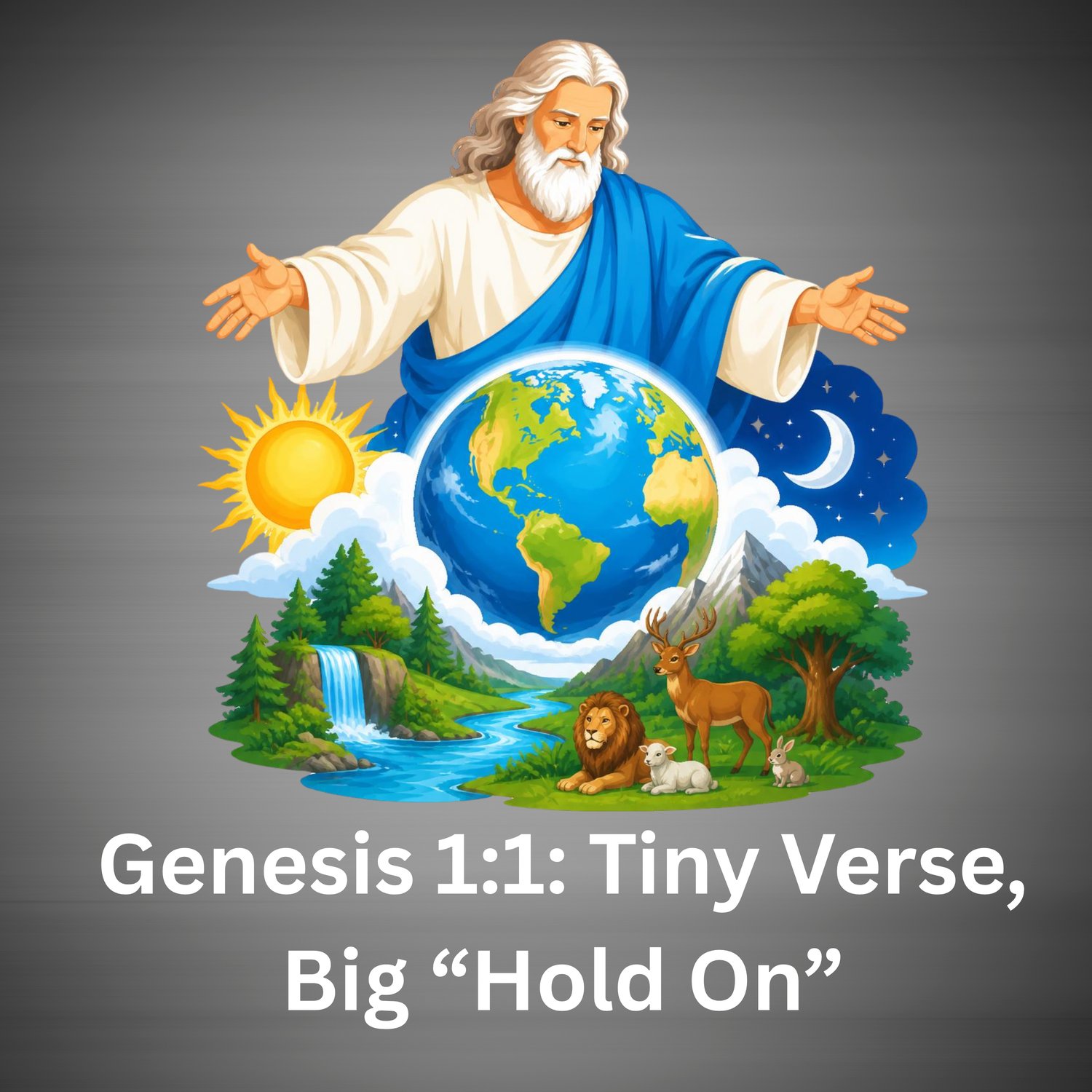
“In the beginning God created the heaven and the earth.” — Genesis 1:1 KJV
Genesis 1:1 is short. It is also the kind of short that makes your brain go “…huh.”
Before light. Before land. Before sea. Before animals. Before people. Before your Tuesday. God is already there.
The Bible does not start with us. It starts with God. Tiny verse. Big reset.
What the words are doing
The Hebrew is often written like this:
Bereshit bara Elohim et hashamayim ve’et ha’aretz.
No panic. Here is the simple version:
• “In the beginning” means God is before the beginning. He is not part of the created starter pack. He is before it.
• “created” is the Hebrew verb bara. In the Old Testament, it is used only with God as the subject. It highlights God’s unique creative action. Does that one word all by itself mean “out of nothing”? Not quite. But the whole Bible points that way.
• “God” is Elohim. It is grammatically plural but takes a singular verb here. In Hebrew, that is often majesty and power language. It is not by itself a proof text for the Trinity. So this verse does not need to carry more than it should.
• “the heaven and the earth” is two opposites used to mean “everything.” Like saying “high and low” or “inside and out.” So it means the whole cosmos. All of it. KJV says “heaven” singular, and we are sticking with KJV.
Why this verse is a big deal
In the ancient world, lots of cultures told stories about gods fighting chaos, popping out of chaos, or being kind of messy themselves. Genesis opens with a very different picture:
One God. No rival. No origin story. No chaos roommate. Just God, before everything, making everything.
This is where the Creator/creature distinction comes in. Fancy phrase, simple meaning:
God is God. We are not. God is not a bigger version of us. We are not tiny gods. We are creatures made by Him. That is humbling, but honestly? It is freeing. We do not have to run the universe. We are not qualified. Great news.
What Genesis 1:1 teaches us
1. God is before everything.
Before time, matter, space, or your notification storm, God was. He is eternal. He is not a creature among creatures.
2. Creation is God’s work.
The world is not self-made in the biblical frame. It is the product of God’s intentional action. Not an accident with a bad attitude.
3. The whole cosmos belongs to God.
“The heaven and the earth” means everything. Your life, your work, your family, your weird little hobbies. None of it is outside God’s claim.
4. The Bible starts with God, not us.
This is such a good reset. We are creatures, not the center of the story. Genesis 1:1 pulls us out of the “me, me, me” spiral and says, “Actually, look up.”
Common questions
Does Genesis 1:1 teach creation out of nothing?
It teaches that God is Creator of all. The doctrine of creation out of nothing ( ex nihilo ) is developed across Scripture and Christian theology. Genesis 1:1 is a foundational text in that conversation, but the full doctrine draws on more than this one verse.
Is “Elohim” plural, and does that prove the Trinity?
The word is grammatically plural, but the verb is singular. In Hebrew, this often expresses majesty. The Trinity is a biblical and theological doctrine, but Genesis 1:1 alone is not a direct proof text. So we can love the verse without making it carry more than it should.
Is Genesis 1 a science textbook?
Genesis 1:1 is theology with a megaphone. It tells us who made everything and why it matters. It is not giving a lab report. Faithful Christians have different views on timing and mechanisms, but this verse is clear on the main thing: God is Creator.
Application
Genesis 1:1 is a verse to return to when life feels loud and chaotic. It reminds us that God was before the chaos and is not stressed by it.
It also reorients our identity. We are creatures made by God, not self-defined little bosses of our own universe. And it invites stewardship rather than ownership. The heaven and the earth are His. We get to care for what belongs to Him.
So yeah. Tiny verse. Huge truth. Deep enough to study for a lifetime, clear enough to hold onto today.
Discussion questions
1. What difference does it make that the Bible begins with God rather than with humanity?
2. How does Genesis 1:1 challenge the way our culture thinks about the world and human identity?
3. Why is the Creator/creature distinction important for how we live?
4. How might this verse shape your view of work, rest, and stewardship?
5. What questions about creation does this verse leave open, and how should we handle those questions wisely?






Comments ()