

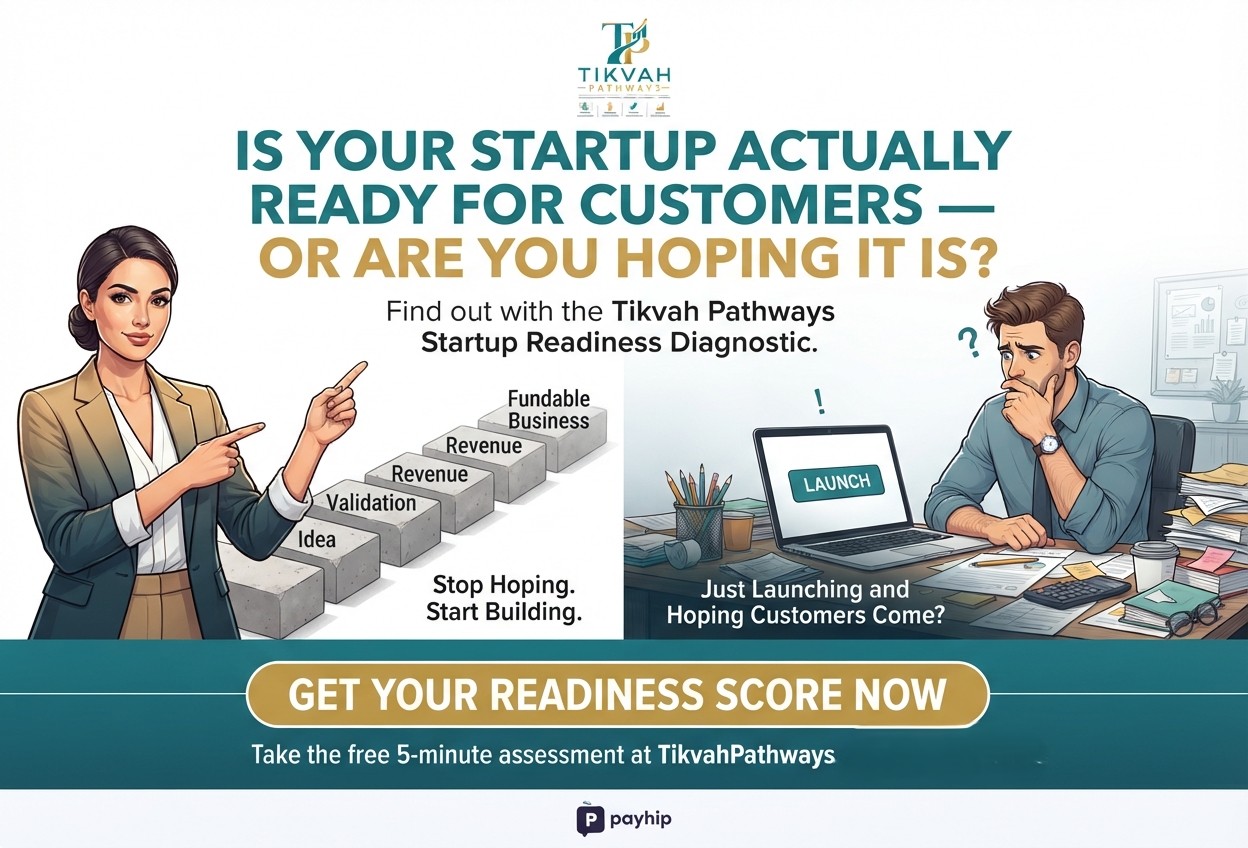
The difference between launching a business and being ready to build one.
There is a moment every entrepreneur eventually reaches.
The idea is there.
The logo is ready.
The website is almost finished.
Social media accounts have been created.
Perhaps the product has even been developed.
And then comes the big question:
"Are we ready to start selling?"
Most founders answer yes.
But here's the uncomfortable question:
Are you actually ready for customers—or are you simply hoping you are?
At Tikvah Pathways, we believe there is a better way to answer that question.
Assess first. Then act.

Being ready is not the same as being excited
Starting a business is exciting.
But excitement is not evidence.
A founder can be passionate about an idea and still have:
- An unclear customer
- An untested problem
- A weak value proposition
- An unrealistic price
- No reliable sales process
- Poor financial controls
- Operational weaknesses
- Insufficient capacity
- No clear competitive advantage
- A business model that has never been tested
None of these necessarily mean the business will fail.
But they do mean the founder needs to know where the gaps are before investing heavily in growth.
That's where a Startup Readiness Assessment becomes valuable.
The question isn't "Do I have a business?"
The better question is:
"What evidence do I have that this business is ready for the next stage?"
A startup should be examined from several perspectives.
1. Problem & Customer
Do you know exactly whose problem you are solving?
Can you describe your ideal customer clearly?
Have you spoken to potential customers?
Do you understand their pain, urgency and current alternatives?
If you cannot answer these questions, your marketing may become guesswork.
2. Solution & Value Proposition
Having a product isn't enough.
The customer must understand why your solution matters.
Can you explain your offer simply?
Does it solve a meaningful problem?
Why should someone choose you rather than doing nothing or using an alternative?
Your solution needs to move from:
"This is what we sell."
to:
"This is the problem we solve and the value we create."
3. Market & Competition
You don't operate in a vacuum.
Who else is solving the problem?
What alternatives already exist?
What makes your offer different?
And perhaps most importantly:
Does the market care enough about your difference to pay for it?
Competition isn't necessarily a reason to stop.
Sometimes competition proves that a market exists.
The real question is whether you have a credible position within that market.
4. Sales Readiness
A startup cannot survive on interest alone.
Eventually someone must buy.
Can you identify potential customers?
Do you know how you will reach them?
Do you have an offer?
Do you know how you will handle objections?
Can you move someone from interest to purchase?
A beautiful website cannot compensate for the absence of a sales process.
5. Financial Readiness
Revenue is not the same as profitability.
And profitability is not the same as cash flow.
Before pushing for growth, founders need to understand:
- What does it cost to deliver the product?
- What are the operating expenses?
- What is the gross margin?
- How much cash is required?
- How long can the business operate?
- What happens if sales take longer than expected?
A startup can have customers and still become financially unhealthy.
6. Operational Readiness
Imagine your marketing suddenly works.
You receive 100 orders.
Can you deliver them?
Can your suppliers cope?
Do you have the necessary equipment?
Do you have enough people?
Are your processes documented?
Can quality be maintained?
Growth exposes weaknesses.
That's why operational readiness needs to be considered before growth arrives.
7. Founder Readiness
The startup is not just a business model.
It is also a founder.
Can you make decisions with incomplete information?
Can you manage pressure?
Can you execute consistently?
Can you accept feedback?
Can you move from being the person who does everything to becoming the person who builds systems and leads people?
Sometimes the biggest constraint in a startup isn't the market.
It's the founder's readiness to build the business.
What happens when you don't assess?
The cost of being wrong increases as you grow.
A small misunderstanding about your customer can become an expensive marketing campaign.
A weak pricing model can become a cash-flow crisis.
An untested product can result in months of development nobody wants.
Poor systems can turn a successful sales campaign into an operational disaster.
And unclear roles can create conflict as the team grows.
The assessment doesn't guarantee success.
What it does is something arguably more valuable:
It helps you see the risks before they become expensive.
From Guesswork to Evidence
At Tikvah Pathways, we believe entrepreneurs shouldn't have to guess where their business stands.
The Startup Readiness Assessment is designed to help identify the gaps that could prevent a startup from progressing confidently.
The purpose isn't to give the founder another complicated report that sits in a drawer.
The purpose is to answer:
Where are we now?
What's working?
What's missing?
What represents the greatest risk?
What should we prioritise next?
That turns assessment into action.
Your next step
Before you spend more money on advertising, equipment, development or expansion, stop and ask:
Is my startup actually ready for customers?
Or am I simply hoping it is?
Don't guess your way into the market.
Assess. Identify the gaps. Prioritise. Act.
Take the Tikvah Pathways Startup Readiness Assessment.
Because the earlier you identify a gap, the less expensive it can be to fix.
Visit our online store