

Think Like a Doctor
When you visit a doctor, they don't normally walk into the room and immediately say:
"Take this medicine."
They first ask questions.
They examine you.
They measure.
They investigate.
They identify the problem.
Then they prescribe.
Why?
Because the same symptom can have completely different causes.
A headache could be caused by dehydration, stress, lack of sleep or something else entirely.
Business is no different.
A founder might say:
"I need more customers."
But perhaps the real problem is an unclear value proposition.
Another founder might say:
"I need funding."
But perhaps the real problem is that the business isn't financially ready for funding.
Another might say:
"I need to grow."
But perhaps the business has weak systems and will collapse under the pressure of growth.
Another might say:
"My team isn't performing."
But perhaps the real issue is leadership, role clarity or communication.
The symptom isn't always the problem.
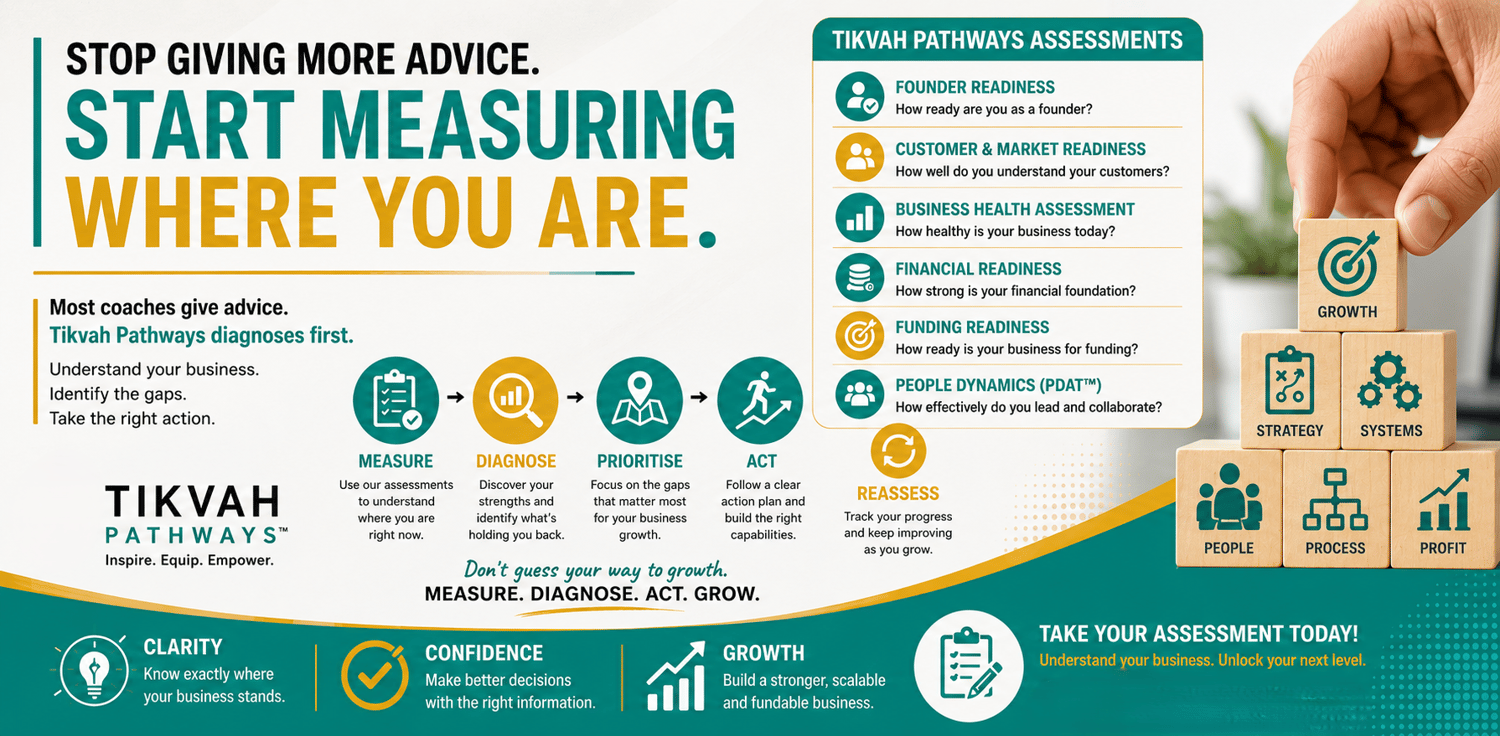
That's why Tikvah Pathways should begin with measurement.

From Advice to Diagnosis
This creates a powerful distinction.
Traditional coaching:
Here's what you should do.
Tikvah Pathways:
Let's first understand where you are.
Then:
Let's identify the gaps.
Then:
Let's determine what needs attention.
Then:
Let's build an action plan.
That is much more powerful than simply producing educational content.
Because your content doesn't have to end with:
"Here are five tips."
It can end with:
"Measure yourself."

The Founder Readiness Question
Consider one of the most important questions facing an entrepreneur:
Why do some founders make progress while others remain permanently busy?
It isn't necessarily intelligence.
It isn't necessarily education.
And it certainly isn't always access to money.
Sometimes the difference is readiness.
A founder may have a brilliant idea but lack execution discipline.
They may have customers but poor financial management.
They may have sales but no systems.
They may have ambition but no clear priorities.
They may work incredibly hard but spend their time working in the business rather than building the business.
That's why Tikvah Pathways developed the Founder Readiness Assessment™.
Instead of telling a founder:
"You need to become more business-ready."
We can ask:
"Let's measure your current level of readiness."
That changes the conversation.

What Happens When You Measure?
Imagine a founder completes an assessment and discovers:
Customer Clarity — Strong
Sales Capability — Moderate
Financial Discipline — Weak
Execution Discipline — Moderate
Business Systems — Weak
Growth Readiness — Low
Now the entrepreneur has something far more valuable than generic advice.
They have a starting point.
They know where to focus.
They can stop trying to improve everything at once.
And that's important.
Because one of the biggest problems entrepreneurs face is trying to fix ten things simultaneously.
A diagnostic approach helps answer:
What should I work on first?

Assessments Create a Journey
The real power isn't the assessment itself.
It's what happens after the assessment.
Think about the journey:
1. CONTENT
The entrepreneur recognises a problem.
↓
2. ASSESSMENT
They measure their current position.
↓
3. DIAGNOSIS
They discover strengths and gaps.
↓
4. PRIORITY
They identify what needs attention first.
↓
5. ACTION PLAN
They receive practical steps.
↓
6. DEVELOPMENT
They access the appropriate Tikvah Pathways programme, workshop, coaching or learning resource.
↓
7. RE-ASSESSMENT
They measure progress.
This creates something much more valuable than a marketing campaign.
It creates a development journey.

Tikvah Pathways as the Business Doctor
This is where your broader positioning becomes extremely powerful.
Doctors diagnose.
Tikvah Pathways can become known as the business diagnostic partner for startup founders and SMMEs.
Not because Tikvah claims to have a magic answer to every business problem.
But because the methodology begins with:
Measure → Diagnose → Prioritise → Develop → Execute → Reassess
That gives your content a distinctive voice.

Every Problem Becomes a Diagnostic Question
Instead of saying:
"You need better cash flow management."
Ask:
How resilient is your cash flow?
Instead of:
"You need more customers."
Ask:
How clear is your ideal customer?
Instead of:
"You need to improve your sales."
Ask:
How effective is your current sales process?
Instead of:
"You need better systems."
Ask:
How dependent is your business on you personally?
Instead of:
"You need to prepare for funding."
Ask:
How funding-ready is your business today?
That is the Tikvah difference.

Why This Can Become a Competitive Advantage
Advice is everywhere.
Information is everywhere.
AI can generate advice in seconds.
But structured diagnosis followed by practical development is much harder to replicate as a meaningful business system.
You're not simply saying:
"Here's some information."
You're saying:
"Let's understand your business."
And then:
"Let's identify what's holding you back."
And finally:
"Let's help you do something about it."
That's a much stronger proposition.

Final Thought
"Here's another business tip."
It can become:
"Something isn't working in your business. Let's find out why."
Because entrepreneurs don't always need another person telling them what to do.
Sometimes they need someone to help them understand where they are, why they're there, and what needs to change next.
That's the power of assessment.
Don't guess your way to growth.
Measure. Diagnose. Act. Grow.
Tikvah Pathways™
Helping founders turn ideas into revenue-generating, fundable businesses through a structured, execution-driven system.
CTA
Where does your business really stand?
Take the relevant Tikvah Pathways Assessment and replace assumptions with evidence.
Don't guess. Measure where you are first.