

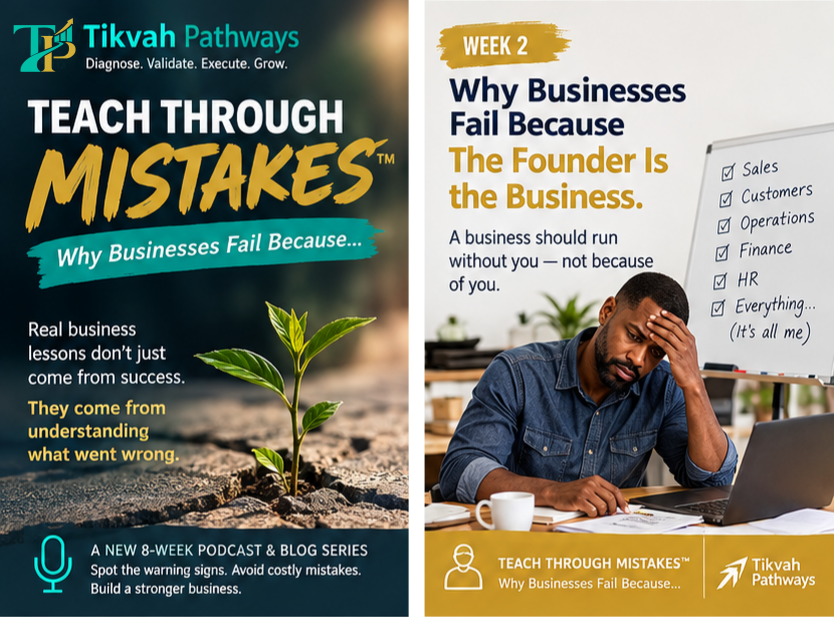
Business Diagnosis #2
You started the business.
You found the first customer.
You made the first sale.
You created the product.
You handled the finances.
You answered the phone.
You solved the problems.
You dealt with suppliers.
You managed the staff.
You did the marketing.
You handled the complaints.
You made the decisions.
And somehow, years later, you're still doing almost everything.
You may have employees.
You may have customers.
You may have a physical location.
You may have a website.
You may even be turning over significant revenue.
But if you disappear for two weeks and everything starts falling apart, there's a difficult question you need to ask:
Do you own a business—or have you simply created a job for yourself?
This is one of the most common traps entrepreneurs fall into.
And it often starts with something completely understandable:
The founder cares.
The founder knows the business best.
The founder wants things done properly.
The founder doesn't trust people to do things the way they should.
The founder believes it is faster to do it themselves.
So they keep taking responsibility.
One task becomes five.
Five becomes twenty.
Eventually, the founder becomes the centre of everything.
And that's when the business becomes vulnerable.

THE FOUNDER IS NOT THE PROBLEM
Let's be clear.
A founder should be involved.
Especially in the early stages.
You can't build a business without taking responsibility.
The problem isn't founder involvement.
The problem is founder dependency.
There is a difference.
A founder-led business says:
"The founder provides direction."
A founder-dependent business says:
"Nothing important happens without the founder."
Those are completely different businesses.
WHAT DOES FOUNDER DEPENDENCY LOOK LIKE?
Ask yourself:
Does every important decision have to come through you?
Do employees constantly ask:
"What must I do?"
Do customers insist on speaking to you?
Do suppliers only deal with you?
Do you personally approve payments?
Do you personally check every sale?
Do you personally solve every complaint?
Do you personally train every new employee?
Do you personally hold all the important information?
Do you know what is happening because people report to you informally rather than because the business has reliable systems?
If you answered yes to many of these questions, you may have a founder-dependency problem.
THE "I'LL JUST DO IT MYSELF" TRAP
One of the most dangerous sentences in entrepreneurship is:
"I'll just do it myself."
It feels efficient.
Someone is doing something incorrectly.
You correct them.
They make another mistake.
You take over.
It is quicker.
Problem solved.
Except it isn't.
You've solved today's problem while creating tomorrow's dependency.
Your employee doesn't learn.
The process doesn't improve.
The knowledge remains in your head.
And next time the problem happens...
they come back to you.
So you solve it again.
And again.
And again.
Eventually you become the company's most important employee.
And potentially its biggest bottleneck.
THE FOUNDER BECOMES THE BOTTLENECK
Imagine your business has ten employees.
But every important decision requires the founder's approval.
Every quotation.
Every purchase.
Every customer complaint.
Every staff issue.
Every payment.
Every supplier decision.
Every operational change.
You may have ten people working.
But the business still moves at the speed of one person.
And that person is you.
This is a scalability problem.
Because growth increases the number of decisions.
More customers create more enquiries.
More sales create more operational requirements.
More employees create more management.
More suppliers create more complexity.
More revenue creates more financial responsibility.
If everything continues flowing through the founder, growth can actually make the business more chaotic, not more successful.
WHEN SUCCESS CREATES A PROBLEM
This is something many entrepreneurs don't expect.
Sometimes the business isn't struggling because it has too little work.
It struggles because it has too much work without enough structure.
The founder becomes overwhelmed.
Customers experience delays.
Employees become frustrated.
Quality becomes inconsistent.
Cash flow becomes harder to manage.
The founder works longer hours.
And eventually the founder says:
"I need more people."
But hiring more people doesn't necessarily solve the problem.
If there are no systems, you may simply create more people for the founder to manage.
YOUR BUSINESS KNOWLEDGE MAY BE TRAPPED IN YOUR HEAD
Another warning sign is when the business operates on tribal knowledge.
People know what to do because:
"That's how we've always done it."
"Ask Neville."
"She knows how to do it."
"The owner will know."
"Just call the founder."
That's not a system.
That's dependency.
A system means the business has a defined way of doing something that another competent person can understand and follow.
It doesn't have to be complicated.
Sometimes a simple checklist is a system.
A standard operating procedure is a system.
A daily cash-up process is a system.
A customer onboarding process is a system.
A purchasing approval process is a system.
A weekly management meeting is a system.
The goal isn't bureaucracy.
The goal is consistency and independence.
THE BUSINESS SHOULD KNOW WHAT TO DO
Consider a simple example.
A customer places an order.
In a founder-dependent business:
Customer orders → founder receives order → founder decides what happens → founder contacts staff → founder checks stock → founder follows up → founder confirms delivery.
In a systemised business:
Customer order → order captured → stock checked → order allocated → payment confirmed → production/delivery triggered → completion recorded.
The second process doesn't eliminate the founder.
It frees the founder to focus on things that actually require entrepreneurial leadership.
YOUR JOB MUST CHANGE AS THE BUSINESS GROWS
One of the hardest transitions for an entrepreneur is understanding that:
The job that got you started is not necessarily the job that will get you to the next level.
At the beginning, you may have been:
The salesperson.
The administrator.
The operations manager.
The marketer.
The bookkeeper.
The customer service representative.
That's normal.
But eventually your role needs to evolve.
You need to move from:
Doing everything
to
building something that can do things without you.
FROM DOER TO BUILDER
A founder's role increasingly becomes:
Direction
Where is the business going?
Strategy
What opportunities should we pursue?
People
Who do we need and how should they perform?
Systems
How should the business operate consistently?
Financial leadership
Is the business financially healthy?
Market development
Where will future customers come from?
Risk
What could threaten the business?
Growth
What needs to change for the business to move to the next stage?
These are leadership responsibilities.
If you're spending your entire day processing orders, solving minor staff issues and answering routine questions, who is working on the business?
DELEGATION IS NOT ABDICATION
Some founders hear "systems" and "delegation" and think:
"So I'm supposed to stop caring?"
No.
Delegation doesn't mean abandoning responsibility.
It means transferring defined responsibility with accountability.
There must still be:
Clear roles.
Clear authority.
Clear expectations.
Clear procedures.
Clear measurements.
Clear reporting.
And clear consequences when standards aren't met.
The founder remains accountable for the organisation.
But the founder doesn't need to personally perform every task.
TRUST WITHOUT CONTROL
Another reason founders struggle to delegate is trust.
And sometimes the concern is justified.
Employees may steal.
People may make mistakes.
People may neglect responsibilities.
People may abuse authority.
But here's the important distinction:
The answer to a lack of trust should not always be more founder control.
It should often be better systems and controls.
For example:
Instead of personally handling all cash:
Have a cash-handling procedure.
Instead of personally checking every purchase:
Create purchasing limits and approval levels.
Instead of personally monitoring stock:
Implement stock counts and reconciliation.
Instead of personally checking every employee:
Use performance measures and reporting.
Instead of personally remembering everything:
Create records and dashboards.
Good systems reduce the need for blind trust.
THE BUSINESS MUST SURVIVE YOUR ABSENCE
Here's one of the simplest tests you can perform.
Ask:
"If I couldn't work in the business for 30 days, what would happen?"
Would sales continue?
Would customers still be served?
Would suppliers still be paid?
Would employees know what to do?
Would stock still be controlled?
Would money still be reconciled?
Would problems be escalated appropriately?
Would management know what decisions they can make?
Would the business continue operating?
If the answer is no, don't panic.
You've discovered something important.
You've identified a business risk.
And now you can begin fixing it.
THE FOUNDER-INDEPENDENCE TEST
Score yourself from 1 to 5:
1 = completely dependent on me
5 = operates effectively without me
Sales
Can someone else sell our products/services without me?
Operations
Can the daily operation continue without me?
Finance
Can financial controls operate without me personally doing everything?
People
Can managers supervise employees without constantly asking me?
Customer Service
Can customer problems be resolved according to defined procedures?
Decision Making
Have I defined which decisions employees can make without me?
Knowledge
Is important business knowledge documented?
Systems
Are key activities supported by repeatable processes?
Reporting
Can I see what is happening without personally checking everything?
Leadership
Am I spending enough time working on the business rather than only in it?
Your score isn't a judgement.
It's a diagnostic.
THE TRANSITION
You don't need to remove yourself from the business overnight.
Start by identifying everything that currently depends on you.
Write down:
What do I do every day?
Then ask:
"Does this task require the founder?"
If the answer is no, ask:
Can it be delegated?
If it can be delegated, ask:
Does the person have the skills?
If not:
Can they be trained?
Then:
Can the process be documented?
Then:
Can performance be measured?
Now you're building independence.
THE FOUR LEVELS OF FOUNDER DEPENDENCY
You can think about the journey like this:
Level 1 — Founder Does
The founder personally performs the task.
Level 2 — Founder Teaches
The founder shows someone else how to do it.
Level 3 — Founder Manages
Someone else performs it while the founder monitors results.
Level 4 — Business System Runs
The process operates through people, systems and controls, with the founder focused on leadership.
The objective isn't to get rid of the founder.
The objective is to move the founder up the ladder.
THE REAL QUESTION
Don't ask:
"How do I get my employees to do more?"
Ask:
"How do I build a business that doesn't require me to personally control everything?"
That's a much more strategic question.
Because the goal of entrepreneurship shouldn't simply be to create employment for yourself.
It should be to create an organisation that can produce value consistently, profitably and sustainably.
BUSINESS DIAGNOSIS #2
Here's today's diagnosis:
If the business cannot function effectively without you, your biggest growth problem may not be sales. It may be founder dependency.
And founder dependency has a cost.
It limits growth.
It slows decisions.
It increases risk.
It creates burnout.
It frustrates employees.
It weakens accountability.
And it makes the business harder to scale—and potentially harder to sell.
THE LESSON
Your business should need your leadership.
It shouldn't need your constant presence.
There's a difference.
A strong founder doesn't build a business where everyone waits for them.
A strong founder builds:
People who know what to do.
Systems that support them.
Controls that protect the business.
Information that enables decisions.
And a structure that allows the founder to focus on the future.
So if you're constantly saying:
"Nobody can do it like me."
"I have to check everything."
"If I'm not there, things go wrong."
"My staff don't take responsibility."
"I can't take a holiday because the business needs me."
Don't simply accept that as the price of entrepreneurship.
Treat it as a diagnostic signal.
Your next stage of growth may not require you to work harder.
It may require you to build a business that can work without you doing everything.
DON'T BUILD A BUSINESS THAT NEEDS YOU FOR EVERYTHING.
Build a business that benefits from your leadership.
Diagnose. Validate. Execute. Grow.
Tikvah Pathways
To Follow Us: Visit