

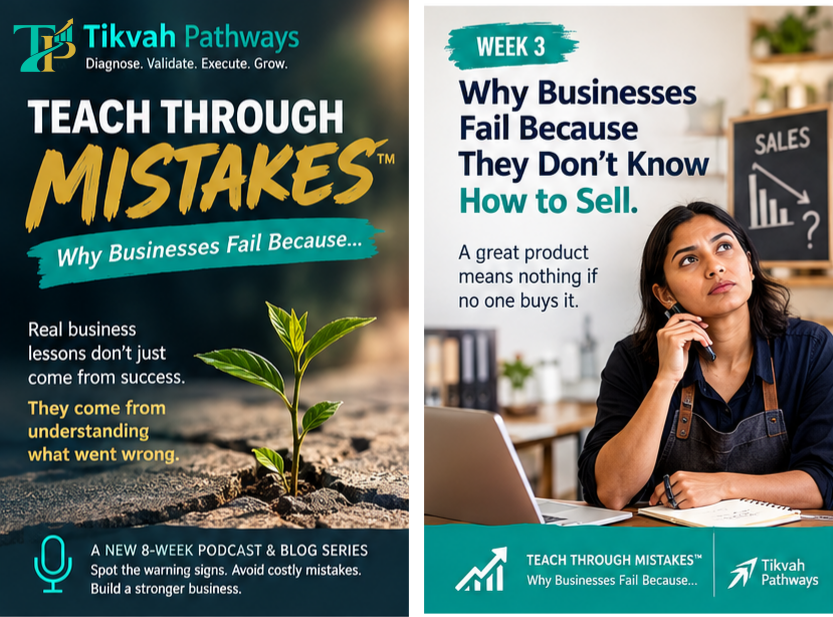
A great product does not automatically create a successful business.
You can have an excellent product.
You can provide a valuable service.
You can have a professional website.
You can have an attractive brand.
You can have thousands of social media followers.
And still struggle to make money.
Why?
Because at some point, someone has to buy.
And many businesses don't fail because they have nothing valuable to offer.
They fail because they haven't learned how to consistently communicate that value, create trust and guide potential customers toward a buying decision.

THE UNCOMFORTABLE TRUTH ABOUT SALES
Many entrepreneurs don't like selling.
They associate sales with pressure, manipulation or desperation.
They don't want to “bother” people.
So they focus on everything around selling.
They improve their logo.
They build a website.
They create social media content.
They attend networking events.
They run advertisements.
They print brochures.
But when it comes to actually asking someone to buy, they hesitate.
The problem is that marketing attention is not the same as sales.
People seeing your business doesn't mean they understand it.
People liking your post doesn't mean they need your product.
Someone making an enquiry doesn't mean they are ready to buy.
And having a conversation doesn't mean you've made a sale.
There is a journey between attention and revenue.
Your business needs to understand that journey.
SELLING IS NOT BEGGING
Selling doesn't have to mean convincing someone to buy something they don't need.
Good selling begins with understanding.
Think about a doctor.
A doctor doesn't immediately prescribe medication before understanding the symptoms.
The doctor asks questions.
What is wrong?
When did it begin?
What are you experiencing?
What has already been tried?
Only after understanding the problem does the doctor recommend a treatment.
Business can work the same way.
Diagnose before you prescribe.
Before trying to sell your product, understand:
- Who is the customer?
- What problem are they experiencing?
- How serious is the problem?
- What is the problem costing them?
- What have they already tried?
- What outcome do they want?
- What would make them trust your solution?
Sales becomes much easier when the conversation is about the customer's problem rather than your product.
STOP SELLING FEATURES. START COMMUNICATING VALUE.
One of the most common sales mistakes is talking too much about what the product does.
“This product has these features.”
“Our service includes these components.”
“We have been operating for ten years.”
“Our company has these qualifications.”
All of this information may be important.
But the customer is often asking a much simpler question:
“What does this do for me?”
A business consultant could say:
“We provide business assessments, strategic planning, systems development and advisory services.”
That's a description.
But the same business could communicate value by saying:
“We help you identify what is holding your business back before you spend more money trying to fix the wrong problem.”
The second message begins with the customer's problem.
That's the difference between describing what you do and communicating why it matters.
YOU MAY NOT HAVE A SALES PROBLEM
This is where business diagnosis becomes important.
An entrepreneur may say:
“I'm struggling to sell.”
But what if selling isn't actually the root problem?
Perhaps:
- Your target market is unclear.
- Your offer is confusing.
- Your customer doesn't understand the value.
- Your price doesn't make sense for the perceived value.
- You're talking to the wrong people.
- Your customers don't trust you yet.
- Your sales process is inconsistent.
- You don't follow up.
- You respond too slowly.
- You make it difficult to buy.
- You don't know why customers say no.
If you don't diagnose the problem, you may prescribe the wrong solution.
For example, a business with poor conversion might decide:
“We need more marketing.”
So it spends more money generating leads.
But if the underlying sales process is broken, more leads may simply create more wasted opportunities.
More traffic doesn't fix a broken conversion process.
SEVEN SALES MISTAKES THAT CAN COST A BUSINESS
1. SELLING TO EVERYONE
If everyone is your customer, it becomes difficult to create a compelling message.
Your ideal customer needs to be clear.
Who has the problem you solve?
Who values the solution?
Who can afford it?
Who is most likely to buy?
2. TALKING ABOUT THE PRODUCT INSTEAD OF THE PROBLEM
Customers don't necessarily care about every feature.
They care about outcomes.
What problem are you solving?
What will improve?
What will the customer gain?
What will they avoid?
What becomes possible?
3. BEING AFRAID TO ASK FOR THE SALE
Some entrepreneurs have excellent conversations but never actually ask for the business.
They end with:
“Let me know what you think.”
Then they wait.
Sometimes the customer simply needs a clear next step.
“Would you like us to proceed?”
“Would you like to book?”
“Shall we prepare the proposal?”
“Would you like to start?”
Selling requires asking.
4. NOT FOLLOWING UP
A potential customer may say:
“Send me the information.”
You send it.
And then nothing happens.
Many entrepreneurs simply move on.
But the customer may still have questions.
They may be comparing options.
They may need approval from someone else.
They may have forgotten.
They may need more information.
Follow-up is not necessarily pressure.
It can simply be continued communication.
5. COMPETING ONLY ON PRICE
When customers don't understand your value, price becomes the easiest comparison.
Then the conversation becomes:
“Your competitor is cheaper.”
If your only response is to lower your price, you may enter a race to the bottom.
Instead, understand and communicate the value you provide.
6. TALKING INSTEAD OF LISTENING
Sales isn't a speech competition.
The entrepreneur who talks the most isn't necessarily the best salesperson.
Ask questions.
Listen.
Clarify.
Understand.
Then respond.
The customer's answers can tell you whether your solution is relevant.
7. HAVING NO SALES PROCESS
Many small businesses operate sales through memory.
Someone enquires.
The owner responds.
A price is sent.
The customer disappears.
Another enquiry comes in.
The owner starts again.
There is no consistent process.
No pipeline.
No follow-up schedule.
No measurement.
No analysis.
Sales becomes unpredictable.
A business needs a repeatable process.
BUILD A SIMPLE SALES PROCESS
Your sales process doesn't have to be complicated.
A simple process could be:
IDENTIFY → CONNECT → DISCOVER → PRESENT → HANDLE CONCERNS → ASK → FOLLOW UP → CLOSE → DELIVER → RETAIN
Identify
Who is your ideal customer?
Connect
How do you get their attention and start a conversation?
Discover
What problem are they experiencing?
Present
How does your solution address that specific problem?
Handle Concerns
What questions or objections do they have?
Ask
Are you actually asking for the business?
Follow Up
What happens after the initial conversation?
Close
How does the customer complete the purchase?
Deliver
Do you deliver what you promised?
Retain
How do you create repeat business, referrals or longer-term relationships?
The objective isn't to make the process complicated.
The objective is to make it repeatable and measurable.
MARKETING IS NOT SALES
Marketing and sales work together, but they are not identical.
Marketing can create:
Awareness → Interest
Sales needs to help move that interest toward:
Conversation → Decision → Purchase
Imagine that 1,000 people see your content.
100 show interest.
20 make enquiries.
10 have meaningful sales conversations.
But only one buys.
The answer isn't automatically:
“We need more followers.”
You need to understand where potential customers are dropping out.
That's a business diagnosis.
MEASURE YOUR SALES FUNNEL
Many entrepreneurs know their monthly revenue.
But they don't know what produced that revenue.
Start measuring:
- Number of leads
- Number of enquiries
- Number of sales conversations
- Number of proposals
- Number of sales
- Conversion rate
- Average sale value
- Sales cycle
- Lead source
- Lost opportunities
- Reasons for not buying
- Repeat customers
- Referrals
Once you begin measuring these numbers, sales becomes less mysterious.
You can start asking better questions.
Where are we losing customers?
Why are they leaving?
Which customers convert?
Which offer converts best?
Which marketing channel produces serious enquiries?
How long does it take to close a sale?
These are questions a growing business should be able to answer.
EVERY LOST SALE CONTAINS INFORMATION
Here's an important mindset shift.
Don't treat every lost sale simply as failure.
Sometimes it is information.
If five customers say:
“I don't understand exactly what you offer.”
That's information.
If several customers say:
“I can't see why your service costs that much.”
That's information.
If customers repeatedly say:
“I need this, but not right now.”
That's information.
If people consistently ask for something you don't currently offer, that's information.
The question isn't simply:
“Why didn't they buy?”
The better question is:
“What is this telling us about our business?”
THE FOUNDER MUST UNDERSTAND SALES
Even if you eventually employ salespeople, the founder needs to understand the customer.
You need to know:
Why do customers buy?
Why don't they buy?
What objections do they have?
What do they value?
What makes them trust you?
What makes them hesitate?
Sales conversations provide market intelligence.
Every objection can teach you something.
Every lost sale can teach you something.
Every successful sale can teach you something.
Every repeat customer can teach you something.
Don't just count the money.
Learn from the conversations that produced the money.
A SIMPLE SALES DIAGNOSIS
Before deciding that your business needs more marketing, ask these questions:
- Who exactly are we selling to?
- What problem are we solving?
- Does the customer recognise the problem?
- Is our offer clear?
- Is the value clear?
- Is our pricing appropriate for the value?
- How do customers find us?
- What happens when someone makes an enquiry?
- Do we have a defined sales process?
- How quickly do we respond?
- How consistently do we follow up?
- Where do potential customers drop out?
- Why do customers say no?
- Why do customers say yes?
- Are we measuring our sales activity and results?
Your answers may reveal that your sales problem isn't really a sales problem.
It may be a positioning problem.
A value proposition problem.
A customer problem.
A pricing problem.
A trust problem.
A follow-up problem.
Or a process problem.
That's why diagnosis comes first.
YOUR SALES CHALLENGE THIS WEEK
Before spending more money on advertising, try something different.
Speak to ten potential or existing customers.
Ask:
“What is the biggest challenge you are currently experiencing that relates to what my business offers?”
Then listen.
Don't immediately pitch.
Don't interrupt.
Don't defend your business.
Listen.
Then ask:
“What would make you confident enough to pay for a solution?”
Their answers may reveal more about your sales problem than another month of social media content.
THE BIG LESSON
Businesses don't necessarily fail because their products are bad.
They can fail because they haven't learned how to consistently move a potential customer from:
PROBLEM → INTEREST → TRUST → DECISION → PURCHASE
Selling is not about convincing everyone.
It is about understanding the right customer, identifying the right problem, communicating relevant value and making it easier for the right customer to make a decision.
Remember:
Likes don't pay invoices.
Followers don't automatically create revenue.
Enquiries don't equal sales.
And:
A great product doesn't necessarily sell itself.
So before you say:
“I need more customers.”
Ask:
“What is happening between the moment someone becomes interested and the moment they decide to buy?”
That may be where your real problem is.
TEACH THROUGH MISTAKES™
The purpose of this series isn't to make entrepreneurs afraid of failure.
It is to help them recognise failure patterns early.
Because the earlier you diagnose the problem, the less expensive the lesson can become.
Don't wait for your business to fail before you diagnose what is wrong.
Measure where you are first.
Diagnose. Validate. Execute. Grow.
Tikvah Pathways
Helping entrepreneurs build businesses that are not only promising—but sustainable, revenue-generating and investment-ready.
Contact us on +27 83 417 0319 tikvahbc@icloud.com