
I'm currently working on the second instalment in my book series, and it is joyful stress. I am largely a pantser with a tiny planner side, so I began with a long summary and an unfinished outline. And I've written quite a bit, allowing the story to write itself out. But here is the problem. The story has beautifully taken on a life of its own, which has elevated it to an amazing narrative, but now, I hit a roadblock: I'm unsure if the current path aligns with the larger arc of the series. So I found myself doing the last thing I expected: I stopped writing, went back to the beginning and made a reverse outline up until the point I reached in writing. And I am so glad I did. I’ll tell you why. But before that,
What is reverse outlining?
Reverse outlining is taking a pause in your writing to go back and make an outline of what you have written so far. Simply put, it is outlining a story after you have written it out. This can happen during your drafting process, or once the draft is done. There are several reasons for this:
- It helps you make sure your story flows well from start to finish
- It helps you identify and solve loopholes in your story.
- It enables you to ensure your characters have a meaningful and impactful arc.
- It helps you clarify themes in your story
- It helps you identify pacing problems
- It helps you make sure every chapter has a place in the overarching theme and story arc.
- It highlights uneven tension and missing transitions.
Applying reverse outlining to my draft (even though I haven’t finished it yet) has been the ingredient I needed to identify the problems with the story that were simmering beneath the surface of my sub-conscious. I identified chapters that had no business being in the narrative, tangent and sub-plots that were headed nowhere, and identified characters and arcs that needed to be highlighted more. As a result, I have a clear picture of the story I’m writing and what is important, and I can proceed with my draft with more clarity and direction (even though I have not outlined straight to the end - the pantser in me is strong!).
That being said, reverse outlining is just as involving as outlining a story before writing it. The only difference is that here you are doing it from a hindsight perspective, looking at it from ‘after the fact’; building on a structure already erected, as opposed to building it from the ground up. So how did I go about this?
Steps to reverse outline your story:
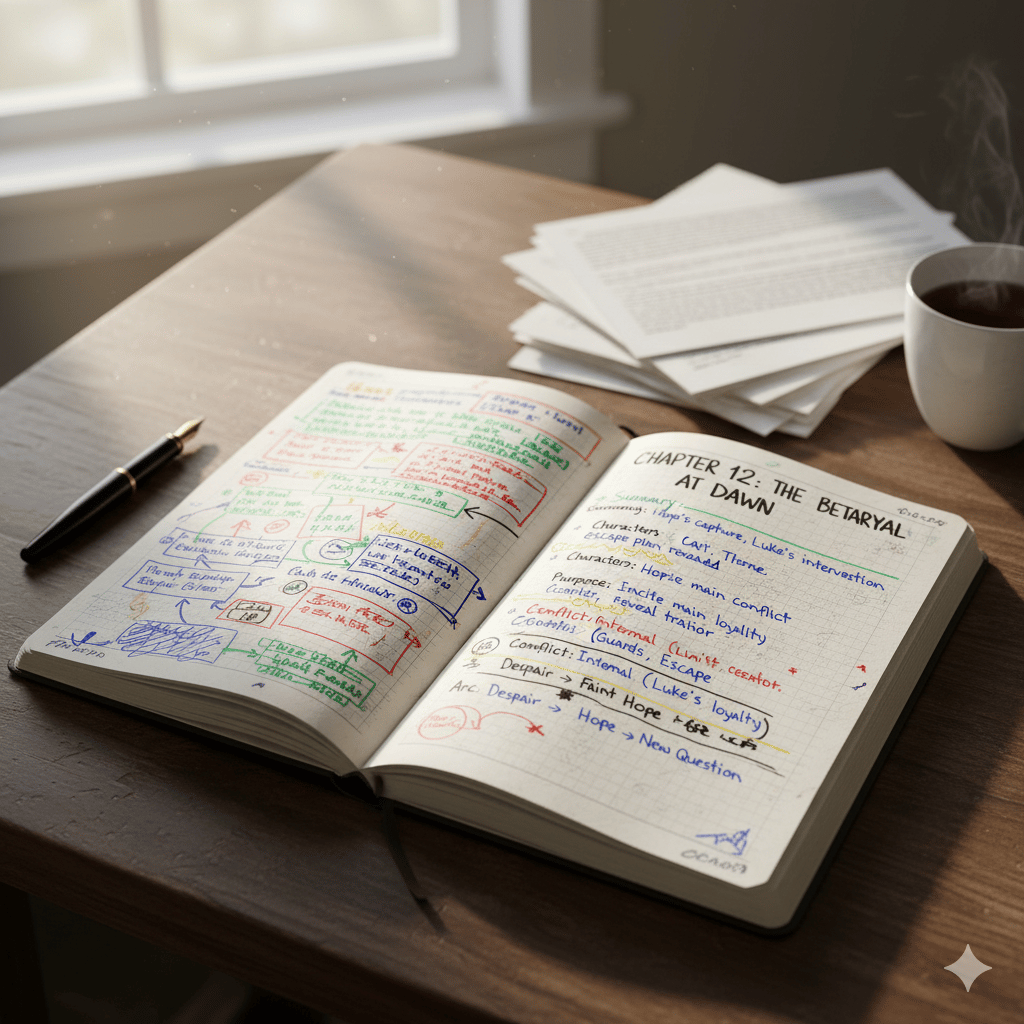
If I’m honest, when I applied these steps, I wasn’t even aware that it was called reverse outlining. I didn’t know it was a thing. I just did it hoping to find some clarity in my writing. And it worked for me. I left the laptop, got a large A4 book and a pen, and dedicated each page to a chapter. This is how I did it:
Title/Summary
My chapters do not have titles, but I put this in just to help me remember what the chapter is about at the first glance (honestly, this was my intention, but I really struggled with coming up with titles so I just skipped that bit). So since coming up with chapter titles didn’t work, I made short summaries of the chapter. Summary, not a detailed narration. And I also jotted down the characters involved (the characters whose presence affects the chapter).
Purpose
What is the purpose of the chapter? How does it aid the narrative; the overall arc? Does it reveal a character? Does it create tension and conflict? Does it highlight the culture, history or relevant background information of the world in the story? Is the chapter’s presence important to the narrative at all?
Conflict
What conflict does the chapter highlight? Is the conflict internal (a character struggling with him or herself) or external (a character struggling with an outer opponent, e.g. nature, another character, etc)? It doesn't have to be an outright argument, altercation, or fight. Conflict can come in different forms: differing motivations, different goals, different beliefs, different personalities and morals. Not every chapter has to have an outright conflict, but there should be evidence, even if it is subtle, of opposing forces.
Arc
Each chapter, like the full narrative, needs a beginning, a middle and an end. It needs to start and end somewhere. Here are things to consider when thinking of a chapter arc:
- Open with a question: what question is the chapter trying to answer? This could also be the goal that starts the chapter.
- What havoc does the question/goal cause? What havoc is caused in pursuit of the answer to that question, or pursuit of that goal?
- How does the chapter answer the question? What answer is provided? This answer could lead to a resolution, or another question.
Following these four steps were helpful as I outlined the chapter. It helped me get a real feel for my novel, and find out what it really is about, and what tangents mattered, and which characters needed more weight. And the best part? The amount of details you give in each section depends on you. Panster or planner, this works, and it works well. Need a template? Follow this link to access a free reverse outline template to help you outline your work.
Hybrid author?
Like I mentioned before, some people are pantsers, and others planners. Neither is more superior to the other. They both have their pros and cons. But applying this technique of reverse outlining may turn you into a hybrid author - one who is able to take the freedom of the panster and the structure of the planner and create beautiful narratives. To learn more about hybrid authors, check out this short 4-lesson course: The Hybrid Writer: Where Instinct Breeds Intention. Until the next time, happy writing!
Comments ()