

I have been writing for as long as I can remember. But the truth is, even after those many years, I still struggle with ‘telling’, mostly because it is a default setting in the brain. Let’s face it: we tell stories by ‘telling,’ so it logically follows that it would end up in our first drafts.
But while ‘telling’ is not all good when writing a story, it is not all bad either. Let’s explore this.
Showing versus Telling
The term ‘show, don’t tell’ is common among writers far and wide, emphasizing the importance of showing over telling. But before getting into that, let’s define the two:
- Telling refers to simply reporting what happened.
- Showing refers to immersing the reader; letting them experience what happened.
Therefore, when people say ‘show, don’t tell,’ they are saying: don’t just tell the reader what happened; paint a picture with your words. Remember, however, that though this is a logical piece of advice, there is a level of nuance to it. But before we talk about that nuance, let’s see how this looks in actual writing.
Examples of Telling and Showing
This technique applies to any situation in writing—from setting a scene to character emotions or even dialogue.
Setting
- Telling: It was a beautiful morning.
- Showing: The sun’s golden rays winked through the hills as it lazily rose in the sky, painting the plains in a warm, hopeful hue.
Emotion
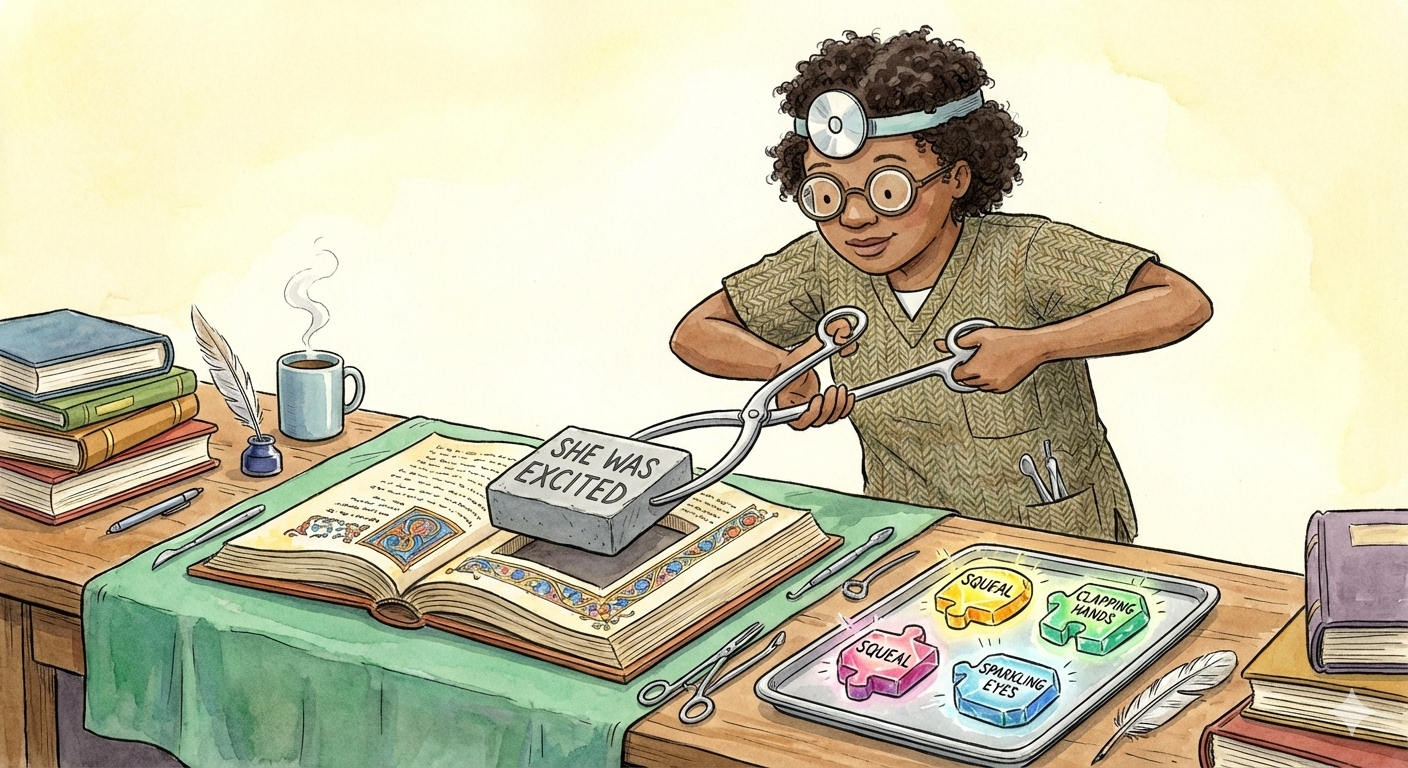
- Telling: She was excited.
- Showing: A squeal escaped her mouth as she bobbed on her heels and clapped her hands together, her eyes wide and sparkling.
Dialogue
- Telling: He did not want to talk about his past.
- Showing:
“Where did you grow up?” the woman asked.
“No,” he replied.
“Could you at least tell me your name?”
“Never mind my name.”
Notice how telling is straightforward and directly feeds the information to the reader, whereas showing allows the reader to infer for themselves through immersive writing. In the dialogue example, we see the power of "subtext"—the character never actually says he is guarded, but his blunt, evasive answers show the reader exactly how he feels without the author having to explain it.
The Nuance
While ‘show, don’t tell’ is widely celebrated, I have come to learn that context and moderation matter. You do not have to show everything. There is a place for telling. For example, if a character is simply crossing the room to turn on the lights, you really don’t have to paint a picture of the floor or the temperature of the air. Just tell it in one line.
The only time you would need to dive into showing is if the act is crucial to the story. If you are writing a thriller and hear a disturbing noise in the dark, crossing the room to the light switch becomes an important beat to create tension. In that case, you would show everything: your breathing, your slow, uncertain steps, and the growing darkness.
In short: tell the boring stuff, show the important stuff.
Don’t Overthink It
I said it in my The Joys of a Terrible Draft blog post, and I’ll say it again here: “First drafts are usually a far cry from the finished product. The real magic happens during editing.” Don’t worry about showing and telling when writing your first draft. That draft is for you—you are telling yourself the story. The drafts that come after are for the reader; that is where you start to work on the showing.
Happy writing!
Take the Next Step
If you want to dive deeper into painting pictures with your words, I’ve put together a beginner course specifically for this: The Art of the Mini-Scene. It’s designed to help you master these small, immersive moments so your readers can truly live inside your story.
Ready for the next stage of the journey?
- Still in the middle of a messy draft? Revisit The Joys of a Terrible Draft.
- Finished with your "Showing" phase and ready for eyes on the page? Check out How to Handle Beta Reader Feedback.
Comments ()