
If you buy stock from China, the calendar matters as much as the price. China's official Spring Festival holiday runs from 5 to 13 February 2027, but many factories stop well before that and take weeks to get back to full speed. Sourcing guides commonly advise confirming orders by early December and having goods loaded by mid-January.
So now is when small Australian importers place their autumn and Mother's Day orders. Before you pay that deposit, it's worth knowing what each unit will really cost once it's on your shelf. Here's how to work it out, step by step.
General information only, not tax, customs or financial advice. Figures checked against the Australian Border Force (ABF), the ATO and DFAT on 22 November 2026.
Step 1: start with the customs value, not the invoice
Duty is charged on the customs value. For most imports that's the price you paid the supplier, converted to Australian dollars, plus costs to get the goods ready for export (packing, inland freight to the port), but not the international freight and insurance to Australia.
That means the Incoterm on your invoice matters:
- FOB (free on board): the price already stops at the port. Usually the customs value as is.
- EXW (ex works): add the supplier's or forwarder's costs to get the goods onto the ship or plane.
- CIF or CFR: the price includes freight (and insurance for CIF) to Australia. Take those out for the customs value.
The exchange rate used is the one in force on the day of export, not the day you pay or the day the goods arrive. The ABF publishes the rates its system uses.
Step 2: work out duty (and whether you can get it to zero)
Most consumer goods attract general duty of free or 5%, depending on the tariff classification. Your customs broker classifies each product.
Goods made in China can usually come in duty free under the China-Australia Free Trade Agreement (ChAFTA): DFAT says Australia's tariffs on Chinese goods were fully eliminated by 1 January 2019. But you only get the free rate if you have the right origin document at import, usually a certificate of origin from the supplier. No certificate, no preference: you pay the general rate.
On a shipment worth A$16,000, that's about A$800 at 5%. Ask for the certificate when you order, not when the goods are already on the water.
Step 3: work out import GST
Import GST is 10% of the value of the taxable importation, which is:
- the customs value,
- plus the duty,
- plus international transport and insurance to Australia.
So GST is charged on the freight too, even though duty isn't. If you're registered for GST, you can claim import GST back as a credit on your BAS, in the period you paid it. It's a cash-flow cost, not a final cost. Businesses that lodge monthly BAS online can apply for deferred GST, which moves the payment from the border to the BAS (label 7A) and claims it at 1B in the same return.
Step 4: add the government charges
For consignments over A$1,000, the ABF lists:
- Import processing charge: $50 for an electronic declaration with a customs value from $1,000 to under $10,000, and $152 for $10,000 or more (documentary lodgement costs more).
- Biosecurity charge per full import declaration: $48 for air, $71 for sea.
Then add your broker, port and terminal fees and local delivery. Those usually carry GST, which you can claim.
Goods worth A$1,000 or less (customs value) don't attract duty, import GST or these charges at the border. Instead, an overseas seller registered for Australian GST may charge you GST at checkout. If your business is GST-registered, give them your ABN and say you're registered, and they shouldn't charge it.
Step 5: the worked example
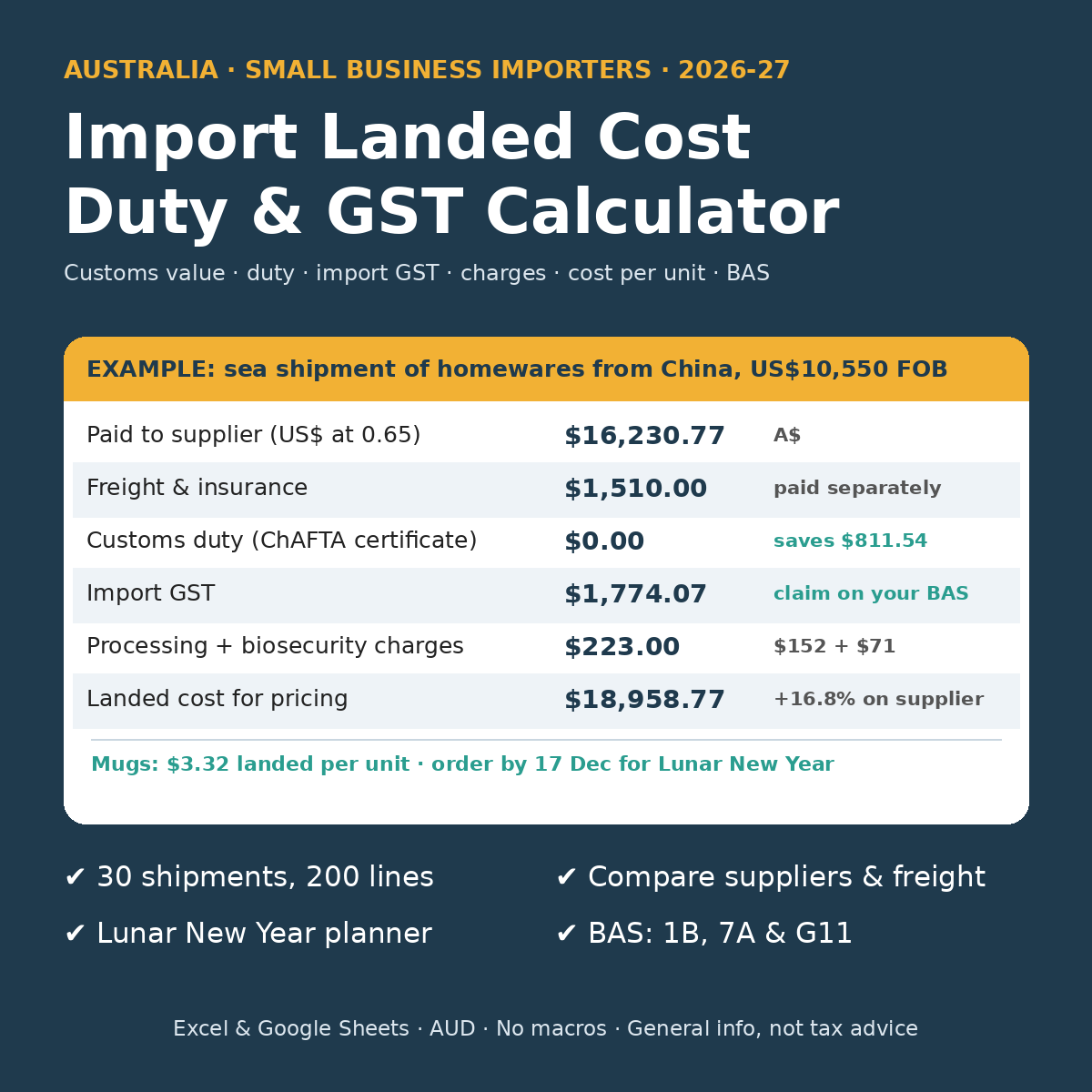
Here's one sea shipment from the template's example: homewares from Ningbo, invoice US$10,550 FOB, exchange rate 0.65, with a ChAFTA certificate.
- Paid to supplier: US$10,550 ÷ 0.65 = A$16,230.77 (also the customs value).
- Duty: A$0 with the certificate. Without it, 5% would be A$811.54.
- Freight and insurance: A$1,510.
- Import GST: 10% × (16,230.77 + 0 + 1,510) = A$1,774.07, claimable.
- Import processing charge A$152 (over $10,000), plus sea biosecurity charge A$71.
- Broker, port and delivery: A$960 plus GST. Bank fees: A$35.
The total cash out is about A$20,829. But the landed cost for pricing, leaving out the GST you'll claim back, is A$18,958.77, or 16.8% more than the supplier price.
Spread across the five products by value, the mugs (US$1.85 each, about A$2.85) land at A$3.32 each. At a 55% margin, that's a price of about A$8.13 including GST, rounded up to A$9. If you'd priced off the supplier price alone, every sale would be thinner than you thought.
A few things change the answer: splitting freight by weight or volume instead of value (bulky cushions cost more to ship than mugs), a missing certificate, or a CIF invoice where the freight hasn't been taken out.
Step 6: work back from Lunar New Year to your order date
Start with the date you need the stock and count backwards:
- Take off clearance and delivery (say 5 days) and sea transit (say 21 days). That's your latest ship date.
- If that ship date falls while the factory is closed, move it to before the closure.
- Take off the supplier's production lead time. If production would run over the closure, take the closure off too.
In the example, autumn stock needed by 15 March 2027 has a latest ship date of 17 February. That's inside an assumed factory closure of 22 January to 22 February, so it must ship by 21 January. With 35 days of production, the order has to go in by 17 December 2026.
Your supplier's real closure dates are what count, so ask them now.
A spreadsheet that does the maths
I built a spreadsheet for this: the Import Landed Cost, Duty & GST Calculator. It handles up to 30 shipments and 200 product lines. It works out customs value from your Incoterm, duty (general or free trade rate, and only if you hold the origin document), import GST, the processing and biosecurity charges, the low-value rules and your landed cost per unit and selling price. It compares suppliers and freight options side by side, plans order dates around Lunar New Year, and totals the GST credits for each BAS period (1B, 7A and G11). It works in Excel and Google Sheets, with no macros and a worked example.
This article is general information, not tax, customs or financial advice. Duty rates depend on each product's tariff classification and origin, so check with a licensed customs broker. See the ABF and the ATO for the full rules.