

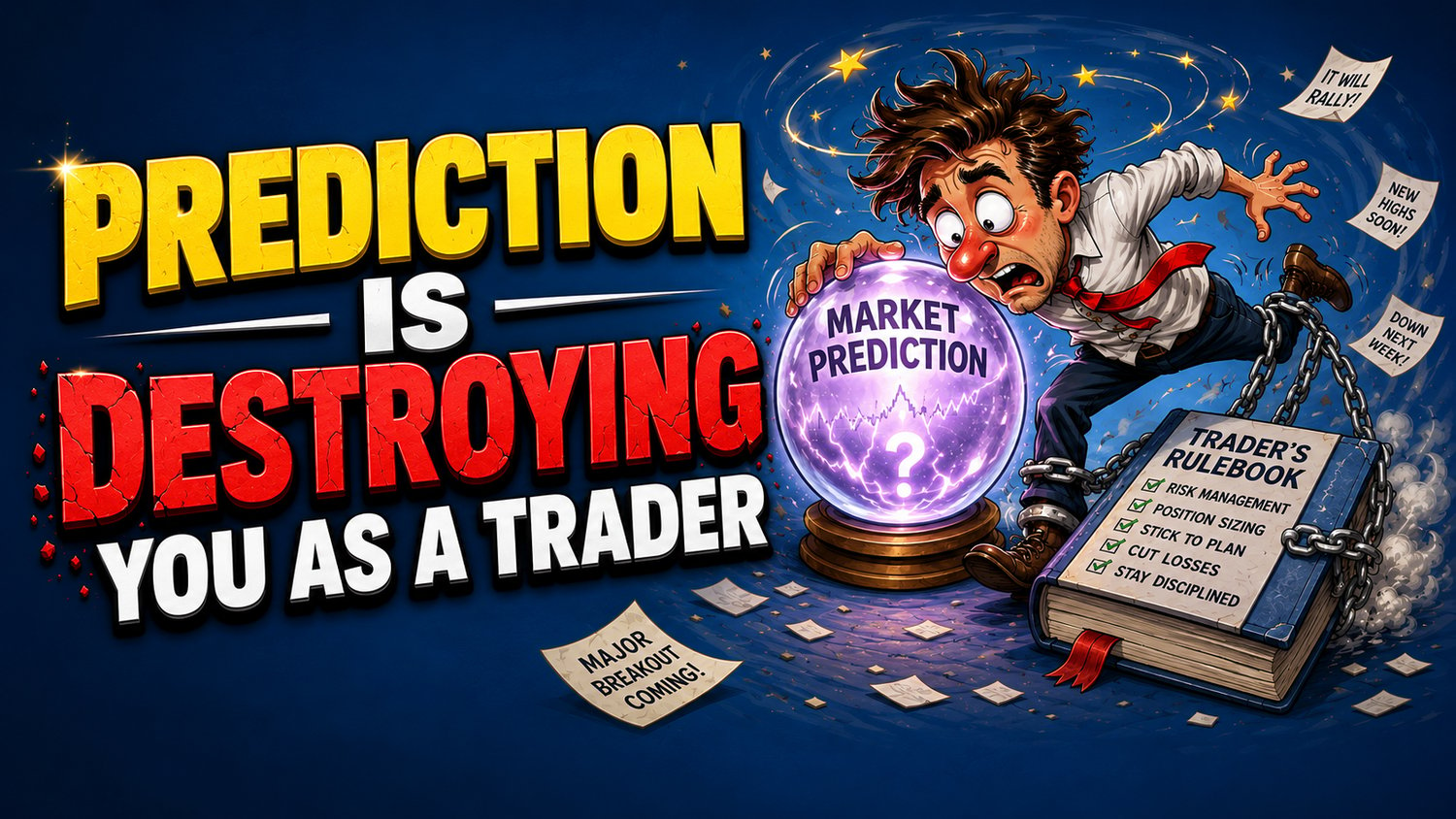
Many traders try to predict whether the chart in front of them will move up or down next, and they believe that improving the accuracy of those predictions is what it means to improve.
But trading is not the job of predicting the future.
In fact, it is precisely because so many traders treat trading as a game of getting the next move right that they lose consistency and move further away from success.
Today, I will explain in detail what trading without prediction actually means, and why it is necessary for success in a world governed by probability.
■ Trading Is Not About Getting the Next Trade Right
The job of a trader is not to predict whether the chart in front of them will move up or down next.
The reason is that the outcome of a single trade is heavily influenced by randomness, and one win or loss cannot tell you whether the action itself was correct.
You can follow your rules perfectly and still lose.
You can also break your rules and still win.
The outcome of one trade does not always match the quality of the decision behind it.
That is why a trader should not be trying to predict the next outcome.
The job is to define the conditions in advance, test them across a large sample size, and consistently execute a system that has been confirmed to have positive expectancy.
A position is not a vote for the prediction that “this one will go up” or “this one will win.”
It is one sample executed because the predefined conditions were met, even though you do not know whether that trade will win or lose.
The goal is not to increase the percentage of individual trades you get right.
The goal is to build a set of comparable samples without destroying the conditions that allow the system’s edge to appear across a large sample size.
■ The Terrifying Damage Prediction Causes
When you predict the next move, you begin to think, “My prediction was right” when you win and “My prediction was wrong” when you lose.
When you win, you assume the decision was correct.
Even if you broke your rules, the profit can make you remember that decision as something that works.
When you lose, you assume the decision was wrong.
Even if you followed your rules, you begin changing them because you think, “My analysis was not good enough” or “I should have added another condition.”
But a single win or loss cannot tell you whether the decision was correct.
Correct actions can lose.
Incorrect actions can win.
If you use wins and losses as your answer key, you will learn bad behavior every time you win and discard correct behavior every time you lose.
Prediction also strengthens the belief that the win or loss in front of you carries enormous meaning.
When your prediction is right, you believe you were right.
When your prediction is wrong, you feel that your judgment has been rejected.
As a result, a profit is no longer just one outcome.
It becomes proof that you were right.
A loss is no longer just one outcome.
It becomes proof that you were wrong.
This is where anger, disappointment, urgency, and the need to win the money back begin.
The problem is not the emotions themselves.
The problem is giving one win or loss enough value to determine the worth of your judgment and ability.
Prediction is not dangerous because it can be wrong.
It is dangerous because it allows one win or loss to control your decisions, your rules, and your emotions.
■ Holding a Position Is Not the Same as Predicting the Next Outcome
At this point, some people may think this.
“But if you take a long position, is that not the same as predicting that price will rise?”
It is not.
Suppose you have a system that has been confirmed through testing across a large sample size to have positive expectancy, even though its win rate is 40%.
A trader using this system does not place a buy order because they predict that the trade in front of them will win.
They understand from the beginning that many trades meeting those conditions will lose.
They take the position not because they believe, “This one must go up.”
They take it because the predefined conditions have been met, and testing has shown that positive expectancy appears across the full set of trades when the same rules are repeated consistently.
That trade is not a position taken because the trader predicted that price would rise.
It is one sample added according to the rules, without knowing whether it will win or lose.
Then another objection may appear.
“If you believe that the system will produce profits in the future, is that not also a prediction?”
If every view about the future is called a prediction, then in the broadest sense, you could call it that.
But predicting that the next trade will move upward and judging that positive expectancy will appear across a large sample are not the same thing.
The first tries to get the next outcome right.
The second begins with the acceptance that the next outcome is unknown and looks at the full result produced by repeatedly applying the same conditions.
This is why traders are often told to move from a short term perspective to a long term perspective.
A long term perspective does not mean looking far into the future or holding positions for longer.
It means judging the full set of repeated decisions under the same conditions rather than judging yourself by one win or loss.
Positive expectancy is not a promise that the next trade will win.
It is not a promise that the next week or month will necessarily be profitable either.
It is a statistical property of a system that appears when the same rules are repeated across a large sample size.
A trader does not trust the prediction in front of them.
They trust the statistical property they have tested, practiced, and confirmed through their own hands, and the rules that lead to it.
■ Trading Without Prediction Begins With Preparation
Trading is not the job of predicting the next price movement.
It is the job of continuously executing a system whose positive expectancy has been confirmed in advance, without allowing one win or loss to change your decisions.
What this requires is thorough preparation.
It is not an exaggeration to say that most of a trader’s work is preparation.
Execution makes up only a few percent of the job.
Most problems that appear in live trading are simply symptoms of insufficient preparation.
Build the right understanding of trading.
Prepare correctly.
Then repeat the correct execution.
That is the path to success as a trader.
If you have not yet built a repeatable system with an edge, I hope you will take a look at the system-building manual I created.
It should help your trading.