
I live in the South—where church steeples rise almost as often as pine trees and nearly everyone you meet will tell you their denomination before you know their middle name. Christianity is woven into the culture here. It’s in the greetings, the billboards, the potlucks, and the politics.
And yet, for all the outward displays of faith, there’s a quiet contradiction I’ve noticed: morality isn’t always clear-cut.
I’ve seen kindness preached on Sunday and cruelty practiced on Monday. I've watched neighbors recite Bible verses while turning a blind eye to injustice, poverty, and exclusion. The truth is, in many places—especially here in the South—religion is assumed to be the source of morality, even when the behavior doesn’t always align.
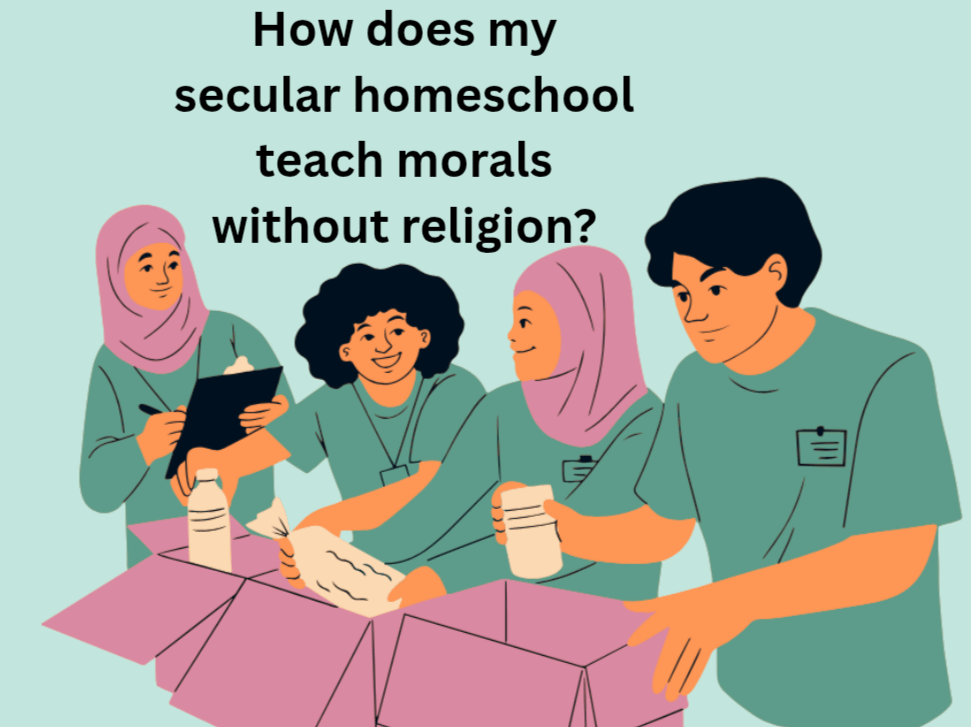
So when people hear that we homeschool secularly—without religion as our foundation—the question often comes quickly:
"But how do you teach your kids right from wrong?"
It's a fair question.
So, here’s what I’d tell anyone wondering the same thing.
Morality Isn’t Just Inherited. It’s Constructed.
We are born into systems—governments, cultures, communities—that already have a blueprint of “how things should be.” These systems shape our moral norms. But those norms? They’re not fixed. They change. They evolve. And they are different across time and geography.
That’s because morality is a social construct—a set of shared agreements about what keeps society functioning and people safe and respected. Religion is one way societies have passed on those agreements, but it’s not the only way. Morality doesn’t come from belief—it comes from belonging.
So in our home, we teach our children that morals are not about obeying a rule book. They’re about understanding people. They’re about consequences. They’re about asking questions, seeing connections, and caring deeply.
What We Use Instead: The Ten Humanist Commitments
Instead of commandments or doctrines, we teach our kids a set of values rooted in human experience and social responsibility.
The Ten Humanist Commitments give us a framework:
Empathy: Understanding others’ feelings.
Critical Thinking: Questioning, reasoning, learning.
Ethical Development: Becoming better on purpose.
Peace & Social Justice: Solving problems fairly.
Service & Participation: Giving back.
Altruism: Helping without expecting rewards.
Humility: Recognizing you don’t know everything.
Environmentalism: Caring for the Earth.
Global Awareness: Seeing yourself as part of a bigger picture.
Responsibility: Owning your actions—even when no one is looking.
These aren’t just ideas we talk about—we live them. When my daughter comforts her little brother after an argument, that’s empathy. When my son challenges something he read in a book because “it doesn’t seem fair,” that’s critical thinking. When we volunteer, recycle, question headlines, listen more than we speak, we’re showing our kids that morality is a muscle—you build it by using it.
What are some examples?
K–5: Foundations of Character & Community
Focus: Exploration through stories, activities, play, and modeling
Methods: Picture books, SEL games, role-play, journaling, classroom jobs
Empathy: Read books like Last Stop on Market Street; act out feelings with puppets.
Responsibility: Daily “helper” roles; nature walks with cleanup goals.
Global Awareness: Learn greetings from around the world; world map studies.
Environmentalism: Nature scavenger hunts; garden planting.
Critical Thinking: Use "Would You Rather?" and “Why?” questions.
Peace & Social Justice: Conflict resolution through story time and scripts.
Ethical Development: “What would you do?” scenario cards.
Service & Participation: Make cards for neighbors or local helpers.
Humility: “I Can Learn From…” books and reflections.
Altruism: Kindness challenge with tokens or a “kindness tree.”
6–8: Identity, Inquiry & Community Action
Focus: Deeper questioning, social-emotional connection, community projects
Methods: Socratic seminars, group projects, personal reflection journals, debates
Empathy: Read memoirs or novels like Wonder; interview peers.
Responsibility: Personal goal setting with reflections.
Global Awareness: Research different cultures and global issues.
Environmentalism: Build a composting project or advocate for local changes.
Critical Thinking: Logic puzzles; media literacy mini-lessons.
Peace & Social Justice: Host a peer mediation session.
Ethical Development: Explore philosophical dilemmas.
Service & Participation: Plan a neighborhood improvement project.
Humility: Self-assessments and “learning from failure” reflections.
Altruism: Volunteer project planning and execution.
9–12: Purpose, Leadership & Societal Engagement
Focus: Personal philosophy, real-world application, legacy
Methods: Capstone projects, internships, community activism, persuasive writing
Empathy: Volunteer in diverse environments; reflective essays.
Responsibility: Mentor younger students or help with family responsibilities.
Global Awareness: Model UN or global issue research paper.
Environmentalism: Propose eco-initiatives to local council.
Critical Thinking: Analyze political debates; logical fallacies study.
Peace & Social Justice: Create a PSA or lead a community dialogue.
Ethical Development: Write a personal ethics manifesto.
Service & Participation: Start or join a civic club.
Humility: Collect feedback from mentors, write gratitude letters.
Altruism: Build and lead a sustainable volunteer program.
Morals Without Religion Are More Than Possible—They’re Powerful
Teaching morality without religion means guiding kids to develop an internal compass, not one that relies on fear or reward. It means they ask why something is right or wrong—not just whether it breaks a rule. And it means they can respectfully engage with people from all backgrounds because they’ve been taught to think for themselves and listen to others.
We talk about history, about harm, about kindness, about systems of power, and about how to live well with others. Our kids are growing up understanding that bei
ng “good” isn’t about what happens after we die—it’s about what we do while we’re here.
And honestly? I wouldn’t have it any other way.
Comments ()