


Multisensory learning—the integration of visual, auditory, tactile, and kinesthetic methods—has been central to human education for millennia. While it is often associated with modern approaches like Montessori and structured literacy, its roots can be traced back to indigenous practices, the invention of writing systems, and ancient educational traditions. This blog post explores the history of multisensory learning and its evolution into today’s evidence-based methods in literacy and math instruction.
1. Indigenous Learning Practices: The Foundation of Multisensory Learning
For centuries, indigenous cultures worldwide have used multisensory methods to pass down knowledge and skills through generations.
Oral Traditions: Knowledge was shared through songs, chants, and storytelling, engaging the auditory sense. These were often accompanied by hand gestures, dances, or physical symbols like carvings or beadwork.
Tactile and Kinesthetic Learning: Hands-on activities like weaving, pottery, and tool-making required learners to engage with materials physically, combining motor skills with cognitive understanding.
Learning in Nature: Indigenous education often took place in natural environments, using sensory exploration to teach about plants, animals, and landmarks.
Community-Based Learning: Lessons were collaborative, reinforcing knowledge through shared experiences and collective memory.
Indigenous practices emphasized holistic learning that connected the mind, body, and environment—a philosophy that resonates with modern multisensory approaches.
2. Sumerian Cuneiform: Writing as a Multisensory Activity (c. 3100 BCE)
The invention of cuneiform, the earliest known writing system, marked a significant step in multisensory learning.
Tactile Engagement: Scribes used a stylus to press wedge-shaped marks into clay tablets, requiring precise motor control and physical interaction with the material.
Visual Learning: The symbols were visually intricate, requiring recognition, memorization, and pattern recognition.
Practical Applications: Cuneiform was used for record-keeping, storytelling, and teaching mathematics, combining literacy and numeracy in a hands-on way.
Writing systems like cuneiform show that the process of learning to read and write has always been multisensory, involving sight, touch, and movement.
3. Ancient Greek and Roman Education: Combining Literacy and Oratory
The Greeks and Romans further developed multisensory learning, especially in education and public life.
Oratory and Rhetoric: Learning to speak and argue effectively required auditory and kinesthetic practice, as students memorized and performed speeches.
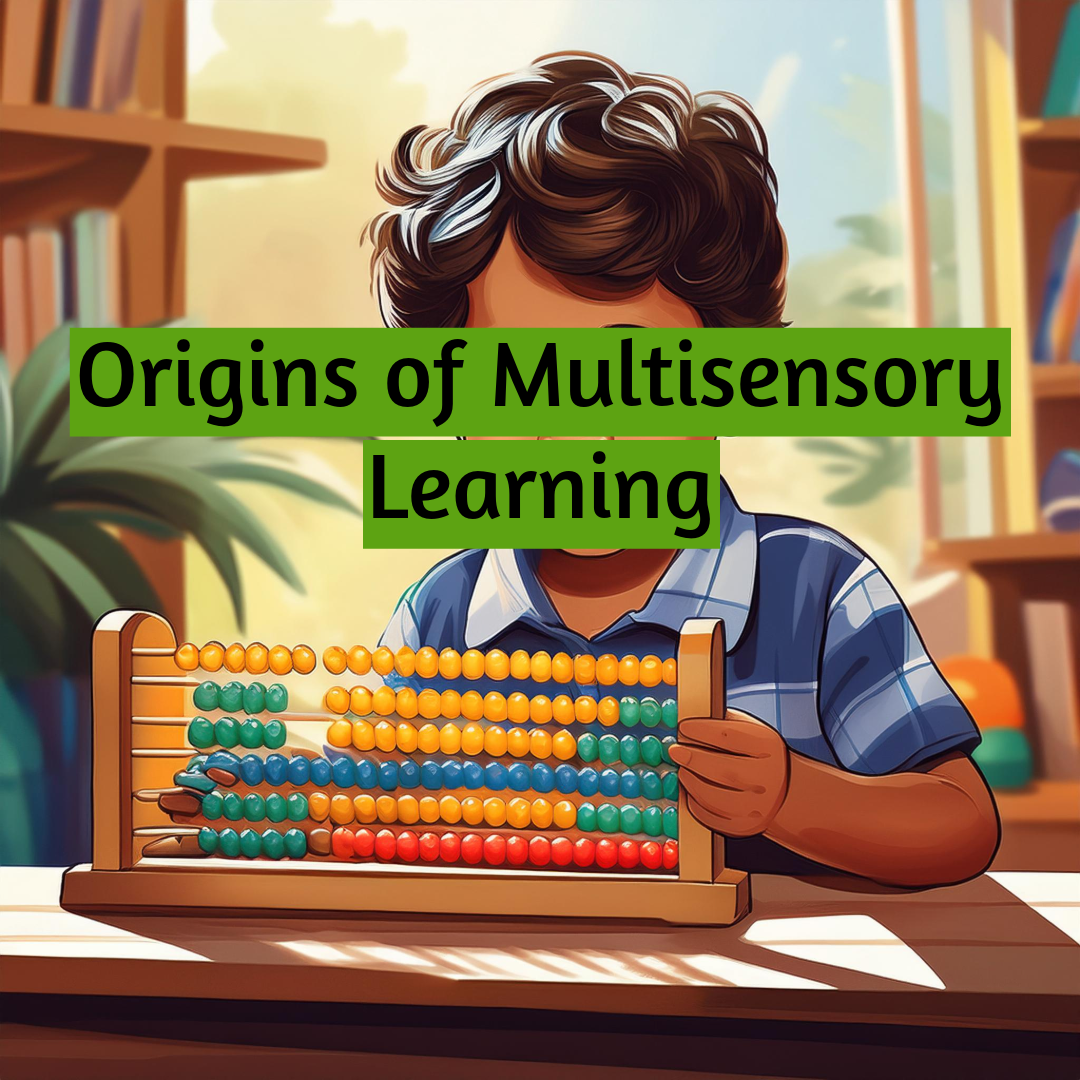
Tactile Tools: Wax tablets and styluses were used for writing, while abacuses facilitated arithmetic, engaging students in hands-on learning.
Visual-Auditory Integration: Poetry, literature, and philosophy were often taught through reading aloud, emphasizing the connection between sound and meaning.
These methods influenced education for centuries, shaping how literacy and numeracy were taught in medieval and Renaissance Europe.
4. Maria Montessori and the Revival of Multisensory Learning (1907)
Modern multisensory education owes much to Dr. Maria Montessori, an Italian physician and educator who revolutionized early childhood learning.
Child-Centered Approach: Montessori classrooms prioritize hands-on exploration, allowing children to engage with materials at their own pace.
Sensory Materials: Tools like sandpaper letters (to trace letters with their fingers) and moveable alphabets combine tactile, visual, and auditory learning.
Integration of Movement: Activities often involve physical motion, such as walking on lines or transferring objects, which reinforces kinesthetic learning.
Montessori’s philosophy aligns with indigenous traditions by emphasizing the whole child—mind, body, and senses—while preparing the foundation for structured literacy and math.
5. Play-Based Learning and Multisensory Integration
Play-based learning, a developmentally appropriate practice used in early childhood education, also incorporates multisensory methods.
Imaginative Play: Children learn through role-playing, storytelling, and pretend play, which engage auditory and kinesthetic senses.
Hands-On Exploration: Activities like building with blocks, drawing, and solving puzzles integrate touch, sight, and movement.
Social Interaction: Collaborative play teaches problem-solving, communication, and empathy, reinforcing auditory and visual cues.
This approach supports the development of foundational literacy and numeracy skills in a way that feels natural and enjoyable for children.
6. Structured Literacy and Structured Math: Evidence-Based Multisensory Instruction
Modern structured literacy and structured math programs draw heavily on multisensory principles to support learners, especially those with dyslexia, dyscalculia, and other neurodivergent profiles.
Structured Literacy
Phonics-Based Instruction: Teaching letter-sound relationships often involves tracing letters, manipulating phoneme tiles, and saying sounds aloud.
Tactile Engagement: Tools like sandpaper letters and writing in rice trays engage touch and movement.
Explicit Teaching: Multisensory methods are paired with systematic and explicit instruction to ensure all learners can access and retain literacy skills.
Structured Math
Concrete-Representational-Abstract (CRA) Framework:
Concrete: Using physical objects like counters or base-ten blocks.
Representational: Drawing pictures to represent concepts.
Abstract: Gradually transitioning to numbers and symbols.
Hands-On Tools: Manipulatives like fraction tiles, number lines, and abacuses provide tactile and visual reinforcement.
Movement-Based Learning: Activities like jumping on number lines or arranging shapes combine physical activity with mathematical thinking.
By integrating sensory input with systematic instruction, these methods help learners build a deep and flexible understanding of reading, writing, and math.
Conclusion
From indigenous storytelling to Sumerian cuneiform, Greek oratory, and Montessori classrooms, multisensory learning has been central to human education. Today, it forms the backbone of evidence-based approaches like structured literacy and math, ensuring that learners of all abilities can succeed. By engaging multiple senses, we honor a timeless principle: the more we connect with knowledge through our whole selves, the deeper and more meaningful our learning becomes.
Comments ()