

It starts at 7:30 a.m.
Your child is clinging to you at the door again, eyes wide, heart pounding. They're not “acting out,” and they’re not “being defiant.” They're terrified. Their stomach hurts. They can’t breathe. They’re crying, but not because they want attention—because their body is reacting as if school is a threat.
But what do the notes from the school say?
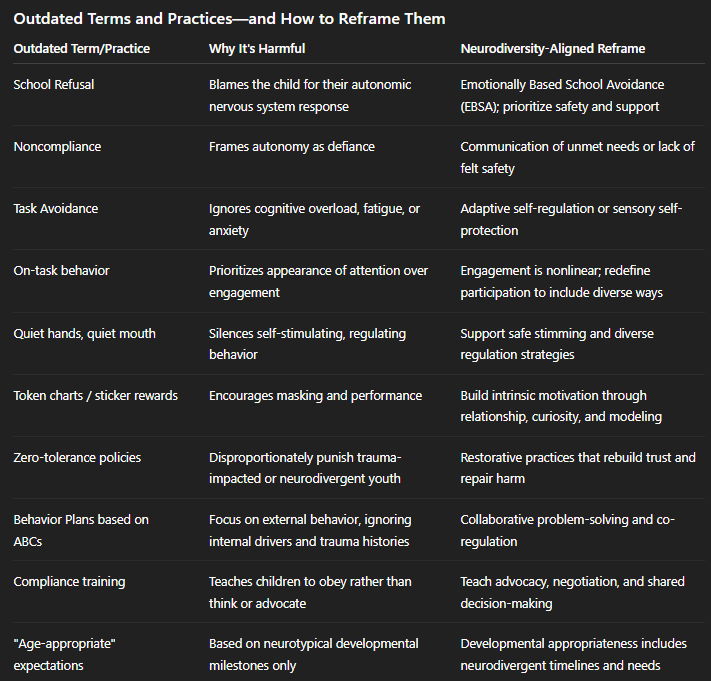
“School Refusal”
“Noncompliant”
“Avoidant”
“Needs Behavior Plan”
For many families, especially those raising neurodivergent children, the labels used in schools can feel more like judgments than supports. These terms—rooted in behaviorism and outdated paradigms—blame the child instead of exploring why they are struggling.
But this isn’t about refusal. It’s about biology, neuroscience, and a paradigm shift that must center safety, autonomy, and connection over compliance.
Why Behaviorism and PBIS Are Outdated in 2025
Behaviorism assumes that all behavior is a choice and that external rewards or consequences will mold a child’s behavior. While this might change surface-level compliance temporarily, it does not address internal emotional regulation, trauma, sensory needs, or neurodevelopmental differences.
In fact, decades of research in neuroscience and psychology have shown us that coercive compliance often suppresses emotional expression, leads to masking in autistic children, and damages trust and relationships.
Positive Behavioral Interventions and Supports (PBIS) may appear “positive,” but they often condition children to perform neurotypical behavior to earn external validation—rather than helping them understand themselves or regulate in a way that works for their own body.
The Power of Mirror Neurons and Social Cognitive Learning Theory
According to Social Cognitive Learning Theory (Bandura), children learn not just through reward and punishment, but primarily through modeling. Mirror neurons—a neural system that fires when we observe others—are one of the neurological foundations of empathy and learning through observation.
What does this mean for educators, parents, and caregivers?
If we model emotional regulation, children mirror it.
If we model respect for boundaries, children internalize that respect.
If we model humility, children learn accountability.
When children see adults navigating their own emotions with honesty and patience, they learn to do the same.
The Need for Autonomy, Safety, and Rights in Education
Neurodivergent children are often not granted the same rights to autonomy and dignity as their neurotypical peers. They are more likely to be:
Physically restrained or isolated
Placed on rigid behavior plans
Denied breaks or sensory tools
Pathologized for normal adaptive responses to stress
Yet every child—regardless of neurology—deserves:
A say in their learning environment
The right to bodily autonomy
Support to regulate rather than punish to control
Respect for their communication style, even if nontraditional
Parents also have rights—to advocate without retaliation, to demand science-based interventions, and to insist their children are seen as full humans, not behavior charts.
A Call for Humility in Adults
Recognizing our own implicit bias is uncomfortable work. As adults—whether educators, parents, or clinicians—we must accept that our worldviews were shaped in systems that often prioritized productivity over personhood.
This means learning to say:
“I was wrong.”
“I didn’t know that was harmful.”
“I want to do better.”
Humility isn’t weakness. It’s the foundation of safety and trust.
How We Can Shift the System—Together
This isn’t just semantics. Language shapes policy. It influences interventions. It determines whose voice is centered.
To shift from behavioral management to nervous system support, we must:
✅ Teach adults the neuroscience of stress, trauma, and development
✅ Reframe "problem behaviors" as communication
✅ Encourage child-adult collaboration and consent
✅ Train educators in co-regulation, modeling, and emotional attunement
✅ Build systems of care, not compliance
Final Thoughts: From Power Over to Power With
Our children are not defiant—they are dysregulated. They are not refusing—they are protecting themselves. They are not broken—they are brilliantly adapting to a world not yet designed for them.
If we can look beyond behavior and listen to the biology—if we can shift our gaze from control to connection—then maybe, just maybe, we can build learning spaces where all brains are welcomed, supported, and free to thrive.
Let’s stop a
sking “how do we make them behave?” and start asking, “how can we make them feel safe enough to learn?”
Comments ()