


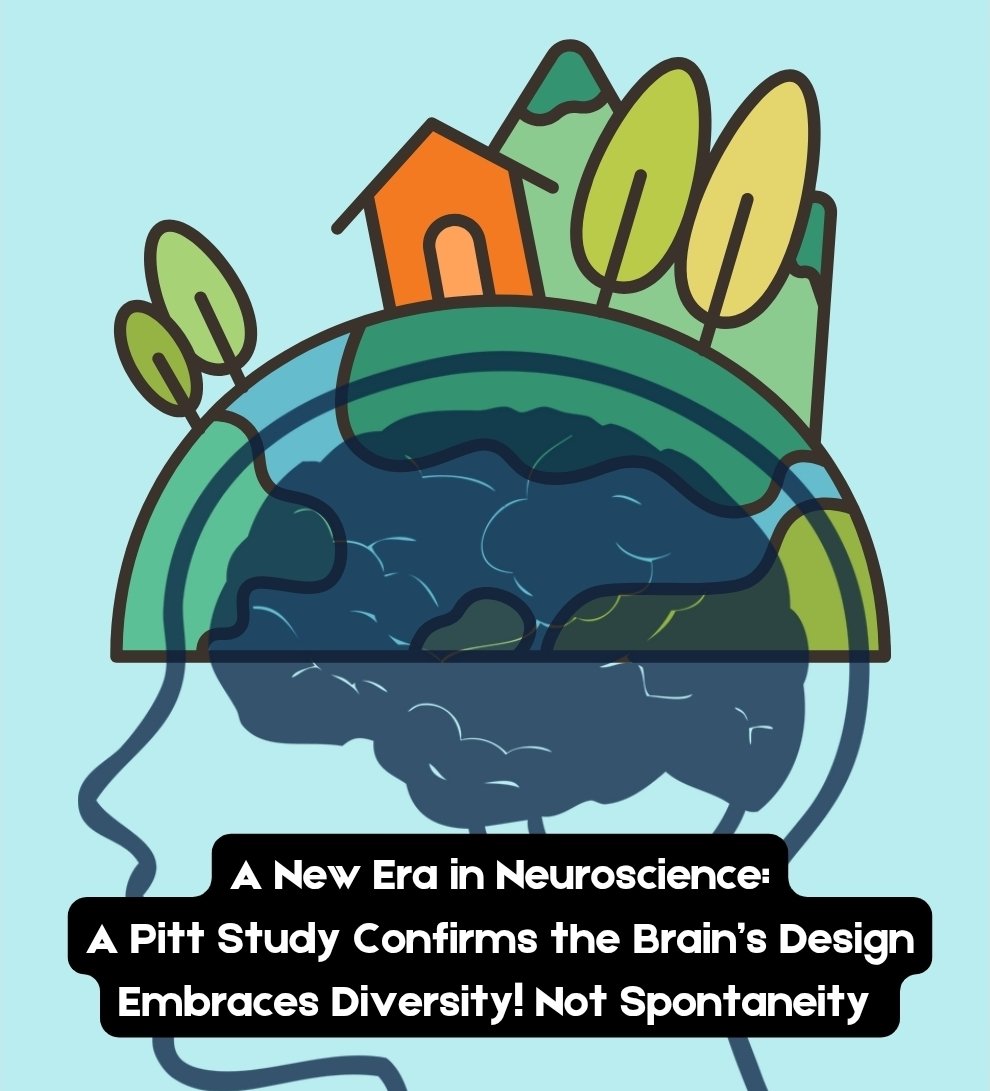
In a groundbreaking new study published in Science Advances, researchers from the University of Pittsburgh have officially upended a long-standing assumption in neuroscience — and in doing so, they may have handed powerful new evidence to advocates for biodiversity, neurodiversity, and biogenesis alike.
For decades, the neuroscience community operated on a shared understanding: that both spontaneous neural transmissions (the kind that happen without any obvious stimulus) and evoked transmissions (responses to touch, light, sound, or experience) came from the same type of synaptic site — like a single machine that just occasionally misfires.
But now, thanks to the work of Dr. Oliver Schlüter and his team, we know this is not the case.
Using a mouse model, the researchers found that the brain actually uses distinct synaptic transmission sites — each with its own molecular machinery, developmental timeline, and rules for regulation — to carry out spontaneous and evoked communication. Rather than sharing one uniform release point, the brain maintains separate, specialized systems for different types of signaling.
This discovery isn’t just technical. It’s transformational — not only for neuroscience, but for how we understand and advocate for variation in all living systems.
From Synaptic Surprise to Scientific Revolution
To understand how revolutionary this is, let’s briefly look at how neurons talk to each other. When one neuron wants to send a message, it releases tiny chemical messengers called neurotransmitters from its presynaptic terminal. These molecules cross a small gap — the synaptic cleft — and bind to receptors on the next neuron, which then responds.
Traditionally, neuroscientists believed that all types of neurotransmitter release came from the same set of vesicles (small storage bubbles) inside the neuron. Whether the message was intentional (evoked) or seemingly random (spontaneous), it was thought to rely on the same synaptic machinery.
That assumption now lies in the dustbin of neuroscience history.
Dr. Schlüter’s team discovered that spontaneous transmissions originate from entirely separate vesicle pools and release sites than evoked ones. This suggests that “spontaneous” activity isn’t random or accidental — it’s biologically structured, developmentally guided, and likely serves unique and essential roles in brain function.
The Case for Biodiversity — Now at the Synaptic Level
For advocates of biodiversity, this study is a major win.
We often think of biodiversity in terms of species variation across ecosystems. But here’s the truth: diversity is the operating principle of all living systems — down to the molecular level. This research reveals that even within a single neuron, diversity in structure and function supports resilience, adaptability, and growth.
Just as ecological systems benefit from a wide range of species with unique roles, the brain benefits from specialized transmission systems that can perform different tasks under different conditions.
This kind of functional biodiversity ensures the brain can maintain both stability (through spontaneous activity) and flexibility (through experience-driven responses). It’s a beautiful parallel to the natural world: balance through variation.
Neurodiversity: Not Just a Social Concept — A Neuroscientific Reality
For those of us in the neurodiversity movement, the implications are profound.
Neurodiversity is often misunderstood as a purely social or educational philosophy — the idea that neurological differences like ADHD, autism, dyslexia, or giftedness are natural and valuable variations of the human brain. Critics have sometimes dismissed it as unscientific or ideological.
This study changes that narrative.
By demonstrating that the brain itself is built on divergent, non-uniform pathways for processing, it validates the idea that difference is not disorder. Brains are not monolithic. Even at the microscopic level, they use different mechanisms for different purposes — and this flexibility is fundamental to learning, memory, creativity, and emotional regulation.
In other words: the brain is neurodiverse by design.
Goodbye, Spontaneous Generation. Hello, Biogenesis.
For centuries, science struggled with the now-disproven idea of spontaneous generation — that life could arise from nothing. In neuroscience, a lingering cousin of that myth remained: the belief that spontaneous brain activity was either meaningless or "noise."
But this study provides biological proof that even spontaneous neural activity is generated with intention. It has its own structure, its own rules, and its own function. This affirms a core truth of biogenesis: all life — and all function within life — arises from pre-existing, purposeful systems.
We no longer need to assume randomness where we haven’t yet looked closely. What once seemed spontaneous is, in fact, deeply organized.
What This Means for the Future of Neuroscience and Education
This research invites us to rethink everything — from how we approach neurological differences to how we design education, therapy, and even artificial intelligence.
It means:
Embracing individualized learning paths is biologically aligned with how brains actually develop.
Conditions like ADHD, autism, or dyslexia may reflect different balances of spontaneous vs. evoked activity, not deficits.
Therapeutic interventions should respect the multiplicity of neural pathways, rather than forcing conformity to one model.
Our systems — educational, social, medical — must evolve to support diverse brain functions as strengths, not failures to meet a norm.
A Call to Advocates, Educators, Scientists, and Policymakers
Let’s let this moment mark a turning point.
We now have hard evidence that variation is not error — it's essential to the system. Whether you're fighting for inclusive education, better mental health care, or more representative neuroscience, this study offers the foundation you’ve been waiting for.
It’s time to teach it.
It’s time to fund it.
It’s time to design for it.
It’s time to believe in it.
Diversity is not a bug in the code — it's the core of all biological intelligence.
Resources:
Schlüter, O. et al. (2025). Distinct sites of spontaneous and evoked neurotransmitter release in the brain. Science Advances.
https://www.science.org/doi/10.1126/sciadv.ads5750
Comments ()