
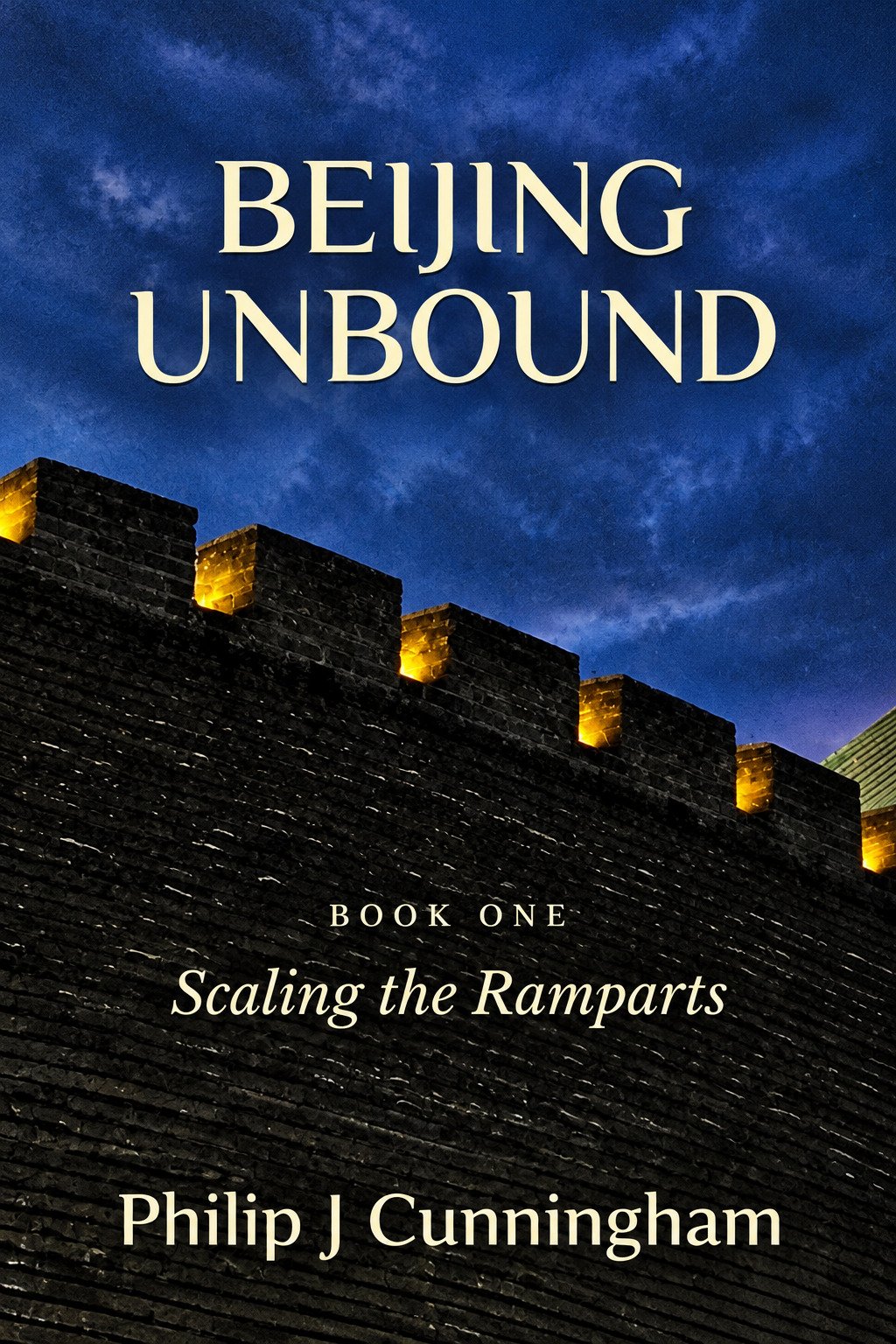
BEIJING UNBOUND: Book 1, Scaling the Ramparts
BEIJING UNBOUND: Scaling the Ramparts is the first installment of a three-volume epic following two young Americans who try to make a home for themselves in Beijing in the uneasy decade following the crackdown at Tiananmen Square.
In "Scaling the Ramparts" we first meet Jim and Kirk on the ramparts of an old monument as they scheme to test China’s social barriers. Key to their quest for acceptance is behind the scenes help from the beautiful but vulnerable Huamei. Her husband, the cunning Crimson Prince, and a mysterious tycoon known only as Big Ten soon enter the picture, complicating things. The love triangle reaches a point of no return by the end of book one.
NARRATOR'S INTRODUCTION:
My name is Jim. I live in Japan. I’m originally from New York—Lynbrook by way of Brooklyn. By the time I was done with my studies at a college upstate, I was fully conversant in Song Dynasty taxation, late Qing uprisings, and the May Fourth Movement, but I couldn't find a job in the field. I packed my bags and flew to Beijing to take up a whimsical offer to teach British Literature.
I owe that job to an enchanting woman, a veritable princess to those in the know, but I wasn’t in the know for a long time. She and I had a thing in college, broke up, vowed to stay friends forever. Her political pull was the alchemy that allowed me to transform from an unemployable China expert to a “foreign expert” in a field I knew nothing about. Her stratospheric social circle was the gyre that chewed me alive and finally spit me out.
As the car sped down the highway from the airport into the city I had abandoned in 1999, I started reading the kanji, the hanzi, out loud in Japanese.
“Shuto Kokusai Kūkō, Shōtenjiku, Hokkō, Shigenkyō…”
It was sufficiently jarring for the self-important driver to turn down the volume on his noisy talk show and give me a quizzical look.
By the time we reached Sanyuanqiao, I had corrected myself, reading signs the Chinese way:
“Hepingmen, Yonghegong, Deshengmen...”
Before moving to Japan, China represented my one and only. It was my imagined other, and it overwhelmed me. There was only one way to read Chinese characters, and a single standard by which to judge things.
Leaving China for Japan gave me an understanding of China I didn’t know I was missing, the “I” in China.
The Beijing I escaped was the Beijing of the Roaring Nineties, a time of great disillusionment cut with elation and unease as the millennium reared into view.
I got in way over my head, caught up in things I didn’t half understand, mired so deep that when things started to go bad, I forgot that I was a foreigner, and, believe me, if you’re a foreigner in China and you forget that basic fact, you are irredeemably lost.
For a fleeting moment, I felt I'd really arrived. Then came the crackdown. Not the Goddess of Democracy getting knocked off her pedestal after a long and unlikely mass uprising; it was more like the fall of Dionysus after a long and unlikely mass bacchanal. The city was like one big black market. I got kicked out of China on charges never specified.
So take what I have to say—about people and places, and most especially about her—with a grain of salt. I was naïve, at times uninformed, but truly fond of the people I met along the way, each in their own crazy way. I was sorry to see it turn out as badly as it did.