
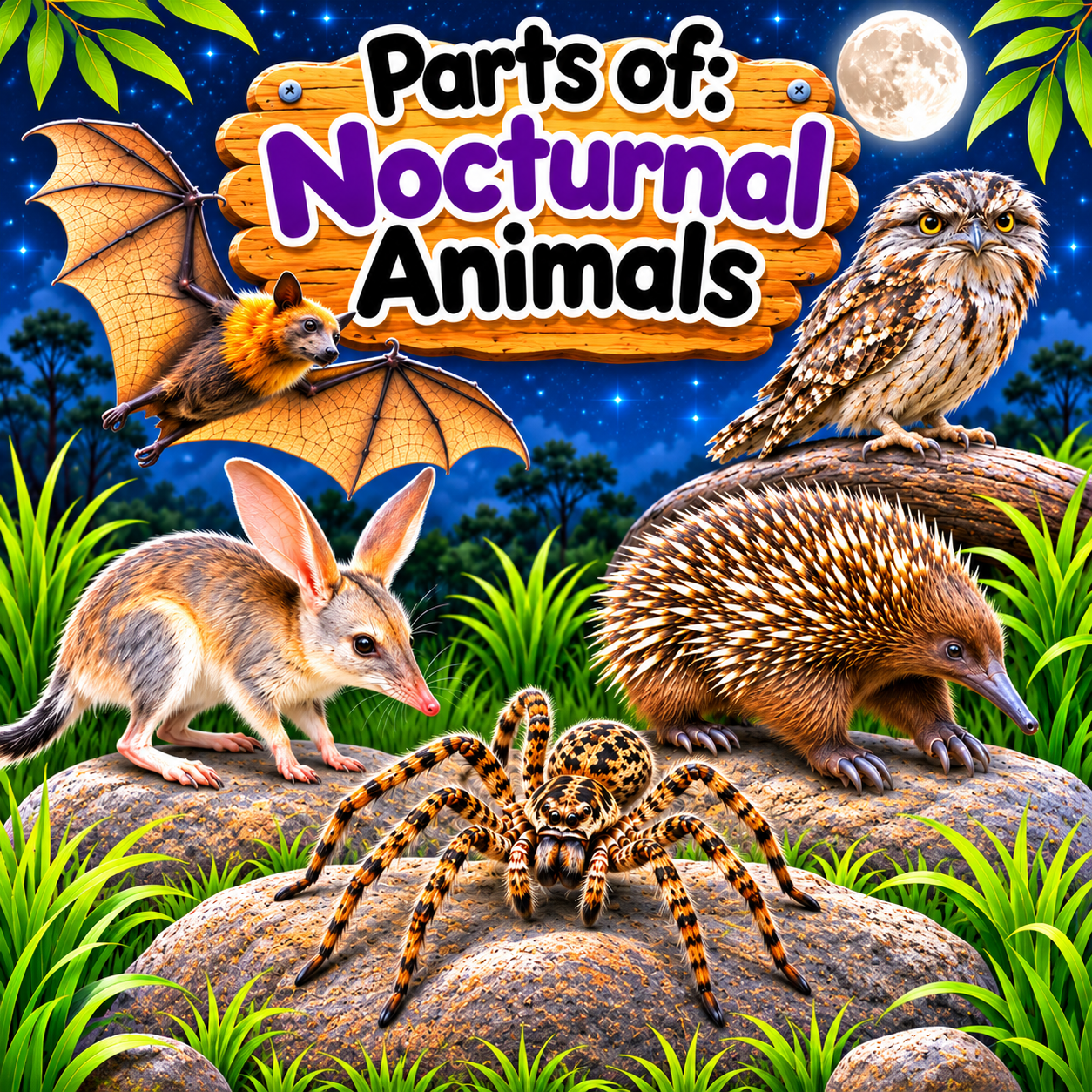
Partof : Nocturnal Animals

 BIG EARS, SHARP CLAWS & SPIKY SURPRISES!


 Have you ever wondered why nocturnal animals have such AMAZING body parts?
Set includes:
5 Nocturnal animals images
5 sets of label cards
5 sets of enlarged animal images (over 2 pages to create A3 image when joined together)
Our little learners became wildlife detectives as we explored the fascinating world of nocturnal animals! 

From the bat's wings to the echidna's spines, everybody part has an important job!
 LET'S EXPLORE!
BAT: Wings for flying and claws for gripping.
TAWNY FROGMOUTH: Large eyes for seeing in low light, a wide beak for catching insects and feathers for camouflage.
 BILBY: Long ears for listening, strong claws for digging and a long tail for balance.
ECHIDNA: Sharp spines for protection, powerful claws for digging and a long snout for finding food.
SPIDER: Eight legs for moving, multiple eyes for detecting its surroundings and fangs for catching prey.
 THE LEARNING MAGIC!
Through exploring animal body parts, children develop:
 Animal anatomy vocabulary.
Observation and identification skills.
Early science and biology knowledge.
Understanding of animal adaptations.
Curiosity about Australian wildlife.
 TRY THIS!
Show children pictures of nocturnal animals and encourage them to point to different body parts.
Ask questions like:
 "Why do you think a bilby has such big ears?"
"How do an echidna's spines help protect it?"
"What makes a bat's wings different from a bird's?"
It's a wonderful way to introduce early childhood science, animal body parts, nocturnal animals and Australian wildlife through playful learning!