
The Science Behind Autism and Puberty
🌻 The Science Behind Autism and Puberty
A Developmental Transition — Not a Worsening of Autism
Puberty is a natural stage of development involving hormonal and physical changes, ongoing brain maturation, changing body sensations, identity development and increasing social and environmental demands.
For autistic young people, many of these changes can happen at the same time. New sensory experiences, unfamiliar internal body signals, changing routines, communication demands and greater expectations for independence can all increase the overall load on the nervous system.
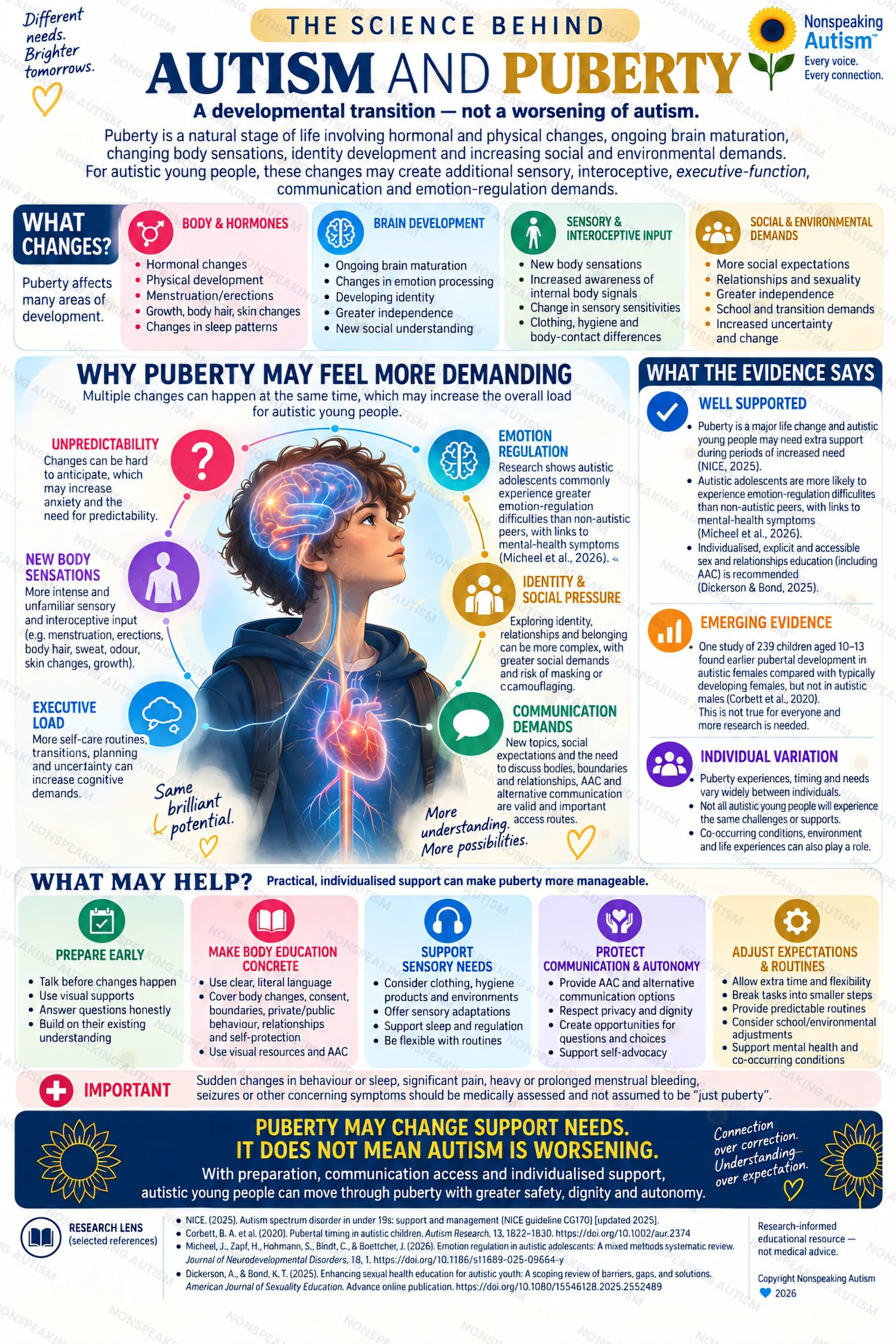
The Science Behind Autism and Puberty is a research-informed educational poster from Nonspeaking Autism, designed to help parents, caregivers, educators and professionals understand why puberty may feel particularly demanding for some autistic young people — and why changing support needs do not mean that autism itself is worsening.
The central message is simple:
Puberty may change support needs. It does not mean autism is worsening. 💙
🌱 What Changes During Puberty?
Puberty affects many interconnected areas of development.
The poster explores four important areas:
🩷 Body & Hormones
Puberty can bring hormonal changes, physical development, menstruation or erections, growth, body hair and skin changes, alongside changes in sleep patterns.
For an autistic young person, these changes may introduce completely new sensations and experiences that take time to understand and adjust to.
🧠 Brain Development
Brain development continues throughout adolescence.
This period can involve changes in emotional processing, developing identity, increasing independence and new forms of social understanding.
🌿 Sensory & Interoceptive Input
Changing bodies can also mean changing sensory experiences.
Young people may become more aware of internal body signals or encounter new sensory demands associated with clothing, hygiene, temperature, body contact and physical development.
🧡 Social & Environmental Demands
At the same time, expectations often increase.
There may be greater social expectations, new conversations about relationships and sexuality, increasing independence, school transitions and more uncertainty or change.
🧠 Why Puberty May Feel More Demanding
Puberty is rarely just one change.
Several developmental, physical, sensory, emotional and social changes may occur simultaneously.
The poster explores how this combined load may involve:
Unpredictability — changes may be difficult to anticipate, increasing uncertainty and the need for predictability.
New body sensations — unfamiliar sensory and interoceptive experiences may become more noticeable.
Executive load — self-care routines, transitions, planning and uncertainty can create additional cognitive demands.
Emotion regulation — emotional experiences and regulation demands may change during adolescence.
Identity and social pressure — relationships, belonging, identity and social expectations may become increasingly complex.
Communication demands — conversations about bodies, boundaries, relationships and needs may require accessible communication and alternative communication routes.
Rather than interpreting increased difficulty as regression or a worsening of autism, it can be more useful to ask:
Has the environment changed? Have the demands increased? Are there new sensory or body experiences? Does this young person now need different support?
🔬 What the Evidence Says
The poster distinguishes between areas with stronger research support, emerging evidence and areas where individual variation is especially important.
Research supports the importance of recognising puberty as a major developmental transition and ensuring autistic young people have access to appropriate support, including accessible education around bodies, relationships and sexual health.
The poster also highlights that research into some aspects of autistic puberty is still developing.
Not every autistic young person experiences puberty in the same way, at the same age or with the same support needs.
Individual experience matters.
💙 Practical Support During Puberty
Understanding the changes is only part of the picture.
The poster also provides practical areas to consider when supporting an autistic young person through puberty.
📅 Prepare Early
Talk about changes before they happen where possible, use visual supports, answer questions honestly and build on the young person's existing understanding.
Predictability can help make unfamiliar changes feel more manageable.
📖 Make Body Education Concrete
Use clear and literal language when discussing body changes, consent, boundaries, private and public behaviour, relationships and self-protection.
Visual resources and AAC should remain available where they support understanding or communication.
🎧 Support Sensory Needs
Consider the sensory impact of clothing, hygiene products and changing environments.
Sensory adaptations, sleep and regulation support and flexibility around routines may all be important.
💜 Protect Communication & Autonomy
Puberty education should support dignity and autonomy.
Provide AAC and alternative communication options where needed, respect privacy, create opportunities for questions and choices, and support self-advocacy.
⚙️ Adjust Expectations & Routines
Allow additional time and flexibility where appropriate.
Breaking tasks into smaller steps, providing predictable routines, considering school or environmental adjustments and supporting mental health and co-occurring needs can all form part of an individualised approach.
❤️ An Important Reminder
Not every new difficulty during puberty should automatically be attributed to autism, sensory processing or puberty itself.
Sudden changes in behaviour or sleep, significant pain, heavy or prolonged menstrual bleeding, seizures or other concerning symptoms should receive appropriate medical assessment.
“It’s just puberty” should not become a reason to overlook a young person's health or wellbeing.
👨👩👧 Who Is This Resource For?
This poster may be particularly useful for:
- Parents and caregivers of autistic children and teenagers
- Autistic young people when the information is appropriate and accessible to them
- Teachers and teaching assistants
- SENCOs and SEN/SEND teams
- Support workers
- Schools and educational settings
- Autism and disability professionals
- Therapists and practitioners
- Family support organisations
- Anyone seeking a clearer understanding of autism and puberty
It can be displayed at home, in schools, support settings, educational environments or used as a starting point for conversations about changing needs during adolescence.
📦 What You Receive
Your purchase includes:
1 × The Science Behind Autism and Puberty — Educational Poster
This is a digital research-informed educational poster from Nonspeaking Autism.
The purchased version is supplied as a high-quality A2 PDF — exact 420 × 594 mm page size, suitable for professional or home printing.
The purchased PDF is supplied clear and without the promotional preview watermark. Watermarks visible on Payhip listing images are used for preview and copyright-protection purposes.
Digital PDF download only — no physical product will be shipped.
📚 Research-Informed Resource
This poster includes a selected research lens drawing on published guidance and research relating to autism, puberty, adolescence, emotional regulation and sexual health education.
References are included directly on the poster so readers can identify the research informing the educational content.
The resource also makes clear where evidence is still emerging and where individual variation must be considered.
Research-informed does not mean that every finding applies to every autistic person.
⚠️ Educational & Medical Disclaimer
This resource is provided for educational and informational purposes only.
It is not a diagnostic, medical, psychological or therapeutic tool and is not intended to diagnose, treat or provide individual medical advice.
The information describes general concepts and research relating to autism and puberty. Every autistic young person is different, and individual experiences, development and support needs can vary considerably.
Parents and caregivers should seek appropriate advice from qualified healthcare or other relevant professionals regarding significant changes in physical or mental health, development, menstruation, pain, sleep, seizures or any other concerning symptoms.
This poster should not be used as a substitute for personalised medical, psychological, educational or safeguarding advice.
© Copyright & Permitted Use
Copyright © Nonspeaking Autism 2026. All rights reserved.
Purchase permits use by the purchaser for personal or individual professional educational purposes.
The digital file may not be resold, redistributed, shared publicly, uploaded to file-sharing platforms, reproduced as another commercial product or claimed as another person's work without permission.
🌻 Puberty may change support needs. It does not mean autism is worsening.
With preparation, communication access and individualised support, autistic young people can move through puberty with greater safety, dignity and autonomy.
Different needs. Brighter tomorrows. 💙
Connection over correction. Understanding over expectation.