
The Science Behind: Autism, Sound Sensitivity & Misophonia
The Science Behind: Autism, Sound Sensitivity & Misophonia
How Broader Sensory Sensitivity May Be Part of the Picture
A Research-Informed Educational Poster
For some autistic people, particular everyday sounds can produce a reaction that is far more intense than simply “finding a noise annoying.”
Chewing, tapping, breathing, pen clicking or keyboard sounds may trigger strong emotional and physiological reactions for people experiencing misophonia.
New peer-reviewed research involving 1,050 autistic adults found elevated misophonia symptoms in the autistic sample compared with previously reported general-population levels. The researchers also found associations involving autistic traits and broader sensory sensitivity — including both hearing and visual sensitivity. PubMed
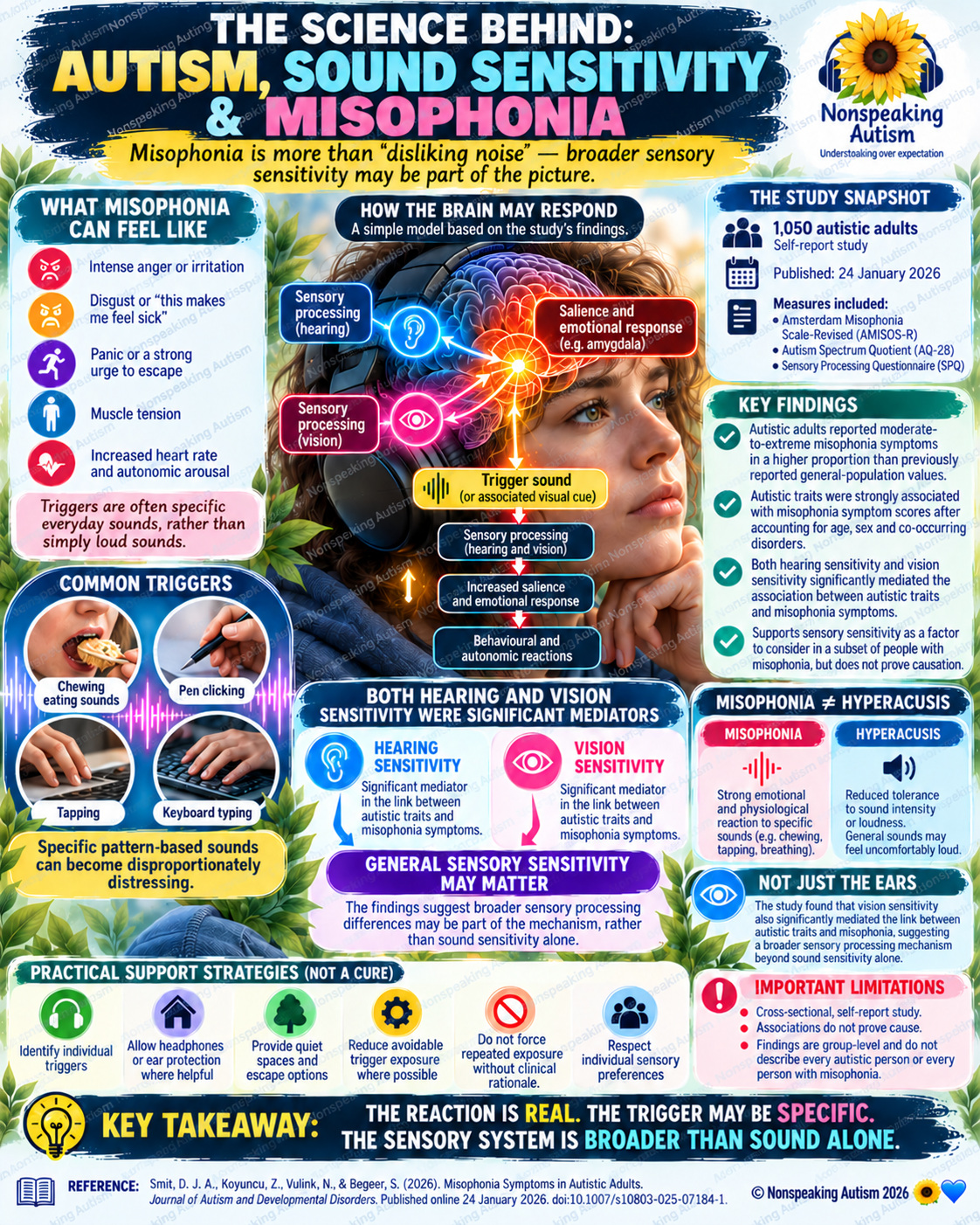
The Science Behind: Autism, Sound Sensitivity & Misophonia translates this research into an accessible educational poster for autistic people, families, educators and professionals.
The central message is:
The reaction is real. The trigger may be specific. The sensory system is broader than sound alone.
🧠 What This Poster Explores
This resource looks at:
- what misophonia can feel like
- common examples of trigger sounds
- autism and sensory sensitivity
- hearing sensitivity
- visual sensitivity
- emotional and physiological responses
- how misophonia differs from hyperacusis
- broader sensory-processing differences
- practical support strategies
- limitations of current research
It is designed to increase understanding without suggesting that every autistic person experiences misophonia or that every sound sensitivity is misophonia.
🎧 What Is Misophonia?
Misophonia involves strong adverse reactions to particular everyday sounds.
Importantly, the problem is not necessarily the volume of the sound.
Triggers can be relatively ordinary sounds that become disproportionately distressing to the individual.
Examples can include:
chewing or eating sounds
pen clicking
tapping
keyboard typing
breathing
and other repetitive or pattern-based sounds.
The 2026 study itself describes misophonia as an adverse emotional reaction to everyday sounds and specifically gives chewing and pen clicking as examples. PubMed
❤️ What Misophonia Can Feel Like
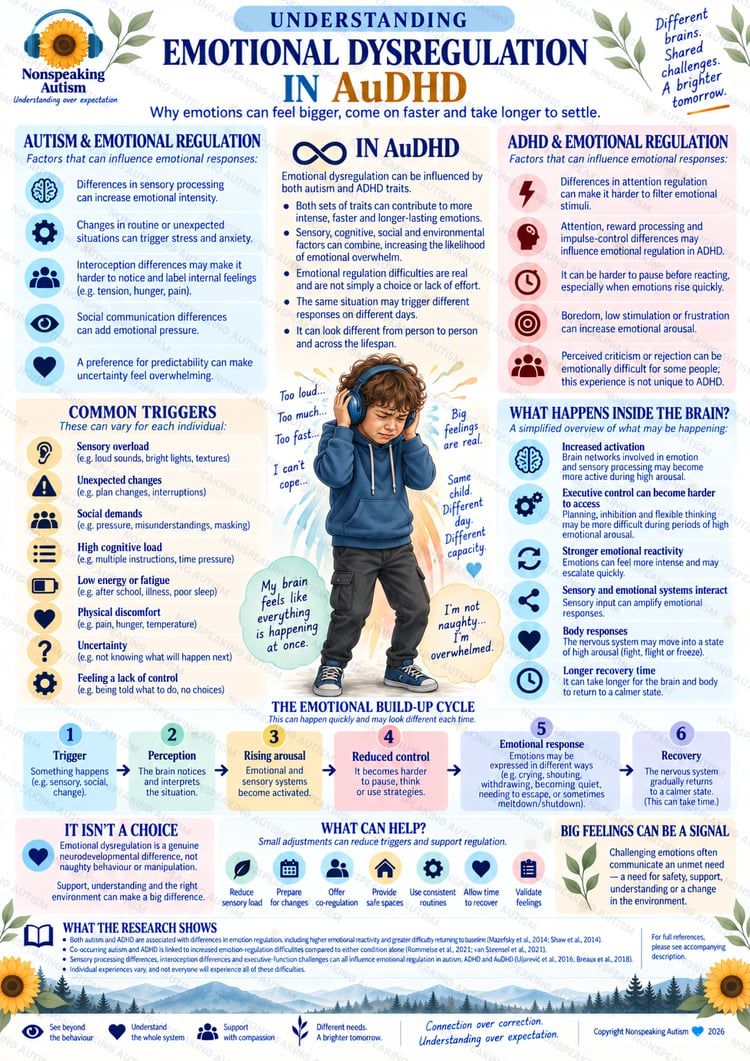
The response to a trigger may involve much more than dislike.
People may experience reactions such as:
- intense irritation or anger
- disgust
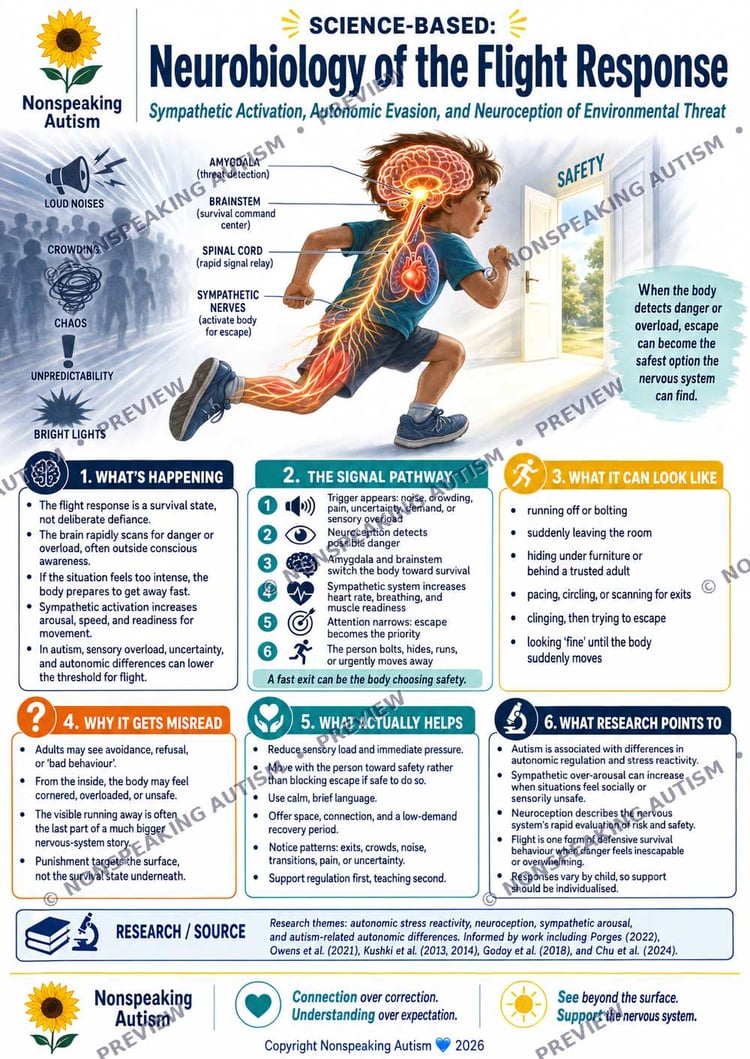
- a powerful urge to escape
- distress or panic-like feelings
- muscle tension
- physiological arousal
These experiences should not automatically be interpreted as overreaction, deliberate intolerance or poor behaviour.
The reaction can be intense even when the sound appears ordinary to somebody else.
🔊 Misophonia Is Not the Same as Hyperacusis
The poster makes an important distinction between misophonia and hyperacusis.
🎵 Misophonia
Misophonia involves strong emotional and physiological responses associated with particular trigger sounds or cues.
The sound does not necessarily need to be loud.
🔊 Hyperacusis
Hyperacusis generally concerns reduced tolerance to the intensity or loudness of sounds.
The two experiences can overlap, but they should not automatically be treated as interchangeable.
🧠 Autism & Misophonia — What Did the 2026 Study Find?
The poster is based primarily on a 2026 peer-reviewed study by Smit, Koyuncu, Vulink and Begeer.
The researchers studied:
1,050 autistic adults
Participants completed self-report measures including:
- Amsterdam Misophonia Scale-Revised — AMISOS-R
- Autism Spectrum Quotient — AQ-28
- Sensory Processing Questionnaire — SPQ
The study found that autistic participants reported moderate-to-extreme misophonia symptoms in a higher proportion than previously reported general-population values. The researchers also found that autistic-trait scores predicted misophonia symptom scores after accounting for several covariates. PubMed
👂 Hearing Sensitivity Matters
The researchers found that hearing sensitivity significantly mediated the relationship examined between autistic traits and misophonia symptoms.
This supports the idea that sensory sensitivity may be an important part of understanding misophonia symptoms in at least some autistic people. PubMed
But hearing was not the only sensory domain involved.
👁️ Not Just the Ears
One of the particularly interesting findings was that visual sensitivity also significantly mediated the relationship examined in the study. PubMed
This suggests that, for some people, misophonia may need to be considered within a broader sensory-processing picture, rather than assuming the experience concerns hearing alone.
This does not prove that visual sensitivity causes misophonia.
It shows an association within this study that deserves further investigation.
Our sensory systems do not operate completely in isolation.
🔬 A Simple Educational Model
The poster uses a simplified visual pathway to help explain the research:
Trigger sound or associated cue
↓
Sensory processing
↓
Increased salience and emotional response
↓
Behavioural and physiological reactions
This is an educational illustration, not a proven neurological sequence that occurs identically in every person with misophonia.
The study used questionnaires and statistical modelling; it did not directly image each participant's brain response to trigger sounds.
That distinction is important.
🌻 Practical Support Strategies — Not a Cure
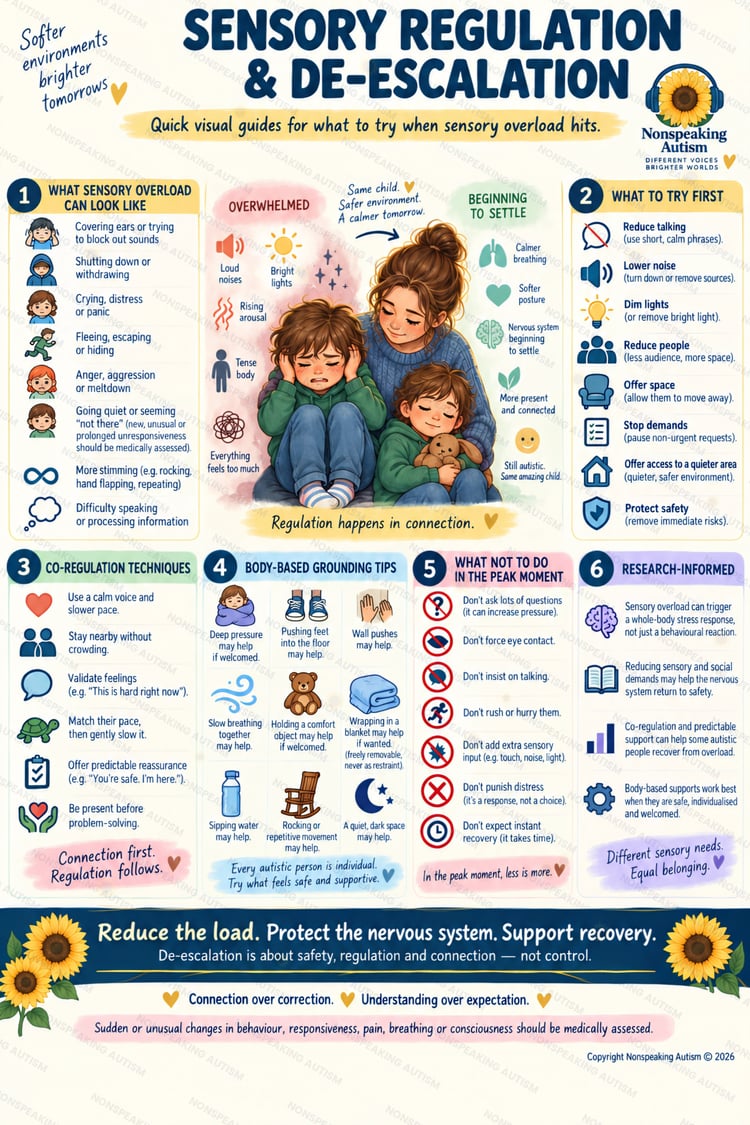
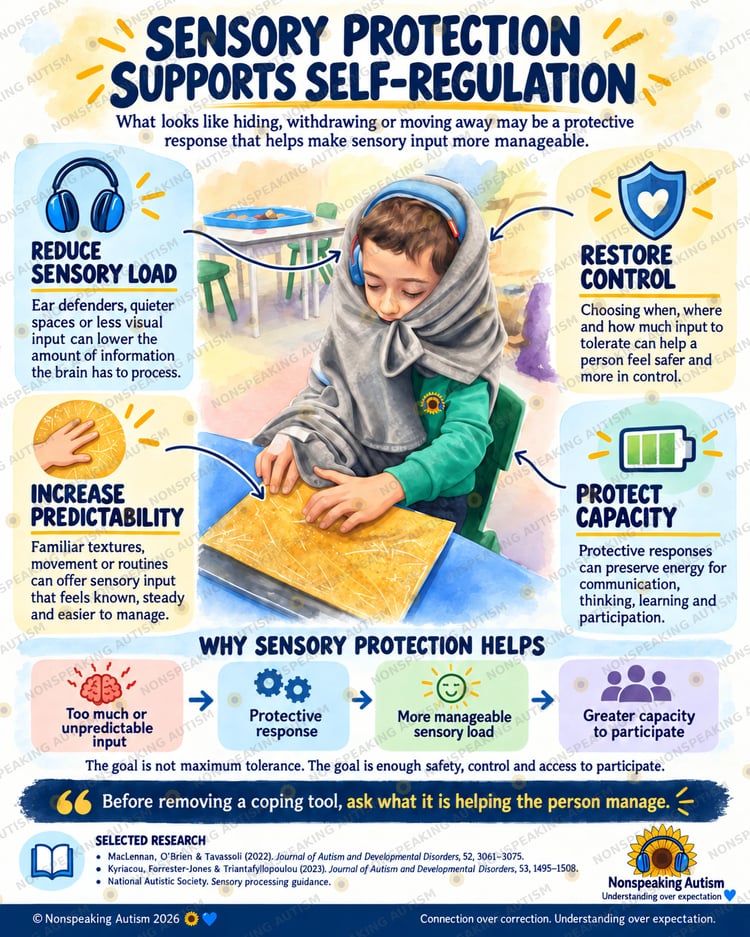
The poster encourages individualized, respectful support rather than forcing a person to repeatedly endure distressing triggers.
Possible strategies include:
🎧 Identify Individual Triggers
Learn which sounds or associated situations are particularly difficult for the person.
🏠 Provide Quiet Spaces & Escape Options
Having somewhere quieter to move to can reduce the feeling of being trapped with a trigger.
🎧 Allow Helpful Hearing Protection
Headphones or ear protection may be useful in some situations according to individual preference and circumstances.
⚙️ Reduce Avoidable Trigger Exposure
Where reasonable and practical, consider environmental changes that reduce unnecessary exposure.
🚫 Do Not Force Repeated Exposure Without Clinical Rationale
Repeated exposure should not automatically be assumed to be therapeutic.
👥 Respect Individual Sensory Preferences
Different autistic people can respond very differently to the same sound or environment.
Support should be individualized — not built around making the person tolerate everything.
⚠️ What the Research Does NOT Prove
This is particularly important for this poster.
The 2026 study was cross-sectional and based on self-report measures. Therefore, it can identify associations but cannot establish that autism, hearing sensitivity or visual sensitivity causes misophonia. PubMed
Its findings are also group-level findings.
They do not mean:
all autistic people have misophonia
all people with misophonia are autistic
all autistic sound sensitivity is misophonia
or
every person with misophonia has the same underlying mechanism.
The researchers themselves concluded that autistic traits and sensory sensitivity are factors worth considering for a subset of people experiencing misophonia. PubMed
🔬 Research-Informed
The principal study behind this poster was published online in the Journal of Autism and Developmental Disorders on 24 January 2026 and is listed as a peer-reviewed journal article. PubMed
The sample consisted of 1,050 autistic adults, and the research examined misophonia symptoms, autistic traits and sensory sensitivity. PubMed
The research supports careful consideration of broader sensory processing when understanding misophonia in autistic adults, while also leaving important questions about causality and individual mechanisms unanswered.
📚 Selected Research & Reference
Smit, D. J. A., Koyuncu, Z., Vulink, N., & Begeer, S. (2026). Misophonia Symptoms in Autistic Adults. Journal of Autism and Developmental Disorders. Advance online publication. DOI: 10.1007/s10803-025-07184-1. PubMed
Evidence Note
This study supports the broader educational discussion presented in the poster. It should not be interpreted as validating every individual example, support strategy or neurological illustration shown.
The poster's brain diagram is a simplified educational model, not an individualized brain scan or established diagnostic pathway.
👨👩👧 Who Is This Resource For?
This poster may be useful for:
- autistic adults
- autistic young people and their families
- parents and carers
- teachers and teaching assistants
- SENCOs and SEND teams
- occupational therapists
- psychologists
- speech and language therapists
- healthcare professionals
- mental-health professionals
- support workers
- autism organisations
- anyone wanting to better understand sound sensitivity and misophonia
It may be useful for personal education, staff training, professional reflection and conversations about sensory accessibility and accommodation.
📦 What You Receive
Your purchase includes:
1 × The Science Behind: Autism, Sound Sensitivity & Misophonia educational poster
1 × high-resolution printable digital PDF
The purchased file is supplied clear and without the promotional preview watermark visible on the Payhip listing image.
The watermark shown on preview images is for copyright and listing protection only.
Digital download only — no physical product will be shipped.
⚠️ Important Disclaimer
This is a research-informed educational resource and is not a diagnostic or screening tool.
It does not provide medical advice, psychological assessment, audiological assessment, occupational therapy assessment, diagnosis, therapy or individualized treatment recommendations.
Sound intolerance can have different causes and presentations. Misophonia, hyperacusis and other forms of sound sensitivity should not automatically be treated as interchangeable.
The practical strategies included are general educational suggestions rather than individualized clinical recommendations.
Significant, new, painful or unexplained changes in hearing or sound tolerance should receive appropriate professional assessment where indicated.
©️ Copyright & Permitted Use
Copyright © 2026 Nonspeaking Autism. All rights reserved.
Purchase permits use for personal/home use, your own classroom or educational setting, your own clinic or individual professional educational practice, and direct educational/support work with people you support.
The digital file may not be resold, redistributed, file-shared, uploaded elsewhere, commercially reproduced, altered for resale or incorporated into another product for sale or distribution.
💛 The Message Behind the Resource
A sound does not need to seem loud to everybody else for someone's response to it to be real.
A trigger may be extremely specific.
The response may involve emotion, physiology, sensory processing and a powerful need to escape.
And the research suggests that, for at least some autistic people, the wider sensory picture may matter too. PubMed
Understanding this changes the question from:
“Why can't they just ignore it?”
to:
“What are they experiencing, and how can we make this more manageable?”
The reaction is real. The trigger may be specific. The sensory system is broader than sound alone.
Connection over correction. Understanding over expectation. 💙🌻
© Nonspeaking Autism 2026