
The Science Behind Speech Access Under Stress — Part 2
The Science Behind Speech Access Under Stress — Part 2: Brain, Body & Speech Under Stress
How stress, overload and communication demands can make speech harder to access — even when understanding is still there.
Speech is not simply an on/off ability. For some autistic people, access to spoken language can change depending on stress, sensory load, fatigue, social pressure, uncertainty and communication demands.
A person may understand what is being said, know what they want to communicate and still find that spoken words become quieter, shorter, delayed or temporarily unavailable.
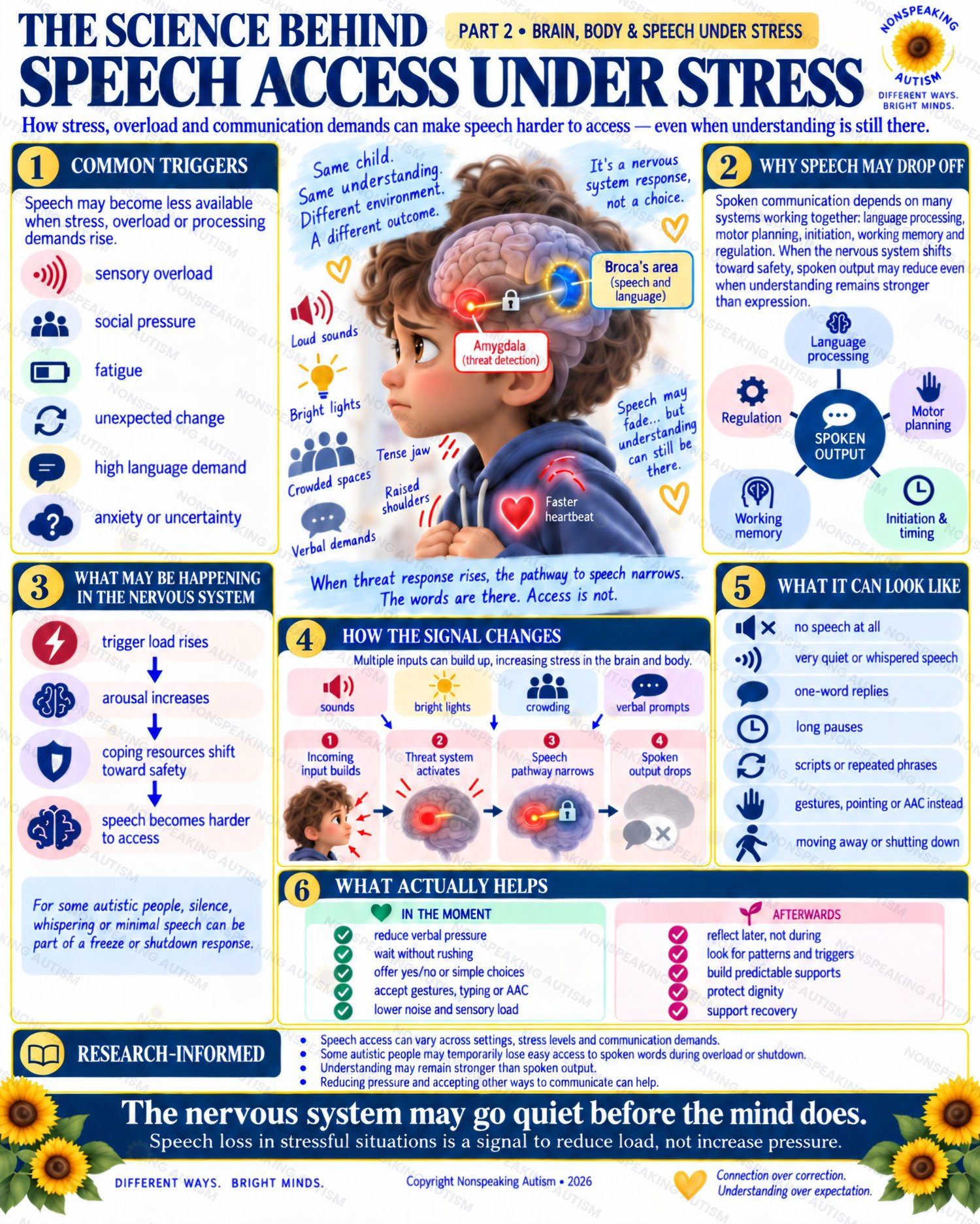
This research-informed educational poster explores what may be happening in the brain, body and nervous system when speech becomes harder to access under stress.
💙 Same child. Same understanding. Different environment. A different outcome.
🧠 Why Speech May Become Harder Under Stress
Spoken communication depends on several systems working together.
These include:
- Language processing
- Motor planning
- Working memory
- Initiation and timing
- Attention and regulation
- Coordinating thoughts into spoken output
When demands rise and the nervous system shifts toward protection or safety, these processes may become harder to coordinate.
The result can be reduced spoken output even when understanding remains stronger than expression.
This is an important distinction.
A reduction in speech does not automatically mean a reduction in comprehension, intelligence, awareness or desire to communicate.
⚡ Common Triggers
Speech may become less available when stress, overload or processing demands increase.
Possible triggers explored in this poster include:
- Sensory overload
- Social pressure
- Fatigue
- Unexpected changes
- High language demands
- Anxiety or uncertainty
- Loud sounds
- Bright lights
- Crowded environments
- Repeated verbal demands
Several of these demands may occur at the same time, creating a cumulative load on the nervous system.
🧠 What May Be Happening in the Nervous System
When a person experiences increasing stress or overload, their nervous system may begin prioritising immediate regulation and safety.
The poster illustrates a possible progression:
Trigger load rises → arousal increases → coping resources shift toward safety → speech becomes harder to access.
For some autistic people, silence, whispering or minimal speech may occur alongside a freeze or shutdown response.
This is why increasing verbal pressure during these moments may be counterproductive.
Sometimes the most supportive response is to reduce the demand rather than demand more speech.
🔄 How the Signal Can Change
Multiple inputs can build simultaneously.
Sounds, bright lights, crowds, verbal prompts, uncertainty and other demands can increase stress within the brain and body.
The poster visually explores the process as:
Incoming input builds → threat/safety systems activate → the pathway to speech narrows → spoken output drops.
This is presented as an accessible educational model rather than a literal representation of one single neurological pathway.
The central message remains:
The words may still be there even when access to them is not.
💬 What Reduced Speech Access Can Look Like
Speech under stress can look different for different people.
It may include:
- No speech at all
- Very quiet or whispered speech
- One-word replies
- Long pauses
- Scripts or repeated phrases
- Gestures or pointing
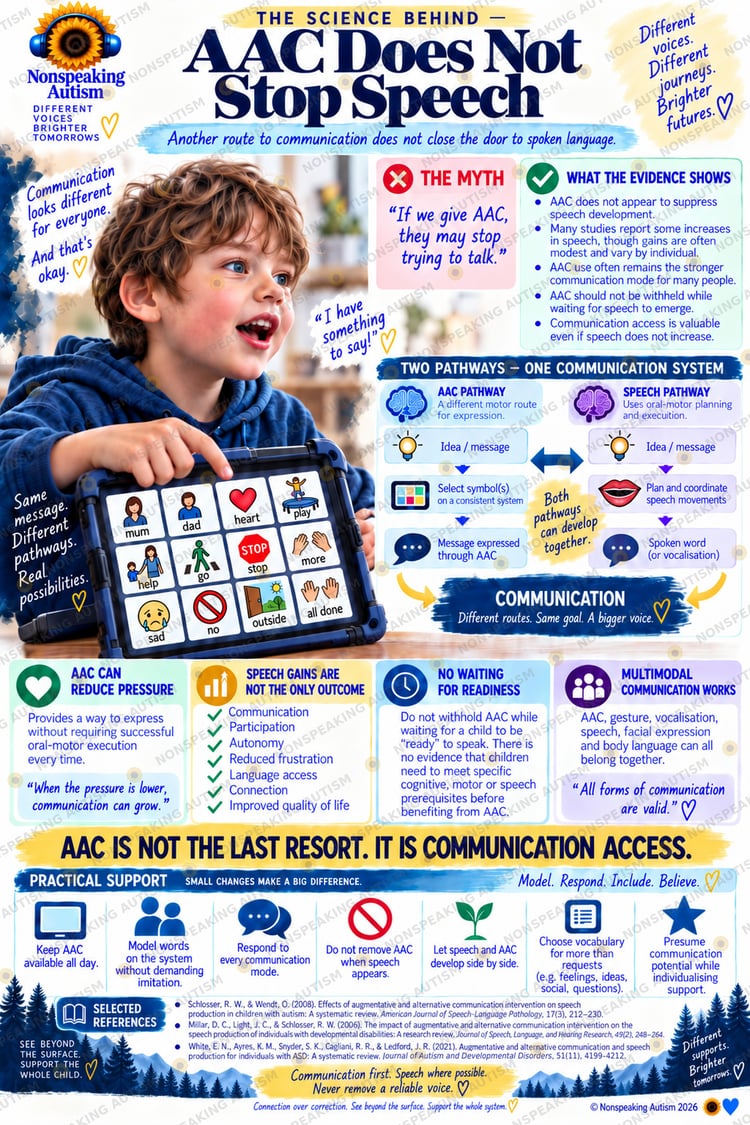
- Typing or AAC instead of speech
- Moving away
- Becoming very quiet
- Shutting down
Alternative communication should not be treated as a lesser form of communication.
If someone can communicate more effectively through AAC, typing, gestures, pointing or simple choices, those methods can provide valuable access while spoken language is difficult.
💚 What Can Help in the Moment
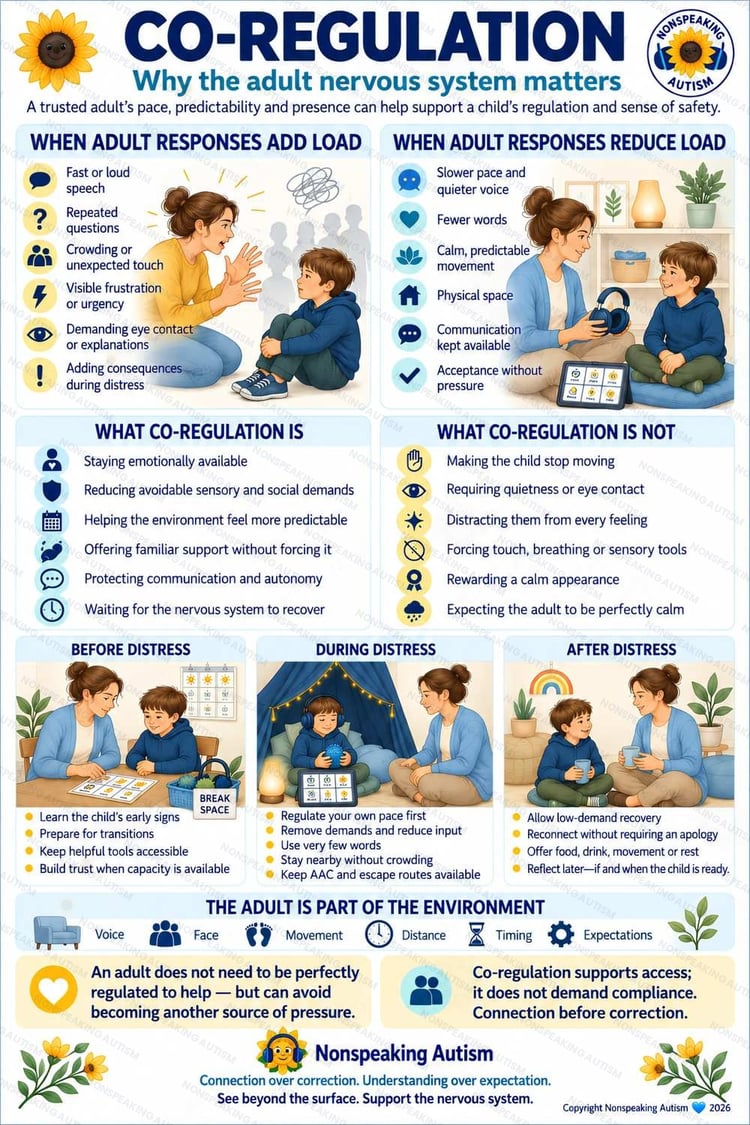
When speech access reduces, support should focus on lowering unnecessary demands and making communication easier.
Helpful approaches may include:
Reducing verbal pressure — avoid repeatedly asking the person to explain or speak.
Waiting without rushing — processing and responding may require considerably more time.
Offering yes/no or simple choices — reducing language demands can make responding more manageable.
Accepting gestures, typing or AAC — communication matters more than the particular method used.
Lowering noise and sensory load — reducing competing input may free up capacity for regulation and communication.
The aim is not to force speech back online as quickly as possible.
The aim is to support safety, regulation, dignity and accessible communication.
🌱 What Can Help Afterwards
Once the immediate stress has passed, it may be helpful to:
- Reflect later rather than during the difficult moment
- Look for recurring patterns and triggers
- Build greater predictability
- Develop individualised supports
- Protect the person's dignity
- Allow time for recovery
- Consider which communication methods were easiest to access
Understanding what happened can help reduce the likelihood of repeating the same overwhelming conditions.
💙 Understanding Before Expectation
A person who cannot easily speak in a stressful moment may still be listening.
They may still understand.
They may still have something they desperately want to communicate.
Their nervous system may simply have fewer resources available for producing spoken language at that moment.
This poster encourages adults to move away from:
“I know you can talk, so tell me.”
and towards:
“I can see speaking is difficult right now. Let's make communication easier.”
That difference can protect both communication and connection.
🏫 Ideal For
This educational resource may be particularly useful for:
- Autistic people and their families
- Parents and carers
- SEND teachers
- Teaching assistants
- SENCOs
- Mainstream and specialist schools
- Speech and language settings
- Occupational therapy environments
- Autism professionals
- Support workers
- Healthcare and clinical environments
- Sensory and regulation spaces
- Staff training
- Neurodiversity education
- AAC and communication-support environments
It can be displayed in classrooms, staff rooms, therapy spaces, clinics, family-support environments and other settings where a clearer understanding of autistic communication may help.
🔬 Research-Informed
This poster is designed as a research-informed educational resource.
It reflects evidence and clinical understanding that communication access can vary across environments and may be influenced by stress, sensory processing, communication demands, overload and nervous-system regulation.
Some autistic people report temporarily reduced access to spoken language during periods of intense overload, shutdown or distress.
The poster also recognises that understanding can remain stronger than spoken output and that reducing pressure while accepting alternative forms of communication may be supportive.
The simplified brain and nervous-system illustrations are intended to make complex concepts accessible. They should not be interpreted as literal brain scans or as demonstrating a single proven neurological mechanism responsible for situational speech loss.
Individual autistic experiences vary considerably.
📦 What You Receive
Your purchase includes:
1 × The Science Behind Speech Access Under Stress — Part 2: Brain, Body & Speech Under Stress
This is a digital educational poster from Nonspeaking Autism.
Your download includes:
1 × High-quality PDF — A2 size (420 × 594 mm)
Suitable for professional or home printing.
The purchased PDF is supplied clear and without the promotional preview watermark. Watermarks visible on Payhip listing images are used only for preview and copyright-protection purposes.
Digital PDF download only — no physical product will be shipped.
⚠️ Important Educational Disclaimer
This poster is provided for education, awareness and general informational purposes only.
It is not a diagnostic tool and does not replace medical advice, individual assessment, speech and language therapy, psychological advice or other professional support.
Reduced or absent speech should not automatically be assumed to result from autism, sensory overload, anxiety, freeze, shutdown or nervous-system stress.
There are many possible reasons for changes in speech.
Sudden or unexplained loss or alteration of speech can be a medical emergency, particularly when accompanied by facial drooping, weakness, severe headache, confusion, altered consciousness or other sudden neurological symptoms. Seek urgent medical assistance where appropriate.
Persistent or concerning changes in communication should be discussed with an appropriately qualified professional.
The experiences represented in this poster will not apply to every autistic or nonspeaking person.
©️ Copyright & Permitted Use
Copyright © Nonspeaking Autism 2026. All rights reserved.
Your purchase is intended for the purchaser's personal, educational or professional use.
You may print and display your purchased copy in your own home, classroom, educational environment, therapy space, clinic or workplace.
The digital file may not be resold, redistributed, shared as a digital download, uploaded to file-sharing websites, reproduced for commercial distribution, altered for resale or incorporated into another product for sale without permission.