
🌻 The Environment May Be the Trigger How everyday settings can contribute to distress
🌻 The Environment May Be the Trigger
How everyday settings can contribute to distress
Autism Professional Poster | A2 Printable | UK Edition
For hospitals, schools, therapy services and care settings.
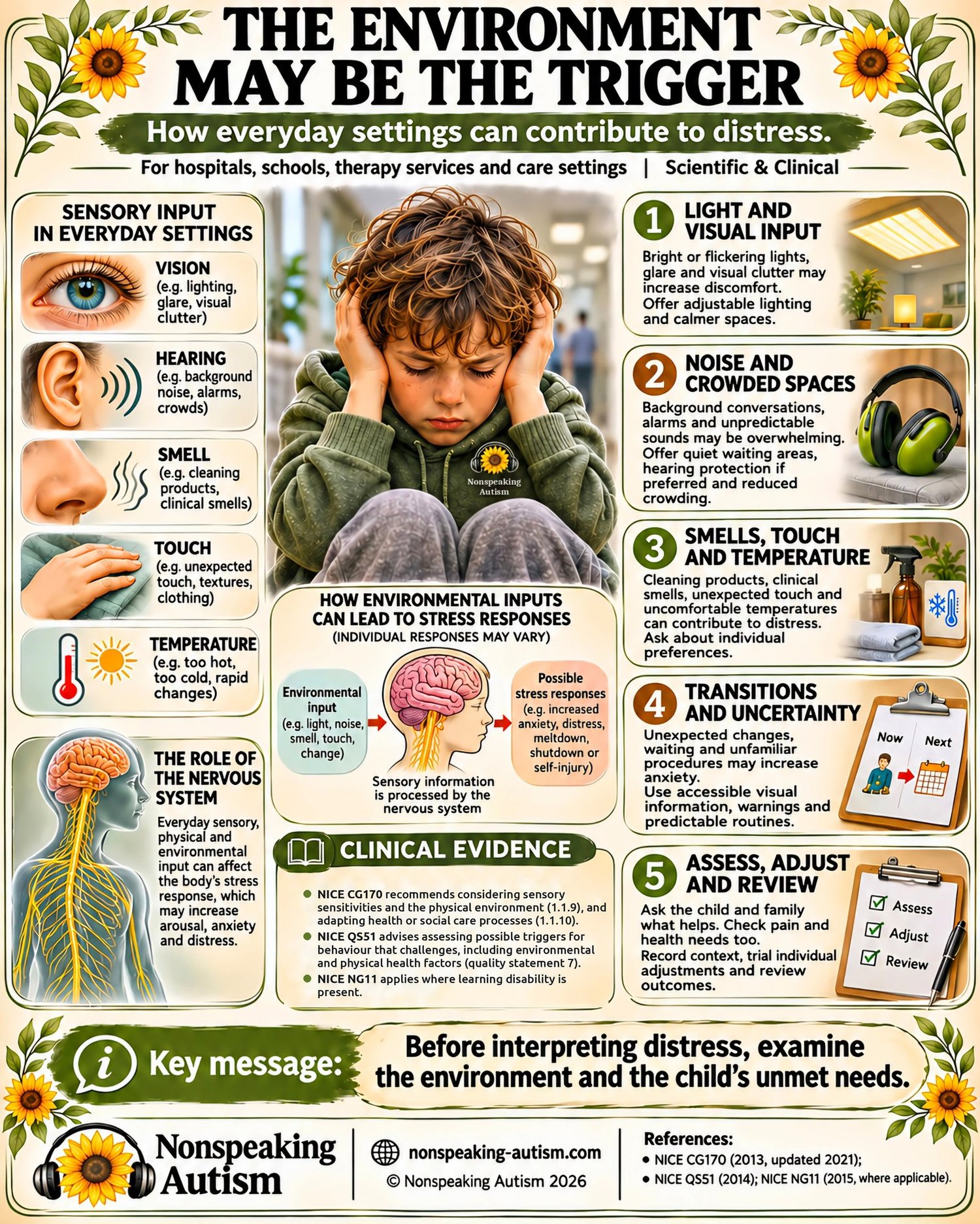
Bright lights, background noise, strong smells, unexpected touch, uncomfortable temperatures and unpredictable changes are part of everyday life in busy settings. For many autistic children, especially nonspeaking children, these inputs can build up into real distress, which may then be misread as "behaviour".
The Environment May Be the Trigger is an illustrated A2 poster that helps professionals look at the setting first, and make practical adjustments that reduce distress.
Before interpreting distress, examine the environment and the child's unmet needs.
🧠 WHAT THIS POSTER COVERS
Sensory input in everyday settings
- Vision (e.g. lighting, glare, visual clutter)
- Hearing (e.g. background noise, alarms, crowds)
- Smell (e.g. cleaning products, clinical smells)
- Touch (e.g. unexpected touch, textures, clothing)
- Temperature (e.g. too hot, too cold, rapid changes)
The role of the nervous system
Everyday sensory, physical and environmental input can affect the body's stress response, which may increase arousal, anxiety and distress. A simple diagram shows how environmental input can lead to stress responses such as anxiety, meltdown, shutdown or self-injury (individual responses may vary).
Five areas to check and adjust
1. Light and visual input
Bright or flickering lights, glare and visual clutter may increase discomfort. Offer adjustable lighting and calmer spaces.
2. Noise and crowded spaces
Background conversations, alarms and unpredictable sounds may be overwhelming. Offer quiet waiting areas, hearing protection if preferred and reduced crowding.
3. Smells, touch and temperature
Cleaning products, clinical smells, unexpected touch and uncomfortable temperatures can contribute to distress. Ask about individual preferences.
4. Transitions and uncertainty
Unexpected changes, waiting and unfamiliar procedures may increase anxiety. Use accessible visual information, warnings and predictable routines.
5. Assess, adjust and review
Ask the child and family what helps. Check pain and health needs too. Record context, trial individual adjustments and review outcomes.
👩⚕️ WHO IS THIS POSTER FOR?
- Hospital wards, A&E, outpatient and dental teams
- GP surgeries and community health services
- Specialist and mainstream schools, SENCOs and teaching staff
- Speech and language therapists and occupational therapists
- CAMHS, learning disability and positive behaviour support teams
- Social care, residential and respite settings
- Parents and carers who want to share it with professionals
Ideal for staff rooms, waiting areas, clinical spaces and training sessions.
📦 WHAT YOU RECEIVE
- A2 print-ready PDF (420 x 594 mm)
- A2 high-resolution image (300 DPI)
Instant digital download. No physical product will be posted.
The downloadable files are provided without a watermark.
🔗 FURTHER RESOURCES
NICE CG170 – Autism spectrum disorder in under 19s: support and management
https://www.nice.org.uk/guidance/cg170
NICE QS51, Quality statement 7: Assessing possible triggers for behaviour that challenges
https://www.nice.org.uk/guidance/qs51/chapter/Quality-statement-7-Assessing-possible-triggers-for-behaviour-that-challenges
NICE NG11 – Challenging behaviour and learning disabilities: prevention and interventions for people with learning disabilities whose behaviour challenges
https://www.nice.org.uk/guidance/ng11
National Autistic Society – Sensory differences
https://www.autism.org.uk/advice-and-guidance/topics/sensory-differences/sensory-differences/all-audiences
📚 RESEARCH & REFERENCES
Mapped to poster sections:
- Sensory input in everyday settings, 1. Light and visual input, 2. Noise and crowded spaces and 3. Smells, touch and temperature: NICE CG170, recommendation 1.1.9 (considering individual sensory sensitivities to lighting, noise levels and the colour of walls and furnishings, and adapting the physical environment); National Autistic Society, Sensory differences.
- 4. Transitions and uncertainty: NICE CG170, recommendations 1.1.9 (visual supports) and 1.1.10 (adjusting care processes, e.g. minimising waiting time).
- The role of the nervous system and How environmental inputs can lead to stress responses: NICE CG170, recommendation 1.4.1 (sensory and environmental factors as possible triggers of distress).
- 5. Assess, adjust and review: NICE QS51, Quality statement 7 (assessing possible triggers, including the environment and physical health); NICE CG170, recommendations 1.4.1–1.4.4; NICE NG11 (where a learning disability is present).
Foundational references (printed on the poster):
1. National Institute for Health and Care Excellence (2013, updated 2021). Autism spectrum disorder in under 19s: support and management (CG170), recommendations 1.1.9–1.1.10.
2. National Institute for Health and Care Excellence (2014). Autism (QS51).
3. National Institute for Health and Care Excellence (2015). Challenging behaviour and learning disabilities: prevention and interventions for people with learning disabilities whose behaviour challenges (NG11), where applicable.
Sources:
- NICE CG170 full guideline PDF (mirror used to check 1.1.9–1.1.10)
- NICE QS51, Quality statement 7
- NICE NG11
⚠️ IMPORTANT DISCLAIMER
This resource is for educational and information purposes only.
It is not a diagnostic tool, sensory assessment, clinical protocol or substitute for professional advice. The nervous system illustrations are conceptual and simplified, and individual responses vary.
Distress may have sensory, environmental, medical, emotional or communication-related causes, so always check for pain and physical health needs too. If a child is injured, seriously unwell or at immediate risk, contact NHS 111, or call 999 in an emergency.
All support should respect the child's communication, dignity, preferences, safety and wellbeing.
©️ COPYRIGHT & PERMITTED USE
© 2026 Nonspeaking Autism. All rights reserved.
For use in one home, classroom, clinic or setting only.
Please keep the original branding and copyright notice intact. The digital file must not be resold, modified, redistributed, uploaded to other websites or included in commercial products without permission.
💛 PLEASE LEAVE US FEEDBACK
If you find this poster helpful, please consider leaving a review on Payhip. We would love to hear how you used it and what you would like us to create next.
Thank you for supporting Nonspeaking Autism! 🌻
Connection over correction. Understanding over expectation.
Nonspeaking Autism © 2026
nonspeaking-autism.com