
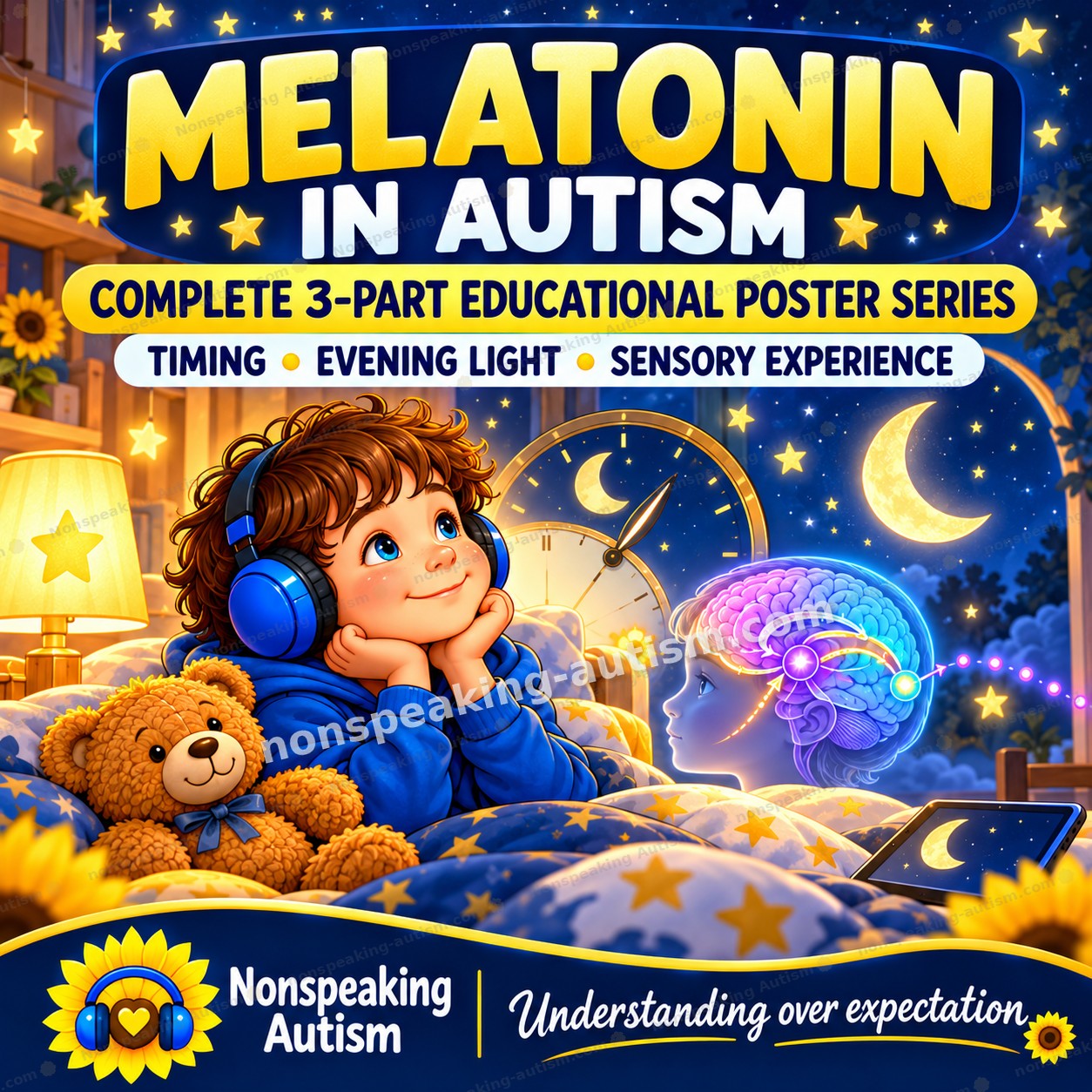
🌙 MELATONIN IN AUTISM
🌙 MELATONIN IN AUTISM
Complete 3-Part Educational Poster Series
Understanding Sleep Timing, Evening Light, and Sensory Experiences in Autistic Children
💙 Nonspeaking Autism | Research-Informed Educational Collection | A2 Printable Posters
Understanding over expectation. Supporting sleep through knowledge, compassion, and individual needs.
🌻 ABOUT THIS EDUCATIONAL POSTER COLLECTION
Sleep can be complicated for autistic children.
Some children find it difficult to fall asleep at the expected time. Others experience irregular sleep patterns, difficulty settling in the evening, sensitivity to light, or challenges with bedtime routines.
Families may hear that autistic children have low melatonin levels or that screens and evening light are always responsible for sleep difficulties.
However, the science is more complex.
Melatonin timing, melatonin amount, environmental light, sensory comfort, and individual sleep patterns are related — but they are not interchangeable.
This three-part educational poster collection explores what research tells us about melatonin in autism, how evening light influences the body's biological sleep signal, and why sensory comfort and biological responses to light must be considered separately.
Designed for families, caregivers, educators, and professionals, the collection presents complex scientific concepts through accessible explanations, colorful illustrations, simplified diagrams, and practical support considerations.
The central message is simple:
Understand the science. Respect the child's experience. Support sleep without making assumptions.
🧠 WHAT THIS 3-PART COLLECTION EXPLORES
🌙 PART 1 OF 3 — MELATONIN IN AUTISM
Timing Versus Amount
A later sleep signal is not the same as a lower hormone level.
The first poster introduces melatonin and explains why it is important to distinguish between when melatonin rises and how much melatonin is produced.
🔬 How the Melatonin Sleep Signal Works
Melatonin is a hormone involved in communicating biological night to the body.
The poster explains a simplified pathway involving:
- Light reaching the eyes — Specialized retinal cells detect environmental light.
- The brain's biological clock — The suprachiasmatic nucleus (SCN), located in the hypothalamus, receives information about light.
- Indirect neural signaling — The SCN influences the pineal gland through a multisynaptic neural pathway.
- The pineal gland — Melatonin production and secretion generally increase during biological night.
Melatonin contributes to sleep timing, but it does not act as an on/off switch that guarantees sleep.
⏰ Later Melatonin Timing
For some autistic children, the evening rise in melatonin may occur later.
This may mean that the body's biological night begins later than expected.
A child may not feel ready for sleep at the time adults expect, even when bedtime routines are consistent.
Later timing does not automatically mean that the body produces less melatonin overall.
📉 Lower Melatonin Amount
Some studies have reported lower melatonin levels in certain autistic groups.
However, findings vary across studies, and melatonin levels alone do not reliably explain an individual child's sleep difficulties.
💙 Key Learning Points
- Melatonin helps signal biological night.
- Timing and amount are different measurements.
- Some autistic children may have differences in melatonin timing or levels.
- Research findings are mixed.
- Sleep difficulties can have many contributing factors.
- No single melatonin pattern applies to every autistic child.
The first poster encourages families to understand the difference between a delayed sleep signal and a reduced hormone level.
🌟 PART 2 OF 3 — MELATONIN IN AUTISM
Evening Light, Screens, and the Sleep Signal
Evening light may influence melatonin and biological timing, but the effects vary between children.
The second poster explores how environmental light can affect the body's sleep–wake timing system.
💡 How Evening Light Influences the Sleep Signal
Specialized retinal cells containing melanopsin are particularly important in detecting light relevant to circadian regulation.
Signals from these cells travel to the brain's biological clock, which helps coordinate the timing of melatonin secretion.
Light exposure in the evening or at night may suppress melatonin or influence biological timing.
However, the effect depends on several factors.
🔍 Five Factors That May Influence the Effect
1. Brightness
Brighter light generally has a stronger potential effect on melatonin than dimmer light, although responses vary.
2. Color and Spectrum
Shorter-wavelength light, including blue-rich light, can have a relatively strong effect on the circadian system.
Warmer, redder lighting often has a smaller effect at comparable exposure conditions, but color alone does not determine the outcome.
3. Timing
Light exposure during the evening or biological night can affect melatonin differently from light experienced during the daytime.
4. Duration
Longer exposures may have greater effects, although brief exposures can also matter depending on the circumstances.
5. Individual Response
Children differ in their sensitivity to light.
Age, health, environment, timing, previous light exposure, and other individual factors may influence the response.
📱 Understanding Screens Without Blame
Screens can be part of an autistic child's preferred routine, communication, leisure, or emotional regulation.
A familiar screen activity may feel calming and predictable.
At the same time, light from a screen may influence the biological sleep signal.
Something can feel emotionally regulating while still having a physiological effect on circadian timing.
This does not mean every autistic child needs the same screen restrictions.
It means families may benefit from considering the child's complete sleep pattern rather than applying rigid rules.
🌻 Practical Support Considerations
- Try comfortable, dimmer evening lighting where appropriate.
- Consider reducing unnecessary bright light close to bedtime.
- Respect familiar and helpful routines.
- Observe sleep onset, night waking, total sleep time, and daytime functioning.
- Consider screen brightness, timing, duration, and the child's preferences.
- Seek individualized professional guidance when sleep difficulties persist.
The goal is not to remove every activity a child enjoys. It is to understand possible influences and make thoughtful adjustments.
🌌 PART 3 OF 3 — LIGHT SENSITIVITY & MELATONIN
What Evening Light Research Does — and Does Not — Tell Us
Light can influence the biological sleep signal, but sensory comfort and melatonin responses are not the same thing.
The third poster explores an important distinction that is sometimes overlooked in discussions about autism and sleep.
👁️ Sensory Discomfort From Light
For some autistic children, certain types of lighting may feel uncomfortable, distracting, or overwhelming.
Possible difficulties include:
- Bright lighting.
- Flickering lights.
- Glare.
- Blue-rich light.
- Unpredictable changes in lighting.
- Visually busy environments.
A child may squint, cover their eyes, move away, or become distressed.
These responses should be considered within the child's individual sensory profile.
Sensory discomfort is a real experience and deserves appropriate accommodation.
🌙 The Biological Sleep Signal
A light source can influence circadian signaling even when it feels comfortable or calming.
For example, a child might enjoy a familiar evening tablet activity and appear relaxed.
However, the light emitted by the device may still influence melatonin timing or secretion.
Equally, discomfort from a bright light does not tell us exactly how much that light affects an individual's melatonin.
🔬 What the Research Shows
The poster discusses experimental research involving typically developing preschool children who were exposed to evening light.
In the study highlighted, researchers reported substantial average melatonin suppression under the specific exposure conditions tested.
The poster reports:
- 36 typically developing preschool children aged 3–4 years.
- One hour of evening light exposure, approximately 5–5,000 lux.
- Salivary melatonin measurements.
- An average suppression figure of 85.4% across the study group, as presented in the poster.
⚠️ Important Research Interpretation
These findings must not be presented as proof that autistic children experience the same degree of melatonin suppression.
The study was conducted with typically developing preschool children, not an autistic sample.
It also does not establish that children experience twice the melatonin suppression, or that all children respond identically.
The findings illustrate that evening light can influence melatonin under particular experimental conditions.
They do not establish a universal response for every child.
💛 Practical Support Considerations
- Adjust lighting brightness and color where comfortable.
- Consider reducing unnecessary evening light exposure.
- Respect familiar activities that help the child feel settled.
- Look at the whole sleep pattern rather than one habit.
- Consider sensory discomfort separately from circadian effects.
- Seek professional guidance when sleep problems affect health, well-being, or daily functioning.
Understand the light. Respect the child. Support sleep.
🌿 WHY SLEEP SUPPORT MUST BE INDIVIDUALIZED
Autistic children do not all have the same sleep needs, sensory preferences, routines, or biological rhythms.
A strategy that helps one child may be ineffective or uncomfortable for another.
Sleep difficulties may involve several interacting factors, including:
- Circadian timing.
- Sensory differences.
- Anxiety or uncertainty.
- Environmental noise or light.
- Physical discomfort or pain.
- Medication effects.
- Medical conditions.
- Bedtime routines.
- Daytime activity and light exposure.
- Individual communication and support needs.
Families may need to explore more than one possible explanation.
The purpose of this collection is not to identify a single cause of sleep difficulties.
It is to encourage a more informed and compassionate understanding of how different factors may contribute.
💡 PRACTICAL SUPPORT FOR FAMILIES AND CAREGIVERS
These posters encourage flexible, individualized approaches rather than rigid bedtime expectations.
🌙 Make the Evening Environment Comfortable
Consider lighting, noise, temperature, bedding, and other sensory factors.
💙 Respect Helpful Routines
Predictability can be reassuring for some children. Familiar activities may form an important part of settling.
⏰ Consider Timing
Observe when the child naturally becomes sleepy, while also considering their overall sleep needs and daytime functioning.
📱 Approach Screens Thoughtfully
Rather than assuming screens are always harmful or always helpful, consider their role in regulation, their light output, and their relationship with sleep.
🧸 Support Communication
Children may communicate discomfort, tiredness, or the need for a change through AAC, speech, movement, gestures, sounds, or other individual signals.
🩺 Seek Professional Advice When Needed
Persistent difficulty falling asleep, frequent night waking, significant daytime sleepiness, snoring, breathing concerns, or changes in sleep patterns may warrant assessment by an appropriate healthcare professional.
Supporting sleep should not require ignoring the child's sensory needs, communication, or well-being.
🔬 RESEARCH-INFORMED EDUCATIONAL CONTENT
This collection draws on published research concerning melatonin, circadian timing, light exposure, and sleep-related differences.
The posters distinguish between:
- Findings involving autistic participants.
- Findings from typically developing children.
- Research involving adults.
- Established biological mechanisms.
- Findings that remain variable or uncertain.
This distinction matters because results from one population or experimental setting cannot automatically be generalized to every autistic child.
📚 SELECTED RESEARCH & REFERENCES
Goldman, S. E., et al. (2014).
Research examining endogenous melatonin in autistic children, including variation in reported timing and levels.
Journal of Autism and Developmental Disorders.
https://doi.org/10.1007/s10803-014-2123-9
Martínez-Cayuelas, E., et al. (2022).
Research examining later dim-light melatonin onset in an autistic sample compared with controls.
Frontiers in Neurology, 13, 813692.
https://doi.org/10.3389/fneur.2022.813692
Arendt, J., & Aulinas, A. (2022).
Physiology of the Pineal Gland and Melatonin.
Endotext. National Center for Biotechnology Information Bookshelf.
https://www.ncbi.nlm.nih.gov/books/NBK550972/
Chang, A.-M., et al. (2015).
Evening use of light-emitting eReaders negatively affects sleep, circadian timing, and next-morning alertness.
Proceedings of the National Academy of Sciences.
https://doi.org/10.1073/pnas.1418490112
Hartstein, L. E., et al. (2022).
High sensitivity of melatonin suppression response to evening light in preschool-aged children.
Journal of Pineal Research, 72(2), e12780.
https://doi.org/10.1111/jpi.12780
Oner, Lenker, & Durmus (2025).
Review of indoor light exposure and related considerations in autistic people, as referenced in Part 2.
Building and Environment.
https://doi.org/10.1016/j.buildenv.2025.113138
Further Resources • Arendt & Aulinas – Physiology of the Pineal Gland and Melatonin (Endotext, free to read): https://www.endotext.org/wp-content/uploads/pdfs/physiology-of-the-pineal-gland-and-melatonin.pdf • Hartstein et al. (2022) – full paper (free to read, University of Colorado Sleep and Development Lab): https://www.colorado.edu/lab/sleepdev/sites/default/files/attached-files/journal_of_pineal_research_-_2022_-_hartstein_-_high_sensitivity_of_melatonin_suppression_response_to_evening_light_in.pdf Research & References Part 1 – Timing versus amount: • Martinez-Cayuelas, E., Gavela-Pérez, T., Rodrigo-Moreno, M., Merino-Andreu, M., Vales-Villamarín, C., Pérez-Nadador, I., Garcés, C., & Soriano-Guillén, L. (2022). Melatonin rhythm and its relation to sleep and circadian parameters in children and adolescents with autism spectrum disorder. Frontiers in Neurology, 13, 813692. https://doi.org/10.3389/fneur.2022.813692 • Goldman, S. E., Adkins, K. W., Calcutt, M. W., Carter, M. D., Goodpaster, R. L., Wang, L., Shi, Y., Burgess, H. J., Hachey, D. L., & Malow, B. A. (2014). Melatonin in children with autism spectrum disorders: endogenous and pharmacokinetic profiles in relation to sleep. Journal of Autism and Developmental Disorders, 44(10), 2525–2535. https://doi.org/10.1007/s10803-014-2123-9 Parts 1–3 – The sleep signal pathway: • Arendt, J., & Aulinas, A. (2022, updated 27 October). Physiology of the pineal gland and melatonin. In Endotext. NCBI Bookshelf ID: NBK550972. https://www.ncbi.nlm.nih.gov/books/NBK550972/ Part 2 – Evening light and screens: • Chang, A.-M., Aeschbach, D., Duffy, J. F., & Czeisler, C. A. (2015). Evening use of light-emitting eReaders negatively affects sleep, circadian timing, and next-morning alertness. Proceedings of the National Academy of Sciences, 112(4), 1232–1237. https://doi.org/10.1073/pnas.1418490112 • Oner, Lenker, & Durmus (2025). Effects of evening indoor light exposure on sleep and circadian functioning in autistic people: a scoping review. Building and Environment, 280, 113138. https://doi.org/10.1016/j.buildenv.2025.113138 Parts 2 & 3 – Young children's sensitivity to evening light: • Hartstein, L. E., Diniz Behn, C., Akacem, L. D., Stack, N., Wright, K. P., & LeBourgeois, M. K. (2022). High sensitivity of melatonin suppression response to evening light in preschool-aged children. Journal of Pineal Research, 72(2), e12780. https://doi.org/10.1111/jpi.12780 Foundational references (printed on the posters): Martinez-Cayuelas et al. (2022) • Goldman et al. (2014) • Arendt & Aulinas (2022) • Chang et al. (2015) • Hartstein et al. (2022) • Oner, Lenker & Durmus (2025)
Sources:
- Arendt & Aulinas – Endotext PDF
- Hartstein et al. 2022 – full paper (University of Colorado)
- Chang et al. 2015 (OpenAlex)
Oner, Lenker & Durmus 2025 (Penn State)
📖 Evidence Note
Research findings vary by study population, light exposure conditions, measurement methods, and individual characteristics.
The illustrated pathways and graphs in these posters are educational simplifications, not individual brain scans, diagnostic tests, or measurements of a particular child's melatonin levels.
The collection should not be interpreted as establishing a universal melatonin difference in autism.
👨👩👧 WHO IS THIS COLLECTION FOR?
This educational collection may be useful for:
- Parents and caregivers of autistic children.
- Families of nonspeaking and minimally speaking autistic children.
- Families exploring sleep and sensory differences.
- Special educational needs and disabilities (SEND) staff.
- Teachers and teaching assistants.
- SENCOs.
- Occupational therapists.
- Speech and language therapists.
- Paediatric professionals.
- Autism support practitioners.
- Family support workers.
- Parent and carer support groups.
- Professional development and staff training.
- Educational and clinical waiting areas.
It may also support conversations between families, schools, and healthcare professionals about sleep-related concerns and reasonable environmental adjustments.
📦 WHAT YOU RECEIVE
🌙 COMPLETE 3-PART MELATONIN IN AUTISM POSTER COLLECTION
This digital collection includes:
1 × Part 1 — Melatonin in Autism: Timing Versus Amount
Exploring the biological sleep signal, later melatonin timing, lower melatonin levels, and variation in research findings.
1 × Part 2 — Melatonin in Autism: Evening Light, Screens and the Sleep Signal
Exploring brightness, light spectrum, timing, duration, individual responses, screen use, and practical support.
1 × Part 3 — Light Sensitivity & Melatonin
Exploring sensory discomfort, biological sleep signaling, experimental research, and individualized adjustments.
🖨️ PRINT FORMAT
- 3 high-quality A2 print-ready PDF files.
- A2 paper size: 420 × 594 mm.
- Portrait orientation.
- Suitable for professional printing or home printing with appropriate equipment.
- Designed for educational displays, training, and personal reference.
The promotional listing images may contain watermarks. The purchased PDF files should be supplied as clear, unwatermarked versions.
Digital download only — no physical product will be shipped.
The illustrated collection cover is a promotional image and is not included as a separate print-ready PDF in the three uploaded poster files.
⚠️ IMPORTANT EDUCATIONAL & MEDICAL DISCLAIMER
This resource is intended for educational and informational purposes only.
It does not provide medical advice, diagnose sleep disorders, assess melatonin production, or recommend treatment for an individual child.
Melatonin medication is different from the body's naturally produced melatonin.
Melatonin supplements or prescribed medication should not be started, stopped, or adjusted on the basis of these posters.
Families should seek advice from an appropriately qualified healthcare professional before considering melatonin medication, particularly for children.
Sleep difficulties can have multiple causes, and an individualized assessment may be necessary.
No poster in this collection should be used as a substitute for professional medical evaluation or treatment.
©️ COPYRIGHT & PERMITTED USE
© Nonspeaking Autism 2026 · nonspeaking-autism.com. All rights reserved. For personal, classroom and professional use only. Please do not resell, redistribute or share the digital files.
Permitted Use
Purchasers may print and publicly display the posters in:
- Homes.
- Educational settings.
- Clinical environments.
- Professional training rooms.
- Community settings.
- Parent and carer support spaces.
- Staff development and educational sessions.
Not Permitted
- Reselling the digital files.
- Redistributing or sharing the downloadable PDFs with third parties.
- Publicly uploading the PDFs.
- Removing copyright information or branding.
- Editing, reproducing, or incorporating the artwork into other products.
- Claiming the material as your own.
The purchase provides permission for the stated uses, not ownership of the original artwork or digital files.
💛 THE MESSAGE BEHIND THIS COLLECTION
Sleep is not simply a matter of telling a child to close their eyes.
A child may be tired but not yet experiencing the biological signals that support sleep.
A familiar screen may provide comfort while its light still influences circadian timing.
A bright light may feel overwhelming to one child and manageable to another.
And a bedtime routine that works for one family may not meet another child's needs.
Understanding these differences can help adults respond with curiosity instead of blame.
Look beyond the bedtime struggle. Consider the biology, the environment, the sensory experience, and the individual child.
🌙 Understand the timing.
💡 Consider the light.
💙 Respect sensory needs.
🌻 Support the child.
Connection over correction. Understanding over expectation.
Nonspeaking Autism © 2026
Different needs. Equal belonging.