
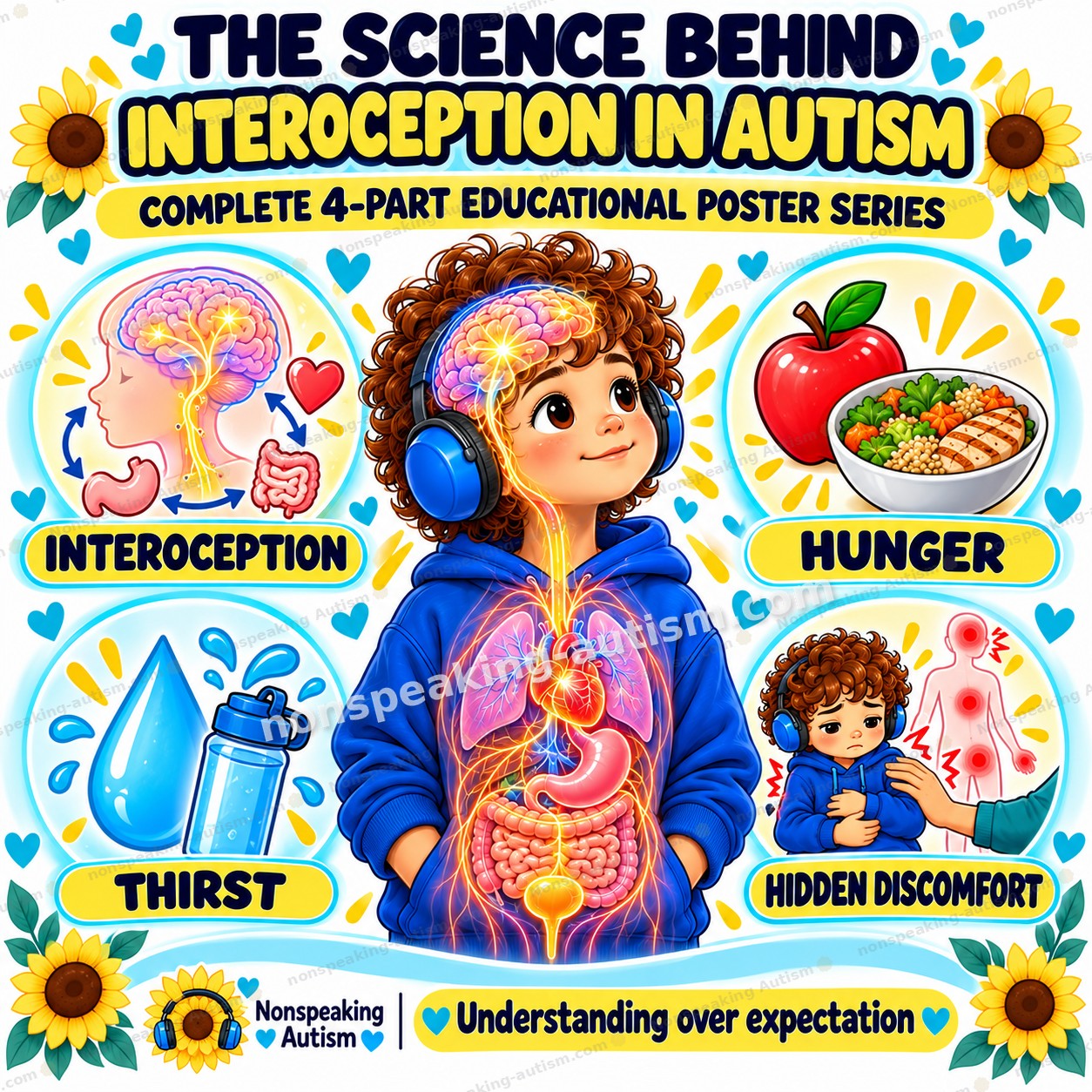
🌻 THE SCIENCE BEHIND INTEROCEPTION IN AUTISM
🌻 THE SCIENCE BEHIND INTEROCEPTION IN AUTISM
Complete 4-Part Educational Poster Collection
💙 Understanding Body Signals, Hunger, Thirst & Hidden Discomfort
Nonspeaking Autism | Research-Informed Educational Resources | Printable A2 Poster Collection
💛 ABOUT THIS COLLECTION
A child may experience a physical need without being able to recognise, explain or communicate it in the way others expect.
Interoception refers to the processes involved in sensing and interpreting signals from inside the body.
These signals contribute to experiences such as hunger, thirst, fullness, temperature, tiredness, breathing, heartbeat, pain and physical discomfort.
For some autistic children, certain internal body signals may be difficult to notice, identify, interpret or communicate. Others may experience particular sensations very intensely.
These differences are individual. Autism does not mean that every child has difficulty sensing their body, and being unable to describe a sensation does not mean the sensation is absent.
The Science Behind Interoception in Autism is a four-part illustrated educational collection designed to help families, educators, carers and professionals explore the relationship between internal body signals, communication and everyday support.
The collection encourages adults to move away from assumptions and towards curiosity, observation, accessible communication and compassionate responses.
The central message:
💙 Not recognising or communicating a body signal does not mean the body has no need.
🧠 WHAT IS INCLUDED IN THE 4-PART COLLECTION?
🌻 PART 1 — THE SCIENCE BEHIND INTEROCEPTION
Understanding the Body's Internal Signals
This introductory poster explores what interoception is and why it matters in everyday life.
It explains how interoception involves sensing and interpreting information related to:
- Hunger and fullness
- Thirst
- Toilet needs
- Tiredness
- Pain and physical discomfort
- Temperature
- Breathing and heartbeat
The poster explores how individual differences may appear, including not noticing hunger until late, missing thirst cues, recognising toilet needs suddenly or finding it difficult to identify discomfort.
Practical support includes:
- Offering regular food and drink opportunities.
- Using simple body maps, pictures or visual communication.
- Offering low-demand choices.
- Creating predictable toilet opportunities.
- Noticing individual patterns.
- Considering pain or illness rather than automatically assuming sensory distress.
Key message: Interoception varies between individuals and between different bodily signals. Difficulty expressing a sensation is not proof that it is not being felt.
🍎 PART 2 — THE SCIENCE BEHIND HUNGER SIGNALS IN AUTISM
Why a Child May Not Notice Hunger Until They Are Already Very Hungry
This poster explores the relationship between hunger, the digestive system, hormones and brain processes.
It introduces how the stomach, gut, brainstem, hypothalamus and other brain regions contribute to hunger regulation.
It also explores why a child may:
- Experience hunger differently.
- Find internal sensations difficult to interpret.
- Recognise hunger only when it becomes more intense.
- Experience a physical need without identifying it as hunger.
- Find it difficult to ask for food or communicate a preference.
- Need support with choosing food or starting to eat.
The poster recognises that sensory differences, motor planning, anxiety, communication barriers and distraction may also affect eating.
Practical support includes:
Offering food at predictable times.
- Watching for individual hunger cues.
- Using simple choices or visual supports.
- Considering sensory and communication needs.
Key message:
Not asking for food does not always mean not feeling hungry.
💧 PART 3 — THE SCIENCE BEHIND THIRST SIGNALS IN AUTISM
Why a Child May Not Recognise, Communicate or Act on Thirst
Thirst regulation involves interactions between fluid balance, blood signals, hormones, the kidneys and the brain.
This poster introduces how changes in the body's fluid balance are detected and how the brain helps regulate thirst.
It explores why some children may find it difficult to:
- Notice thirst early.
- Identify a bodily sensation as thirst.
- Recognise when they need a drink.
- Request water or another suitable drink.
- Choose a drink or initiate drinking.
- Communicate their need using speech, gestures or AAC.
It also highlights that recognising thirst and responding to it are not necessarily the same process.
Practical support includes:
- Offering drinks regularly and at predictable times.
- Noticing individual thirst cues.
- Providing simple drink choices.
- Using visual supports or AAC.
- Considering sensory preferences and communication needs.
Key message:
Not asking for a drink does not always mean not feeling thirsty.
💙 PART 4 — THE SCIENCE BEHIND HIDDEN DISCOMFORT IN AUTISM
Why a Child May Be Hurting Even When They Cannot Show or Explain What Is Wrong
This poster explores why pain and physical discomfort may not always be recognised or communicated in expected ways.
A child may experience pain without being able to identify its location, describe its intensity or explain what is wrong.
The poster considers possible contributing factors, including:
- Differences in interoceptive awareness.
- Difficulty identifying or naming internal experiences.
- Communication barriers.
- Individual differences in how distress is expressed.
It also explores possible changes that may warrant further investigation, such as:
- Sudden changes in behaviour.
- Becoming unusually quiet or withdrawn.
- Increased agitation or pacing.
- Changes in eating or sleeping.
- Unusual responses to touch or movement.
- Self-injury or other signs of significant distress.
These signs are not diagnostic and can have several explanations.
Practical support includes:
- Staying calm and reducing demands.
- Looking for possible medical causes.
- Using the child's preferred communication methods.
- Comparing changes with the child's usual patterns.
- Seeking appropriate assessment when symptoms persist, worsen or cause concern.
Key message:
Not showing pain in an expected way does not mean pain is absent.
🌿 WHY THIS COLLECTION MATTERS
When children cannot easily explain internal sensations, their needs may be misunderstood.
A child who does not ask for food may be assumed not to be hungry.
A child who does not request a drink may be assumed not to be thirsty.
A child who cannot describe pain may have their discomfort overlooked.
And a child whose behaviour changes may be treated as deliberately difficult rather than someone who needs support.
This collection encourages a different approach.
Instead of asking only, “Why aren't they telling us?”, we can also ask:
“What might their body be communicating, and how can we make support more accessible?”
Understanding internal body signals can help adults respond with greater curiosity, respect and compassion.
💛 PRACTICAL WAYS TO SUPPORT INTEROCEPTIVE NEEDS
Across the four posters, the collection promotes individualised strategies that may help some children.
1. Make Basic Needs Accessible
Offer regular opportunities for food, drinks, rest and toileting without relying entirely on the child recognising and communicating an internal signal first.
2. Respect All Forms of Communication
Recognise speech, AAC, gestures, facial expressions, movement, behaviour and other individual communication methods.
Avoid assuming that a child who cannot explain a need does not experience it.
3. Notice Individual Patterns
Observe what is typical for the child and look for meaningful changes.
Consider the environment, recent activities, physical health, communication demands and sensory experiences.
4. Reduce Pressure
Offer choices, processing time and predictable routines.
Avoid forcing children to label sensations they cannot confidently identify.
5. Investigate Possible Physical Causes
Pain, illness, dehydration, gastrointestinal difficulties and other medical concerns should not automatically be explained
as sensory or behavioural issues.
6. Work Together
Families, schools and relevant professionals can share observations and agree on supportive, practical adjustments.
The goal is not to make every child experience their body in the same way. The goal is to recognise their needs and support their wellbeing.
🔬 RESEARCH-INFORMED COLLECTION
The four posters draw on research and guidance relating to interoception, bodily awareness, communication and autism.
Research suggests that internal bodily experiences are complex and that findings vary depending on which signals are studied and how interoception is measured.
Some autistic individuals report difficulties recognising or interpreting certain sensations. Others may experience heightened awareness or different patterns across different bodily systems.
Importantly, no single explanation applies to every autistic child.
📚 SELECTED RESEARCH & GUIDANCE
Loureiro, F., Ringold, S. M., & Aziz-Zadeh, L. (2024).
Interoception in autism: A narrative review of behavioral and neurobiological data.
Psychology Research and Behavior Management, 17, 1841–1853.
https://doi.org/10.2147/PRBM.S410605
National Institute for Health and Care Excellence (NICE).
Autism spectrum disorder in under 19s: support and management (CG170).
https://www.nice.org.uk/guidance/cg170
Additional studies and guidance are referenced on the individual posters, including research relating to hunger and thirst regulation, interoceptive awareness, pain communication and hidden discomfort.
Further Resources • NHS England – Clinical guide for front line staff to support the management of patients with a learning disability and autistic people: https://www.england.nhs.uk/long-read/clinical-guide-for-front-line-staff-to-support-the-management-of-patients-with-a-learning-disability-and-autistic-people-relevant-to-all-clinical-specialties/ • National Autistic Society – Autism and sensory processing: https://www.autism.org.uk/advice-and-guidance/about-autism/sensory-processing Research & References Parts 1–4 – Interoception in autism: • Loureiro, F., Ringold, S. M., & Aziz-Zadeh, L. (2024). Interoception in autism: a narrative review of behavioral and neurobiological data. Psychology Research and Behavior Management, 17, 1841–1853. https://doi.org/10.2147/PRBM.S410605 • Klein, J., Witthöft, M., & Jungmann, S. M. (2025). Interoception in individuals with autism spectrum disorder: a systematic literature review and meta-analysis. Frontiers in Psychiatry, 16, 1573263. https://doi.org/10.3389/fpsyt.2025.1573263 Part 1 – Self-reported interoception: • Adams, K. L., Catmur, C., & Bird, G. (2026). Associations between autism and self-reported dimensions of interoception. Autism, 30(6), 1465–1477. https://doi.org/10.1177/13623613261434431 Parts 2 & 3 – Hunger and thirst awareness: • Fiene, L., & Brownlow, C. (2015). Investigating interoception and body awareness in adults with and without autism spectrum disorder. Autism Research, 8(6), 709–716. https://doi.org/10.1002/aur.1486 Part 3 – How thirst is regulated: • Bichet, D. G. (2019). Regulation of thirst and vasopressin release. Annual Review of Physiology, 81, 359–373. https://doi.org/10.1146/annurev-physiol-020518-114556 Part 4 – Pain in autistic children: • Kumar, J. E., Hartzell, C., Abelson, E., Jastrowski Mano, K., & Chidambaran, V. (2026). Prevalence, expression, assessment, mechanisms, and management of pain in autistic children: a scoping review. A&A Practice. https://doi.org/10.1213/XAA.0000000000002178 • Johnson, E., van Zijl, K., & Kuyler, A. (2023). Pain communication in children with autism spectrum disorder: a scoping review. Paediatric and Neonatal Pain, 5(4), 127–141. https://doi.org/10.1002/pne2.12115 • NHS England. Clinical guide for front line staff to support the management of patients with a learning disability and autistic people – relevant to all clinical specialties (PRN00296). Foundational references (printed on the posters): Loureiro et al. (2024) • Klein et al. (2025) • Adams et al. (2026) • Fiene & Brownlow (2015) • Bichet (2019) • Johnson et al. (2023) • Kumar et al. (2026) • NHS England
Research papers
- Loureiro, Ringold & Aziz-Zadeh (2024) – Psychology Research and Behavior Management (DOAJ record)
- Klein, Witthöft & Jungmann (2025) – Frontiers in Psychiatry (full article)
- Adams, Catmur & Bird (2026) – Autism (journal page)
- Fiene & Brownlow (2015) – Autism Research (record with DOI)
- Bichet (2019) – Annual Review of Physiology (publisher page)
- Kumar et al. (2026) – A&A Practice (summary record)
- Johnson, van Zijl & Kuyler (2023) – Paediatric and Neonatal Pain (ResearchGate)
Guidance and further resources
- NHS England – Clinical guide for front line staff (learning disability and autistic people)
- National Autistic Society – Autism and sensory processing
📖 IMPORTANT EVIDENCE NOTE
These posters use simplified conceptual illustrations to explain complex biological processes.
The diagrams are not medical scans, individual neurological assessments or proof that a particular pathway functions differently in a specific child.
Research does not establish that every autistic child experiences hunger, thirst or pain differently.
The strategies presented are examples of supportive practice and should be adapted to the individual's needs.
👨👩👧 WHO IS THIS COLLECTION FOR?
This collection may be helpful for:
- Parents and carers of autistic children.
- Families of nonspeaking and minimally speaking children.
- Teachers and teaching assistants.
- SENCOs and SEND teams.
- Mainstream and specialist schools.
- Occupational therapists.
- Speech and language therapists.
- Paediatric and healthcare professionals.
- Dietitians and feeding-support practitioners.
- Autism support workers.
- Parent and carer support groups.
- Staff training and professional development.
- Anyone seeking to understand interoception and communication differences in autism.
The posters may support educational discussions, family learning, classroom displays and multidisciplinary conversations.
📦 WHAT YOU RECEIVE
Complete 4-Part Educational Poster Collection
Four individual A2 print-ready PDF resources:
- The Science Behind Interoception — Understanding the body's internal signals.
- The Science Behind Hunger Signals in Autism — Understanding hunger recognition and communication.
- The Science Behind Thirst Signals in Autism — Understanding thirst recognition and response.
- The Science Behind Hidden Discomfort in Autism — Recognising possible pain and physical discomfort.
DIGITAL FORMAT
- 4 × individual printable A2 PDF posters.
- A2 portrait format: 420 × 594 mm.
- Suitable for home, school, educational and professional printing.
- A coordinated collection with colourful illustrations and accessible explanations.
- Designed for educational display and reference.
Digital download only — no physical posters will be shipped.
The product listing uses watermarked preview artwork. Purchased downloadable PDFs should be provided as clear, unwatermarked versions.
⚠️ IMPORTANT EDUCATIONAL & MEDICAL DISCLAIMER
This collection is intended for general educational and informational purposes only.
It is not a diagnostic tool, validated interoception assessment, feeding assessment, medical evaluation or substitute for professional healthcare advice.
Hunger, thirst, pain and changes in behaviour can have many causes.
Persistent difficulties with eating or drinking, suspected dehydration, unexplained pain, changes in physical health or significant changes from a child's usual presentation should be discussed with an appropriately qualified healthcare professional.
Seek urgent medical assistance for serious or rapidly worsening symptoms.
No single behavioural sign can reliably identify hunger, thirst, pain or another internal bodily state.
©️ COPYRIGHT & PERMITTED USE
Copyright © 2026 Nonspeaking Autism. All rights reserved.
Purchasers may print and publicly display the resources for personal, educational, clinical, workplace, community and professional training purposes.
The digital PDF files must not be:
- Resold or redistributed.
- Shared with third parties as downloadable files.
- Uploaded publicly or to file-sharing platforms.
- Rebranded or altered.
- Reproduced within other commercial products.
Purchasing the collection does not transfer copyright or ownership of the artwork.
💛 THE MESSAGE BEHIND THE COLLECTION
A child does not need to describe hunger perfectly to deserve food.
A child does not need to ask for water before adults consider their hydration needs.
A child does not need to explain pain in words for their discomfort to be taken seriously.
And a child does not need to experience their body in the same way as someone else to be understood.
© Nonspeaking Autism 2026 · nonspeaking-autism.com. All rights reserved. For personal, classroom and professional use only. Please do not resell, redistribute or share the digital files.
🌻 Notice the signals.
💧 Support the needs.
💙 Respect communication.
Connection over correction. Understanding over expectation.
Nonspeaking Autism © 2026
Different needs. Equal belonging.