
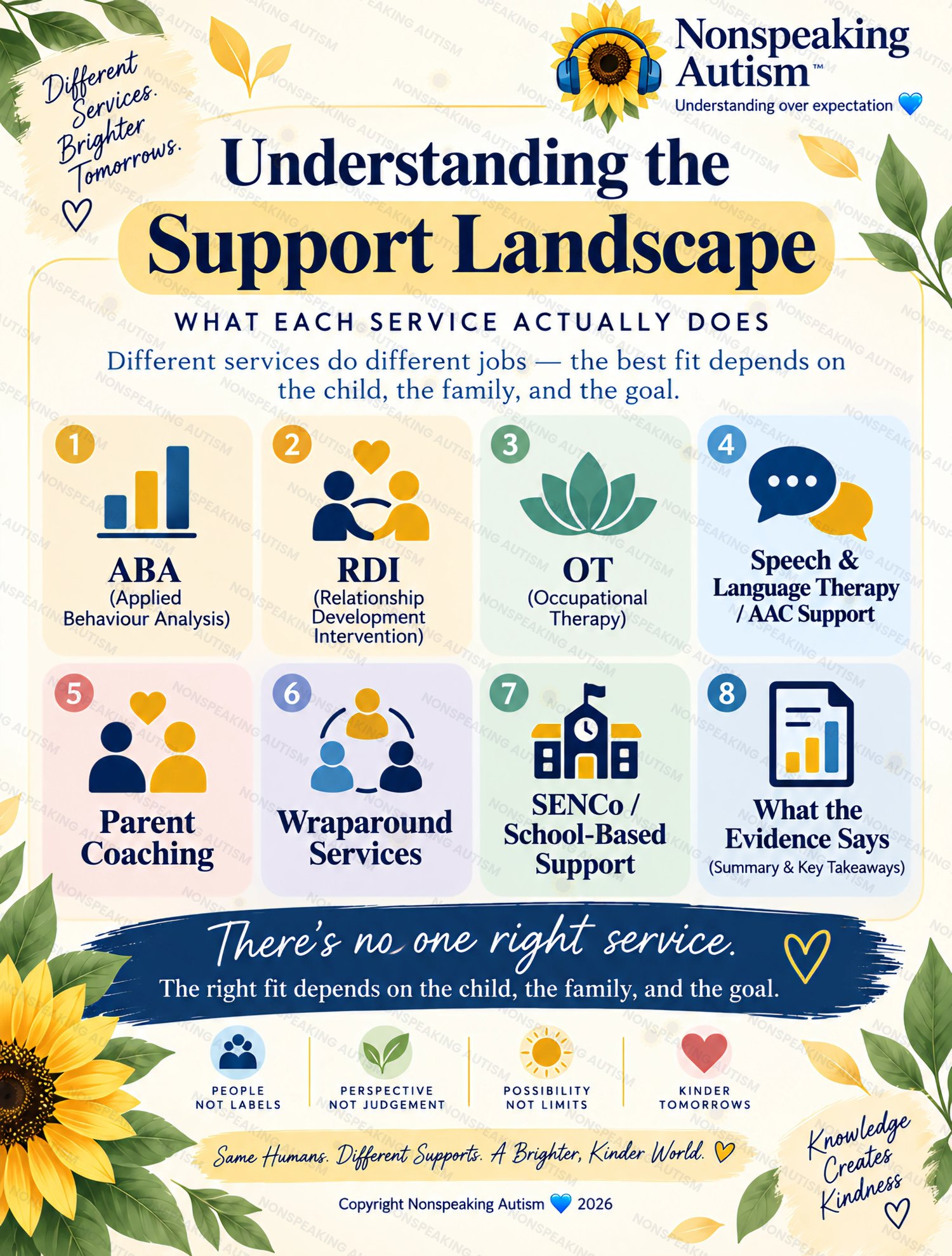
Understanding the Support Landscape
Understanding the Support Landscape — Complete 8-Part Educational Poster Series
A clear, research-informed guide to autism support services for families — what each approach does, what it may help with, and what to consider
Navigating autism services can feel overwhelming.
Families may hear terms such as ABA, RDI, OT, speech therapy, AAC, parent coaching, wraparound services and school-based support — often without receiving a clear explanation of how these services differ, what each one is designed to address, or how strong the evidence is for different approaches.
Understanding the Support Landscape is a complete 8-part educational poster series created to make that landscape easier to understand.
Rather than promoting one programme as the answer for every autistic child, this collection compares different forms of support through a consistent framework:
Main Focus → What It Often Looks Like → Best For → What to Watch For → Evidence
The central message across the collection is:
There’s no one right service.
The right fit depends on the child, the family, and the goal.
Because good support should fit the person — not force the person to fit the programme.
🌻 The Complete 8-Part Collection
1️⃣ ABA — Applied Behavior Analysis
ABA uses principles of learning and behavior to teach skills and influence behavior through structured approaches, reinforcement, prompting, practice and data collection.
The poster explores how ABA may involve breaking skills into smaller steps, measuring progress and practicing skills across routines.
It also acknowledges an important reality: ABA is not one uniform intervention, and quality and practice vary considerably.
Some behavioral and developmental approaches have evidence supporting particular skill outcomes, but this does not mean every goal, technique or programme is appropriate for every autistic person.
The resource encourages families to pay particular attention to:
Meaningful goals.
Autonomy.
Assent.
Communication access.
Masking risk.
Neurodiversity-affirming practice.
Harmless autistic characteristics should not automatically become targets simply because they look different.
Evidence matters — and so does how support is delivered.
2️⃣ RDI — Relationship Development Intervention
RDI is a relationship-focused intervention that emphasizes areas such as shared experiences, connection, flexible thinking and parent-guided interaction.
The poster introduces possible elements including:
Co-regulation
Shared attention
Reflection
Parent-guided interaction
Gradual support for flexibility
For some families, the relationship-centered philosophy may feel appealing, particularly when they are looking for an approach that places connection at the center of support.
However, an important distinction is made:
An appealing theory is not the same as a strong evidence base.
Compared with more extensively researched approaches, independent evidence for RDI remains limited.
The poster therefore encourages families to look carefully at the evidence, goals and claims surrounding any programme they are considering.
Connection builds possibility.
3️⃣ OT — Occupational Therapy
Occupational therapy is about participation in everyday life.
For autistic children, OT may address areas such as:
Sensory processing
Regulation
Motor skills
Dressing and self-care
Feeding-related participation
Handwriting and fine-motor skills
Play
Daily routines
Environmental adaptations
Independence and participation
The poster also makes an important distinction between occupational therapy as a profession and individual techniques used within OT.
Not every sensory-based intervention has the same level of research support.
Good practice should connect strategies to meaningful, functional goals in the child's real life, rather than treating sensory techniques as universally effective.
Skills for everyday life.
4️⃣ Speech & Language Therapy / AAC Support
Communication is bigger than speech.
Speech-language services may support receptive and expressive language, interaction, comprehension and access to effective communication.
For some children, this includes AAC — Augmentative and Alternative Communication.
AAC can include:
Signs and gestures
Paper-based communication tools
Pictures or symbols
Communication boards
Writing or typing
Speech-generating devices
Other multimodal communication systems
AAC should not be viewed simply as a last resort when speech has not developed.
The goal is communication access.
Good support should protect communication autonomy and respect multiple ways of communicating rather than measuring success solely by spoken language.
Communication access, not verbal compliance.
Different ways to communicate. Same value.
5️⃣ Parent Coaching
Parent and caregiver coaching takes support into ordinary daily life.
Rather than limiting strategies to a clinic or therapy session, coaching may help caregivers understand, practice and adapt supportive approaches within everyday routines.
Depending on the programme, this might involve:
Coaching and modeling
Video feedback
Problem-solving
Communication strategies
Interaction and play
Adapting home routines
Supporting carryover between sessions and everyday life
The poster also recognizes that family capacity matters.
An intervention cannot be considered genuinely family-centered if it places an unrealistic burden on parents or ignores family circumstances, culture, values or stress.
Support should work with families rather than simply giving families more work to do.
Stronger families. Brighter futures.
6️⃣ Wraparound Services
Some children need support from several systems at the same time.
Wraparound services aim to improve coordination around the child and family, particularly where needs are complex or overlapping.
Depending on the U.S. service system and local provision, this may involve collaboration between:
Schools
Healthcare providers
Behavioral or mental-health services
Social or family services
Community organizations
Other professionals involved with the child
The goal is to reduce fragmented care and improve shared planning, communication, goals and responsibilities.
But coordination matters.
A collection of services is not automatically a coordinated system.
Poor communication can still leave parents functioning as the case manager between multiple providers.
Stronger together for brighter futures.
7️⃣ School-Based Support / Special Education
For U.S. families, school-based support can be a major part of the overall support landscape.
Depending on eligibility and individual circumstances, students may receive special education, related services, accommodations or other school-based supports.
This may involve:
IEP — Individualized Education Program
Section 504 accommodations where applicable
Speech-language services
School-based occupational therapy where educationally relevant
AAC and communication access
Sensory or environmental accommodations
Visual and organizational supports
Additional processing time
Movement or regulation breaks
Adapted instruction
Transition planning
Collaboration between families, educators and specialists
School support is not simply another “therapy.”
Its role is to help translate individual needs into meaningful educational access, participation and support throughout the school day.
A child can achieve good grades and still need significant support.
Academic performance alone does not reveal sensory load, communication demands, executive-function difficulties, emotional effort or recovery needs.
Support learning. Build belonging.
8️⃣ What the Evidence Says
The final poster brings the collection together by asking an essential question:
What does the evidence actually tell us?
Different autism services have different evidence bases, target different outcomes and are studied in different ways.
The poster separates the landscape into broad areas of:
✅ Better Supported
Examples include evidence supporting particular forms of:
Parent-mediated and parent-coaching approaches
Communication-focused support, including AAC access
Behavioral and developmental approaches for specific goals
Functional school supports and collaborative planning
⚖️ More Mixed or Emerging
Evidence may be more mixed, limited or dependent on the specific intervention for areas such as:
Some sensory-based OT techniques when considered in isolation
RDI and other less-studied relationship programmes
Service models with limited independent trials
These categories should not be interpreted as a universal ranking of services.
A research finding about one intervention, outcome or population cannot automatically be generalized to every child or every provider using the same broad label.
🧠 What Matters Most Across All Approaches
The final poster emphasizes several principles that apply across the entire collection:
No single service helps every child in every area.
Outcomes depend on goals, fit, quality and family context.
Shared decision-making and lived experience matter.
And most importantly:
The best support should increase participation, communication, safety and wellbeing — not just outward compliance.
This shifts the question away from:
“Which programme is best?”
and toward:
“What does this individual need, and which support is most appropriate for that particular goal?”
💙 Choosing Support Around the Child & Family
A useful starting point is identifying the actual need before choosing the service.
Families may want to consider questions such as:
What are we hoping this support will help with?
Is this goal important to the child and family?
Is the difficulty located within the child, or could changing the environment remove a barrier?
Does the approach support communication and autonomy?
How does the provider respond to distress or refusal?
Are goals functional and meaningful outside therapy sessions?
What evidence supports the specific intervention being offered?
How will progress be measured?
Does the child appear safe, respected and able to communicate?
What burden does the intervention place on the child and family?
Two families can receive the same autism diagnosis and need very different services.
Even within the same family, support needs can change over time.
Different approaches. Brighter possibilities.
Created With U.S. Families in Mind
This edition is intended for families navigating the United States autism, healthcare, community and education support landscape.
Terminology and service structures can vary significantly between states, school districts, insurers and individual providers.
For school-aged children, educational support may involve special education and related services under IDEA or accommodations under Section 504, depending on the student's individual circumstances and eligibility.
An IEP, 504 Plan, private therapy and medical or community-based services serve different purposes and should not be treated as interchangeable.
Families should use appropriate federal, state, school-district, healthcare and professional resources when determining eligibility or making decisions about an individual child's services.
🔬 Research-Informed
The series draws on research and guidance concerning autism interventions, parent-mediated approaches, communication, AAC, occupational therapy, school support, behavioral and developmental interventions, and relationship-based approaches.
The evidence poster includes selected research and guidance to help readers understand an important principle:
“Evidence-based” does not mean “one-size-fits-all.”
Research can tell us whether an approach has demonstrated benefits for particular outcomes in studied groups.
It cannot, by itself, determine what an individual child should receive.
Good decision-making brings together:
Research evidence
Professional expertise
Individual strengths and support needs
Family circumstances
Communication and autonomy
The autistic person's experience and preferences
Meaningful real-world outcomes
Research evolves, and the evidence base for individual programmes can change as higher-quality studies become available.
👨👩👧 Who Is This 8-Part Collection For?
This collection may be especially useful for:
- U.S. parents and caregivers
- Families newly navigating autism services
- Autistic people and self-advocates
- Families comparing different support options
- Preschool and early-childhood professionals
- General-education teachers
- Special-education teachers and teams
- IEP teams
- School psychologists
- Speech-language pathologists (SLPs)
- Occupational therapists (OTs)
- AAC professionals
- Behavioral professionals and BCBAs
- Pediatric and developmental professionals
- Mental-health professionals
- Social workers and case managers
- Family-support professionals
- Disability and autism organizations
- Community organizations
- Professional-development and training settings
The series can be used as a family education resource, professional discussion tool or visual starting point when navigating different types of support.
📦 What You Receive
Your purchase includes the complete:
Understanding the Support Landscape — 8-Part Educational Poster Series
You will receive:
1 × ABA — Applied Behavior Analysis
1 × RDI — Relationship Development Intervention
1 × OT — Occupational Therapy
1 × Speech & Language Therapy / AAC Support
1 × Parent Coaching
1 × Wraparound Services
1 × School-Based Support / Special Education — U.S. Edition
1 × What the Evidence Says — Summary & Key Takeaways
8 × high-resolution digital PDF educational posters
The purchased files are supplied clear and without the promotional PREVIEW watermarks shown on the Payhip listing images.
Preview watermarks are used for copyright protection and are not present on the purchased files.
Digital download only — no physical product will be shipped.
⚠️ Important Educational Disclaimer
This collection is provided for educational and informational purposes only.
It does not constitute medical, psychological, therapeutic, educational or legal advice and is not intended to diagnose autism, prescribe treatment, establish eligibility for services or determine which intervention an individual should receive.
The inclusion of ABA, RDI, occupational therapy, speech-language therapy, AAC, parent coaching, wraparound services, special education or any other approach does not constitute endorsement of a particular programme, provider or method by Nonspeaking Autism.
Research evidence varies by specific intervention, population, outcome, study design and implementation. Broad service labels can contain substantially different practices, so evidence about one programme or technique should not automatically be generalized to every provider working under the same label.
Eligibility for an IEP, Section 504 accommodations, school-based related services or other educational supports in the United States is determined according to applicable law and the individual student's circumstances.
Service availability, funding, insurance coverage, professional requirements and educational procedures can vary by state, school district, insurer and provider.
Families should seek appropriately qualified professional guidance when making decisions about an individual child's medical, therapeutic, communication or educational needs.
©️ Copyright & Permitted Use
Copyright © 2026 Nonspeaking Autism. All rights reserved.
Your purchase permits use of these resources for personal, home, classroom, school, clinic or individual professional educational purposes.
Files may not be resold, redistributed, shared as downloadable files, uploaded to other websites or marketplaces, commercially reproduced, or incorporated into another product for resale.
💛 The Message Behind the Collection
Families are often handed a diagnosis and then confronted with an alphabet soup of services:
ABA. RDI. OT. SLP. AAC. IEP. 504.
It can feel as though everyone has a different answer about what a child “needs.”
This collection was created to make that landscape easier to understand.
Because the most useful question is rarely:
“Which service is best?”
It is:
“What does this service actually do — and does it match what this person needs?”
A child may need communication access.
Another may need help participating in everyday routines.
Another may need environmental accommodations at school.
Another family may benefit from coaching and coordinated services.
Some children will use several forms of support.
Others may need fewer.
And those needs may change.
The name of the programme should never become more important than the person receiving it.
Look at the goal.
Look at the evidence.
Look at quality.
Look at communication.
Look at autonomy.
Look at what happens in real life.
And above all, look at the individual child and family in front of you.
There’s no one right service.
The right fit depends on the child, the family, and the goal.
People, not programs.
Support informs belonging.
Different ways. Brighter tomorrows.
Same humans. Different supports. A brighter, kinder world.
Connection over correction.
Understanding over expectation.
© Nonspeaking Autism 2026