

💙 SENSORY DECODING: WHY AUTISTIC CHILDREN MAY NEED EAR DEFENDERS
💙 SENSORY DECODING: WHY AUTISTIC CHILDREN MAY NEED EAR DEFENDERS
Understanding Sound Sensitivity, Sensory Overload and Auditory Protection
Research & Guidance-Informed Autism Educational Poster | UK Edition | Nonspeaking Autism
🌻 Support the nervous system. Reduce the overload.
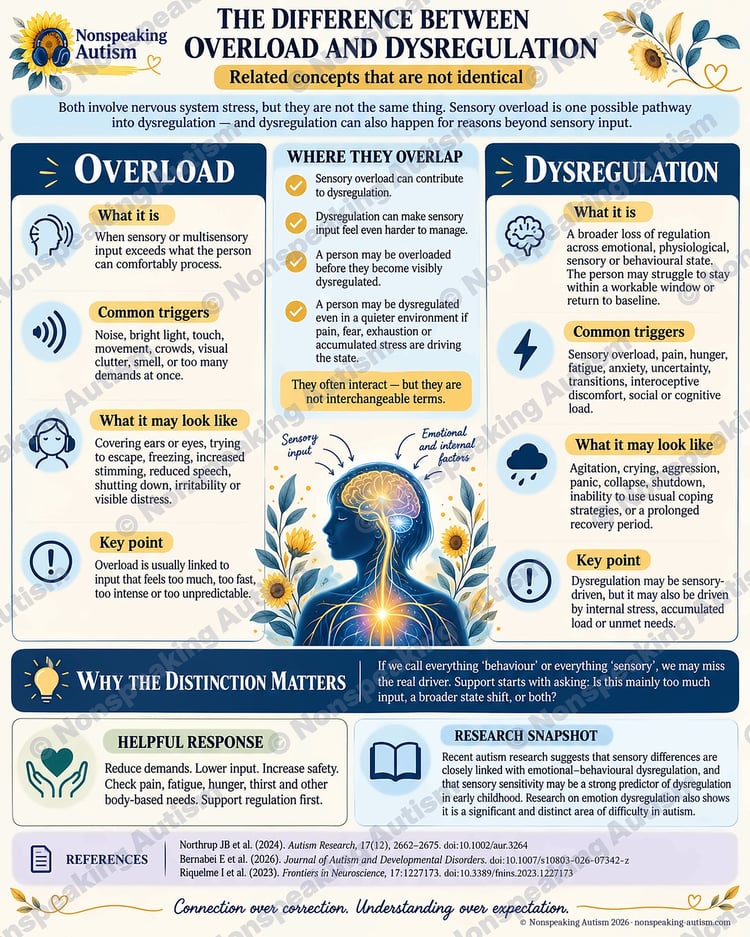
For some autistic children, everyday sounds can feel intense, unpredictable, distracting or physically uncomfortable.
A busy classroom, school assembly, hand dryer, supermarket, playground or family gathering may contain layers of sound that are difficult to tolerate or separate.
What one person experiences as ordinary background noise may feel overwhelming to someone else.
Ear defenders can be an important sensory accommodation. They may help some children reduce unwanted sound, feel more comfortable and participate in environments that would otherwise be difficult to access.
This illustrated educational poster explores why auditory experiences can differ, what ear defenders may help with and how adults can support children without treating sensory protection as avoidance or misbehaviour.
The goal is not to make children tolerate unnecessary distress. It is to help them access everyday life with greater comfort, choice and safety.
🧠 WHAT THIS POSTER EXPLORES
🔊 1. Why Sound May Feel Overwhelming
Autistic children can experience auditory information differently.
The poster introduces several possible contributors to sound-related distress.
Auditory hypersensitivity
Some children experience particular sounds as unusually intense, sharp, unpleasant or painful.
The experience is not necessarily explained by how loud a sound measures on a device. Pitch, repetition, duration, suddenness and context may also matter.
Difficulty filtering background noise
Busy environments can contain many competing sounds.
For some autistic learners, separating important information from background noise may require additional effort.
Speech in noisy environments
A child may find it harder to follow spoken instructions when conversations, movement, equipment and environmental noise occur together.
This does not necessarily mean the child does not understand the language being used.
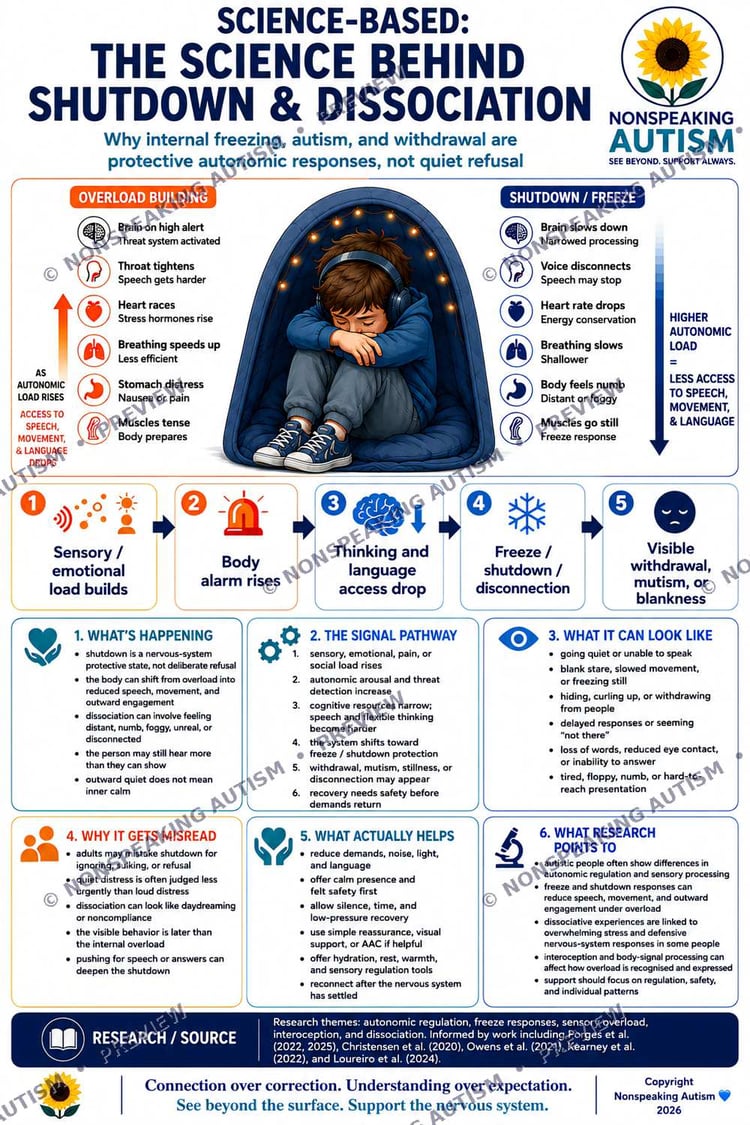
Stress and sensory overload
Unwanted or unpredictable noise may contribute to distress, fatigue or increased alertness.
These experiences vary considerably. Not every autistic child has auditory hypersensitivity, and not every sound-related difficulty has the same cause.
🎧 2. What Ear Defenders May Help With
Ear defenders reduce the amount of sound reaching the ears.
Depending on the child and situation, they may help:
- Reduce exposure to distressing environmental noise.
- Improve comfort in busy or noisy places.
- Make certain activities feel more manageable.
- Support attention or participation for some learners.
- Reduce the likelihood of sound-related distress escalating.
- Give children more control over their sensory environment.
Ear defenders do not eliminate all sound, and their effectiveness depends on fit, sound characteristics, the environment and individual needs.
They are a possible support tool, not a guaranteed treatment for sensory overload.
💛 3. Ear Defenders Are an Accommodation, Not a Behaviour Problem
A child choosing to wear ear defenders may be communicating an important sensory need.
They might be saying:
“This sound is uncomfortable.”
“I need less noise to concentrate.”
“I want to stay here, but I need some protection.”
“I need a break before this becomes overwhelming.”
Wearing ear defenders should not automatically be interpreted as avoidance, defiance, disengagement or unwillingness to participate.
Sometimes a small environmental adjustment makes meaningful participation possible.
Reducing an unnecessary barrier is not the same as reducing expectations for learning or belonging.
🌿 IMPORTANT GUIDANCE FOR EVERYDAY USE
Offer Choice and Accessibility
Keep ear defenders available when the child finds them helpful.
Where possible, allow the child to choose when to use them, remove them or take a break.
Respect communication through speech, AAC, gestures, behaviour and other individual signals.
Consider the Environment
Ear defenders work best as one part of an individualised approach.
Other adjustments may include:
- Quieter spaces
- Reduced background noise
- Advance warning of predictable loud sounds
- Sensory breaks
- Clear visual information
- Flexible seating
- Access to calm, supportive adults
Consider Comfort and Safety
Choose well-fitting, age-appropriate hearing protection.
Check that the child can still access important communication and safety information. Additional visual or other accessible alerts may be needed in some environments.
Avoid forcing a child to wear equipment that causes discomfort.
Review How the Tool Is Working
Some children may prefer ear defenders during particular activities. Others may need them more frequently.
There is no universal wearing schedule suitable for every autistic child.
Regularly consider whether they improve comfort, access, participation and wellbeing.
The poster encourages thoughtful use rather than automatic all-day use. However, there is insufficient evidence to assume that frequent use inevitably reduces everyday sound tolerance. Decisions about duration should be individualised rather than based on a blanket rule.
🏫 PRACTICAL EXAMPLES
In school: Ear defenders may help during assemblies, busy corridors, dining halls, practical lessons or other noisy activities.
At home: They may provide relief from vacuum cleaners, kitchen appliances, visitors or unexpected household noise.
In the community: Some children may choose hearing protection in supermarkets, transport hubs, shopping centres or crowded events.
During transitions: Having ear defenders available may make it easier to move between quieter and noisier spaces.
These examples are possibilities, not recommendations that every autistic child should use ear defenders in each setting.
🔬 RESEARCH & GUIDANCE-INFORMED
This resource draws on established understanding of sensory differences in autism and practical approaches to auditory accommodation.
Research recognises that sensory responses in autism are highly variable. Some autistic people experience increased sensitivity to sound, while others experience different auditory patterns.
The evidence for individual sensory tools is more limited than the evidence documenting sensory differences themselves.
It is therefore important to distinguish between:
- Evidence that auditory sensory differences occur in autism.
- The practical purpose of hearing protection in reducing sound exposure.
- Claims that a particular tool improves regulation, learning or participation for every child.
The poster does not claim that ear defenders are a proven universal intervention for autism.
📚 SELECTED RESEARCH & GUIDANCE
Ben-Sasson, A., et al. (2019). Update of a Meta-analysis of Sensory Symptoms in ASD: A New Decade of Research. Journal of Autism and Developmental Disorders, 49, 4974–4996.
https://doi.org/10.1007/s10803-019-04180-0
Ikuta, N., et al. (2016). Effectiveness of earmuffs and noise-cancelling headphones for coping with hyper-reactivity to auditory stimuli in children with autism spectrum disorder. Hong Kong Journal of Occupational Therapy, 28(1), 24–32.
https://doi.org/10.1016/j.hkjot.2016.09.001
National Institute for Health and Care Excellence (NICE). Autism spectrum disorder in under 19s: support and management (CG170).
https://www.nice.org.uk/guidance/cg170
Derbyshire Healthcare NHS Foundation Trust (2018). Recommendations for Use of Ear Defenders. Referenced on the poster; the precise source document should be independently checked before treating it as a fully verified citation.
Further Resources - Derbyshire Healthcare NHS Foundation Trust – Recommendations for use of Ear Defenders: https://www.derbyshirehealthcareft.nhs.uk/download_file/view/3091/1908 - Derbyshire Local Offer – Recommendations for the use of Ear Defenders (Sensory Processing Needs Toolkit, 2022): https://www.localoffer.derbyshire.gov.uk/site-elements/documents/education-and-learning/spn/spn-use-of-ear-defenders.pdf - National Autistic Society – Autism and sensory processing: https://www.autism.org.uk/advice-and-guidance/about-autism/sensory-processing Research & References Why Sound May Feel Overwhelming – auditory hypersensitivity and stress: - Song, C., Ma, R., Ni, W., Peng, X., Li, X., Shi, R., Zhang, Y., & Li, Y. (2024). Pupillometry reveals hyper-arousal in response to auditory stimuli in autistic children. Journal of Zhejiang University SCIENCE B, 25(11), 996–1008. https://doi.org/10.1631/jzus.B2300462 What Ear Defenders May Help With – focus, participation and reduced sound distress: - Zanin, J., Tomlin, D., & Rance, G. (2024). Effectiveness of noise cancelling earbuds in reducing hearing and auditory attention deficits in children with autism. Journal of Clinical Medicine, 13(16), 4786. https://doi.org/10.3390/jcm13164786 - Kwong, T. C., Yuan, H.-L., Mung, S. W. Y., Chu, H. K., Lai, Y. Y. C., Chan, C. C. H., et al. (2025). Intervention technology of aural perception controllable headset for children with autism spectrum disorder. Scientific Reports, 15, 5356. https://doi.org/10.1038/s41598-025-89609-6 Important Usage Guidance: - Derbyshire Sensory Processing Needs Toolkit (2022). Recommendations for the use of Ear Defenders. Derbyshire Local Offer.
Evidence Note
Research findings vary by study design, population, sensory tool and outcome.
A small study of hearing protection cannot establish that ear defenders benefit every autistic child or determine how often each child should wear them.
Individual comfort, consent, hearing safety, communication access and everyday participation should guide their use.
Sources:
- Derbyshire Healthcare NHS FT – Ear Defenders (2018)
- Derbyshire Local Offer – Ear Defenders (2022)
- Zanin et al. 2024 (MDPI)
- Kwong et al. 2025 (Scientific Reports)
- Song et al. 2024 (PMC)
- NAS – Sensory processing
👨👩👧 WHO IS THIS RESOURCE FOR?
This educational poster is designed for:
- Parents and carers of autistic children
- Primary and secondary school teachers
- Teaching assistants and learning support assistants
- SENCOs and SEND teams
- Mainstream and specialist schools
- Early years practitioners
- Occupational therapists
- Speech and language therapists
- Autism support workers
- Educational psychologists
- Families supporting nonspeaking or minimally speaking autistic children
It may be useful for staff awareness, parent education, classroom displays, SEND resource areas, sensory support planning and discussions about reasonable adjustments.
📦 WHAT YOU RECEIVE
💙 PAID DIGITAL DOWNLOAD
1 × Sensory Decoding: Why Autistic Children May Need Ear Defenders educational poster
The poster includes:
- Reasons everyday sounds may feel overwhelming
- Auditory hypersensitivity and background noise
- Possible benefits of ear defenders
- Practical usage guidance
- The importance of choice and sensory accommodation
- A central message supporting comfort and participation
- Selected research and guidance
Digital product only. No physical poster will be shipped.
The listing image is watermarked for preview purposes. The purchased file should be provided without promotional watermarks.
Please verify the final PDF's dimensions and resolution before advertising it as A2 or 300 DPI.
⚠️ IMPORTANT DISCLAIMER
This resource is intended for general education and awareness.
It does not replace an individual hearing assessment, occupational therapy assessment, medical advice or personalised sensory support plan.
Sound sensitivity can have different causes. Persistent ear pain, sudden changes in hearing or unusual reactions to sound may warrant assessment by an appropriate healthcare professional.
Ear defenders should be selected and used with consideration for comfort, safety, communication access and the child's preferences.
©️ COPYRIGHT & PERMITTED USE
Copyright © 2026 Nonspeaking Autism. All rights reserved.
This resource may be used for personal, home, classroom, school and individual professional educational purposes.
The digital file must not be resold, redistributed, publicly uploaded, shared through file-sharing platforms or incorporated into another commercial product without written permission.
Please share the Payhip listing link rather than distributing the purchased file.
💛 THE MESSAGE BEHIND THE RESOURCE
A child should not have to prove that a sound is unbearable before adults take their discomfort seriously.
They should not have to reach distress before being offered protection.
They should not be shamed for using a tool that helps them feel comfortable and safe.
Listen to their signals. Respect their preferences. Make the environment more accessible.
🌻 Support the nervous system. Reduce the overload.
Connection over correction. Understanding over expectation.
Nonspeaking Autism © 2026