

💙 WHY THE MELTDOWN HAPPENS IN THE MIDDLE OF ENJOYMENT
💙 WHY THE MELTDOWN HAPPENS IN THE MIDDLE OF ENJOYMENT
Understanding Sensory Overload, Monotropic Interests and Hidden Distress in Autism
Nonspeaking Autism | Research-Informed Educational Poster | UK Edition
🌻 ABOUT THIS POSTER
A child can be completely happy, deeply engaged and genuinely enjoying an activity — and still become overwhelmed.
Sometimes an autistic child appears calm, excited, connected and fully immersed in something they love. Then, seemingly without warning, they experience intense distress or a meltdown.
To an observer, this change may seem sudden or confusing.
But what appears to happen without warning may involve a build-up of sensory, emotional or physiological demands that was difficult to notice from the outside.
Why the Meltdown Happens in the Middle of Enjoyment explores this experience through an illustrated example of James, an autistic child who loves watching the washing machine.
For James, the washing machine is more than an everyday household appliance. Its rhythm, sound, spinning movement and predictability may provide an enjoyable and meaningful sensory experience.
Yet even an enjoyable experience can become difficult to manage when stimulation increases, circumstances change or the child reaches their individual tolerance limit.
This educational poster encourages families, educators and professionals to recognise that enjoyment and overwhelm are not necessarily opposites.
💙 The central message:
Our job is not to stop the joy — it is to understand the edge.
🧠 WHAT THIS POSTER EXPLORES
1. Fully Engaged — The Enjoyment Is Real
James is watching the washing machine.
He is interested in the spinning drum, the movement, the sounds and the repeating rhythm.
He may appear settled, absorbed and connected to an activity that brings him genuine enjoyment.
This engagement should not automatically be interpreted as problematic.
Autistic interests and preferred sensory experiences can be important sources of enjoyment, meaning, predictability and connection.
2. Intensity Builds — The Experience Changes
As James continues watching, the amount or intensity of sensory input may increase.
The machine may become louder, change speed or produce a different vibration.
Even when the activity remains enjoyable, the overall sensory demands may become harder to manage.
The poster introduces the possibility that positive engagement and increasing sensory load can occur at the same time.
This is not a fixed neurological sequence, and it will not describe every autistic child's experience.
3. The Threshold — A Small Change May Matter
A subtle shift in sound, movement, rhythm or predictability may become significant.
For some children, a small change in a highly familiar experience can be particularly noticeable or distressing.
Other contributing factors may already be present, including fatigue, hunger, anxiety, physical discomfort or demands from earlier in the day.
An adult may not see a clear warning sign before distress becomes visible.
4. The Meltdown — Distress Becomes Visible
James may suddenly cry, cover his ears, become distressed or struggle to remain near the activity.
This does not necessarily mean he has stopped enjoying the washing machine or that his earlier happiness was not genuine.
A meltdown may reflect an overwhelming experience in which the child's usual coping strategies are no longer sufficient.
A meltdown is not automatically deliberate misbehaviour, manipulation or an attempt to gain attention.
The immediate priority should be safety, reduced demands and compassionate support.
5. The Aftermath — Recovery Takes Time
Following intense distress, James may need quiet, rest, reduced sensory input and time.
He may not be ready to explain what happened, answer questions or return immediately to his previous activity.
Adults can support recovery by remaining available, respecting his preferences and allowing him to settle without additional pressure.
Recovery is not the moment for blame, punishment or demanding explanations.
🔍 POSSIBLE CONTRIBUTING FACTORS UNDER THE SURFACE
The poster explores four possible factors that may help explain why overwhelm sometimes appears during an enjoyable activity.
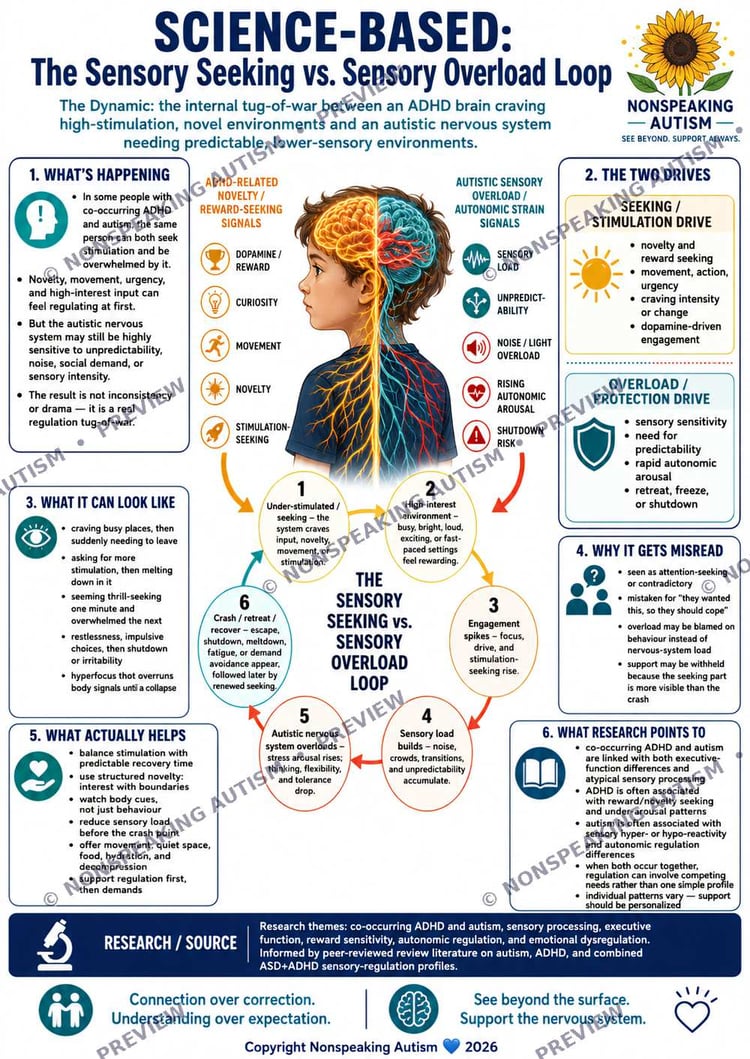
💙 Sensory Overload
Sounds, vibrations, movement and visual stimulation may become too intense or difficult to manage.
Sensory tolerance can vary depending on the environment, physical health, fatigue, stress and other demands.
🌻 Monotropic Interests and Deep Engagement
Monotropism is a theoretical framework that describes concentrated attention and deep engagement with a limited number of interests or activities.
For some autistic people, changes or interruptions during deeply absorbing activities may be particularly difficult.
However, monotropism does not explain every meltdown and should not be treated as a confirmed neurological mechanism for an individual child.
🧠 Interoception
Interoception involves sensing and interpreting signals from within the body.
Some children may find it difficult to recognise or communicate rising discomfort, fatigue or other internal sensations.
This may make early signs of distress harder for adults to identify.
Interoceptive experiences vary, and not every autistic person has difficulty recognising internal signals.
💛 Sudden Changes and Transitions
A change in sound, movement, routine or expectation may contribute to distress.
For example, the washing machine may suddenly enter a different cycle or stop spinning.
The change may feel much more significant to the child than it appears to an observer.
These factors are possibilities, not a diagnosis or proof of why any particular meltdown occurred.
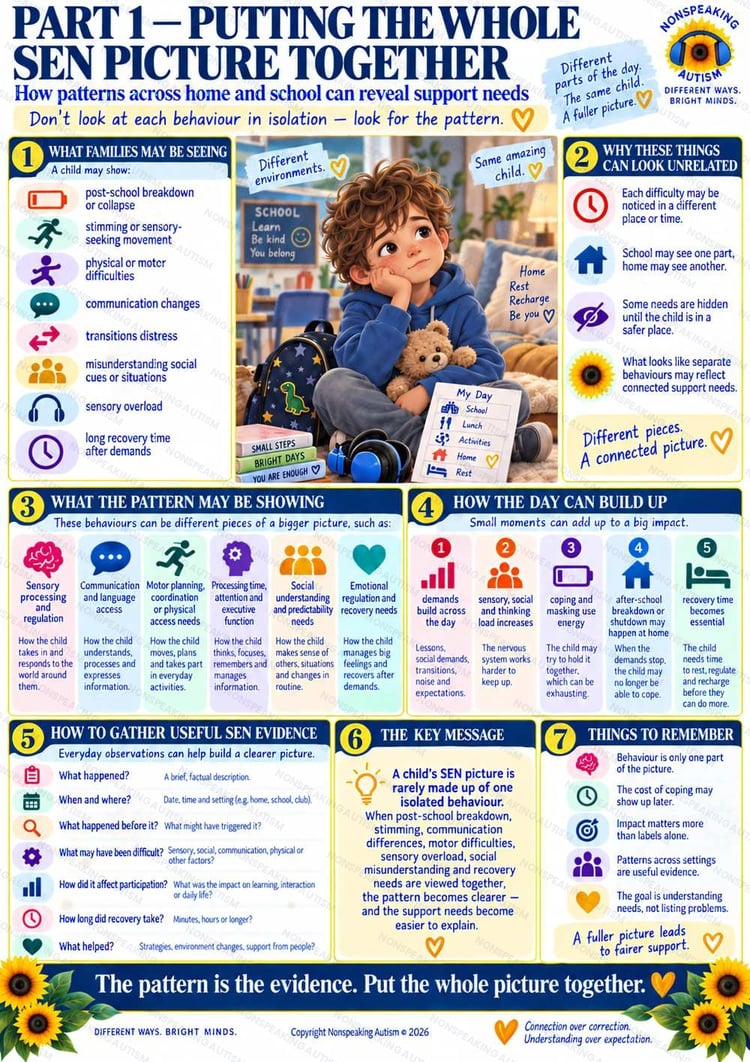
💙 WHY IT CAN LOOK AS THOUGH THE MELTDOWN CAME FROM NOWHERE
A child's outward appearance does not always reveal their internal experience.
Some children may show subtle early signs of distress that adults have not yet learned to recognise.
Others may have difficulty identifying or communicating their discomfort before it becomes overwhelming.
An apparently sudden meltdown may therefore be associated with:
- Early warning signs that are difficult to see.
- Changes in sensory tolerance.
- Fatigue or accumulated demands.
- Difficulty communicating a need for a break.
- Unexpected changes in a preferred activity.
- Pain, illness or another physical need.
Rather than assuming there was no reason, adults can explore what may have changed before the distress became visible.
It feels sudden because the build-up may have been hidden.
🌿 WHAT MAY HELP?
Before Distress Builds
- Learn the child's individual preferences and sensory patterns.
- Observe what happens before, during and after highly engaging activities.
- Notice subtle changes in movement, communication, facial expression or participation.
- Consider whether sound, movement, vibration or visual stimulation changes during the activity.
- Offer accessible ways to request a break, adjustment or help.
- Consider predictable transitions and gentle preparation where useful.
During a Meltdown
- Prioritise immediate safety.
- Reduce unnecessary noise, language and demands.
- Remain calm and offer reassurance in a way the child accepts.
- Avoid forced touch, restraint or pressure.
- Allow space or closeness according to the child's preferences.
- Avoid punishment, criticism or demands for an explanation.
Afterward
- Allow adequate recovery time.
- Offer preferred comfort and a quieter environment.
- Check for hunger, thirst, pain, fatigue or illness.
- Revisit the experience later only when the child is ready.
- Consider practical adjustments that preserve enjoyment while reducing avoidable distress.
The aim is not to remove every preferred activity. It is to make meaningful activities as accessible, comfortable and safe as possible.
🔬 RESEARCH & EVIDENCE-INFORMED UNDERSTANDING
This poster draws on broader research and theoretical perspectives concerning autistic sensory experiences, attention, interoception and emotional regulation.
Relevant literature explores:
- Sensory processing differences in autism.
- Relationships between sensory experiences and emotional distress.
- Deep engagement and monotropic attention.
- Individual differences in interoceptive awareness.
- The importance of individualised environmental and communication support.
📚 SELECTED REFERENCES & GUIDANCE
Ben-Sasson, A., et al. (2009). A meta-analysis of sensory modulation symptoms in individuals with autism spectrum disorders. Journal of Autism and Developmental Disorders, 39, 1–11.
https://doi.org/10.1007/s10803-008-0593-3
Murray, D., Lesser, M., & Lawson, W. (2005). Attention, monotropism and the diagnostic criteria for autism. Autism, 9(2), 139–156.
https://doi.org/10.1177/1362361305051398
Loureiro, F., Ringold, S. M., & Aziz-Zadeh, L. (2024). Interoception in autism: A narrative review of behavioral and neurobiological data. Psychology Research and Behavior Management, 17, 1841–1853.
https://doi.org/10.2147/PRBM.S410605
National Institute for Health and Care Excellence (NICE). Autism spectrum disorder in under 19s: support and management (CG170).
https://www.nice.org.uk/guidance/cg170
Further Resources • National Autistic Society – Meltdowns: a guide for all audiences: https://www.autism.org.uk/advice-and-guidance/topics/behaviour/meltdowns/all-audiences • National Autistic Society – Autism and sensory processing: https://www.autism.org.uk/advice-and-guidance/about-autism/sensory-processing Research & References 1. Sensory Overload May Contribute: • Tavassoli, T., Marco, E. J., & Puts, N. (2026). Sensory reactivity in autism: integrating behavioural, affective, physiological, and neural dimensions. Current Psychiatry Reports, 28(1), 36. https://doi.org/10.1007/s11920-026-01682-4 2. Monotropic Interests May Play a Role: • Murray, D., Lesser, M., & Lawson, W. (2005). Attention, monotropism and the diagnostic criteria for autism. Autism, 9(2), 139–156. https://doi.org/10.1177/1362361305051398 3. Interoception May Contribute: • Loureiro, F., Ringold, S. M., & Aziz-Zadeh, L. (2024). Interoception in autism: a narrative review of behavioral and neurobiological data. Psychology Research and Behavior Management, 17, 1841–1853. https://doi.org/10.2147/PRBM.S410605 Fully Engaged and Deep Regulation – the value of sensory interests: • Kapp, S. K., Steward, R., Crane, L., Elliott, D., Elphick, C., Pellicano, E., & Russell, G. (2019). 'People should be allowed to do what they like': autistic adults' views and experiences of stimming. Autism, 23(7), 1782–1792. https://doi.org/10.1177/1362361319829628
📖 IMPORTANT EVIDENCE NOTE
The five-stage sequence illustrated in this poster is an educational example, not an established or universal progression of autistic meltdowns.
Research supports the importance of considering sensory experiences, individual differences and environmental demands, but does not establish one single mechanism explaining why a child may become distressed during an enjoyable activity.
The example of James should not be used to infer the internal experience of every autistic child.
Sources:
- Murray, Lesser & Lawson 2005 (monotropism.org)
- Tavassoli et al. 2026 (Crossref)
- Loureiro et al. 2024 (DOAJ)
- Kapp et al. 2019 (University of Portsmouth)
- NAS – Meltdowns
- NAS – Sensory processing
👨👩👧 WHO IS THIS RESOURCE FOR?
This poster may be helpful for:
- Parents and carers of autistic children.
- Families of nonspeaking and minimally speaking children.
- Teachers and teaching assistants.
- SENCOs and SEND teams.
- Mainstream and specialist schools.
- Occupational therapists.
- Speech and language therapists.
- Autism support workers.
- Professionals involved in individualised support planning.
- Parent and carer support groups.
- Staff training and continuing professional development.
It may be used to support conversations about sensory experiences, preferred interests, emotional distress, recovery and compassionate responses.
📦 WHAT YOU RECEIVE
1 × Educational Poster — Why the Meltdown Happens in the Middle of Enjoyment
A colourful, illustrated digital poster featuring:
- James's five-stage example.
- Possible contributing factors beneath the surface.
- Explanations of why distress may appear sudden.
- A compassionate, neurodiversity-affirming key message.
- Nonspeaking Autism branding and illustrations.
Digital download only — no physical product will be shipped.
The listing preview contains a watermark. Ensure the purchased file is supplied in its intended clear, unwatermarked print format.
⚠️ IMPORTANT EDUCATIONAL DISCLAIMER
This poster is intended for general educational and informational purposes only.
It is not a diagnostic assessment, clinical explanation of an individual child's behaviour, or substitute for professional medical, psychological or therapeutic advice.
Meltdowns and episodes of intense distress may have different contributing factors. Sudden, unusual, persistent or escalating distress should prompt consideration of physical health, pain, illness, environmental factors and other possible causes.
Support should always be individualised, respectful and based on the person's communication, preferences and safety needs.
©️ COPYRIGHT & PERMITTED USE
Copyright © 2026 Nonspeaking Autism. All rights reserved.
Purchasers may print and publicly display this resource in personal, educational, clinical, workplace, community and professional training settings.
Redistribution, resale, public uploading, sharing the digital PDF with third parties, editing, rebranding or incorporating the artwork into other commercial products is not permitted.
💛 THE MESSAGE BEHIND THIS RESOURCE
A child can love something and still become overwhelmed by it.
Their enjoyment was real.
Their distress is real.
And their need for safety, understanding and recovery is real.
We do not need to take away every joyful experience to support a child.
We need to understand what makes that experience manageable, notice their individual limits and help them access the things they love.
🌻 Protect the joy. Understand the distress. Support the recovery.
💙 Connection over correction. Understanding over expectation.
© Nonspeaking Autism 2026 · nonspeaking-autism.com. All rights reserved. For personal, classroom and professional use only. Please do not resell, redistribute or share the digital file.
Nonspeaking Autism © 2026