
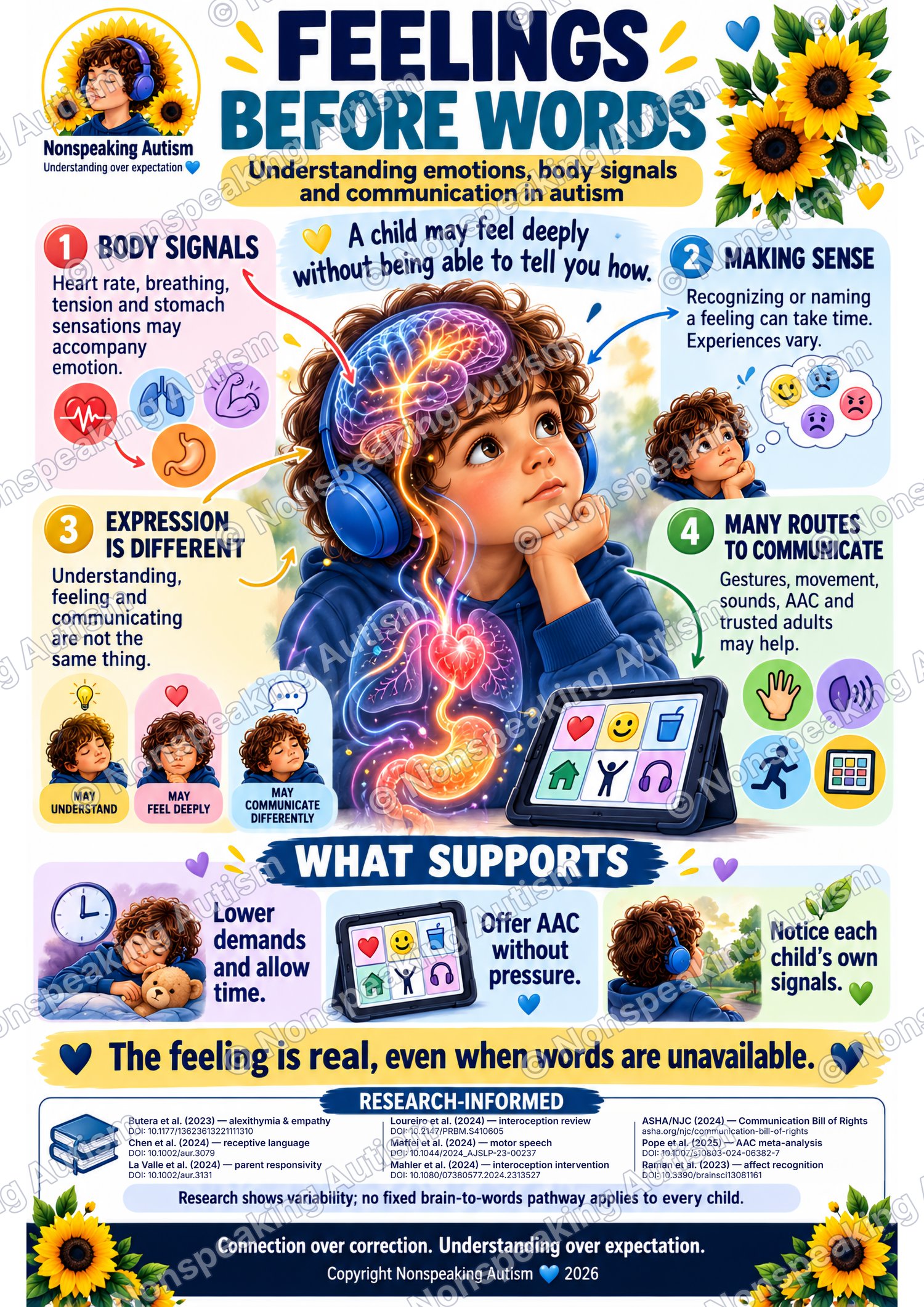
Understanding Emotions, Body Signals, and Communication in Autism
💙 FEELINGS BEFORE WORDS
Understanding Emotions, Body Signals, and Communication in Autism
U.S. Edition | Research-Informed Autism, Interoception, and AAC Educational Poster | Nonspeaking Autism
🌻 A child may feel deeply without being able to tell you how.
A child may experience happiness, fear, excitement, frustration, sadness, or discomfort without being able to communicate those feelings through spoken words.
They may notice their heart beating faster without knowing what that sensation means.
They may experience stomach discomfort without being able to identify whether they feel anxious, hungry, unwell, or overwhelmed.
They may understand what someone is saying but need additional time, accessible communication, or motor support to respond.
For some autistic people, differences in interoception, emotional awareness, language, speech production, and communication access can make identifying or expressing emotions more complex.
But difficulty communicating a feeling does not mean the feeling is absent.
Feelings Before Words is a beautifully illustrated, research-informed educational poster exploring the relationship between internal body signals, emotional experiences, and communication in autism.
Designed for families, educators, speech-language pathologists, occupational therapists, AAC specialists, and autism professionals, this resource encourages a more compassionate and accessible approach to emotional communication.
💛 THE CENTRAL MESSAGE
The feeling is real, even when words are unavailable.
🧠 UNDERSTANDING EMOTIONS, BODY SIGNALS, AND COMMUNICATION
Emotions involve complex interactions between bodily sensations, attention, thoughts, past experiences, and the environment.
For example:
- Anxiety may be accompanied by a faster heartbeat or muscle tension.
- Excitement may also involve a faster heartbeat.
- Fear may be associated with changes in breathing.
- Hunger or physical discomfort may affect how a person feels and responds.
- Sensory overload may make it harder to process language or communicate.
These experiences are not identical for everyone.
Some autistic people notice internal sensations clearly. Others may find particular signals difficult to notice, identify, interpret, or communicate.
A person may also know exactly how they feel but have difficulty expressing that experience through speech.
Feeling, understanding, identifying, and communicating an emotion are related processes, but they are not the same thing.
🌈 WHAT THIS EDUCATIONAL POSTER EXPLORES
1. ❤️ BODY SIGNALS — THE CONNECTION BETWEEN PHYSICAL SENSATIONS AND EMOTIONS
The body continuously provides information about its internal condition.
This process is commonly discussed in relation to interoception.
The poster introduces several body signals that may accompany emotional experiences.
Heart Rate
A faster or more noticeable heartbeat may occur during excitement, anxiety, physical activity, or other experiences.
Breathing
Breathing may change during stress, exertion, excitement, or physical discomfort.
Muscle Tension
Some people experience tightness, stiffness, or changes in muscle tension during emotionally demanding situations.
Stomach Sensations
Nausea, butterflies, abdominal discomfort, or changes in appetite may occur alongside certain emotions.
However, these physical sensations can also have non-emotional causes.
A stomachache does not automatically mean anxiety.
A racing heartbeat does not automatically mean fear.
One body signal cannot reliably identify one particular emotion.
Understanding Interoception in Autism
Interoception involves sensing and interpreting internal bodily conditions.
Research suggests that aspects of interoceptive processing may differ for some autistic individuals, but findings are variable.
Not every autistic person has difficulty with interoception.
Some people may experience heightened awareness of certain signals, reduced awareness of others, or difficulty interpreting what those signals mean.
Individual experiences matter more than assumptions based on diagnosis.
2. MAKING SENSE — RECOGNIZING AND NAMING FEELINGS
Recognizing an emotion may take time.
A child may experience an uncomfortable sensation without immediately knowing whether it relates to:
- Anxiety
- Excitement
- Hunger
- Pain
- Frustration
- Fatigue
- Sensory overload
- Uncertainty
- Several experiences happening together
Some autistic people experience difficulties identifying or describing emotions, sometimes discussed in relation to alexithymia.
Alexithymia is not the same as autism and can occur in autistic and non-autistic people.
Importantly, difficulty identifying or describing an emotion does not mean a person lacks emotional experiences or empathy.
A person can feel something deeply without being able to name it.
3. 💙 EXPRESSION IS DIFFERENT FROM UNDERSTANDING
One of the most important messages in this poster is:
Understanding, feeling, and communicating are not the same thing.
A child may:
- Understand spoken language but have difficulty producing speech.
- Experience strong emotions without being able to describe them.
- Recognize what is happening but need more time to respond.
- Communicate differently depending on stress, fatigue, or sensory demands.
- Have difficulty pointing accurately or accessing a communication device.
- Use facial expressions, movements, gestures, sounds, or AAC to express needs.
A child who does not answer a question may still understand it.
A child who cannot explain an emotion may still experience it intensely.
At the same time, adults should not automatically assume a child's level of understanding from their outward behavior.
Communication access should be assessed and supported individually.
4. 💬 MANY ROUTES TO COMMUNICATE
Communication is not limited to spoken words.
The poster highlights several ways autistic children may communicate feelings and needs.
Gestures
Pointing, reaching, signing, or using familiar movements.
Movement
Moving toward or away from an activity, changing position, or seeking a different environment.
Sounds
Vocalizations and changes in vocal expression that may carry meaning for an individual.
AAC — Augmentative and Alternative Communication
Communication boards, picture symbols, speech-generating devices, typing, and other accessible systems.
Trusted Communication Partners
Responsive adults who allow time, provide access to communication tools, and respect the child's responses.
AAC should include meaningful vocabulary beyond requesting objects.
Children may need ways to communicate:
- I feel scared.
- I'm happy.
- Something hurts.
- I need a break.
- I'm overwhelmed.
- I don't know.
- Please stop.
- I need help.
- I want to be alone.
- I want someone with me.
AAC is communication, not a reward, and it should remain available during distress.
🌻 WHAT SUPPORTS EMOTIONAL COMMUNICATION?
💜 1. LOWER DEMANDS AND ALLOW TIME
When a child is overwhelmed, repeated questions may increase communication demands.
Instead of repeatedly asking, “What's wrong?” consider:
- Reducing unnecessary demands.
- Using calm, predictable language.
- Allowing additional processing time.
- Offering a quiet or familiar environment.
- Checking for physical discomfort.
- Avoiding pressure to speak or make eye contact.
- Providing recovery time before expecting explanations.
Sometimes support needs to come before discussion.
💙 2. OFFER AAC WITHOUT PRESSURE
Provide accessible communication options that allow the child to express emotions, physical needs, preferences, and refusals.
Useful vocabulary may include:
Feelings: happy, sad, worried, angry, excited, confused.
Body needs: hungry, thirsty, tired, hurt, sick, too hot, too cold.
Sensory needs: too loud, too bright, need quiet, need movement.
Choices and boundaries: yes, no, stop, more, different, break, help.
AAC should be modeled naturally and made available without requiring the child to perform or demonstrate a particular emotional label.
💚 3. NOTICE EACH CHILD'S OWN SIGNALS
Every child communicates differently.
Observe patterns while remembering that one behavior may have several possible explanations.
Ask:
- What happened before the response?
- Has the environment changed?
- Could the child be in pain or physically uncomfortable?
- Is the child tired, hungry, or overwhelmed?
- Is their communication system accessible?
- What has the child communicated about similar situations?
- What helps them feel comfortable and supported?
Observe the pattern, check your interpretation, and adapt the support.
🧠 THE SCIENCE BEHIND THE BRAIN–BODY CONNECTION
The poster includes a colorful conceptual illustration of the brain and internal organs.
This represents the complex relationship between internal body sensations, emotional experiences, and communication.
Relevant processes may involve:
- Sensory and interoceptive processing
- Autonomic nervous system activity
- Attention and memory
- Emotional awareness
- Language comprehension
- Speech and motor planning
- Access to alternative communication
These systems interact in complex ways.
There is no single fixed neurological pathway that turns a body sensation into a spoken emotional label for every autistic child.
The artwork is an educational illustration, not a brain scan or precise anatomical map.
Neuroscience can inform our understanding, but it cannot tell us exactly what an individual child is feeling based on outward behavior alone.
🏫 SUPPORTING STUDENTS IN U.S. SCHOOLS
This poster may support more inclusive approaches to emotional communication in general education, special education, and related service settings.
It can help educators consider:
- Accessible AAC systems
- Visual emotional vocabulary
- Additional response time
- Sensory accommodations
- Reduced communication pressure
- Individual communication profiles
- Opportunities for self-advocacy
- Physical comfort and health needs
- Collaboration with families
- Support from speech-language pathologists and occupational therapists
IEP AND SCHOOL SUPPORT CONSIDERATIONS
Where appropriate, a student's communication and sensory needs may be addressed through an Individualized
Education Program (IEP), a Section 504 plan, or other individualized school supports.
Examples may include access to AAC throughout the school day, communication partner training, sensory accommodations, and alternative ways to demonstrate understanding.
A student's emotional support should not depend on their ability to explain feelings through spoken language.
Access first. Communication without pressure. Support without assumptions.
🔬 RESEARCH-INFORMED EDUCATIONAL RESOURCE
The poster draws on research relating to interoception, alexithymia, emotional awareness, receptive language, motor
speech, and augmentative and alternative communication.
📚 SELECTED RESEARCH AND REFERENCES
1. Butera et al. (2023)
Butera, C., Harrison, L., Kilroy, E., Jayashankar, A., Pruyser, A., Shipkova, M., & Aziz-Zadeh, L. (2023).
Relationships between alexithymia, interoception, and emotional empathy in autism spectrum disorder.
Autism, 27(3), 690–703.
https://doi.org/10.1177/13623613221111310
2. Chen et al. (2024)
Chen, Y., Siles, B., & Tager-Flusberg, H. (2024).
Receptive language and receptive-expressive discrepancy in minimally verbal autistic children and adolescents.
Autism Research, 17(2), 381–394.
https://doi.org/10.1002/aur.3079
3. La Valle et al. (2024)
La Valle, C., Shen, L., Butler, L. K., & Tager-Flusberg, H. (2024).
Are minimally verbal autistic children's modality and form of communication associated with parent responsivity?
Autism Research, 17(5), 989–1000.
https://doi.org/10.1002/aur.3131
4. Loureiro et al. (2024)
Loureiro, F., Ringold, S. M., & Aziz-Zadeh, L. (2024).
Interoception in autism: A narrative review of behavioral and neurobiological data.
Psychology Research and Behavior Management, 17, 1841–1853.
https://doi.org/10.2147/PRBM.S410605
5. Maffei et al. (2024)
Maffei, M. F., Chenausky, K. V., Haenssler, A., Abbiati, C., Tager-Flusberg, H., & Green, J. R. (2024).
Exploring motor speech disorders in low and minimally verbal autistic individuals: An auditory-perceptual analysis.
American Journal of Speech-Language Pathology, 33(3), 1485–1503.
https://doi.org/10.1044/2024_AJSLP-23-00237
6. Mahler et al. (2024)
Mahler, K., Hample, K., Ensor, C., Ludwig, M., Palanzo-Sholly, L., Stang, A., Trevisan, D., & Hilton, C. (2024).
An interoception-based intervention for improving emotional regulation in children in a special education classroom: Feasibility study.
Occupational Therapy in Health Care, 38(3), 636–650.
https://doi.org/10.1080/07380577.2024.2313527
7. National Joint Committee for the Communication Needs of Persons With Severe Disabilities (2024)
Communication Bill of Rights (3rd ed.).
American Speech-Language-Hearing Association (ASHA).
https://www.asha.org/njc/communication-bill-of-rights/
8. Pope et al. (2025)
Pope, L., Light, J., & Laubscher, E. (2025).
The effect of naturalistic developmental behavioral interventions and aided AAC on the language development of children on the autism spectrum with minimal speech: A systematic review and meta-analysis.
Journal of Autism and Developmental Disorders, 55, 3078–3099.
https://doi.org/10.1007/s10803-024-06382-7
9. Raman et al. (2023)
Raman, N., Ringold, S. M., Jayashankar, A., Butera, C. D., Kilroy, E., Harrison, L., Cermak, S. A., & Aziz-Zadeh, L. (2023).
Relationships between affect recognition, empathy, alexithymia, and co-occurring conditions in autism.
Brain Sciences, 13(8), 1161.
https://doi.org/10.3390/brainsci13081161
IMPORTANT RESEARCH NOTE
The references above are provided as supplied for this poster and have not been independently verified in this listing.
Research findings vary between individuals and studies. Not all autistic people experience interoceptive or emotional identification difficulties, and not all nonspeaking people have difficulties understanding language.
Studies of AAC and communication support do not establish a single intervention that is appropriate for every child.
This poster is educational and is not a validated assessment of emotional awareness, interoception, alexithymia, receptive language, or communication ability.
FURTHER RESOURCES - ASHA Practice Portal: Augmentative and Alternative Communication (AAC) https://www.asha.org/Practice-Portal/Professional-Issues/Augmentative-and-Alternative-Communication/ - NJC Communication Bill of Rights, 3rd Edition (hosted by ASHA) https://www.asha.org/njc/communication-bill-of-rights/ - AAC Learning Center, Penn State University & RERC on AAC https://aac-learning-center.org - Center for Autism Research Excellence, Boston University (research on minimally verbal autism) https://www.bu.edu/autism/ - Kelly Mahler, OTD: interoception resources https://www.kelly-mahler.com/
RESEARCH & REFERENCES Up-to-date research supporting each section (2024–2026): 1. Body Signals - Loureiro, F., Ringold, S. M., & Aziz-Zadeh, L. (2024). Interoception in autism: A narrative review of behavioral and neurobiological data. Psychology Research and Behavior Management, 17, 1841–1853. https://doi.org/10.2147/PRBM.S410605 2. Making Sense - Loureiro et al. (2024), as above. Findings on interoceptive differences vary across studies. Supporting background (2023): - Butera, C., Harrison, L., Kilroy, E., Jayashankar, A., Pruyser, A., Shipkova, M., & Aziz-Zadeh, L. (2023). Relationships between alexithymia, interoception, and emotional empathy in autism spectrum disorder. Autism, 27(3), 690–703. https://doi.org/10.1177/13623613221111310 - Raman, N., Ringold, S. M., Jayashankar, A., Butera, C. D., Kilroy, E., Harrison, L., Cermak, S. A., & Aziz-Zadeh, L. (2023). Relationships between affect recognition, empathy, alexithymia, and co-occurring conditions in autism. Brain Sciences, 13(8), 1161. https://doi.org/10.3390/brainsci13081161 3. Expression Is Different - Chen, Y., Siles, B., & Tager-Flusberg, H. (2024). Receptive language and receptive-expressive discrepancy in minimally verbal autistic children and adolescents. Autism Research, 17(2), 381–394. https://doi.org/10.1002/aur.3079 - Maffei, M. F., Chenausky, K. V., Haenssler, A., Abbiati, C., Tager-Flusberg, H., & Green, J. R. (2024). Exploring motor speech disorders in low and minimally verbal autistic individuals: An auditory-perceptual analysis. American Journal of Speech-Language Pathology, 33(3), 1485–1503. https://doi.org/10.1044/2024_AJSLP-23-00237 4. Many Routes to Communicate - La Valle, C., Shen, L., Butler, L. K., & Tager-Flusberg, H. (2024). Are minimally verbal autistic children's modality and form of communication associated with parent responsivity? Autism Research, 17(5), 989–1000. https://doi.org/10.1002/aur.3131 - Pope, L., Light, J., & Laubscher, E. (2025). The effect of naturalistic developmental behavioral interventions and aided AAC on the language development of children on the autism spectrum with minimal speech: A systematic review and meta-analysis. Journal of Autism and Developmental Disorders, 55, 3078–3099. https://doi.org/10.1007/s10803-024-06382-7 What Supports - National Joint Committee for the Communication Needs of Persons With Severe Disabilities. (2024). Communication Bill of Rights (3rd ed.). American Speech-Language-Hearing Association. https://www.asha.org/njc/communication-bill-of-rights/ - Mahler, K., Hample, K., Ensor, C., Ludwig, M., Palanzo-Sholly, L., Stang, A., Trevisan, D., & Hilton, C. (2024). An interoception-based intervention for improving emotional regulation in children in a special education classroom: Feasibility study. Occupational Therapy in Health Care, 38(3), 636–650. https://doi.org/10.1080/07380577.2024.2313527 (small feasibility study; promising, not conclusive) Foundational references printed on the poster: - Klein, M., Witthöft, M., & Jungmann, S. M. (2025). Interoception in individuals with autism spectrum disorder: A systematic literature review and meta-analysis. Frontiers in Psychiatry, 16, 1573263. https://doi.org/10.3389/fpsyt.2025.1573263 - Loureiro, F., Ringold, S. M., & Aziz-Zadeh, L. (2024). Psychology Research and Behavior Management, 17, 1841–1853. https://doi.org/10.2147/PRBM.S410605 - Pope, L., Light, J., & Laubscher, E. (2025; online 2024). Journal of Autism and Developmental Disorders, 55, 3078–3099. https://doi.org/10.1007/s10803-024-06382-7 Research shows variability. No single brain-to-words pathway applies to every child.
Sources:
- Loureiro et al. 2024 (PMC)
- Butera et al. 2023 (PMC)
- Raman et al. 2023 (DOAJ)
- Chen et al. 2024 (PMC)
- Maffei et al. 2024 (URI lab page)
- La Valle et al. 2024 (PMC)
- Pope et al. (Auburn AAC Lab)
- Mahler et al. 2024 (UTMB)
- NJC Communication Bill of Rights (ASHA)
👨👩👧 WHO IS THIS RESOURCE FOR?
This poster may be helpful for:
- Parents and caregivers
- Autistic children, teens, and adults
- Families supporting nonspeaking autistic individuals
- General education teachers
- Special education teachers
- Classroom aides and paraprofessionals
- Speech-language pathologists (SLPs)
- Occupational therapists (OTs)
- AAC specialists
- School psychologists
- Behavior support professionals
- Early intervention providers
- Autism advocates and educators
It can be displayed in homes, classrooms, therapy rooms, resource centers, communication support spaces, and professional training environments.
📦 WHAT YOU RECEIVE
💙 PAID DIGITAL DOWNLOAD — INDIVIDUAL EDUCATIONAL POSTER
Your purchase includes:
1 × Feelings Before Words — Understanding Emotions, Body Signals, and Communication in Autism
The poster features:
- Body signals associated with emotions
- Interoception and internal body awareness
- Recognizing and naming feelings
- The difference between understanding and expression
- Gestures, movement, vocalizations, and AAC
- Practical emotional communication supports
- An illustrated brain–body connection
- Research-informed educational references
- Nonspeaking Autism branding and artwork
The listing preview contains promotional watermarks. The purchased printable file should be supplied without preview watermarks.
Digital download only. No physical item will be shipped.
Print dimensions and resolution should be confirmed against the final downloadable file.
⚠️ IMPORTANT DISCLAIMER
This resource is intended for educational and informational purposes only.
It does not provide a medical diagnosis, psychological evaluation, speech-language assessment, occupational therapy assessment, or individualized treatment plan.
Physical sensations such as a racing heartbeat, stomach discomfort, breathing changes, or muscle tension can have many causes, including medical conditions.
Do not assume that physical symptoms are caused by autism, anxiety, or emotional distress without considering other explanations.
Seek appropriate medical advice for persistent, unusual, or concerning symptoms.
Communication supports should be individualized and guided by the person's abilities, preferences, and access needs.
©️ COPYRIGHT & PERMITTED USE
Copyright © 2026 Nonspeaking Autism. All rights reserved.
Your purchase permits personal, family, classroom, school, and individual professional educational use.
You may print the poster for these purposes.
You may not:
- Resell or redistribute the digital file
- Upload the artwork to another website
- Share the purchased file publicly
- Remove branding or claim the design as your own
- Reproduce it commercially
- Include it in another product for resale without permission
Please share the original Payhip product listing rather than distributing the purchased file.
💛 THE MESSAGE BEHIND THIS RESOURCE
A child may feel anxious without knowing how to explain it.
A child may experience excitement without being able to name the sensation.
A child may feel pain, sadness, joy, or frustration without having access to spoken words.
A child may understand more than they can express through speech.
And a child who appears quiet may still be experiencing powerful emotions.
We can provide time.
We can reduce pressure.
We can offer AAC.
We can notice individual signals.
We can respect different communication methods.
Because feelings do not become less real when words are unavailable.
💙 THE FEELING IS REAL, EVEN WHEN WORDS ARE UNAVAILABLE.
🌻 Connection over correction. Understanding over expectation.
Nonspeaking Autism © 2026