

Crisis & Regulation Framework Phase 3: Crisis Management & Immediate Safety — Red Zone
Crisis & Regulation Framework
Phase 3: Crisis Management & Immediate Safety — Red Zone
Safety First • Reduce Immediate Risk • Add as Little Extra Threat as Possible
When an autistic person is already in acute distress, the priority changes.
This is not the moment for teaching, lengthy explanations, consequences, demands for eye contact or attempts to make the person appear calm.
The immediate priority is safety.
Phase 3: Crisis Management & Immediate Safety — Red Zone is a practical, research- and guidance-informed educational poster from Nonspeaking Autism, designed to help parents, carers, educators and professionals think clearly about what may help when distress has escalated and immediate risk is present.
The central question is not:
“How do I stop this quickly?”
It is:
“How do I reduce immediate risk while adding as little extra threat as possible?”
🔴 What Does “Red Zone” Mean?
In this resource, Red Zone is an educational term for a period of intense distress or crisis where immediate safety has become the priority.
It is not a diagnosis, validated clinical stage, universal sequence or description of the person's character.
A person in crisis is not a “red-zone person.”
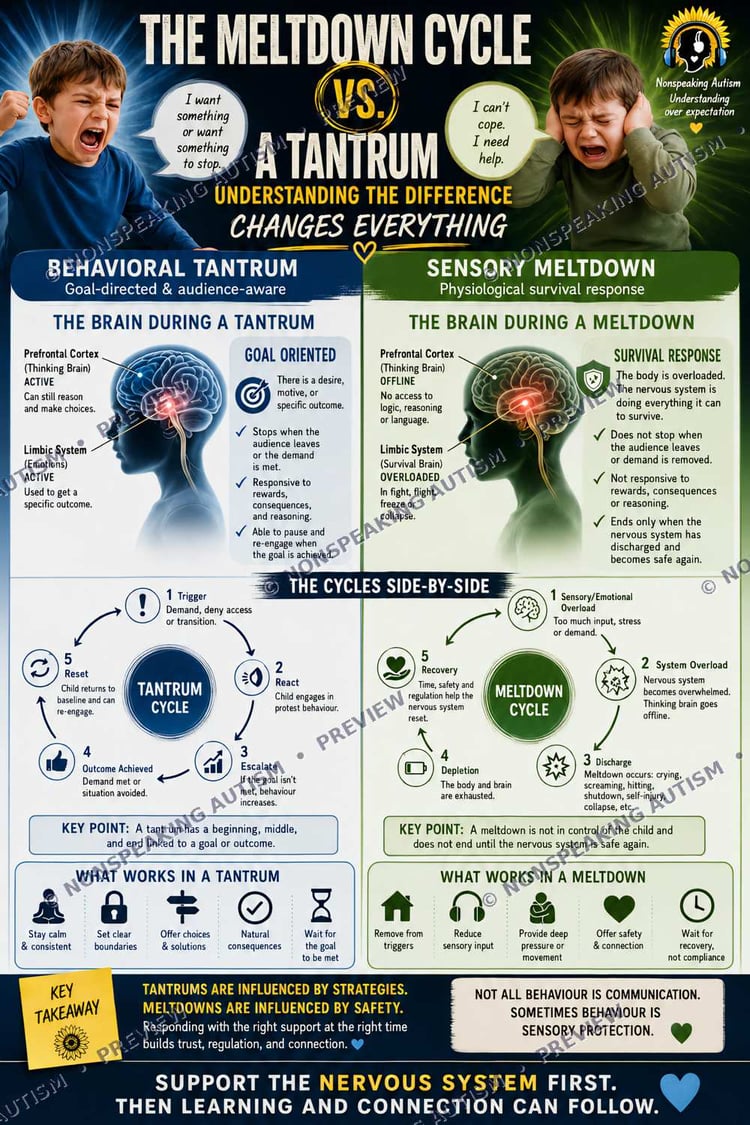
People may also show crisis very differently. Some may cry, shout, hit, kick, bite, run or throw objects. Others may freeze, shut down, become very quiet, lose access to speech or become less responsive.
Look at the individual person and situation — not simply the label.
🛡️ 1. Prioritise Physical Safety
When there is an immediate risk of injury, focus first on making the environment safer.
Where it can be done safely:
- clear hard or dangerous objects
- move other people back
- create as much space as possible
- block access to immediate hazards
- protect without unnecessarily crowding the person
- follow the person's established safety or crisis plan
The objective is risk reduction, not immediate compliance.
Safety is the goal — not immediate compliance.
🗣️ 2. Reduce Talking
When someone is highly distressed, large amounts of language can add further processing demand.
Where appropriate, use:
- a calm, steady voice
- very short, familiar phrases
- pauses and processing time
- one lead adult where possible
Simple language might include:
“Safe.”
“I'm here.”
“This way.”
“No rush.”
Avoid turning the crisis into a conversation that requires the person to explain themselves.
Questions, lectures and corrections can wait.
Fewer words can mean less additional load.
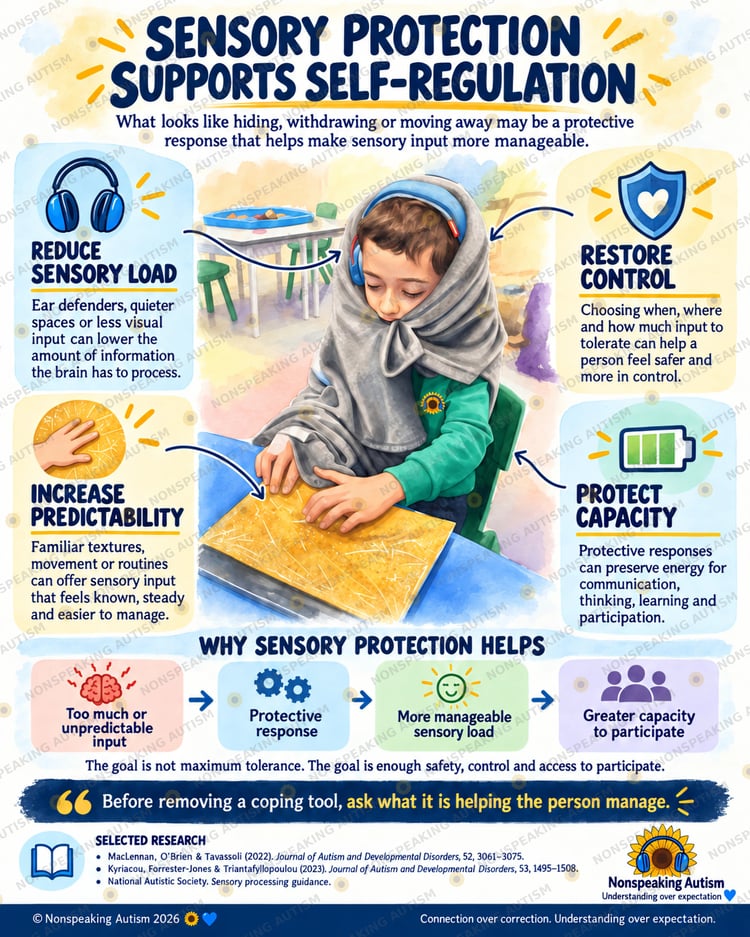
🔉 3. Lower the Environmental Load
Look around the person as well as at the person.
Where possible:
- reduce noise
- dim or soften lighting
- stop unnecessary conversations nearby
- remove unnecessary touch
- reduce movement around the person
- move to a safer, quieter area if this can be achieved without creating additional distress or danger
Sometimes changing the environment may reduce risk faster than adding more verbal instruction.
👥 4. Remove the Audience
A crowded response can increase sensory input, social pressure and perceived threat.
Where safe and appropriate:
- move peers, siblings or bystanders away
- avoid surrounding the person
- reduce the number of adults giving directions
- keep the immediate area calm and clear
- have one familiar adult take the lead where possible
More adults do not automatically mean more safety.
More space. Fewer words. Less crowding.
❤️ 5. Do Not Add More Threat
During acute distress, avoid unnecessary actions that may increase pressure.
Do not:
- argue
- shame
- threaten
- demand eye contact
- demand explanations
- force unnecessary interaction
- assume intent from behaviour
- begin lengthy teaching or consequences
Understanding distress does not mean ignoring harm or abandoning boundaries.
It means addressing immediate safety without adding avoidable fear, humiliation or processing demand.
Crisis behaviour is not the moment for teaching, consequences or long explanations.
⭐ 6. Use the Person's Known Crisis Plan
Crisis is rarely the best time to invent a completely new strategy.
Use individualized information already known to be helpful, such as:
- preferred safe spaces
- familiar communication methods
- known regulation supports
- named lead adults
- agreed emergency steps
- relevant healthcare or safeguarding plans
What helps one autistic person may be ineffective or distressing for another.
Known individualized support is usually safer than improvising.
🚑 7. Watch for Medical or Safeguarding Concerns
Not every crisis should automatically be attributed to autism, sensory overload or emotional dysregulation.
Consider possible:
- injury
- severe pain
- breathing difficulties
- head injury
- sudden or unusual change from baseline
- seizure activity
- acute illness
- medication-related concerns
- other signs of a medical emergency
Behaviour and communication changes can sometimes be signs that something is physically wrong.
A sudden change deserves attention.
Seek urgent medical assistance when there is a serious injury, breathing problem, suspected seizure, loss of consciousness or another medical emergency.
Safeguarding concerns should be managed according to applicable safeguarding procedures.
🌿 8. Once the Immediate Danger Passes
The end of immediate danger does not necessarily mean the person's nervous system has recovered.
Afterwards, the person may still need:
- reduced demands
- recovery time
- space
- quiet
- water or other basic needs
- access to AAC
- familiar regulation supports
- assessment for pain or injury
- sleep or rest
- time before discussing what happened
This is also an opportunity for supporters to record what appeared to increase or reduce risk, so future planning can become more individualized.
Safety first. Reflection later.
💬 Communication Still Matters in Crisis
Speech may become less accessible during intense distress.
Continue to respect communication through:
AAC • gesture • pointing • symbols • typing • writing • body movement • familiar yes/no systems • other individualized methods
Do not assume reduced speech means reduced understanding.
Do not remove AAC because someone is distressed.
And where immediate safety allows, give the person time to process rather than repeatedly demanding a response.
Communication access matters most when communication is hardest.
🤝 Co-Regulation Continues Even in Crisis
Co-regulation does not mean forcing someone to calm down.
It means considering whether the actions of people around them are reducing or increasing pressure.
A supporter may help by being:
- predictable
- calm in their movements
- concise
- non-shaming
- respectful of space
- attentive to communication
- aware of sensory load
- focused on immediate safety
The adult's role is not to demand the performance of calmness.
It is to avoid adding unnecessary threat while supporting safety.
⚠️ Understanding Distress Does Not Mean Ignoring Risk
A compassionate approach and a safety-conscious approach are not opposites.
If somebody is at risk of seriously hurting themselves or another person, immediate safety matters.
The principle is to use the least threatening, least intrusive response that can safely address the situation, while following the person's individualized plans, professional guidance, organisational policies and applicable law.
This poster does not provide instructions for physical restraint, seclusion or restrictive intervention.
🧠 After Crisis: Look Beyond the Behaviour
Once everyone is safe and sufficient recovery time has passed, useful questions may include:
What happened beforehand?
Was the environment unusually noisy, bright, crowded or unpredictable?
Was communication accessible?
Was the person experiencing pain, illness, hunger, thirst or fatigue?
Were demands accumulating?
Was there an unexpected transition?
What appeared to increase distress?
What reduced risk?
What could we change next time?
The purpose is not blame.
It is to improve future understanding and support.
🔬 Research & Guidance-Informed
This resource is informed by established guidance emphasising individualized assessment, communication needs, environmental factors, sensory sensitivities, physical-health considerations, prevention and least-restrictive approaches to safety.
NICE autism guidance recommends considering environmental and communication factors that may contribute to distress, including sensory sensitivities and changes to routines.
NICE guidance concerning behaviour that challenges also emphasises understanding the function and context of behaviour, physical and mental health, communication, environmental factors and proactive strategies rather than relying only on reactive responses.
The National Autistic Society similarly provides guidance around distressed behaviour, encouraging supporters to consider possible triggers, communication, sensory factors, physical health and individualized approaches.
The Red Zone, eight-part structure and wording in this poster are an educational framework created to make these wider principles accessible. They are not a validated clinical crisis-assessment tool.
📚 Selected Guidance & References
National Institute for Health and Care Excellence (NICE). (2013, updated). Autism spectrum disorder in under 19s: support and management (CG170).
Includes guidance relevant to environmental adjustments, communication, sensory sensitivities and understanding factors contributing to behaviour that challenges.
National Institute for Health and Care Excellence (NICE). Autism (QS51).
Quality standard addressing individualized, coordinated and appropriate support for autistic people.
National Institute for Health and Care Excellence (NICE). (2015). Challenging behaviour and learning disabilities: prevention and interventions for people with learning disabilities whose behaviour challenges (NG11).
Includes assessment of communication, physical and mental health, environmental factors and proactive strategies, alongside guidance relating to reactive approaches.
National Autistic Society. Guidance and information on distressed behaviour and meltdowns in autistic people, including consideration of triggers, sensory environments, communication and individualized support.
🔬 Up-to-date guidance and research (2024–2026) Department for Education. (2025). Restrictive interventions, including use of reasonable force, in schools: Guidance for schools in England. Published December 2025; in force from 1 April 2026. → Supports: 1 Prioritise Physical Safety; Safety, Restraint and Consent note; "Safety is the goal — not immediate compliance" Tavassoli, T., Marco, E. J., & Puts, N. A. J. (2026). Sensory reactivity in autism: Integrating behavioural, affective, physiological, and neural dimensions. Current Psychiatry Reports, 28, Article 36. → Supports: 2 Reduce Talking; 3 Lower the Environmental Load Chen, Y., Xi, Z., Saunders, R., Simmons, D., Totsika, V., & Mandy, W. (2024). A systematic review and meta-analysis of the relationship between sensory processing differences and internalising/externalising problems in autism. Clinical Psychology Review, 114, 102516. https://doi.org/10.1016/j.cpr.2024.102516 → Supports: 3 Lower the Environmental Load; 4 Remove the Audience Therrien, M. C. S., Whalon, K., Nunes, D., Marti, P., & Sellers, A. (2025). A systematic review of AAC interventions using speech generating devices for autistic preschoolers. Augmentative and Alternative Communication, 41(2). https://doi.org/10.1080/07434618.2025.2479768 → Supports: 6 Use the Person's Known Crisis Plan ("familiar communication method") Kumar, J., Hartzell, C., Abelson, E., Jastrowski Mano, K., & Chidambaran, V. (2026). Prevalence, expression, assessment, mechanisms, and management of pain in autistic children: A scoping review. A&A Practice, 20(4), e02178. https://doi.org/10.1213/XAA.0000000000002178 → Supports: 7 Watch for Medical or Safeguarding Concerns; 8 "check for pain or injury" Paris, K., Lodestone, A. Z., Houser, M., & Lewis, L. F. (2025). "Shutdowns are like you're stuck on the blue screen of death": A metaphor analysis of autistic shutdowns. Autism in Adulthood, 8(4), 687–697. https://doi.org/10.1089/aut.2024.0193 → Supports: 8 Once the Immediate Danger Passes ("the nervous system may still be overwhelmed")
📖 Evidence Note
The references above support the broader principles behind this resource. They should not be interpreted as validating every individual strategy for every person or establishing the Green/Yellow/Red framework as a clinical model.
Crisis response must be individualized and proportionate to actual risk.
👨👩👧 Who Is This Resource For?
This educational poster may be useful for:
- parents and carers
- autistic people and their supporters
- teachers and teaching assistants
- SENCOs and SEND teams
- mainstream and specialist schools
- support workers
- respite services
- occupational therapists
- speech and language therapists
- healthcare professionals
- social-care professionals
- psychologists and behavioural professionals
- multidisciplinary teams
- autism and disability organisations
It can support staff training, family discussion, support planning and reflection on crisis-response environments.
📦 What You Receive
Your purchase includes:
1 × Crisis & Regulation Framework — Phase 3: Crisis Management & Immediate Safety — Red Zone educational poster
1 × high-resolution printable digital PDF
The purchased file is supplied clear and without the promotional preview watermark shown on the Payhip listing image.
Watermarks visible in promotional images are used for preview and copyright protection only.
Digital download only — no physical product will be shipped.
⚠️ Important Safety & Professional Disclaimer
This resource is for educational and informational purposes only.
It is not a medical assessment, diagnosis, psychological assessment, Functional Behaviour Assessment, risk assessment, safeguarding plan, individualized crisis plan, emergency protocol, treatment plan, restraint protocol or substitute for qualified professional advice.
The Red Zone is an educational organizing concept and is not a validated clinical stage or universal sequence of crisis.
This resource does not provide instructions for restraint, seclusion or other restrictive interventions. Any restrictive intervention must be governed by applicable law, organizational policy, professional standards, individualized risk assessment and appropriately trained personnel.
Where there is foreseeable significant risk of harm, seek appropriately qualified professional support and develop individualized safety and crisis planning.
Sudden, severe, unusual or unexplained changes in behaviour, communication, consciousness or physical functioning may have medical causes and should not automatically be attributed to autism or distress.
For serious injury, breathing difficulty, suspected seizure, loss of consciousness or another medical emergency, contact the appropriate emergency service.
©️ Copyright & Permitted Use
Copyright © 2026 Nonspeaking Autism. All rights reserved.
Purchase permits use for personal and family use, your own classroom or educational setting, your own clinic or individual professional educational practice, and direct support work with people you support.
The file may not be resold, redistributed, file-shared, uploaded elsewhere, commercially reproduced, altered for resale or incorporated into another product for sale or distribution.
Please direct others who require their own copy to the original Nonspeaking Autism listing.
💛 The Message Behind the Resource
When somebody is already in crisis, adding more demands, more voices, more people and more pressure can add to an already overwhelming situation.
The priority becomes:
Protect people.
Create space.
Reduce noise.
Use fewer words.
Keep communication accessible.
Remove unnecessary demands.
Watch for medical concerns.
Use what is already known about the individual.
Allow recovery.
And when the immediate danger has passed, there will be time to understand what happened and improve future support.
LESS TALKING • LESS CROWDING • LESS THREAT • MORE SPACE • MORE SAFETY • MORE REGULATION SUPPORT
“How do I reduce immediate risk while adding as little extra threat as possible?”
Co-regulation continues even in crisis.
Safety support should reduce risk — not add fear.
Connection over correction. Understanding over expectation. 💛🌻
© Nonspeaking Autism 2026