
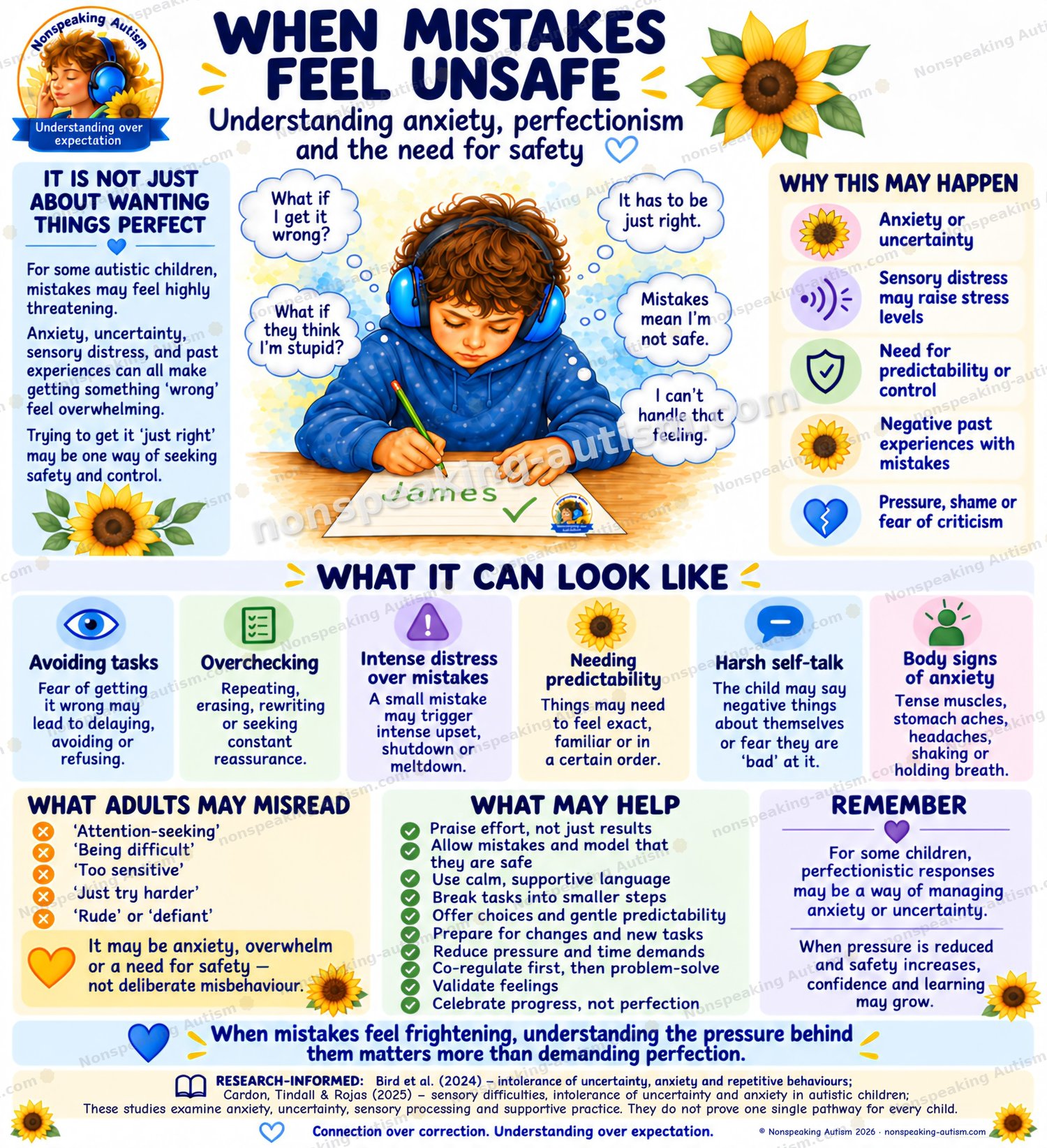
💙 WHEN MISTAKES FEEL UNSAFE
💙 WHEN MISTAKES FEEL UNSAFE
Understanding Anxiety, Perfectionism and the Need for Safety in Autistic Children
Research-Informed Autism Educational Poster | UK Edition | Nonspeaking Autism
🌻 Understanding over expectation. Connection over correction.
For some autistic children, making a mistake can feel like much more than simply getting something wrong.
A small error in schoolwork, an unexpected change to a familiar routine or uncertainty about whether something has been completed correctly may trigger significant anxiety, distress or overwhelm.
A child might repeatedly erase their writing, start an activity again, ask for reassurance, refuse to attempt a task or become extremely upset when something does not go as expected.
From the outside, these responses can sometimes be misunderstood as stubbornness, attention-seeking, defiance or an unwillingness to try.
But underneath, a child may be experiencing genuine distress.
When Mistakes Feel Unsafe is a compassionate, research-informed educational poster exploring why mistakes, uncertainty and the pressure to get things right may feel threatening for some autistic children.
It helps families, educators and professionals recognise possible signs of anxiety-related perfectionism and respond with understanding, reassurance, flexibility and practical support.
The central message:
A child who struggles with mistakes may not need more pressure to try harder. They may need greater emotional safety, predictability and support.
🧠 WHAT THIS POSTER EXPLORES
1. Why Mistakes May Feel Unsafe
Perfectionistic responses are not always about wanting everything to look neat or achieve the highest standard.
For some children, trying to get something exactly right may be connected to:
- Anxiety: Worry about getting something wrong or what might happen afterwards.
- Intolerance of uncertainty: Finding it difficult to manage situations without a clear or predictable outcome.
- Sensory distress: Feeling less able to cope with mistakes when sensory demands are already overwhelming.
- Need for predictability: Feeling more comfortable when activities follow familiar patterns.
- Past negative experiences: Remembering criticism, punishment, embarrassment or other difficult experiences.
- Fear of judgement: Worrying that mistakes mean they are not capable or will disappoint someone.
These factors may interact, but they do not explain every child's experience.
Perfectionism can also occur in non-autistic children, and not all autistic children experience anxiety about mistakes.
👀 2. WHAT ANXIETY-RELATED PERFECTIONISM MAY LOOK LIKE
💙 Avoiding Tasks
A child may delay starting, avoid unfamiliar activities or refuse a task because they are worried about making a mistake.
Avoidance can sometimes be a response to anxiety rather than a lack of motivation.
💚 Repeated Checking
A child may repeatedly:
- Check answers or instructions.
- Erase and rewrite work.
- Restart an activity.
- Ask whether something is correct.
- Seek reassurance before moving on.
Repeated checking may have different causes. It should not automatically be labelled as perfectionism or assumed to indicate obsessive-compulsive disorder.
💜 Intense Distress Over Small Mistakes
An error that seems minor to an adult may feel significant to the child.
Possible responses include crying, frustration, withdrawing, freezing or becoming overwhelmed.
💛 Needing Predictability
Some children may prefer familiar instructions, a clear sequence of steps or advance information about what will happen next.
🩵 Harsh Self-Talk
A child may say:
- “I'm stupid.”
- “I can't do anything right.”
- “Everyone will think I'm bad at this.”
- “I always get things wrong.”
These statements deserve a compassionate response, not dismissal.
🌻 Physical Signs of Anxiety
Anxiety may be accompanied by physical experiences such as:
- Muscle tension.
- Stomach discomfort.
- Headaches.
- Shaking.
- Changes in breathing.
- Restlessness or fatigue.
Physical symptoms should not automatically be attributed to anxiety. Pain, illness and other medical explanations may also need consideration.
⚠️ 3. WHAT ADULTS MAY MISUNDERSTAND
A child who repeatedly checks their work, struggles to start or becomes distressed over an error may be described as:
- “Attention-seeking.”
- “Being difficult.”
- “Too sensitive.”
- “Not trying hard enough.”
- “Rude.”
- “Defiant.”
These descriptions may overlook the child's underlying experience.
What appears to be resistance may sometimes reflect anxiety, uncertainty, overload, communication difficulties or a need for support.
Instead of asking:
“Why won't this child just get on with it?”
Consider asking:
“What about this task feels difficult, uncertain or unsafe, and how can we make it more manageable?”
This change in perspective can help adults respond to the child's needs rather than focusing only on the visible behaviour.
💛 4. WHAT MAY HELP
🌱 Praise Effort and Progress
Recognise persistence, curiosity, exploration and the willingness to try.
Avoid making approval dependent on perfect outcomes.
💙 Make Mistakes Feel Safe
Model everyday mistakes calmly.
Show that errors can be corrected, explored or accepted without shame.
A supportive adult might say:
“It's okay if this isn't right the first time.”
“We can work through this together.”
“You don't have to get everything perfect to be proud of your effort.”
🧩 Break Tasks Into Smaller Steps
Large or unfamiliar activities may feel more manageable when presented in smaller, clearly explained stages.
Offer a starting point and check that instructions are accessible.
🗓️ Offer Gentle Predictability
Use visual supports, clear expectations, examples and preparation for changes where helpful.
Predictability should support confidence without creating rigid expectations that become difficult to manage.
🤝 Offer Meaningful Choices
Allow the child some control over how they approach a task.
This may include choosing materials, taking a break, selecting a starting point or using a preferred communication method.
💜 Co-Regulate Before Problem-Solving
When a child is overwhelmed, explanations and corrections may be difficult to process.
Reduce pressure, offer calm support and allow time for recovery before revisiting the task.
⏰ Reduce Time Pressure
Allow additional processing time and avoid unnecessary urgency.
Some children may benefit from flexible deadlines or alternative ways of demonstrating their understanding.
🌻 Validate Feelings
Acknowledge the child's experience without reinforcing the belief that every mistake is dangerous.
For example:
“I can see that getting this wrong feels really upsetting.”
“Making a mistake doesn't change how I feel about you.”
“We can find a way forward when you're ready.”
The aim is to build confidence and flexibility through safety, not pressure.
🏫 SUPPORTING AUTISTIC LEARNERS IN SCHOOL
Mistake-related anxiety may affect classroom participation, written work, tests, transitions and unfamiliar learning activities.
Supportive approaches may include:
- Giving clear, accessible instructions.
- Showing examples of completed work.
- Reducing unnecessary time pressure.
- Offering visual task sequences.
- Allowing movement or sensory breaks.
- Providing alternatives to public correction.
- Avoiding criticism or embarrassment in front of peers.
- Supporting AAC and other communication methods.
- Recognising effort without insisting on perfection.
- Working collaboratively with parents, carers and the child.
For UK schools, these approaches may contribute to SEND support, individual learning plans and reasonable adjustments where appropriate.
It is important to distinguish anxiety-related avoidance from difficulties caused by motor coordination, language processing, sensory demands or inaccessible tasks.
A child may understand the learning objective but struggle with the physical or communication demands of demonstrating it.
🔬 RESEARCH-INFORMED: WHAT THE EVIDENCE SUGGESTS
Research has explored relationships between anxiety, intolerance of uncertainty, sensory differences and repetitive behaviours in autistic children.
Intolerance of uncertainty refers to finding uncertain situations difficult or distressing.
Some research suggests that greater intolerance of uncertainty is associated with increased anxiety in autistic populations.
Research also suggests that sensory experiences and anxiety can interact for some individuals.
However, the evidence does not establish that perfectionism in every autistic child results from the same neurological or psychological mechanism.
A child's response to mistakes may reflect several interacting factors, including learning experiences, emotional wellbeing, sensory needs and environmental expectations.
📚 SELECTED RESEARCH AND GUIDANCE
Jenkinson, R., Milne, E., & Thompson, A. (2020). The relationship between intolerance of uncertainty and anxiety in autism: A systematic literature review and meta-analysis. Autism, 24(8), 1933–1944.
NICE. Autism spectrum disorder in under 19s: support and management (CG170).
https://www.nice.org.uk/guidance/cg170
NICE. Social anxiety disorder: recognition, assessment and treatment (CG159).
https://www.nice.org.uk/guidance/cg159
Evidence Note
Research & References Why This May Happen – anxiety, uncertainty and need for predictability: - Bird, S., Moid, L., Jones, C., & Surtees, A. (2024). The relationships between restrictive/repetitive behaviours, intolerance of uncertainty, and anxiety in autism: a systematic review and meta-analysis. Research in Autism Spectrum Disorders, 117, 102428. https://doi.org/10.1016/j.rasd.2024.102428 Why This May Happen – sensory distress: - Cardon, G., Tindall, K., & Rojas, D. (2025). Behavioral and neural interrelationships of sensory difficulties, intolerance of uncertainty, and anxiety in autistic children. Research in Autism, 125, 202618. https://doi.org/10.1016/j.reia.2025.202618 - Recio, P., Pozo, P., García-López, C., & Sarriá, E. (2024). Autistic sensory traits and psychological distress: mediating role of worry and intolerance of uncertainty. Brain Sciences, 14(11), 1088. https://doi.org/10.3390/brainsci14111088 (study of autistic adults) Foundational references (printed on the poster): Bird et al. (2024) • Cardon, Tindall & Rojas (2025)
Sources:
- Bird et al. 2024 (OpenAlex)
- Bird et al. 2024 (University of Birmingham)
- Cardon, Tindall & Rojas 2025 (Crossref)
- Recio et al. 2024 (Crossref)
👨👩👧 WHO IS THIS RESOURCE FOR?
This poster is suitable for:
- Parents and carers of autistic children.
- Autistic children, teenagers and their support networks.
- Teachers and teaching assistants.
- SENCOs and SEND teams.
- Mainstream and specialist schools.
- Educational psychologists.
- Occupational therapists.
- Speech and language therapists.
- Autism support professionals.
- Professionals supporting anxiety and emotional regulation.
It may be particularly useful when supporting children who struggle with mistakes, unfamiliar tasks, reassurance-seeking, uncertainty or fear of criticism.
📦 WHAT YOU RECEIVE
💙 PAID DIGITAL DOWNLOAD
1 × When Mistakes Feel Unsafe educational poster
The illustrated resource covers:
- Why mistakes may feel threatening.
- Anxiety, uncertainty and the need for predictability.
- Signs of mistake-related distress.
- Behaviours adults may misinterpret.
- Practical ways to reduce pressure.
- Emotional safety and co-regulation.
- Building confidence through supported learning.
- Research-informed context.
Digital download only. No physical item will be shipped.
The image shown in the Payhip listing is a branded preview. The final customer file should be supplied without promotional preview watermarks.
Print dimensions and resolution should be confirmed from the final downloadable file.
⚠️ IMPORTANT DISCLAIMER
This resource is for educational and informational purposes only.
It is not a diagnostic tool, validated assessment, treatment plan or substitute for professional psychological, educational or medical advice.
Mistake-related distress can have different causes. Anxiety, perfectionism, obsessive-compulsive symptoms, sensory difficulties, learning needs and other experiences require individual consideration.
If anxiety or distress is persistent, severe or significantly affects everyday life, seek advice from an appropriately qualified professional.
©️ COPYRIGHT & PERMITTED USE
Copyright © 2026 Nonspeaking Autism. All rights reserved.
Permitted uses include personal, home, classroom, school and individual professional educational use.
You may print and display your purchased resource for these purposes.
You may not resell, redistribute, share the digital file, upload it to other websites, remove copyright branding or reproduce the artwork for commercial purposes.
Please share the original Payhip product link rather than distributing copies.
💛 THE MESSAGE BEHIND THIS RESOURCE
Some children are not afraid of learning.
They are afraid of getting something wrong.
Some are not refusing to try.
They are overwhelmed by the uncertainty of what might happen if they make a mistake.
And some are not trying to be perfect for praise.
They may be trying to feel safe.
When adults respond with patience, predictability, flexibility and reassurance, children may have more opportunities to build confidence and explore learning without fear.
A mistake should be an opportunity to learn, not a reason to feel unsafe.
🌻 See beyond the behaviour. Understand the pressure. Support the child.
Nonspeaking Autism © 2026