
Beyond ‘Aggression’
Beyond ‘Aggression’
Describe the Behaviour. Understand the Distress. Find the Cause.
When a child hits, pushes, bites, kicks, scratches, shouts, throws objects or runs away, the word “aggressive” can quickly become the whole story.
But a label does not tell us what happened, what the person was experiencing, what they were trying to communicate, or what support they needed.
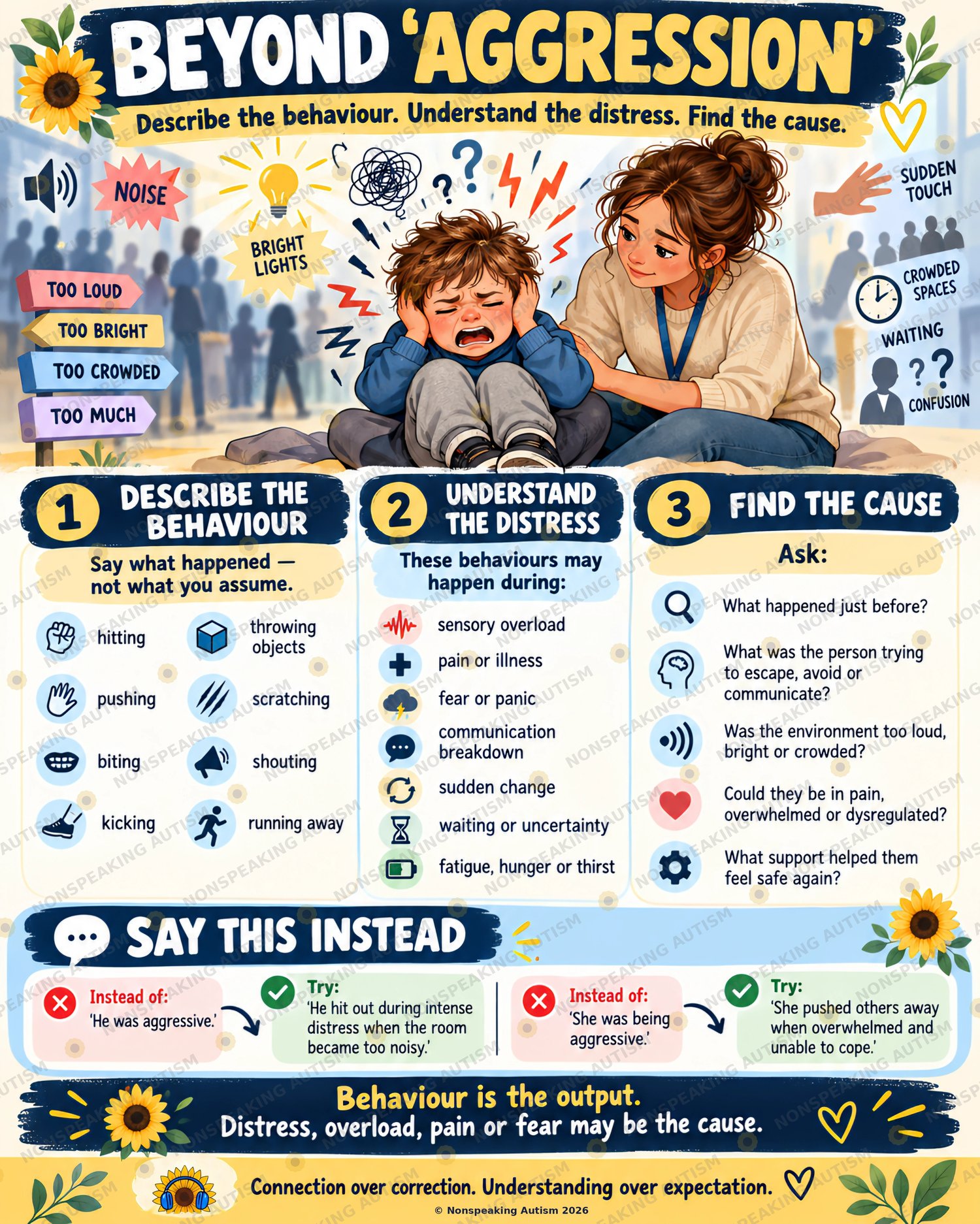
Beyond ‘Aggression’ is a practical, neurodiversity-affirming educational poster designed to help parents, carers, educators and professionals move from judgement towards observation, curiosity and understanding.
Instead of beginning with:
“Why are they being aggressive?”
this resource encourages adults to ask:
“What actually happened?”
“What was happening around them?”
“Could they be overwhelmed, frightened, in pain or unable to communicate what they needed?”
“What helped them feel safe again?”
The central message is:
Behaviour is the output. Distress, overload, pain or fear may be the cause.
🧠 Why Move Beyond the Label “Aggression”?
Words influence how people respond.
If a distressed child is described only as “aggressive,” “violent,” “difficult” or “challenging,” important information can be lost.
The label tells us very little about:
- what the person actually did
- what happened immediately beforehand
- what the sensory environment was like
- whether something hurt
- whether communication had become difficult
- whether the person was frightened
- whether they were trying to escape
- whether an unexpected change had occurred
- what support reduced the distress
This poster encourages a more descriptive approach.
Instead of beginning with an interpretation, begin with what can actually be observed.
1️⃣ Describe the Behaviour
Say what happened — not what you assume.
The first step is to describe the observable behaviour as clearly and neutrally as possible.
For example:
hitting
pushing
biting
kicking
throwing objects
scratching
shouting
running away
This does not mean minimizing behaviour that can cause injury.
Safety still matters.
The difference is that a factual description gives us more useful information than a broad character judgement.
Compare:
❌ “He was aggressive.”
with:
✅ “He hit out during intense distress when the room became too noisy.”
The second description gives us information we can actually investigate.
2️⃣ Understand the Distress
The next step is to consider what may have been happening around or within the person.
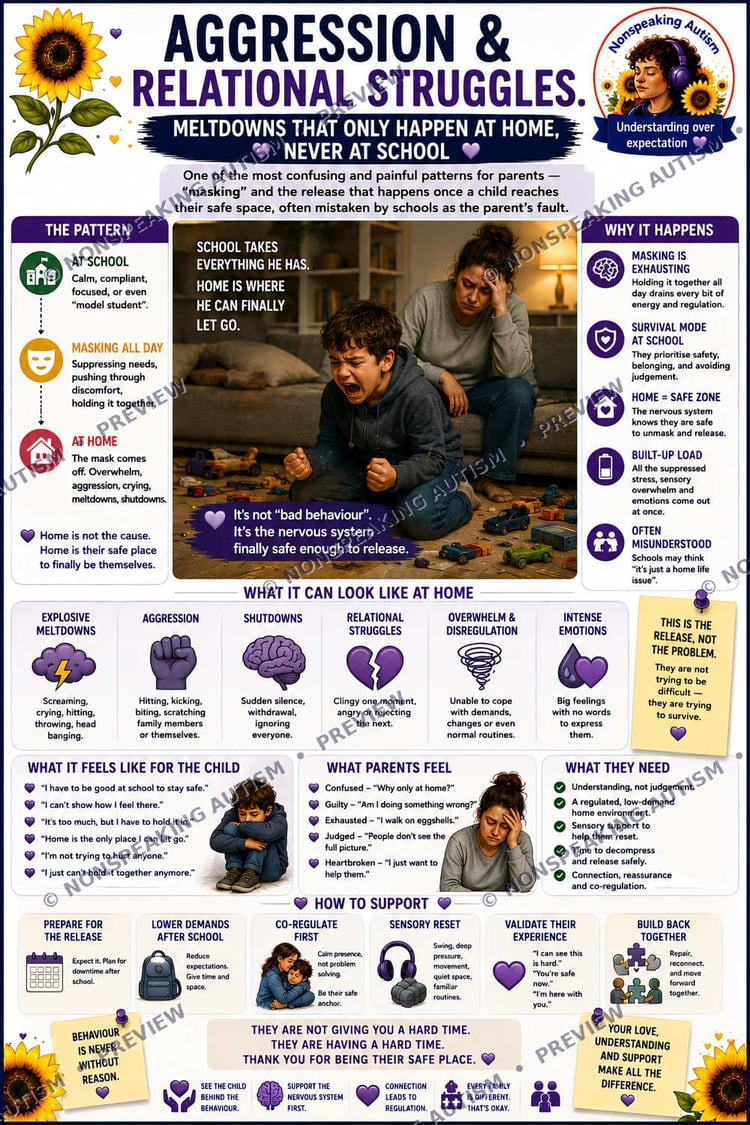
Behaviour of concern can occur in many different contexts.
Possible contributors include:
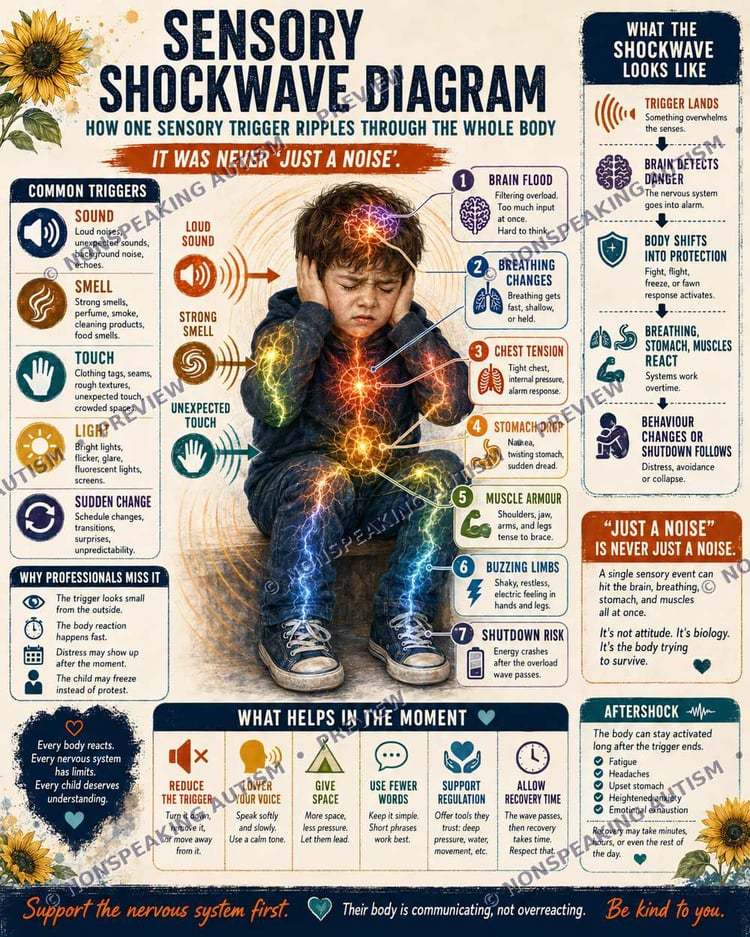
🔊 Sensory Overload
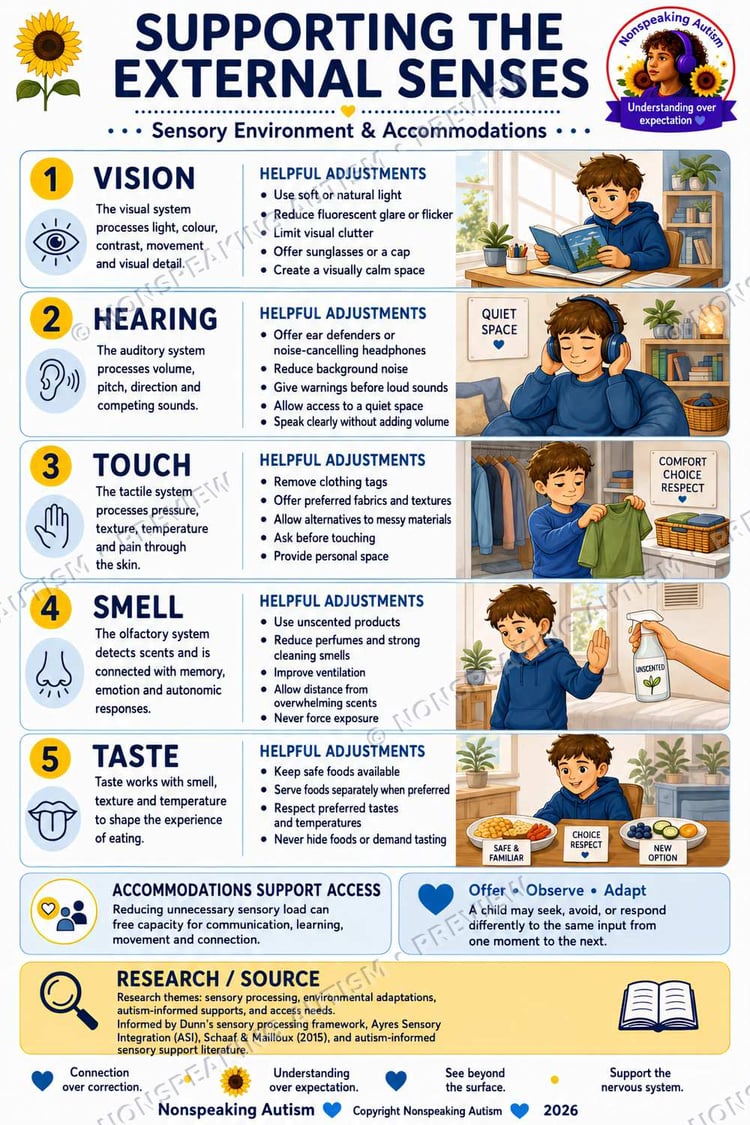
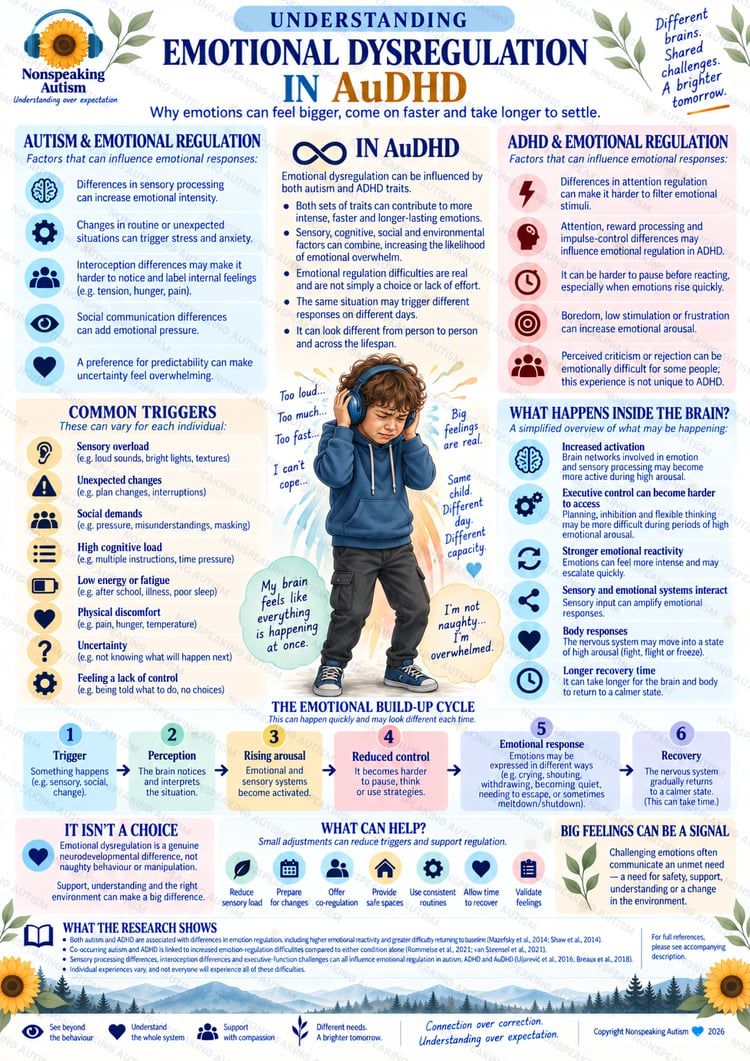
Noise, bright lighting, crowds, touch, smells, heat, visual clutter or multiple sensory demands may become difficult to manage.
🩺 Pain or Illness
Dental pain, ear pain, headache, gastrointestinal discomfort, constipation, injury, illness or another physical problem can affect behaviour and regulation.
This is especially important when a person has difficulty identifying, describing or communicating pain.
⛈️ Fear or Panic
A person who feels unsafe, frightened or trapped may respond rapidly and physically.
💬 Communication Breakdown
The person may not have an accessible way to communicate:
stop
no
help
too loud
I need a break
I am in pain
or
I need to leave.
🔄 Sudden Change
Unexpected transitions, cancelled plans, unfamiliar people or abrupt changes in routine can increase uncertainty and distress.
⏳ Waiting or Uncertainty
Not knowing what is happening, how long something will last or what comes next may add substantial demand for some people.
🔋 Fatigue, Hunger or Thirst
A person's capacity to manage sensory, emotional and communication demands can change when basic physical needs are unmet.
Understanding context does not excuse harm. It helps us respond more effectively and reduce the chance of it happening again.
3️⃣ Find the Cause — Ask Better Questions
Rather than stopping at the behaviour, the poster encourages adults to investigate.
Ask:
🔍 What happened just before?
Was there a transition?
A demand?
A sudden noise?
An unexpected touch?
A crowded room?
A communication misunderstanding?
A change of plan?
🧠 What was the person trying to escape, avoid or communicate?
Were they trying to move away?
Were they indicating no, stop or finished?
Did they have another reliable way to communicate those messages?
🔊 Was the environment too loud, bright or crowded?
Sometimes changing the environment is more effective than expecting the person to tolerate increasing distress.
❤️ Could they be in pain, overwhelmed or dysregulated?
Physical health and pain should not be overlooked.
⚙️ What support helped them feel safe again?
Look at what actually reduced distress.
A quieter space?
Reduced language?
A familiar person?
AAC?
More distance?
Time?
A sensory support?
Removing a demand?
Finding this information can help transform an incident into useful support planning.
💬 Say This Instead
Language can either close down curiosity or encourage it.
Instead of:
❌ “He was aggressive.”
try:
✅ “He hit out during intense distress when the room became too noisy.”
Instead of:
❌ “She was being aggressive.”
try:
✅ “She pushed others away when overwhelmed and unable to cope.”
This approach separates the person from the behaviour.
It also makes documentation more useful.
Rather than defining somebody by an incident, it describes:
what happened + the context + possible contributing factors
📝 Describe — Don't Diagnose From Behaviour
A behaviour is observable.
Its cause often is not.
For example, covering the ears may be associated with sensory discomfort — but it could also accompany pain.
Running away could represent an attempt to escape overwhelming sensory input, fear, a demand, confusion or something else entirely.
Hitting might occur in the context of panic, pain, frustration, communication difficulty or multiple interacting factors.
That is why the poster encourages:
Describe first. Investigate second. Avoid assuming third.
🔊 Consider the Environment
Sometimes adults focus entirely on changing the child while leaving the environment unchanged.
This resource encourages consideration of:
noise
lighting
crowds
waiting
unexpected touch
confusion
unpredictability
and other environmental demands.
The question becomes:
“What can we change around the person?”
rather than automatically:
“How do we make the person behave differently?”
Environmental changes do not remove every difficulty, but they can sometimes remove an unnecessary source of distress.
💬 Communication Before Compliance
Behaviour may sometimes occur when a person's usual communication becomes difficult to access or is not understood.
This is especially important for nonspeaking, minimally speaking and AAC-using people.
Accessible communication might include:
AAC
gesture
pointing
signs
symbols
writing
typing
body movement
spoken language
or another established communication system.
During distress, language processing and communication access may also change.
A person should not have to demonstrate calm behaviour before their communication is respected.
Keep communication available when it is needed most.
🩺 Always Consider Pain & Physical Health
A sudden or significant change in behaviour should never automatically be attributed to autism.
Consider possible:
pain
illness
injury
dental problems
ear problems
headaches
gastrointestinal discomfort
constipation
sleep difficulties
hunger
thirst
medication effects
and other relevant physical needs.
Where a behaviour is new, unexplained, severe, persistent or significantly different from the person's usual pattern, appropriate medical assessment may be needed.
🛡️ Understanding the Cause Does Not Mean Ignoring Safety
Looking beyond the word “aggression” does not mean that hitting, biting, kicking or other potentially harmful behaviour should simply be accepted without response.
The immediate priority during dangerous situations remains safety.
People at risk should be protected, unnecessary demands reduced where possible, communication kept accessible and appropriate support sought.
Once everyone is safe and regulated, understanding the circumstances surrounding the event can help inform prevention and individualized support.
Compassion and safety are not opposites.
We can protect people from harm without reducing a distressed person to a behavioural label.
🔄 Look for Patterns Over Time
One incident rarely tells the whole story.
Consider recording:
what happened beforehand
where it happened
who was present
sensory conditions
communication demands
transitions
waiting
sleep
food and hydration
pain or illness
what the person appeared to be communicating
and
what helped afterwards.
Over time, repeated observations may reveal patterns that are difficult to see when each incident is considered separately.
🌻 From Behaviour Management to Support Planning
A useful response does more than ask how to stop an action.
It asks what could reduce the likelihood of the person reaching that level of distress again.
That might involve:
reducing sensory barriers
increasing predictability
providing accessible communication
allowing more processing time
recognizing early signs
checking physical health
changing demands
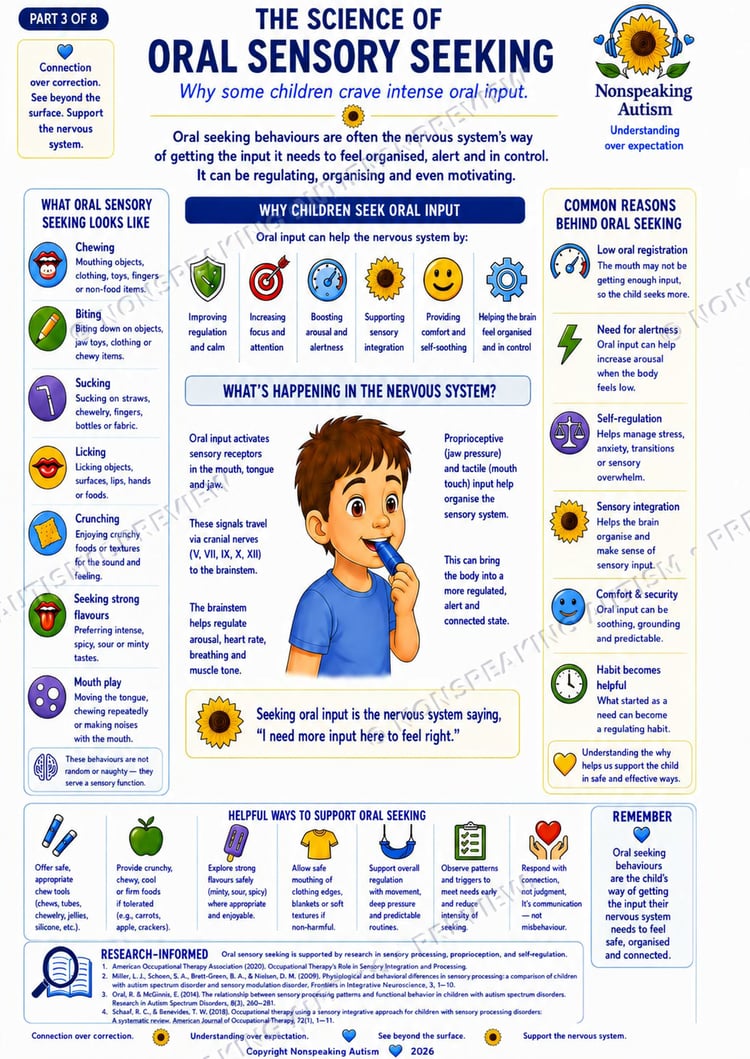
providing regulation opportunities
supporting transitions
or developing an individualized professional plan where risk is significant.
The appropriate response will depend on the person and the circumstances.
🔬 Research & Practice-Informed
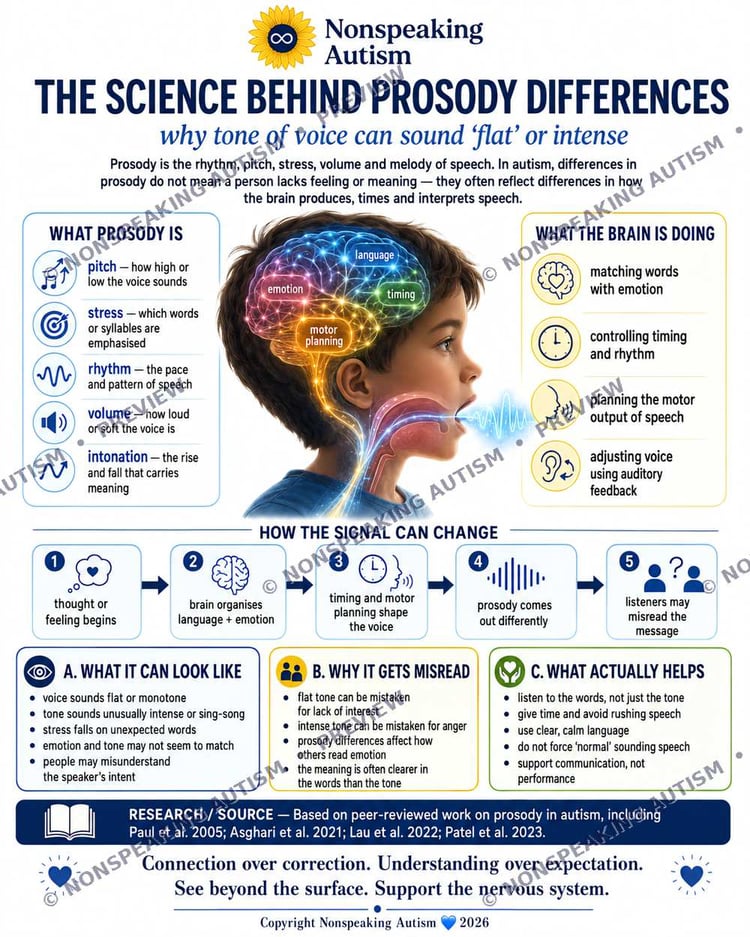
The principles behind this resource are consistent with established approaches that emphasize understanding antecedents, communication, physical health, environmental factors and the function or context of behaviour, rather than relying solely on broad behavioural labels.
Research and professional guidance also recognize that autistic people may experience substantial sensory differences and communication barriers, while pain may sometimes be communicated in individualized or less conventional ways.
The poster therefore encourages curiosity rather than certainty.
It does not claim that distress, sensory overload, pain or fear explains every instance of behaviour that causes harm.
Several factors can interact, and individual assessment may be necessary.
👨👩👧 Who Is This Resource For?
Beyond ‘Aggression’ may be useful for:
- parents and carers
- autistic people and their supporters
- teachers and teaching assistants
- SENCOs and SEND teams
- special and mainstream schools
- support workers
- respite teams
- occupational therapists
- speech and language therapists
- healthcare professionals
- social-care professionals
- behaviour-support professionals
- multidisciplinary teams
- autism and disability organizations
It can be displayed as a poster or used to support staff discussions, parent/carer conversations, training and reflective practice.
📦 What You Receive
Your purchase includes:
1 × Beyond ‘Aggression’ — Describe the Behaviour, Understand the Distress, Find the Cause educational poster
1 × high-resolution printable PDF
The purchased file is supplied clear and without the promotional preview watermark shown on the Payhip listing image.
Any watermarks visible on the listing images are used for preview and copyright protection only and are not included on the purchased file.
Digital download only — no physical product will be shipped.
⚠️ Important Safety, Medical & Professional Disclaimer
This resource is provided for educational and informational purposes only.
It is not a diagnostic tool, medical assessment, psychological assessment, behavioural assessment, functional behaviour assessment, risk assessment, safeguarding plan, crisis plan, treatment plan or substitute for individualized professional advice.
The possible causes shown — including sensory overload, pain, illness, fear, communication difficulty, change, uncertainty, fatigue, hunger and thirst — are examples to consider, not explanations that should automatically be assigned to a particular behaviour.
Behaviour that causes harm can have multiple, interacting causes. Observation alone cannot always establish why an incident occurred.
Do not assume that new or changing behaviour is “just autism,” sensory overload or distress. Sudden, severe, persistent, unusual or unexplained changes may require appropriate medical or professional assessment.
Where there is a known or foreseeable risk of significant harm to the person or others, seek appropriately qualified professional support for individualized assessment, risk management and safety planning.
In an immediate emergency or where someone is seriously injured or at imminent risk, use the emergency services appropriate to your location.
©️ Copyright & Permitted Use
Copyright © 2026 Nonspeaking Autism. All rights reserved.
Purchase permits use of this resource for:
personal or family use
your own classroom or educational setting
your own clinic or professional practice
and direct educational/support work with the people you support.
The digital file may not be resold, redistributed, shared as a digital file, uploaded to other websites or platforms, commercially reproduced, altered for resale, or incorporated into another product for sale or distribution.
Please direct other individuals, schools or organizations who would like their own digital copy to the original Nonspeaking Autism product listing.
💛 The Message Behind the Resource
A behaviour can tell us that something happened.
It cannot, by itself, tell us why.
When we replace:
“They are aggressive.”
with:
“What happened, what were they experiencing, and what did they need?”
we create space for better questions.
Questions about communication.
Questions about sensory load.
Questions about pain.
Questions about fear.
Questions about the environment.
Questions about safety.
And questions about what might prevent the same level of distress next time.
The goal is not to pretend harmful behaviour does not matter.
It is to respond to it without losing sight of the human being experiencing the distress.
Describe the behaviour. Understand the distress. Find the cause.
Behaviour is the output. Distress, overload, pain or fear may be the cause.
Connection over correction. Understanding over expectation. 💛
© Nonspeaking Autism 2026 🌻💙