
💙 SENSORY DECODING WHO DECIDES WHEN IT’S ‘TOO MUCH’?
💙 SENSORY DECODING
WHO DECIDES WHEN IT’S ‘TOO MUCH’?
The Child’s Nervous System — Not the Adult
Research-Informed Autism Educational Poster | UK Edition | Nonspeaking Autism
🌻 Listen early. Reduce the load. Support regulation.
What feels manageable to one person may feel overwhelming, distressing or even painful to another.
A classroom may seem quiet to an adult, yet feel unbearably noisy to a child.
A light may appear ordinary, yet cause significant discomfort.
A child may look calm on the outside while using considerable energy to cope internally.
The adult’s perception of an environment does not determine how manageable it feels to the child.
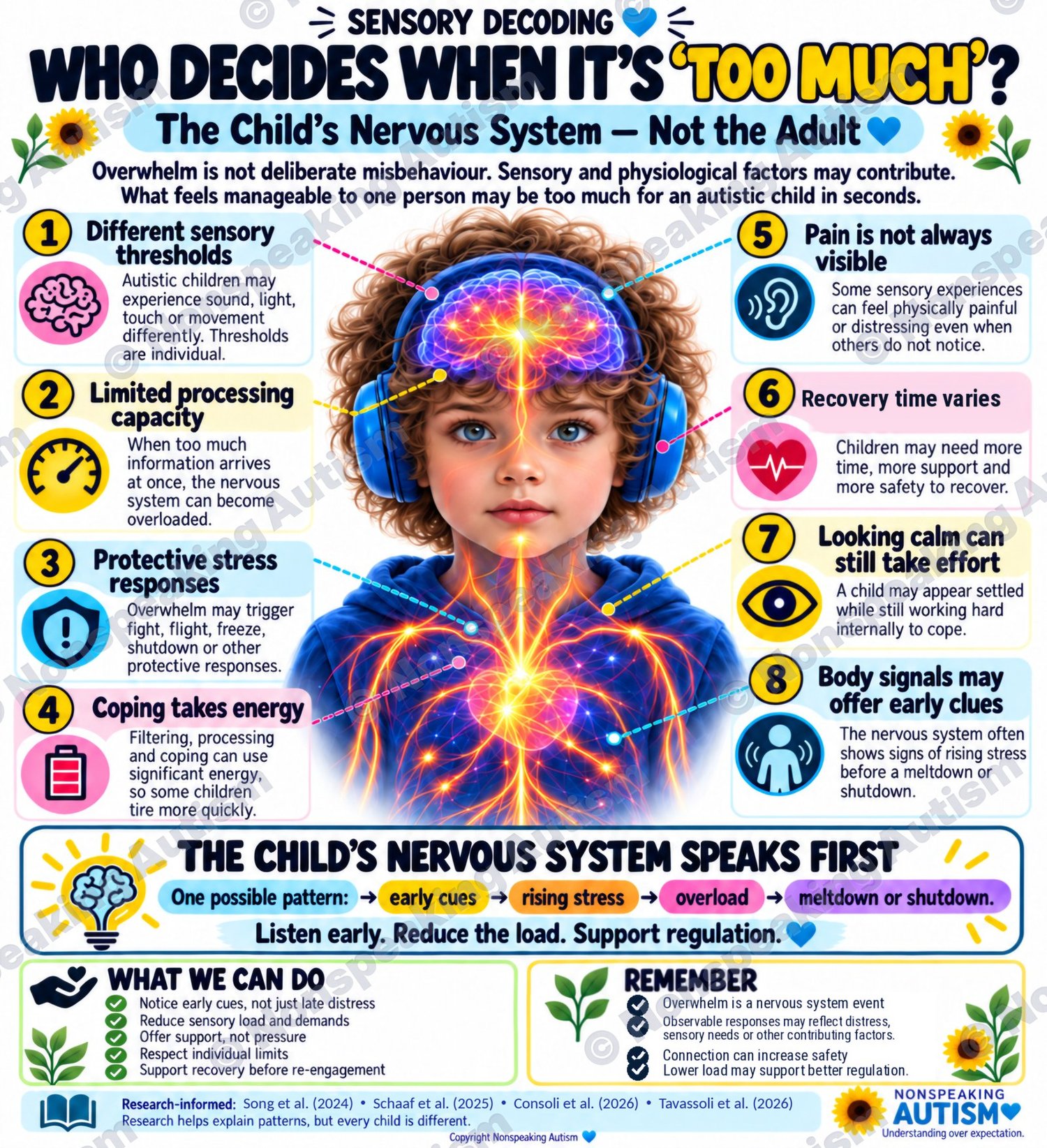
Who Decides When It’s ‘Too Much’? is an illustrated educational poster from Nonspeaking Autism that explores individual sensory thresholds, the effects of accumulating demands, protective stress responses, body signals and recovery.
It encourages families, carers, teachers and professionals to recognise early signs of distress and adapt support before overwhelm escalates.
The central message is:
Respect the child’s experience, even when you cannot feel what they feel.
🧠 WHAT THIS POSTER EXPLORES
1. Different Sensory Thresholds
Autistic children may experience sound, light, touch, movement and other sensory input differently.
Some children may be particularly sensitive to certain sensations, while others may seek additional sensory input.
Responses can also change depending on fatigue, illness, stress, familiarity and the environment.
There is no single sensory threshold that applies to every child.
A child’s discomfort should not be dismissed because someone else finds the same environment comfortable.
2. Processing Demands and Capacity
Busy environments can involve several competing demands at once.
For example, a child may be expected to listen to instructions while coping with background conversations, movement, lighting, physical discomfort and the effort of communicating.
Managing these demands may become increasingly difficult.
This does not mean every autistic child has a fixed or measurable limit on sensory processing. Rather, the combined demands of an environment may exceed what a person can comfortably manage at that moment.
3. Protective Stress Responses
When distress becomes intense, a child may show responses such as:
- Moving away or trying to escape
- Becoming agitated or distressed
- Freezing or becoming unusually still
- Withdrawing or communicating less
- Experiencing a meltdown or shutdown-like response
These reactions should not automatically be interpreted as defiance or deliberate misbehaviour.
The outward response does not identify one certain cause.
4. Coping Takes Energy
Coping with uncomfortable sensory input, uncertainty and competing demands can require significant effort.
A child may manage an environment for a period of time but become increasingly tired or distressed.
This may help explain why someone appears to cope earlier in the day but needs more support later.
Appearing to manage does not always mean the experience is comfortable.
5. Pain Is Not Always Visible
Some sensory experiences may feel physically painful or intensely uncomfortable.
A child may be distressed by sounds, textures, lighting or other input that adults barely notice.
Pain and discomfort may also arise from illness, headaches, dental problems or other physical causes.
Never assume that all distress is sensory in origin.
6. Recovery Time Varies
After an overwhelming experience, some children may need:
- A quieter environment
- Reduced demands
- Familiar comforts
- Access to preferred communication
- Rest and recovery time
- Support from a trusted person
Recovery may take longer than an adult expects.
7. Looking Calm Can Still Take Effort
A child may appear settled while continuing to experience significant internal discomfort.
Some children may mask their distress or suppress visible responses.
A quiet child is not necessarily a comfortable child.
Check in respectfully and offer accessible ways to communicate needs.
8. Body Signals May Offer Early Clues
Changes in breathing, movement, facial expression, communication, posture or activity may sometimes provide clues that distress is increasing.
However, these signs are not specific to sensory overload and may have other explanations.
Learning an individual child’s patterns can help adults respond earlier.
💙 THE CHILD’S NERVOUS SYSTEM SPEAKS FIRST
The poster illustrates one possible pattern:
Early cues → Rising stress → Overload → Meltdown or shutdown
This is an example, not a fixed neurological sequence.
Not every child experiences these stages, and not every episode of distress leads to a meltdown or shutdown.
The purpose is to encourage adults to notice changes before distress becomes more intense.
Listen early. Reduce the load. Support regulation.
🤝 WHAT ADULTS CAN DO
Support should be individualised, respectful and responsive.
Notice Early Cues
Look for changes in the child’s usual communication, movement, behaviour or comfort.
Reduce Sensory Load
Where possible, adjust noise, lighting, crowding, touch and other unwanted input.
Reduce Demands
Offer processing time, breaks and flexibility when the child is struggling.
Offer Support, Not Pressure
Avoid forcing communication, eye contact, physical contact or participation during distress.
Respect Individual Limits
A child should not have to reach a crisis before their needs are taken seriously.
Protect Recovery
Allow time to rest and reconnect before expecting the child to return to demanding activities.
For children who use AAC, ensure their communication system remains accessible wherever possible.
🏫 WHY THIS MATTERS IN SCHOOLS
In educational settings, sensory distress may be misunderstood as refusal, avoidance, lack of attention or challenging behaviour.
This resource encourages staff to consider whether the environment or expectations may be contributing to a pupil’s difficulties.
Practical support may include quieter spaces, predictable routines, movement breaks, communication access, adjusted lighting and individual sensory accommodations.
Teachers, teaching assistants, SENCOs and other professionals can work with the child and family to identify helpful adjustments.
Reasonable adjustments may be relevant under the Equality Act 2010, depending on the pupil’s circumstances.
The goal is not to make every child tolerate the same level of input.
The goal is to make learning, communication and participation more accessible.
🔬 RESEARCH-INFORMED
This poster draws on research themes concerning sensory processing differences, sensory distress, stress responses and individual variability in autism.
Research suggests that sensory experiences and responses can differ substantially between autistic individuals.
However, current research does not establish a single brain mechanism, universal sensory threshold or fixed sequence that explains every episode of overwhelm.
The illustrated nervous system is a conceptual educational image, not an anatomical scan or a direct representation of an individual child’s brain activity.
📚 RESEARCH NOTE
The poster names the following research sources:
- Song et al. (2024)
- Schaaf et al. (2025)
- Consoli et al. (2026)
- Tavassoli et al. (2026)
These abbreviated citations require bibliographic verification before they can be presented as a fully verified reference list. They are included here as shown on the artwork rather than expanded into unconfirmed publication details.
The poster is research-informed educational material, not a validated assessment or clinical model.
Further Resources - National Autistic Society – Autism and sensory processing: https://www.autism.org.uk/advice-and-guidance/about-autism/sensory-processing - National Autistic Society – Meltdowns: a guide for all audiences: https://www.autism.org.uk/advice-and-guidance/topics/behaviour/meltdowns/all-audiences Research & References Sections 1, 2 & 5 – Thresholds, processing capacity and hidden pain: - Song, C., Ma, R., Ni, W., Peng, X., Li, X., Shi, R., Zhang, Y., & Li, Y. (2024). Pupillometry reveals hyper-arousal in response to auditory stimuli in autistic children. Journal of Zhejiang University SCIENCE B, 25(11), 996–1008. https://doi.org/10.1631/jzus.B2300462 Sections 3, 7 & 8 – Stress responses, effortful calm and body signals: - Tavassoli, T., Marco, E. J., & Puts, N. (2026). Sensory reactivity in autism: integrating behavioural, affective, physiological, and neural dimensions. Current Psychiatry Reports, 28(1), 36. https://doi.org/10.1007/s11920-026-01682-4 Sections 4 & 6 and What We Can Do – Energy, recovery and individualised support: - Schaaf, R. C., Ridgway, E. M., Jones, E. A., Dumont, R. L., Foxe, J., Conly, T., Sancimino, C., Yi, M., Mailloux, Z., Hunt, J. M., Kirschner, L., Leiby, B. E., & Molholm, S. (2025). A comparative trial of occupational therapy using Ayres Sensory Integration and applied behavior analysis interventions for autistic children. Autism Research, 18(10), 2120–2134. https://doi.org/10.1002/aur.70099
Remember – Every child is different: - Consoli, C., Turriziani, L., Antoci, M., Lo Monaco, M., Ceraolo, G., Spoto, G., Nicotera, A. G., & Di Rosa, G. (2026). Sensory phenotypes in autism spectrum disorder associated with distinct patterns of social communication, repetitive and restrictive behaviors or interests, and comorbidities: a state-of-the-art review. Brain Sciences, 16(1), 53. https://doi.org/10.3390/brainsci16010053 Foundational references (printed on the poster): Song et al. (2024) • Schaaf et al. (2025) • Consoli et al. (2026) • Tavassoli et al. (2026)
Sources:
- Song et al. 2024 (PMC)
- Tavassoli et al. 2026 (Crossref)
- Schaaf et al. 2025 (Wiley)
- Schaaf et al. 2022/2023 (Crossref)
- Consoli et al. 2026 (MDPI)
- NAS – Sensory processing
- NAS – Meltdowns
👨👩👧 WHO IS THIS RESOURCE FOR?
This poster may be useful for:
- Parents and carers
- Autistic children and young people
- Teachers and teaching assistants
- SENCOs and SEND professionals
- Occupational therapists
- Speech and language therapists
- Educational psychologists
- School inclusion and pastoral teams
- Autism support services
- Professionals supporting nonspeaking and minimally speaking children
It can support conversations about sensory accessibility, early distress signals and compassionate adjustments.
📦 WHAT YOU RECEIVE
💙 PAID DIGITAL DOWNLOAD
1 × Sensory Decoding: Who Decides When It’s ‘Too Much’? — Educational Poster
Featuring eight illustrated educational explanations, a possible escalation pattern, practical support strategies and research-informed messaging.
Digital product only. No physical poster will be shipped.
The Payhip preview contains promotional watermarks. Supply a clean, watermark-free final file for purchasers.
Please confirm the final file’s print dimensions and resolution before advertising a specific print size or 300 DPI quality.
⚠️ IMPORTANT DISCLAIMER
This resource is for educational and informational purposes only.
It is not a diagnostic tool, medical assessment, occupational therapy assessment or individualised treatment plan.
Sensory distress, pain, illness, fatigue, anxiety and communication barriers can overlap.
If a child experiences sudden, severe, persistent or unexplained changes in behaviour or wellbeing, seek appropriate professional advice.
Individual sensory strategies should be guided by safety, consent, personal preferences and observed outcomes.
©️ COPYRIGHT & PERMITTED USE
Copyright © 2026 Nonspeaking Autism. All rights reserved.
Purchase permits personal, home, classroom, school and individual professional educational use.
The digital file must not be resold, redistributed, publicly uploaded, shared through file-sharing services or incorporated into another commercial product without permission.
Please share the original Payhip product link rather than the purchased file.
💛 THE MESSAGE BEHIND THE RESOURCE
A child does not need an adult to agree that a sound is loud before their distress deserves attention.
They do not need to prove that a light is too bright.
They do not need to reach meltdown before receiving support.
Their experiences matter, even when they differ from our own.
The question is not simply, “Should this be too much?”
It is:
“Is this too much for this child, right now — and what can we change to help?”
🌻 Listen early. Reduce the load. Support regulation.
Connection over correction. Understanding over expectation.
💙 Nonspeaking Autism © 2026