

💙 THE SCIENCE BEHIND SENSORY REGULATION TOOLS
💙 THE SCIENCE BEHIND SENSORY REGULATION TOOLS
Why Body-Based Support May Help When Words Are Too Much
UK Edition | Research-Informed Autism & Sensory Regulation Educational Poster | Nonspeaking Autism
🌻 Offer support, not demands. Regulation tools are choices, not rewards.
When an autistic child is overwhelmed, distressed or struggling to communicate, spoken reassurance and repeated instructions may not always be helpful.
Sometimes, reducing unwanted sensory input or offering preferred sensory experiences may provide a more accessible form of support.
A child may seek pressure, movement, something to chew, a familiar texture or a quieter environment.
Another child may find those same experiences uncomfortable or overwhelming.
There is no single sensory tool that works for every autistic person.
The Science Behind Sensory Regulation Tools is an illustrated, research-informed educational poster exploring six commonly used approaches to sensory regulation, why some people may find them helpful and the importance of individual choice, consent and safety.
Designed for parents, carers, teachers, SENCOs, therapists and professionals, this resource encourages a compassionate approach to understanding sensory needs.
The aim is not to stop harmless stimming, enforce compliance or make a child tolerate distressing experiences.
The aim is to support comfort, communication, safety, self-regulation and meaningful participation.
🧠 WHAT ARE SENSORY REGULATION TOOLS?
Sensory regulation tools are objects, activities or environmental adjustments that may help a person manage sensory input or access preferred sensory experiences.
Some approaches reduce unwanted stimulation, such as ear defenders in a noisy environment.
Others provide additional sensory feedback, such as movement, pressure or tactile input.
Their usefulness depends on factors including:
- Individual sensory preferences
- The type and intensity of input
- Physical comfort and safety
- The environment
- The person's emotional and physical state
- Whether the activity is freely chosen
- Whether it supports an outcome meaningful to the person
A tool that helps in one situation may not help in another.
Sensory support should be responsive and individualised, not a fixed programme imposed on every child.
🌈 THE SIX SENSORY REGULATION APPROACHES EXPLORED
1. 💙 DEEP PRESSURE — COMFORT, PRESSURE & BODY FEEDBACK
Some people enjoy firm, predictable pressure.
Examples may include:
- Hugging a favourite teddy
- Wrapping up in a comfortable blanket
- Using a lap pad
- Choosing firm pressure from a trusted person
- Other personally preferred pressure experiences
For some individuals, pressure may feel reassuring or provide useful tactile and proprioceptive feedback.
However, the effects of deep-pressure approaches vary, and research does not establish that they reliably improve regulation for everyone.
Important safety considerations:
- Never force hugs, holding or pressure.
- Respect refusal and signs of discomfort.
- Use weighted products only where appropriate, with individual safety guidance.
- Avoid pressure that restricts breathing, movement or the ability to leave.
- Never use deep pressure as restraint, punishment or a way to enforce compliance.
Comfort must be chosen, not imposed.
2. 🦷 SAFE CHEWING TOOLS — ORAL SENSORY INPUT
Some autistic people seek oral sensory experiences through chewing or mouthing objects.
This may involve preferences for particular textures, firmness or resistance.
Appropriate chewing tools may offer a safer alternative to chewing unsuitable items for some individuals.
The poster encourages adults to consider:
- Age and developmental suitability
- Product safety
- Choking risks
- Appropriate supervision
- Cleaning and hygiene
- Individual preferences
- Dental or jaw discomfort
Chewing is not always sensory seeking. It may also relate to pain, anxiety, habits or other needs.
Where chewing is frequent, intense, causes injury or involves unsafe objects, individual professional assessment may be appropriate.
Offer safe alternatives without automatically trying to eliminate the person's preferred sensory experience.
3. 🎧 EAR DEFENDERS — REDUCING DISTRESSING SOUND
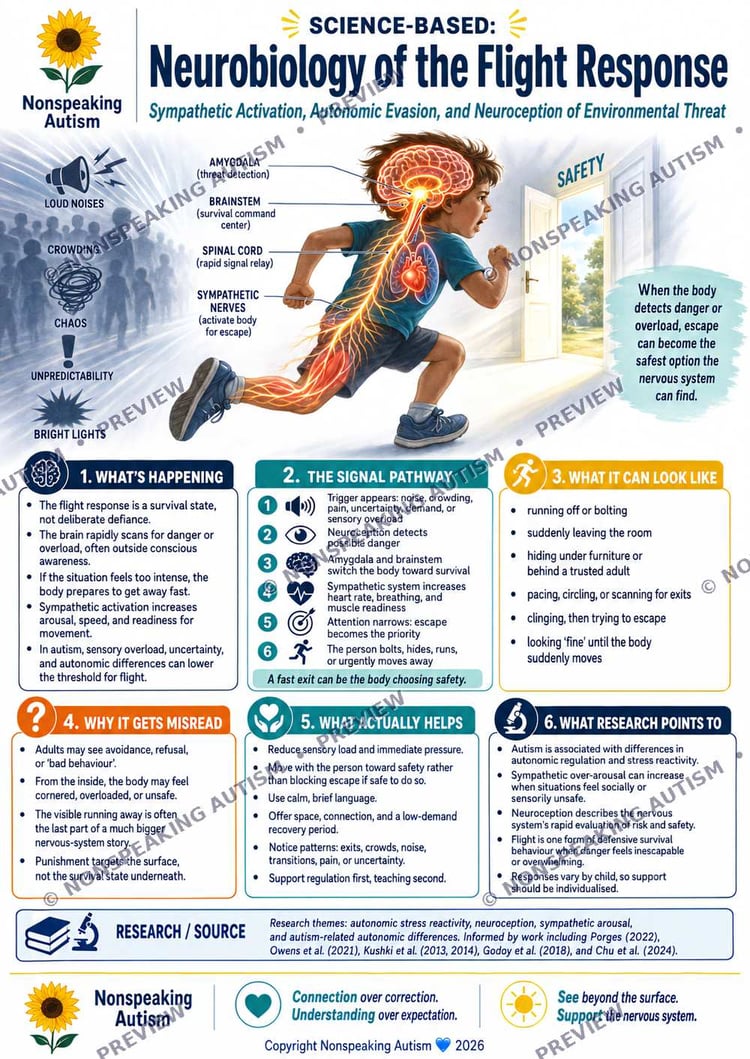
Sounds that appear manageable to one person may feel intense, distracting, painful or overwhelming to another.
Examples include:
- School bells
- Hand dryers
- Busy classrooms
- Crowded corridors
- Traffic
- Loud conversations
- Unexpected alarms
- Competing background sounds
Ear defenders or noise-reducing headphones may help some people access noisy environments more comfortably.
The poster emphasises two important principles:
Offer choice. Not everyone wants or benefits from wearing ear defenders.
Allow regular breaks where appropriate. Comfort, communication access, situational awareness and the person's preferences should guide use.
Environmental changes may also help, such as reducing background noise, providing quieter spaces or preparing for predictable loud events.
The goal is not to make someone endure distressing sound. It is to improve comfort and access.
4. 🏃 MOVEMENT & RESISTANCE — PROPRIOCEPTIVE FEEDBACK
Movement and resistance activities may provide sensory information about body position, movement and effort.
Some people enjoy:
- Pushing against a wall
- Pulling or carrying suitable objects
- Walking or stretching
- Climbing or active play
- Movement breaks
- Other safe resistance activities
Proprioception involves sensory information from muscles, tendons and joints that contributes to awareness and control of movement.
For some individuals, movement or resistance may feel organising, enjoyable or helpful during periods of restlessness.
Others may prefer stillness or find particular movements uncomfortable.
Activities should be appropriate to the person's physical abilities, health, preferences and environment.
Movement should be offered as an accessible choice, never demanded as a condition for receiving support.
5. 🌡️ TEMPERATURE & COMFORT — PREFERRED PHYSICAL SENSATIONS
Temperature, fabric texture and physical comfort can influence how manageable an environment feels.
Some people may prefer:
- A comfortably warm blanket
- A cool, soft cloth
- Familiar clothing
- Comfortable room temperatures
- Particular fabrics or textures
Others may be sensitive to temperature changes or find certain materials unpleasant.
These preferences are individual.
Avoid extreme heat or cold, and do not apply temperature-based strategies without considering safety, skin sensitivity, medical needs and the person's ability to communicate discomfort.
A small comfort adjustment may matter more than a complicated intervention.
6. ✋ TACTILE FIDGETS — TOUCH, TEXTURE & REPETITIVE MOVEMENT
Some autistic people enjoy exploring tactile sensations through objects that can be squeezed, rolled, pressed or handled.
Examples include:
- Textured sensory toys
- Soft squeeze objects
- Flexible rings
- Suitable tactile fidgets
- Objects with preferred surfaces or resistance
These activities may provide enjoyment, familiarity or a preferred form of sensory feedback.
Some people find tactile objects helpful for attention or comfort.
Others find them distracting, irritating or unpleasant.
The evidence for specific fidget products and outcomes varies.
A person's preferences and meaningful everyday outcomes should guide whether a tool is useful.
A sensory tool is only supportive when it meets the person's needs.
WHY BODY-BASED SUPPORT MAY HELP WHEN WORDS ARE TOO MUCH
During periods of distress, a child may find it harder to process questions, instructions or spoken explanations.
This does not mean they cannot understand language generally.
Their immediate capacity to respond may be affected by factors such as:
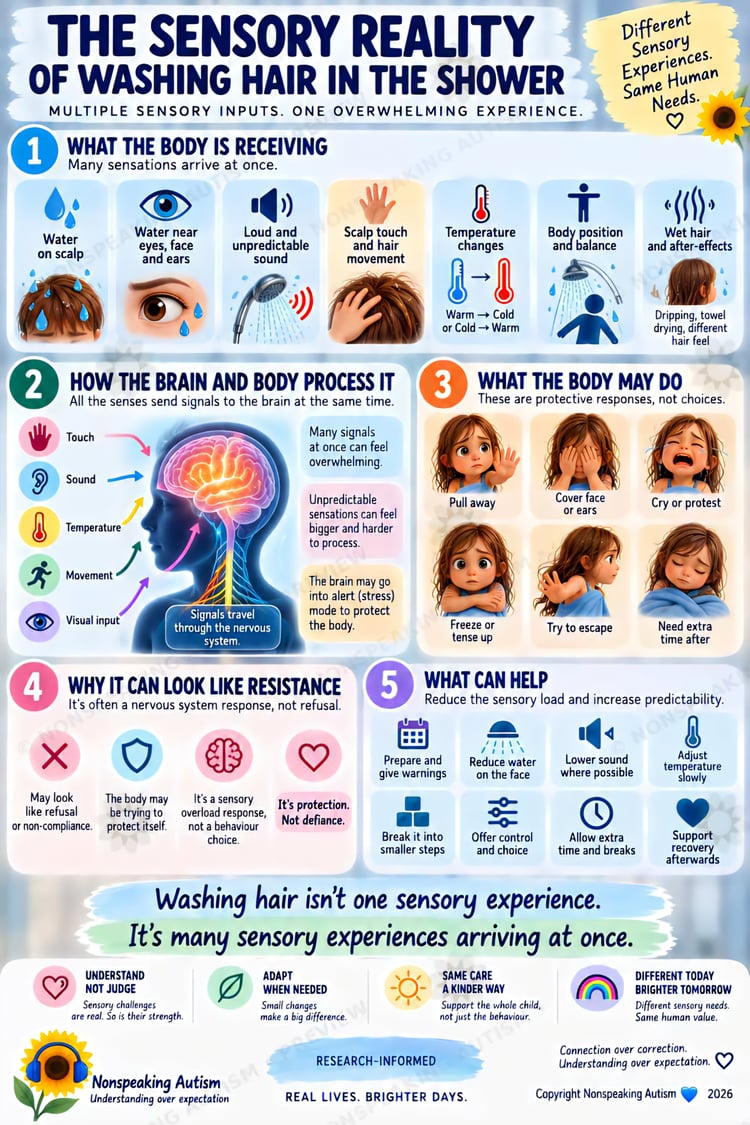
- Sensory overload
- Anxiety or uncertainty
- Physical discomfort
- Fatigue
- Competing demands
- Communication barriers
- Difficulty accessing speech or AAC
- The need for additional processing time
A preferred sensory tool may offer a familiar or accessible form of support for some people.
However, sensory tools do not replace communication access, emotional safety, medical care or environmental adjustments.
Adults can help by reducing demands, using fewer words where appropriate, allowing time and making preferred supports available without pressure.
🔬 WHAT DOES THE RESEARCH SAY?
Research on sensory-based interventions in autism is mixed.
Different approaches have different levels of evidence, and findings vary depending on the population, intervention and outcomes measured.
It is important to distinguish between:
Individual sensory tools
Such as ear defenders, chewing tools, tactile objects or pressure-based products.
Environmental adjustments
Such as reducing noise, modifying lighting or providing a quieter space.
Structured sensory integration interventions
Which are delivered using specific therapeutic approaches and are not equivalent to simply offering individual sensory objects.
Evidence from a structured occupational therapy programme cannot automatically be used as proof that every individual sensory tool is effective.
📚 SELECTED RESEARCH FEATURED ON THE POSTER
Piller et al. (2025)
Systematic review of sensory-based interventions for children and youth (2015–2024).
Frontiers in Pediatrics, 13, 1720179.
DOI: 10.3389/fped.2025.1720179
Ikuta et al. (2016)
Effectiveness of earmuffs and noise-cancelling headphones for coping with hyper-reactivity to auditory stimuli in children with autism spectrum disorder.
Hong Kong Journal of Occupational Therapy, 28(1), 24–32.
DOI: 10.1016/j.hkjot.2016.09.001
Randell et al. (2022)
Sensory integration therapy for children with autism and sensory processing difficulties: the SenITA RCT.
Health Technology Assessment, 26(29), 1–140.
DOI: 10.3310/TQGE0020
IMPORTANT EVIDENCE NOTE
The SenITA study examined a structured sensory integration therapy programme. It did not establish the effectiveness of the six individual tools shown on this poster.
The evidence base does not support assuming that all sensory strategies work equally well or that any single tool will benefit every autistic child.
The references above are reproduced from the poster; the complete bibliographic records have not been independently verified for this listing.
Individual preferences, safety, consent and meaningful functional outcomes should guide sensory support.
SAFETY & CONSENT
Pressure and other sensory input should always be offered, never imposed. The person should be able to remove a weighted item or end pressure themselves at any time. Deep pressure must never be used as restraint. Seek occupational therapist advice before using weighted products, especially with young children.
RESEARCH & REFERENCES
- Piller, A., McHugh Conlin, J., Glennon, T. J., Andelin, L., Auld-Wright, K., Teng, K., & Tarver, T. (2025). Systematic review of sensory-based interventions for children and youth (2015–2024). Frontiers in Pediatrics, 13, 1720179. https://doi.org/10.3389/fped.2025.1720179
- Ikuta, N., Iwanaga, R., Tokunaga, A., Nakane, H., Tanaka, K., & Tanaka, G. (2016). Effectiveness of earmuffs and noise-cancelling headphones for coping with hyper-reactivity to auditory stimuli in children with autism spectrum disorder: A preliminary study. Hong Kong Journal of Occupational Therapy, 28(1), 24–32. https://doi.org/10.1016/j.hkjot.2016.09.001
- Randell, E., Wright, M., Milosevic, S., Gillespie, D., Brookes-Howell, L., Busse-Morris, M., Hastings, R., Maboshe, W., Williams-Thomas, R., Mills, L., Romeo, R., Yaziji, N., McKigney, A. M., Ahuja, A., Warren, G., Glarou, E., Delport, S., & McNamara, R. (2022). Sensory integration therapy for children with autism and sensory processing difficulties: The SenITA RCT. Health Technology Assessment, 26(29). https://doi.org/10.3310/TQGE0020
💛 SENSORY TOOLS ARE CHOICES, NOT REWARDS
A child should not have to earn access to a necessary sensory support by completing work, speaking, remaining still or demonstrating compliance.
A preferred sensory tool may be part of the adjustments that make an environment accessible.
For example:
- Ear defenders may help someone enter a noisy classroom.
- A familiar object may support comfort during a transition.
- Movement breaks may help someone manage physical restlessness.
- A quiet space may offer recovery from overwhelming input.
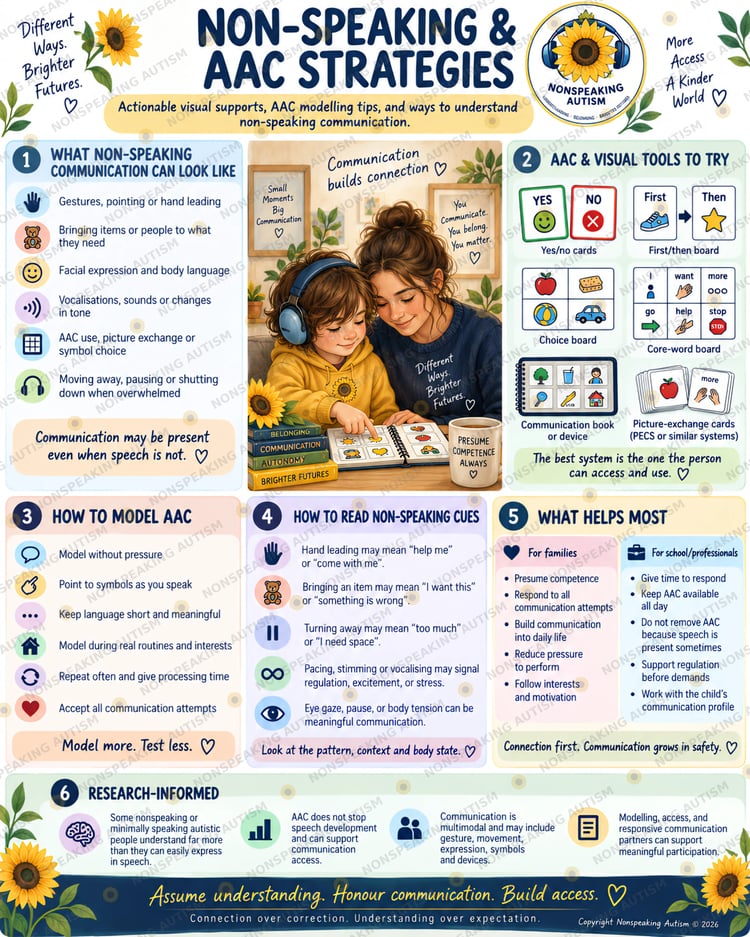
- AAC may help a child request a tool, refuse it or ask for something different.
Support should be based on need, not performance.
Do not remove necessary sensory supports as a punishment.
🏫 HOW THIS POSTER CAN SUPPORT UK SCHOOLS & SEND PRACTICE
This poster can encourage practical conversations about sensory accessibility in mainstream and specialist educational settings.
Possible applications include:
- Developing an individual sensory support profile
- Identifying preferred and unwanted sensory input
- Planning reasonable adjustments
- Supporting transitions and busy school environments
- Offering safe sensory choices
- Reducing unnecessary sensory demands
- Supporting AAC access
- Helping staff recognise signs of discomfort
- Reviewing whether adjustments improve participation
- Working collaboratively with parents, carers and relevant professionals
SENCOs, teachers, teaching assistants and occupational therapists may find it useful as a visual discussion resource.
Sensory support should not be reduced to a list of equipment.
The environment, the demands being placed on the child and the child's own preferences are equally important.
👨👩👧 WHO IS THIS RESOURCE FOR?
This educational poster may be useful for:
- Parents and carers
- Autistic children and young people
- Families supporting nonspeaking autistic people
- Teachers and teaching assistants
- SENCOs and SEND teams
- Occupational therapists
- Speech and language therapists
- AAC specialists
- Early years practitioners
- Educational psychologists
- Family support professionals
- Autism and neurodiversity educators
It may be displayed in homes, classrooms, SEND resource areas, therapy rooms, sensory spaces and staff training environments.
📦 WHAT YOU RECEIVE
PAID DIGITAL DOWNLOAD — INDIVIDUAL POSTER
Your purchase includes:
1 × The Science Behind Sensory Regulation Tools — Why Body-Based Support May Help When Words Are Too
Much
The illustrated poster covers:
- Deep pressure
- Safe chewing tools
- Ear defenders
- Movement and resistance
- Temperature and comfort
- Tactile fidgets
It also includes:
- Individual sensory preferences
- Safety and consent reminders
- Research evidence and limitations
- Practical examples
- Neurodiversity-affirming support messages
- Nonspeaking Autism branding
The listing image contains promotional watermarks. The final purchased printable file should be provided without those preview watermarks.
Digital download only. No physical product will be posted.
Please confirm the final PDF dimensions and resolution before advertising a specific print size.
⚠️ IMPORTANT DISCLAIMER
This resource is for educational and informational purposes only.
It is not a diagnostic tool, clinical assessment, occupational therapy prescription or substitute for individual professional advice.
Sensory tools may be unsuitable for some people or circumstances.
Consider choking hazards, allergies, physical health, breathing, circulation, dental health, temperature safety and other relevant risks.
Never force sensory input, pressure, touch or equipment.
If a child shows persistent pain, significant distress, sudden changes in behaviour or unsafe chewing or sensory-seeking patterns, seek appropriate professional advice.
Support should be individualised and regularly reviewed.
©️ COPYRIGHT & PERMITTED USE
Copyright © 2026 Nonspeaking Autism. All rights reserved.
Your purchase permits personal, family, classroom, school and individual professional educational use.
You may print the poster for these purposes.
You may not resell, redistribute, share the digital file publicly, upload it to another website, remove the branding or incorporate the artwork into products for resale without permission.
Please share the original Payhip product listing rather than distributing the purchased file.
🌻 THE MESSAGE BEHIND THIS RESOURCE
Sometimes a child does not need another instruction.
Sometimes they need less noise.
Sometimes they need movement.
Sometimes they need a familiar texture.
Sometimes they need space, rest or a way to communicate what feels uncomfortable.
And sometimes they need adults to recognise that a sensory tool is not a luxury or a reward.
It may be one part of making the world more accessible.
The right support is not always the most complicated strategy.
It is the support that is safe, welcomed and genuinely helpful to that individual.
💙 Offer support, not demands.
Regulation tools are choices, not rewards.
Connection over correction. Understanding over expectation.
🌻 Nonspeaking Autism © 2026