

Understanding Autistic Girls & Women
Understanding Autistic Girls & Women — Complete 7-Part Educational Poster Series
A research-informed collection exploring development, masking, stimming, hidden load, demand avoidance, recognition and affirming support across the lifespan
Autistic girls and women are extraordinarily diverse.
There is no single “female autism profile,” no single developmental pathway and no one way an autistic girl or woman should look, communicate, socialise or cope.
Yet for many years, autistic females have sometimes been overlooked, misunderstood or identified later, particularly when their presentation does not match traditional expectations of autism or when significant effort is hidden behind an outward appearance of capability.
The Understanding Autistic Girls & Women — Complete 7-Part Educational Poster Series brings together seven detailed visual resources exploring autism from early childhood through adulthood and later life.
Rather than focusing only on what other people can see, this collection looks beneath the surface at sensory processing, regulation, masking and camouflaging, stimming, social effort, demand-related distress, autonomy, recovery and changing support needs.
The message running throughout the entire collection is simple:
See beyond the surface.
Different experiences. Equal value.
Support the person — not the stereotype.
🌻 The Complete 7-Part Collection
1️⃣ Supporting Autistic Girls — Early Development & Nervous System Care
The first poster begins in childhood.
It explores how autistic characteristics in girls may sometimes be less readily recognised and why early understanding should consider the whole developmental and sensory picture.
Topics include early communication differences, sensory processing, emotional regulation, motor development, social interaction, routines and transitions.
It also provides practical ideas for supporting children at home, nursery and school through:
- Predictability and gentle transitions
- Sensory-friendly environments
- Communication access, including AAC where appropriate
- Acceptance of safe stimming
- Rest and recovery
- Recognition of early overwhelm
- Strengths- and interest-based support
- Individualised approaches
Its central principle is:
Support the child in front of you — not a checklist.
2️⃣ Stimming in Autistic Females — Childhood to Adulthood
Stimming is not something autistic people necessarily leave behind as they grow older.
Its form, frequency, visibility and social context may change.
This poster follows stimming from early childhood through middle childhood, adolescence and adulthood.
It explores visible movement, sensory exploration, quieter or subtler stims, internal strategies and the possible influence of masking and social expectations.
It also explains why stimming may support:
Self-regulation.
Stress management.
Attention.
Sensory processing.
Emotional expression.
Safety and control.
The emphasis is on understanding the purpose rather than automatically trying to stop the behaviour.
Same purpose. Different expressions. A more inclusive understanding.
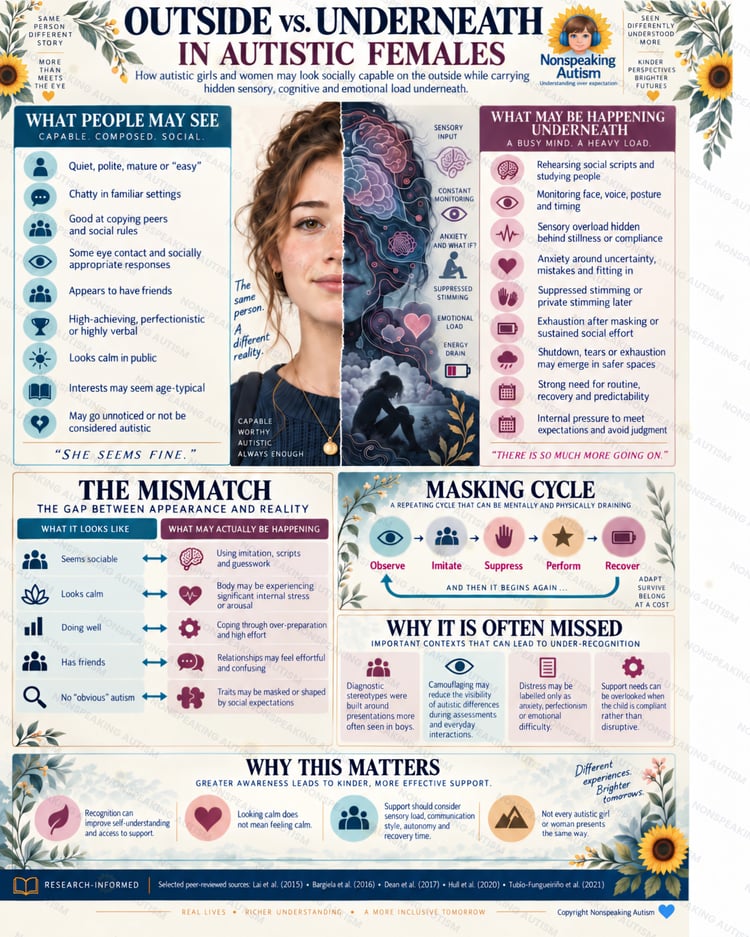
3️⃣ Outside vs. Underneath in Autistic Females
“She seems fine.”
But what does “fine” actually tell us?
This poster examines the possible mismatch between outward appearance and internal experience.
A girl or woman may look socially capable, calm, verbal or successful while internally managing:
- Social scripts and rehearsal
- Constant self-monitoring
- Sensory overload
- Anxiety and uncertainty
- Suppressed stimming
- Emotional load
- Exhaustion
- Recovery needs
- Pressure to meet expectations
The poster also introduces a possible masking cycle:
Observe → Imitate → Suppress → Perform → Recover
It helps challenge the assumption that appearing capable automatically means something is easy.
The same person. A different reality.
4️⃣ Across the Lifespan: Autistic Girls & Women
Autism is lifelong — but life does not remain the same.
This poster follows autistic experiences and possible support needs across:
Childhood → Adolescence → Emerging Adulthood → Adulthood → Midlife & Later Life
It explores how changing social expectations, education, employment, relationships, independence, health, hormonal changes and life responsibilities may interact with autistic experience.
The poster considers both what other people may see and what may be missed at each stage.
It also includes an illustrative lifespan graph exploring possible changes in social expectations, camouflaging, mental-health or burnout risk, and self-awareness.
Importantly, these are illustrative patterns rather than precise statistics or predictions.
Same person. Different seasons. A full life.
5️⃣ Affirming Support for Autistic Girls & Women
This poster moves from recognition to action.
Its focus is the shift from compliance and masking toward genuine understanding and accessible support.
Eight practical principles are explored:
Look beyond appearance.
Reduce pressure to perform.
Make communication flexible.
Design for sensory access.
Support autonomy.
Understand behaviour as information.
Support recovery without judgement.
Accommodate without requiring proof of distress.
Rather than judging success by how non-autistic somebody can appear, the poster encourages support that promotes access, autonomy, communication, participation and wellbeing.
Its central message is one of the strongest in the collection:
The goal is not to make autism less visible.
The goal is to make support more accessible.
6️⃣ Autistic Demand Avoidance in Girls & Women
Why can an apparently simple request sometimes feel enormous?
This poster explores demand avoidance as a descriptive experience, particularly where requests, expectations, uncertainty or a perceived loss of autonomy may create intense pressure.
It examines possible contributing factors including:
- Anxiety and uncertainty
- Executive-function demands
- Sensory and social load
- Transitions and interruptions
- Performance pressure
- Cumulative demands
- Masking
- Fatigue
- Reduced autonomy
It also explores practical approaches such as lowering unnecessary urgency, offering meaningful choices, collaborating, improving predictability, breaking tasks into flexible steps, reducing sensory and verbal load and allowing recovery.
The poster clearly acknowledges that PDA remains debated and is not a stand-alone diagnosis in DSM-5 or ICD-11.
Its central question encourages curiosity rather than judgement:
“What is making this feel unsafe or too much right now?”
Less pressure. More possibility.
7️⃣ Why Autistic Females Are Overlooked
The final poster brings many of the collection's themes together.
It explores why some autistic girls and women may be missed, misdiagnosed or identified later in life.
It considers:
- Historical male bias within autism research
- Social imitation and scripting
- Masking and camouflaging
- Internalised distress
- Intense interests that may appear age-typical
- Sensory difficulties
- Friendship differences
- Perfectionism and high achievement
- Delayed distress
- Changes across childhood, adolescence and adulthood
It also challenges several common clinical and educational blind spots.
Having friends does not rule autism out.
Being imaginative does not rule autism out.
Speaking well does not rule autism out.
Good grades do not rule autism out.
Compliance can hide distress.
The aim is not to replace an old stereotype with a new “female autism” stereotype.
It is to widen the lens.
Subtle differences. Real experiences. They still matter.
🧠 What the Complete Series Explores
Taken together, the seven posters provide a much broader picture of autistic experience.
The collection explores development, sensory processing, nervous-system regulation, communication, stimming, masking and camouflaging, social effort, hidden distress, autonomy, demand avoidance, recovery, recognition, late identification and affirming support.
It repeatedly returns to one important distinction:
What somebody looks like from the outside may not tell us how much effort life requires underneath.
A child can be quiet and overwhelmed.
A teenager can have friends and find social life exhausting.
A student can achieve highly while struggling to sustain daily functioning.
An adult can appear capable while needing significant recovery.
A woman can discover she is autistic later in life after years of adapting without understanding why everyday experiences felt different.
Capability and support need can coexist.
🎭 Masking & Camouflaging Across the Collection
Several posters explore masking because it can be relevant to understanding why some autistic people's needs become less visible.
Camouflaging may involve consciously or unconsciously hiding, compensating for or adapting aspects of autistic presentation.
This can include copying peers, rehearsing conversations, suppressing stimming, monitoring expression or trying to meet expected social conventions.
However, this series deliberately avoids presenting masking as something that all autistic females do.
Camouflaging occurs across genders, and individual experiences vary considerably.
The important lesson is not:
“Autistic girls mask.”
It is:
“Do not assume outward appearance tells you everything about internal experience.”
💙 From Recognition to Better Support
Understanding differences matters most when it changes how we respond.
Across the collection, support is consistently framed around:
Individualisation rather than stereotypes.
Communication access rather than speech expectations.
Sensory accessibility rather than forced tolerance.
Autonomy rather than unnecessary control.
Understanding behaviour rather than immediate judgement.
Recovery rather than constant productivity.
Connection rather than correction.
The aim is not to remove every challenge from someone's life.
It is to remove unnecessary barriers and make participation more accessible.
🔬 Research-Informed
The complete collection draws on peer-reviewed research and established literature concerning autistic females, sex/gender and autism, camouflaging, sensory processing, stimming, emotional regulation, demand avoidance, diagnostic recognition and lived experience.
Research represented across the individual posters includes work by authors such as:
Lai et al.
Bargiela, Steward & Mandy
Loomes, Hull & Mandy
Dean et al.
Hull et al.
Tubío-Fungueiriño et al.
Pearson & Rose
Lord et al.
O'Nions et al.
and other researchers represented within the individual resources.
Research in many of these areas continues to develop. Evidence about group-level patterns should therefore not be turned into rules about individual autistic girls or women.
The posters use cautious language such as may, can and for some intentionally.
There is no single autistic female experience.
👩👧 Who Is This 7-Part Collection For?
The complete series may be especially useful for:
- Autistic girls and women
- People exploring possible late autistic identification
- Parents and carers
- Families and partners
- Early-years practitioners
- Teachers and teaching assistants
- SENCOs and SEND teams
- Mainstream and specialist schools
- Colleges and universities
- Autism and inclusion teams
- Occupational therapists
- Speech and language professionals
- Psychologists
- Healthcare and social-care professionals
- Support workers
- Employers and workplace-support teams
- Family-support organisations
- Autism and SEND training
- Professional-development sessions
The posters can be displayed individually or used together as a coordinated educational series across homes, schools, SEND spaces, colleges, clinics, therapy environments, workplaces and professional training.
📦 What You Receive
Your purchase includes the complete 7-part Understanding Autistic Girls & Women Educational Poster Series:
1 × Supporting Autistic Girls — Early Development & Nervous System Care
1 × Stimming in Autistic Females — How Self-Regulation Shifts from Childhood to Adulthood
1 × Outside vs. Underneath in Autistic Females
1 × Across the Lifespan: Autistic Girls & Women
1 × Affirming Support for Autistic Girls & Women
1 × Autistic Demand Avoidance in Girls & Women
1 × Why Autistic Females Are Overlooked
7 × high-resolution digital PDF educational posters
The purchased poster files are supplied clear and without the promotional preview watermarks. Watermarks visible across Payhip listing images are used for preview and copyright-protection purposes only.
Digital download only — no physical products will be shipped.
⚠️ Important Disclaimer
This collection is provided for educational and informational purposes only.
It is not medical advice, psychological treatment, therapy, a diagnostic assessment or a substitute for individual guidance from appropriately qualified healthcare, educational or other professionals.
The characteristics and experiences illustrated throughout the posters are examples, not diagnostic criteria or a checklist for identifying autism in girls or women.
Autistic people are highly diverse.
Not every autistic girl or woman masks, stims in the same way, experiences demand avoidance, has sensory sensitivities, struggles socially, experiences burnout or follows the developmental patterns illustrated.
Likewise, characteristics such as shyness, anxiety, perfectionism, sensory sensitivity, demand avoidance, intense interests or social difficulty do not by themselves establish that somebody is autistic.
PDA/demand avoidance terminology remains debated, and PDA is not presented within this collection as a stand-alone DSM-5 or ICD-11 diagnosis.
Sudden, severe or concerning changes in physical health, mental health, eating, communication, behaviour or everyday functioning should receive appropriate professional assessment rather than automatically being attributed to autism, masking, sensory processing or regulation.
Support should always be individualised, collaborative and informed by the person's communication, preferences, autonomy, circumstances and lived experience.
💛 The Message Behind the Collection
This collection is not about creating another checklist for what autistic girls and women are supposed to look like.
It is about making the picture bigger.
Seeing the child whose distress is quiet.
Understanding why stimming may change rather than disappear.
Recognising the effort underneath an apparently capable exterior.
Following the same autistic person through changing seasons of life.
Moving away from compliance and towards affirming support.
Becoming curious when ordinary demands feel extraordinary.
And recognising that friendships, imagination, speech, achievement or outward capability do not tell us the whole story.
The more we understand, the less we need to rely on stereotypes.
The more we listen, the more individualised support can become.
And the more we see beyond the surface, the more space autistic girls and women have to communicate, regulate, participate, belong and be themselves.
Different stages. Different experiences. Same worth.
See beyond the surface.
Same person. Different journeys. Brighter futures.
Connection over correction.
Understanding over expectation.
Different Ways. Bright Minds.
© Nonspeaking Autism 2026. All rights reserved.