
Non-Speaking & AAC Strategies
Non-Speaking & AAC Strategies
Actionable visual supports, AAC modelling tips and practical ways to understand and support non-speaking communication
Communication is much bigger than speech.
A person may communicate through gestures, movement, facial expression, vocalisations, AAC, symbols, pointing, body language, eye gaze, bringing objects, moving away — or a combination of different methods.
For some nonspeaking or minimally speaking autistic people, the amount they understand may also be greater than they can easily express through speech.
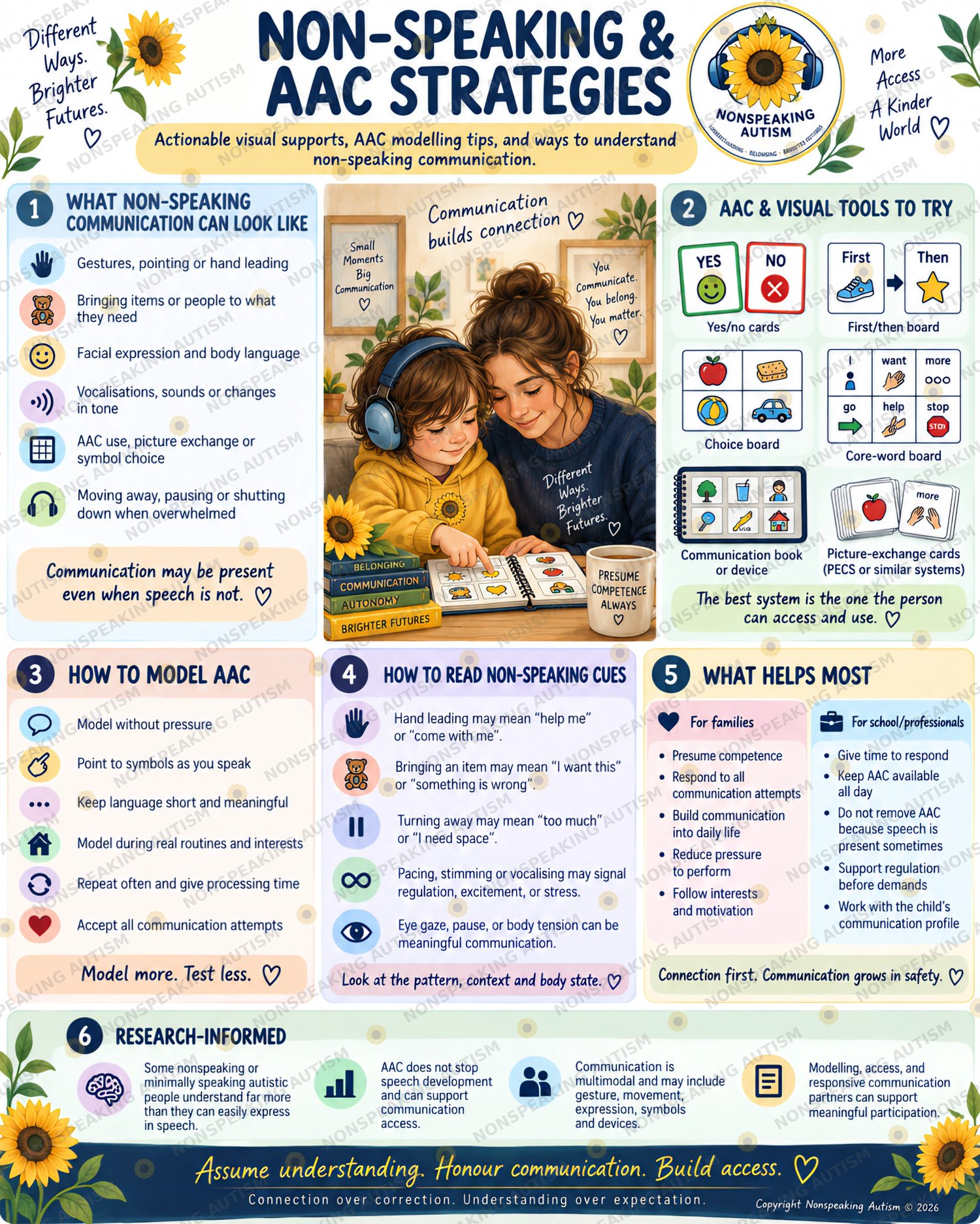
Non-Speaking & AAC Strategies is a practical, neurodiversity-affirming educational poster designed to help families, caregivers, teachers and professionals recognize communication beyond spoken words and create greater access to meaningful communication.
Rather than asking:
“How do we make them talk?”
this resource encourages a more useful question:
“How can we make communication more accessible?”
The central message is:
Assume understanding. Honour communication. Build access. 💛
🧠 What This Poster Explores
The poster brings together six key areas:
1️⃣ What Non-Speaking Communication Can Look Like
2️⃣ AAC & Visual Tools to Try
3️⃣ How to Model AAC
4️⃣ How to Read Non-Speaking Cues
5️⃣ What Helps Most — at Home and in School
6️⃣ Research-Informed Communication Principles
It is designed to move beyond simply identifying AAC and provide practical everyday strategies that can be used across home, school and community environments.
1️⃣ What Non-Speaking Communication Can Look Like
Not speaking does not mean not communicating.
Communication may appear through:
gestures
pointing
hand leading
bringing an object to another person
taking someone towards something
facial expression
body language
vocalisations
changes in tone
AAC
picture or symbol selection
movement
pausing
moving away
changes in body tension
A behaviour that looks insignificant to someone unfamiliar with the person may carry important meaning.
The aim is not to assign a fixed meaning to every movement.
Instead, look at the person + context + pattern.
Communication may be present even when speech is not.
💬 2️⃣ AAC & Visual Tools to Explore
AAC stands for Augmentative and Alternative Communication.
It includes many different ways of supporting or replacing spoken communication.
Examples shown on the poster include:
✅ Yes / No Cards
A simple accessible way to communicate responses where these are reliable for the individual.
➡️ First–Then Boards
Visual information that can make sequences and expectations clearer.
🖼️ Choice Boards
Visual options that may make choosing and communicating preferences easier.
💙 Core-Word Boards
Providing access to useful words such as:
want • more • go • help • stop
📖 Communication Books or Devices
More extensive systems that can provide access to a much wider vocabulary.
🃏 Picture-Exchange Systems
Picture-based communication approaches, including PECS or other individualized systems where appropriate.
There is no single AAC system that is right for every person.
The best communication system is one the person can access and use.
🌻 AAC Is More Than Requesting
Communication should not be restricted to:
“I want…”
or choosing between two adult-selected options.
People communicate to:
refuse
protest
ask questions
share ideas
tell stories
express pain
talk about feelings
make jokes
comment
seek help
connect socially
express opinions
talk about interests
say no
and much more.
Where possible, an AAC system should provide access to a broad range of meaningful communication rather than only teaching someone to request preferred objects.
3️⃣ How to Model AAC
Learning to use an AAC system should not mean spending every interaction being tested.
One useful approach is AAC modelling.
This means communication partners use the AAC system themselves while interacting naturally with the person.
The poster encourages:
💬 Model Without Pressure
Show the person how communication can happen without requiring them to immediately copy you.
👉 Point to Symbols as You Speak
Use relevant words on the communication system during natural conversation.
🗣️ Keep Language Meaningful
Avoid turning every interaction into a long stream of instructions.
🏠 Model During Real Routines & Interests
Use AAC during everyday activities, play, meals, outings and topics the person genuinely cares about.
⏳ Repeat & Allow Processing Time
Communication learning takes time.
❤️ Accept Communication Attempts
Do not require perfect symbol selection or a particular communication mode before responding to an understandable message.
The principle is:
Model more. Test less.
4️⃣ Understanding Non-Speaking Cues
A communication partner can learn a great deal by observing repeated patterns.
For example, hand leading could sometimes communicate:
“Help me.”
“Come with me.”
“I want to show you something.”
Bringing an object might mean:
“I want this.”
“Help me with this.”
“Something is wrong with this.”
Turning away might communicate:
“Too much.”
“I need space.”
“I don't want this.”
And pacing, stimming or vocalising may occur during regulation, excitement, uncertainty, concentration or stress.
The important word is may.
We should not create a universal dictionary in which one behaviour is assumed to mean the same thing for every autistic person.
Instead:
Look at the pattern, context and body state.
Then confirm meaning through the person's reliable communication system wherever possible.
👁️ Behaviour Can Contain Information — But Don't Guess
It can be useful to notice changes in:
eye gaze
movement
facial expression
body tension
vocalisations
proximity
stimming
withdrawal
But observation is not mind-reading.
For example, looking away could mean sensory overload, concentration, discomfort, disinterest, regulation — or something entirely different.
Supporters should therefore avoid treating interpretations as facts.
The better approach is:
Observe → consider context → offer accessible communication → learn the individual's patterns over time.
❤️ 5️⃣ What Helps Most for Families?
The poster encourages families to:
presume communication potential
respond to all meaningful communication attempts
build communication opportunities into everyday life
reduce pressure to perform
follow interests and motivation
allow sufficient processing time
keep communication tools accessible
Communication does not have to happen only at a table or during a therapy session.
Some of the most meaningful communication happens during ordinary life.
🎒 What Helps at School & in Professional Settings?
Supporters and professionals can help by:
giving adequate response time
keeping AAC available throughout the day
not removing AAC simply because speech is present sometimes
supporting regulation before increasing demands
learning the child's individual communication profile
responding consistently across communication modes
making sure communication access travels between environments
A communication device sitting in a cupboard cannot provide communication access.
AAC needs to be available when communication happens — which is throughout everyday life.
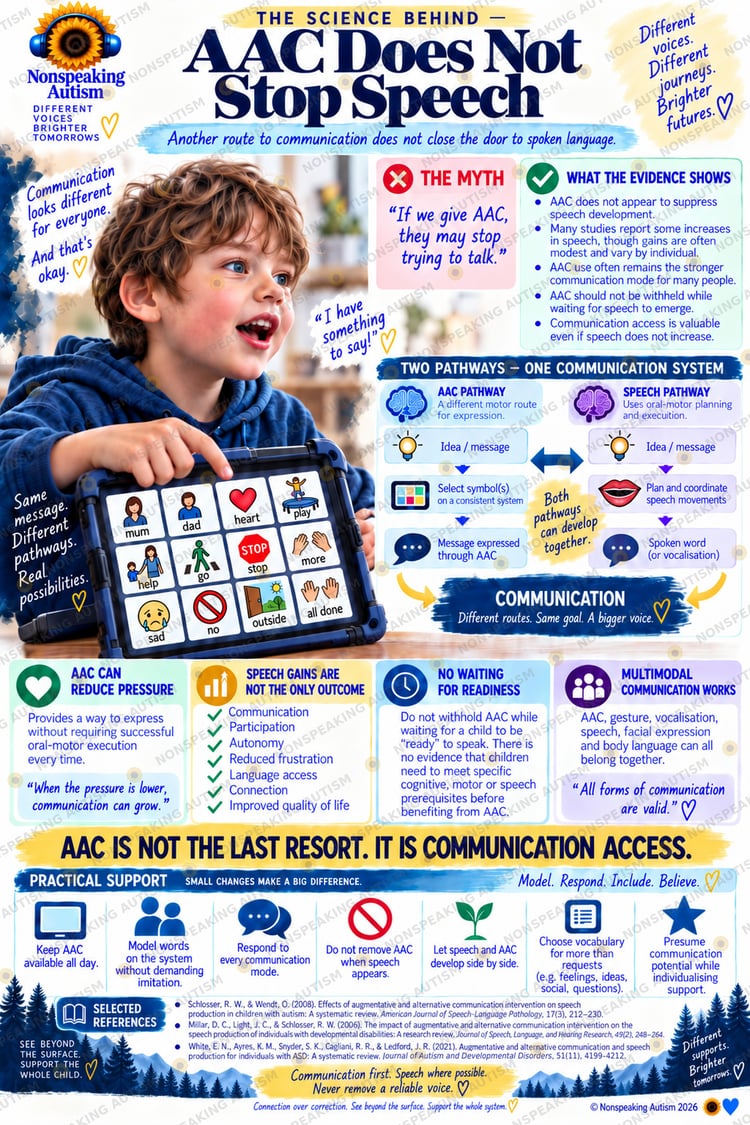
🚫 Don't Remove AAC Because Speech Appears
Some autistic people have variable access to spoken communication.
Someone may speak more easily:
at home
with familiar people
when rested
in quieter environments
and find speech much more difficult:
under stress
during sensory overload
when exhausted
in unfamiliar environments
when language demands increase
The presence of speech therefore does not automatically mean AAC is unnecessary.
AAC and speech can exist side by side.
🗣️ Respond to Communication — Not Just Speech
If a person points to STOP, that message matters.
If they gesture NO, that matters.
If they use their device to ask for a break, that matters.
If they move away from something distressing, that deserves attention even while adults work to establish its meaning.
One communication mode should not automatically be considered more legitimate simply because it looks more typical.
Communication builds connection.
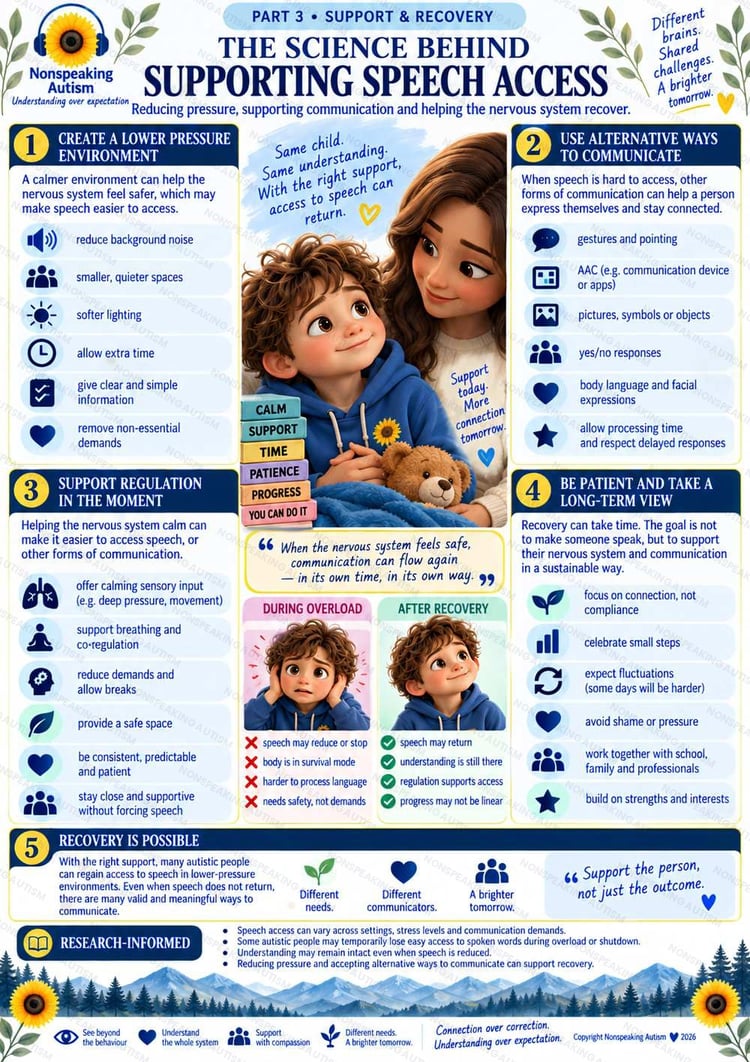
🌿 Regulation & Communication Are Connected
Communication can become harder when someone is overwhelmed.
Sensory overload, anxiety, fatigue, pain, uncertainty or excessive demands may affect a person's ability to use their most familiar communication method.
During those moments, increasing pressure to communicate in a particular way can be counterproductive.
Support may involve:
reducing verbal demands
allowing additional time
reducing unnecessary sensory input
keeping AAC available
accepting simpler communication
offering familiar communication options
supporting regulation
The goal is not perfect communication performance.
The goal is access.
🧠 Presume Competence — Without Making Assumptions
“Presume competence” can be a useful reminder not to underestimate someone because they do not speak.
But it should not mean pretending we know exactly what someone understands.
Understanding, language, literacy, motor abilities and communication needs vary substantially between individuals.
A respectful approach is to:
speak age-respectfully
provide meaningful opportunities
avoid treating lack of speech as evidence of lack of thought
provide accessible communication
observe carefully
assess skills appropriately
support learning without imposing arbitrary ceilings
In other words:
Do not underestimate — and do not assume. Build access and find out.
🔬 Research-Informed
Research supports AAC as a legitimate communication intervention for autistic people with significant communication needs.
AAC does not appear to prevent the development of speech. Research reviews have reported some increases in speech production following AAC intervention for some participants, although outcomes vary and speech gains should never be guaranteed.
AAC also has value independently of speech development.
Communication access can support:
participation
choice
autonomy
language
social connection
self-advocacy
and the ability to express needs, ideas and preferences.
Communication is also inherently multimodal.
Speech, gesture, movement, facial expression, symbols and AAC can all contribute to an individual's communication system.
📚 Selected References & Evidence Base
Schlosser, R. W., & Wendt, O. (2008). Effects of augmentative and alternative communication intervention on speech production in children with autism: A systematic review. American Journal of Speech-Language Pathology, 17(3), 212–230.
Millar, D. C., Light, J. C., & Schlosser, R. W. (2006). The impact of augmentative and alternative communication intervention on the speech production of individuals with developmental disabilities: A research review. Journal of Speech, Language, and Hearing Research, 49(2), 248–264.
White, E. N., Ayres, K. M., Snyder, S. K., Cagliani, R. R., & Ledford, J. R. (2021). Augmentative and alternative communication and speech production for individuals with ASD: A systematic review. Journal of Autism and Developmental Disorders, 51(11), 4199–4212.
Brignell, A., Chenausky, K. V., Song, H., Zhu, J., Suo, C., & Morgan, A. T. (2018). Communication interventions for autism spectrum disorder in minimally verbal children. Cochrane Database of Systematic Reviews, 2018(11), CD012324.
Evidence Note
Research supports the use of AAC for communication access and does not support withholding AAC because of fears that it will prevent speech.
However, no particular AAC system is appropriate for every person, and individual communication assessment remains important.
👨👩👧 Who Is This Resource For?
This resource may be useful for:
- nonspeaking autistic people
- minimally speaking autistic people
- autistic people with intermittent or unreliable speech
- AAC users
- parents and caregivers
- families beginning their AAC journey
- teachers
- teaching assistants
- SENCOs and SEND professionals
- speech and language therapists
- occupational therapists
- AAC professionals
- support workers
- early-years professionals
- autism and disability organizations
- communication-training settings
It can be used as a home reference, classroom visual, staff-training resource or conversation starter around communication access.
📦 What You Receive
Your purchase includes:
1 × Non-Speaking & AAC Strategies educational poster
1 × high-resolution printable PDF
The purchased file is supplied clear and without the promotional preview watermark shown on the Payhip listing image.
Preview watermarks are used for copyright protection only and will not appear on the purchased resource.
Digital download only — no physical product will be shipped.
⚠️ Important Educational & Communication Disclaimer
This resource is provided for educational and informational purposes only.
It is not a diagnosis, speech and language assessment, AAC assessment, medical advice, therapy programme or individualized communication plan.
Communication profiles vary substantially between individuals. Nonspeaking or minimally speaking people should not automatically be assumed to have either intact or impaired understanding solely on the basis of spoken output.
Behaviours, gestures, movements and body-language examples within this poster are possible communication cues, not fixed meanings. The same behaviour can have different meanings for different people or in different contexts.
AAC systems, access methods and vocabulary should be individualized according to factors including the person's communication, language, sensory and motor profile, vision, hearing, preferences, environment and circumstances.
AAC should not be presented as a guaranteed method of producing spoken language. Its primary purpose is communication access.
A sudden, significant or unexplained change in established speech, communication, responsiveness or functioning should not automatically be attributed to autism and may require appropriate medical or professional assessment.
Where individualized AAC support is required, assessment and guidance from an appropriately qualified speech and language therapist or AAC professional may be beneficial.
💛 The Message Behind the Resource
Communication can be easy to miss when we are only listening for words.
It might be a hand reaching towards you.
A symbol selected on a device.
An object brought across the room.
A pause.
A vocalisation.
A gesture.
A look.
A movement away.
A typed sentence.
Or a carefully selected AAC message that says exactly what the person has been trying to tell everyone.
The job of communication support is not to force all of those possibilities into speech.
It is to help create a reliable pathway between:
“I have something to say”
and
“Someone can understand me.”
Model more.
Test less.
Keep AAC available.
Give time.
Respond to communication.
Learn the person's patterns.
And never assume that the absence of speech means the absence of something worth saying.
Assume understanding. Honour communication. Build access. 💛
Communication builds connection.
More access. A kinder world.
Different Ways. Brighter Futures.
Connection over correction. Understanding over expectation.
© Nonspeaking Autism 2026 🌻💙