
Supporting Autistic Girls
Supporting Autistic Girls
Early Development & Nervous System Care
Autistic girls can sometimes present in ways that are less obvious, differently expressed or more easily misunderstood than traditional descriptions of autism might suggest.
Some girls may be quieter or highly observant, prefer one-to-one interaction, show strong imaginative interests, communicate differently, or work hard to adapt themselves to social expectations. Others may have much more visible support needs. There is no single presentation of autism in girls.
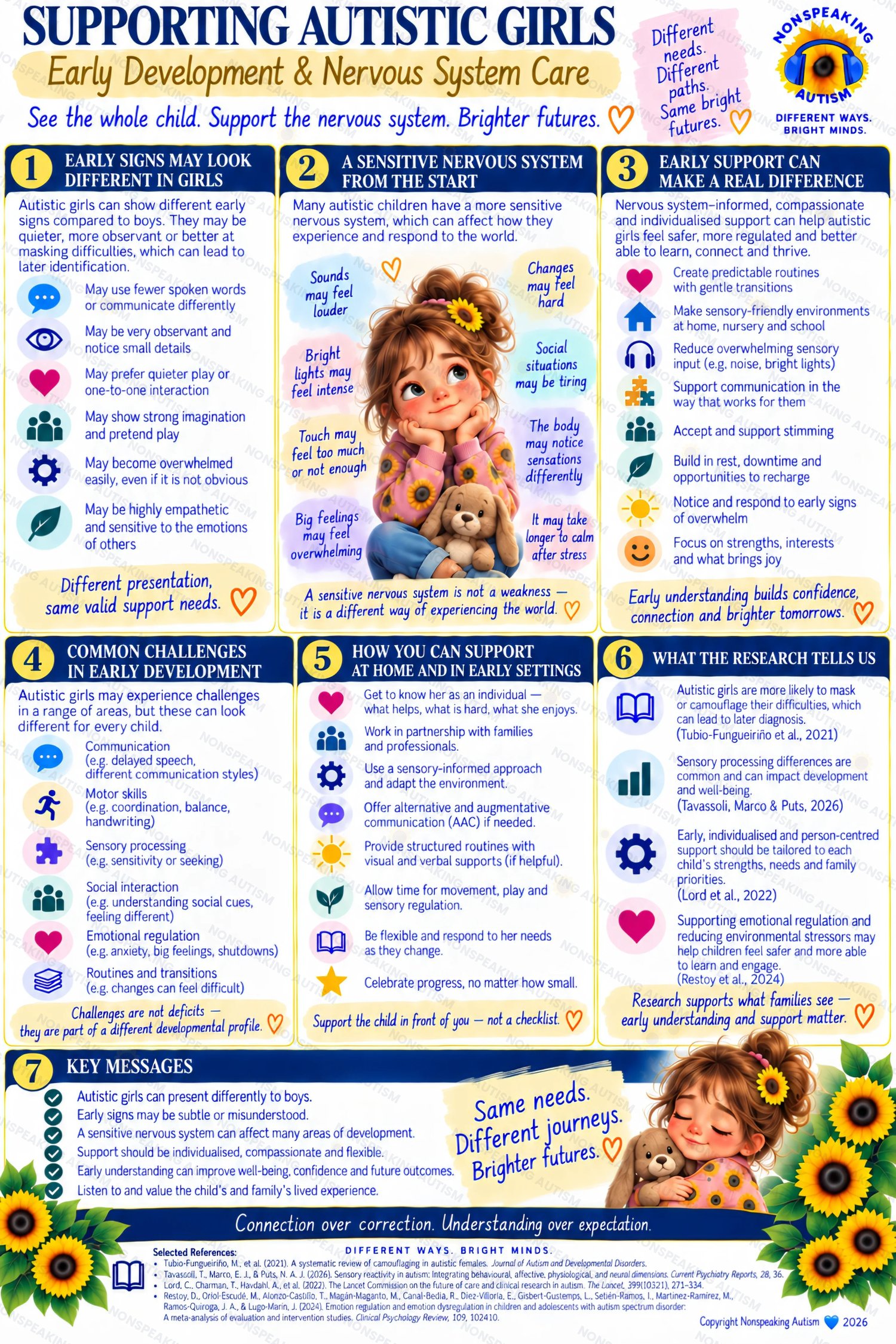
Supporting Autistic Girls — Early Development & Nervous System Care is a research-informed educational poster designed to help parents, carers, early-years practitioners, educators and professionals look at the whole child rather than relying on a checklist of stereotypical signs.
It brings together communication, sensory processing, emotional regulation, motor development, social interaction, routines and nervous-system needs while emphasising compassionate, individualised early support.
The central message is:
See the whole child. Support the nervous system. Brighter futures.
🧠 What This Poster Explores
This visual resource provides an accessible overview of early autistic development in girls, including:
- How early autistic characteristics may sometimes present differently in girls
- Why some signs may be subtle or misunderstood
- Sensory and nervous-system differences
- Communication and interaction differences
- Emotional regulation and overwhelm
- Motor and coordination needs
- Routines, transitions and predictability
- The importance of early, individualised support
- Practical strategies for home, nursery and school
- Masking and camouflaging
- What research tells us about autistic girls and development
Most importantly, the poster encourages adults to consider the individual child's strengths, challenges, preferences and support needs, rather than expecting every autistic girl to fit the same profile.
🌻 Early Signs May Look Different in Girls
Autism does not have one appearance.
Some autistic girls may show characteristics that are less readily recognised or that do not match traditional expectations of autism.
The poster highlights possible examples such as:
Different communication
A child may use fewer spoken words, communicate in an unexpected way or have a communication style that differs from her peers.
Being highly observant
Some girls may watch other people carefully and notice small details.
Preferring quieter interaction
One-to-one interaction or quieter forms of play may feel more manageable than larger social situations.
Strong imagination or pretend play
The presence of imaginative play does not automatically rule out autism.
Becoming overwhelmed without it being immediately obvious
A child may appear to cope externally while experiencing considerable internal stress.
Sensitivity to other people's emotions
Some autistic girls may be highly aware of or affected by the emotional states of people around them.
These are possible examples rather than diagnostic signs on their own.
Different presentation. Same valid support needs.
💙 A Sensitive Nervous System From the Start
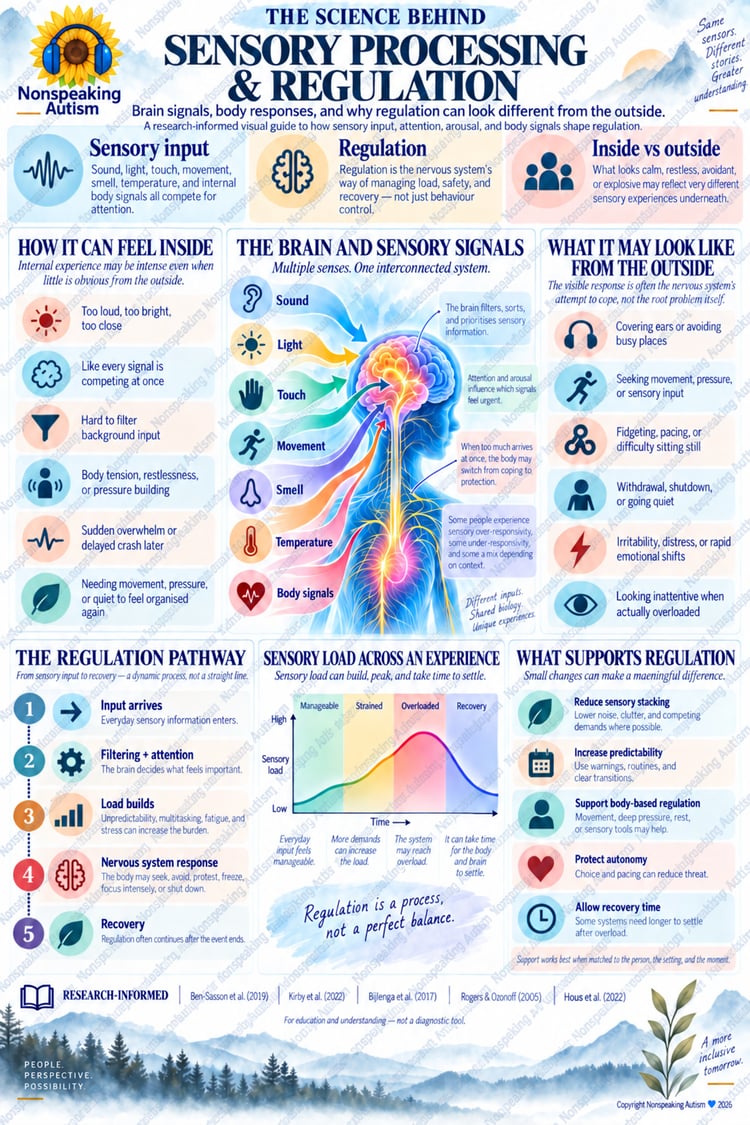
Many autistic children experience sensory information differently.
Everyday experiences that seem minor to another person may feel much more intense — or sometimes not intense enough.
The poster illustrates how an autistic child might experience:
- Sounds as unusually loud or intrusive
- Bright lighting as intense
- Touch as uncomfortable or insufficient
- Internal body sensations differently
- Social situations as tiring
- Unexpected change as particularly difficult
- Strong emotions as overwhelming
- A longer recovery period following stress
These experiences are not a weakness or a failure to cope.
They can be part of a different way of processing and responding to the world.
🌱 Early Support Can Make a Real Difference
Support does not need to wait until a child is already overwhelmed.
Creating environments that work with the child's nervous system can reduce unnecessary stress and make participation, communication and learning more accessible.
The poster suggests approaches such as:
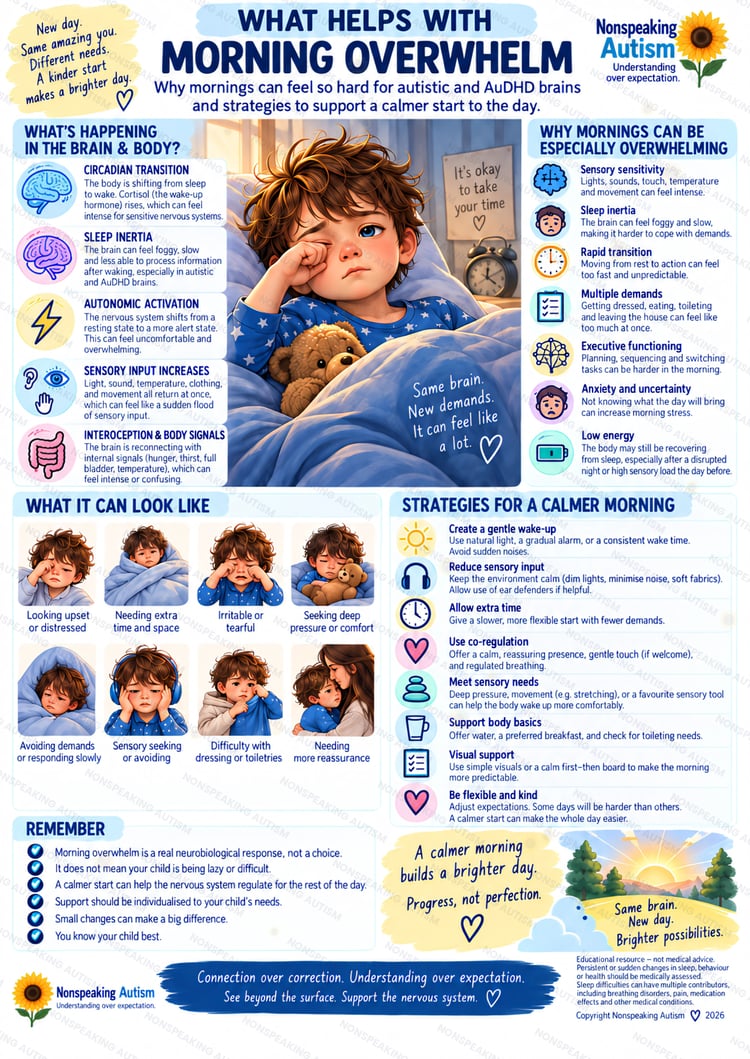
Create predictable routines
Gentle transitions and advance preparation can make changes easier to navigate.
Make environments sensory-friendly
Consider noise, bright lighting, crowds, clothing, movement and other sensory demands.
Support communication in the way that works for the child
Communication does not have to depend entirely on speech.
Accept and support safe stimming
Repetitive movement or sensory behaviour may serve an important regulatory function.
Build in rest and recovery
Downtime is not wasted time. Recovery can be an important part of regulation.
Notice early signs of overwhelm
Responding before distress reaches its peak may reduce the overall load.
Focus on strengths and interests
Developmental support should also recognise what the child enjoys, values and does well.
Early understanding builds confidence, connection and brighter tomorrows.
Common Challenges in Early Development
Autistic girls may experience support needs across several developmental areas.
These can include:
Communication — including delayed speech or different communication styles.
Motor skills — coordination, balance, handwriting or other movement-related tasks may be difficult for some children.
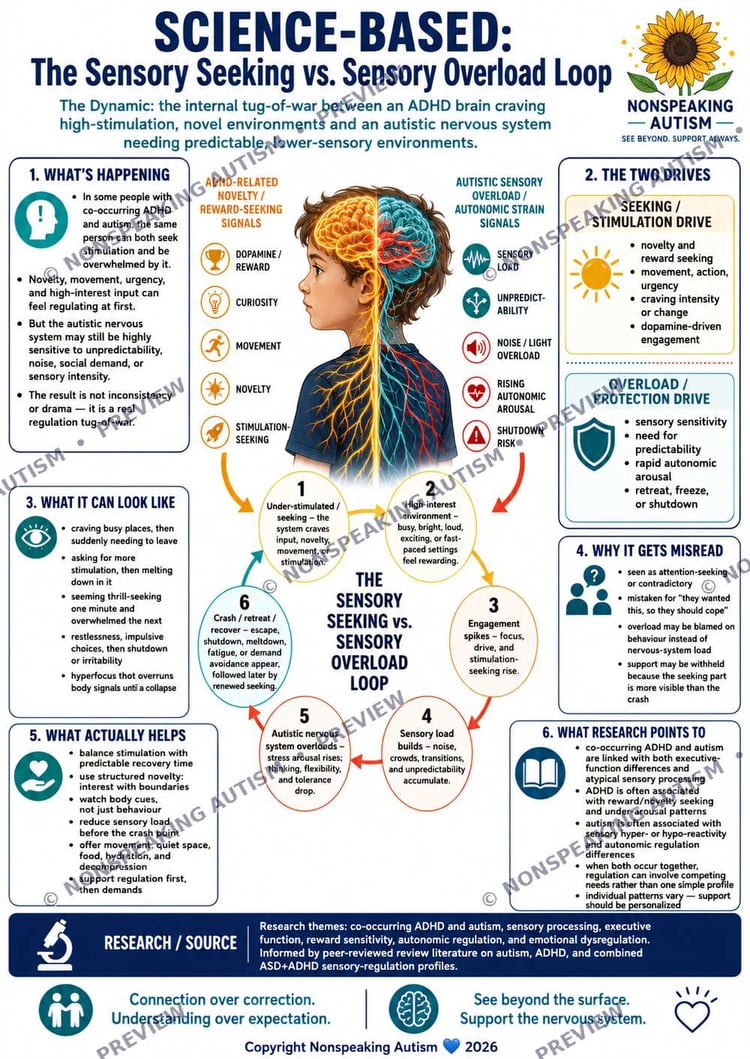
Sensory processing — sensory sensitivity, sensory seeking or mixed sensory responses may affect everyday activities.
Social interaction — understanding social information, maintaining interaction or feeling socially different may require additional support.
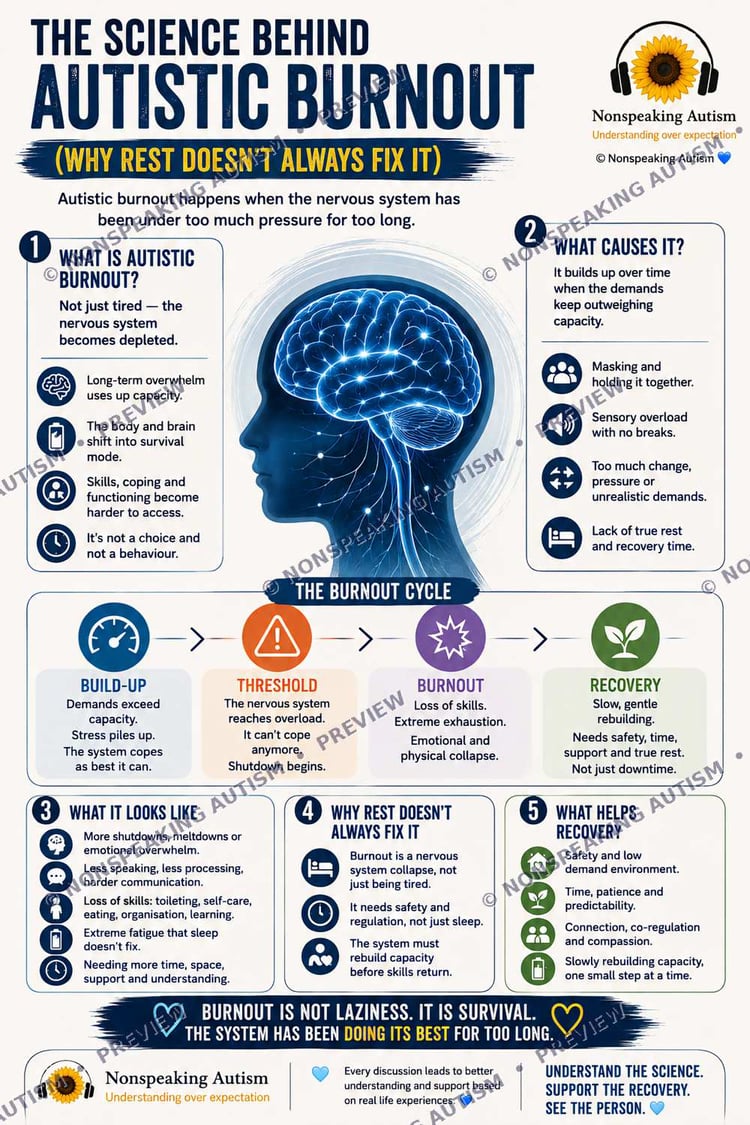
Emotional regulation — anxiety, intense emotions, shutdowns or overwhelm may occur when demands exceed available capacity.
Routines and transitions — unpredictability and unexpected changes can be particularly demanding.
These differences should not be viewed simply as deficits.
They form part of an individual developmental profile containing both strengths and areas where support may be needed.
🏡 How You Can Support at Home & in Early Settings
Effective support begins with understanding the child who is actually in front of you.
Helpful principles include:
Get to know her as an individual
Notice what helps, what is difficult, what she enjoys and what situations increase stress.
Work in partnership with families and professionals
Parents and carers hold valuable knowledge about their child's communication, regulation and everyday experiences.
Use a sensory-informed approach
Adapt the environment rather than continually expecting the child to tolerate unnecessary sensory distress.
Offer AAC or alternative communication when needed
Communication access should be protected and supported.
Provide structure and predictability
Visual information and verbal supports can help some children understand what is happening and what comes next.
Allow movement, play and sensory regulation
These can be important parts of participation rather than distractions from it.
Remain flexible
Needs can change depending on fatigue, environment, health, sensory load and many other factors.
Celebrate progress — however small.
Above all:
Support the child in front of you — not a checklist.
🔬 Research-Informed
This poster draws on research concerning autistic girls, camouflaging, sensory processing, early intervention and emotional regulation.
Research has highlighted that autistic females may sometimes camouflage or mask aspects of their difficulties, potentially contributing to later recognition or diagnosis. However, masking is not unique to females, and autistic girls are a diverse group.
The research base also supports recognising sensory-processing differences as an important part of many autistic people's everyday experiences and considering these needs when planning support.
Selected research represented on the poster includes:
Tubío-Fungueiriño et al. (2021) — a systematic review examining camouflaging in autistic females.
Tavassoli, Marco, & Puts (2026) — work concerning sensory reactivity in autism and its behavioural, affective, physiological and neural dimensions.
Lord et al. (2022) — discussion of the Lancet Commission's recommendations concerning the future of autism care and clinical research, including individualised approaches.
Restoy et al. (2024) — research relating to emotional regulation and autism.
The evidence should not be interpreted as suggesting that every autistic girl follows the same developmental pathway.
Research can identify patterns. It cannot replace understanding the individual child.
👨👩👧 Who Is This Resource For?
This poster may be particularly useful for:
- Parents and carers
- Families of autistic girls
- Early-years practitioners
- Nursery and preschool staff
- Teachers and teaching assistants
- SENCOs and SEND teams
- Mainstream and specialist schools
- Autism and inclusion teams
- Occupational therapists
- Speech and language professionals
- Educational and clinical psychologists
- Support workers
- Family-support organisations
- Professionals involved in early childhood development
- Autism and SEND training sessions
It can be displayed at home, in nurseries, classrooms, SEND spaces, therapy rooms, clinics or professional settings, or used as a visual starting point for discussions about a child's individual development and support needs.
📦 What You Receive
Your purchase includes:
1 × Supporting Autistic Girls — Early Development & Nervous System Care
This is a digital educational poster from Nonspeaking Autism, supplied as a PDF file.
The purchased version is supplied clear and without the promotional preview watermark. Watermarks visible on Payhip listing images are used for preview and copyright-protection purposes.
Digital download only — no physical product will be shipped.
⚠️ Important Disclaimer
This resource is provided for educational and informational purposes only.
It is not a diagnostic tool, medical advice, therapy or a substitute for individual assessment or guidance from an appropriately qualified healthcare, developmental or educational professional.
The characteristics described on this poster are examples, not a diagnostic checklist. A child does not need to demonstrate every characteristic shown, and the presence or absence of any individual characteristic does not establish or exclude an autism diagnosis.
Autistic girls are highly diverse. Communication, sensory experiences, emotional regulation, development, strengths and support needs vary substantially between individuals.
Concerns about a child's development, communication, physical or mental health should be discussed with an appropriately qualified professional.
Support should always be individualised and respect the child's communication, sensory needs, preferences, autonomy, wellbeing and lived experience.
💛 The Message Behind the Resource
Recognising autism in girls should not be about creating another stereotype of what an autistic girl is supposed to look like.
It is about widening our understanding enough to notice the child whose needs might otherwise be missed.
A quieter presentation does not necessarily mean fewer needs. Coping outwardly does not always tell us how much effort something requires internally. And development should never be reduced to a checklist of deficits.
When adults understand the whole child, support can become earlier, kinder and more individualised.
Same needs. Different journeys. Brighter futures.
See the whole child.
Support the nervous system.
Brighter futures.
Connection over correction.
Understanding over expectation.
© Nonspeaking Autism 2026. All rights reserved.